Federal District Judge Reyes Asks, What Would Jesus Do? The Attorney General is Deeply, Deeply Offended

ABA Journal, DOJ files complaint against federal judge for alleged hostility against government lawyer

Her Excellency, Attorney General Bondi, would like the Court of Appeals for the DC Circuit to please, pretty please say some bad things about Judge Reyes. And what, you may ask, was the burr in the Attorney General’s saddle? 

A few days ago, Judge Reyes held a hearing in the case of Talbott v. Trump, challenging an executive order requiring the expulsion of transgender troops from the military, and specifically defaming all transgender people as dishonorable, untruthful, and undisciplined.

As an aside, I have to hand it to Orange Mussolini; if anyone knows how to recognize someone who’s dishonorable, untruthful, and undisciplined, that would be him. 

Anyway, during the hearing, the judge was really tough on the unnamed Justice Department attorney who had the misfortune of trying to defend Trump’s words and actions. The ABA Journal writes,

­­The Associated Press and Law 360 report that during the hearings, Reyes:

  • Raised her voice and demanded an answer from a government attorney about whether President Donald Trump’s executive order showed animus by calling “an entire category of people dishonest, dishonorable, undisciplined.”

  • Engaged in a rhetorical exercise regarding discrimination. Reyes declared that graduates of the University of Virginia School of Law would be barred from her courtroom because they are “liars and lack integrity.” She then told the government lawyer who was a University of Virginia School of Law grad “to sit down.” According to the ethics complaint, the directive “served no legitimate judicial purpose and transformed an attorney appearing before the court into an unwilling participant in the judge’s unnecessary demonstration.”

  • Asked the government lawyer what “Jesus would say to telling a group of people that they are so worthless, so worthless that we’re not going to allow them into homeless shelters? Do you think Jesus would be, ‘Sounds right to me’?” she asked. The complaint says the question “placed DOJ counsel in an untenable position of either appearing unresponsive or speculating about how an incoherent hypothetical aligns with Judge Reyes’ personal religious beliefs.”

Cass Sunstein Explains the Unitary Executive Theory of Presidential Power

Cass R. Sunstein, This Theory Is Behind Trump’s Power Grab

Professor Sunstein, a distinguished public intellectual, teaches law at Harvard. As I often remark: you can always tell a Harvard man, but you can’t tell him much. 

In this guest essay in the New York Times, Sunstein brilliantly covers a whole lot of ground and explains a whole lot of political theory and history, in a way that an ordinary educated person can readily understand. 

Bottom line: full presidential control over all aspects of the federal executive is not, contrary to claims of some, mandated by the text of the Constitution or by our history. Such massive control poses many, many dangers.

Professor Sunstein is a polite person, so he did not say, in so many words, that presidential dictatorial powers given to a crazed monomaniac would likely produce disastrous results. 

Bad as the unitary executive theory, read broadly, would be, Trump is also pursuing other ideas that are even worse. Sunstein writes,

[C]onsider the claim that the president gets to impound congressionally appropriated funds and choose which ones to spend. That claim would render Congress subordinate to the executive in what might be its most fundamental power: the purse. Impoundment authority, on the part of the president, would go well beyond the idea of a unitary executive. It would be a devastating blow to the separation of powers.

He did not add—but might well have added—that the notion that the president gets to pick and choose which court orders he obeys would likewise end the constitutional republic, and that right soon.

Indraneel Sur, Esquire’s Terrible, Horrible, No Good, Very Bad Day in Court

Washington Post, Judge orders Trump administration to pay millions in USAID funds: Officials have one day to resume foreign aid payments after a contentious hearing in which a government lawyer couldn’t say if funds had been unfrozen.

Politico, Judge warns Trump administration to comply with court order on foreign aid payments

Indraneel Sur graduated from Yale, earned his law degree at the prestigious University of Pennsylvania Law School, worked as an associate at the prestigious law firm Gibson, Dunn & Crutcher, and then joined the Justice Department as an attorney. One source claims that he is a member of the Federalist Society. Yesterday, he appeared in court to defend the government’s response to the judge’s pending order to resume payments owed for supplies delivered to USAID. 

The Washington Post reports that “During the contentious 90-minute hearing, Justice Department lawyer Indraneel Sur told [the judge] he was ‘not in a position to answer’ whether the Trump administration had taken needed steps to allow the assistance to begin moving.”

Politico writes about his day in court yesterday:

During a telephone hearing, U.S. District Judge Amir Ali grew impatient with a lack of clear responses from the administration’s lawyers to claims from aid contractors that they have seen no payments from the State Department or U.S. Agency for International Development since Ali issued an emergency order Feb. 13 halting a broad freeze on aid-related programs.

“I don’t know why I can’t get a straight answer from you,” the judge lamented after Justice Department attorney Indraneel Sur repeatedly sidestepped a question about whether the Trump administration released any funds following the judge’s earlier order.

After Sur suggested that officials were holding up or canceling payments under the terms of individual contracts, Ali said he was baffled by the government’s view.

“I guess I’m not understanding where there is any confusion here,” the judge said. “It’s clear as day.”

What Seems to be Happening—and Some Friendly Advice from Your Dutch Uncle Ron

The picture will become clearer as this case proceeds—along with the many dozens of other cases involving the legality of the Trump administration’s acts. Right now, however, the picture that seems to be emerging is that someone in the administration is ordering its frontline lawyers to pull the wool over the eyes of the judges in these cases. 

So here’s a friendly piece of advice. If you have drunk freely of the Trump Kool-Aid and want to defend its contentions about its dictatorial powers, then you can probably do so without being disbarred or sent to jail. 

But do not lie to the court. If you do, you are going to be in a world of hurt. 

And the day when your boss—or his boss—orders you to lie to the court is the day you need to walk off the job.

For your own protection, if for no other reason than to protect yourself. 

This is What Happens When Rich Folks Want Their Tax Cuts So Much That They Hand Over Power to an Actual Crazy Person

Trump’s Hissy Fit About the WSJ Editorial Board

Folks, grab a six pack and pop a big old bowl of popcorn.

The Guardian, Trump threatens to sue media after Wall Street Journal editorial criticizes tariffs: Journal argued Trump’s tariff plans would harm ‘US auto workers and Republican prospects in Michigan’

The Guardian writes, 

Wall Street Journal editorial slamming Donald Trump’s tariff plans as terrible for the US economy and auto industry prompted a broadside from the president on Wednesday followed by threats to sue the media.

In an opinion piece titled Trump’s Tariffs Will Punish Michigan, the Journal argued Trump’s tariff plans would harm “US auto workers and Republican prospects in Michigan”.

Trump has threatened to impose 25% tariffs on goods from Mexico and Canada, a move the editorial argues would increase US vehicle prices, hurt auto workers and advantage Asian and European manufacturers.

“If the goal is to harm US auto workers and Republican prospects in Michigan, then by all means go ahead, Mr President,” wrote the Journal.

On his social media site, Truth Social, Trump wrote the Journal is “soooo wrong”. “The tariffs will drive massive amounts of auto manufacturing to MICHIGAN, a State which I just easily one [sic] in the Presidential Election,” he wrote.

Trump followed the rebuttal with a threat to those publishing “Fake books and stories with the so-called ‘anonymous’, or ‘off the record’, quotes” criticizing the opening month of his second presidency.

“At some point I am going to sue some of these dishonest authors and book publishers, or even media in general, to find out whether or not these ‘anonymous sources’ even exist, which they largely do not. They are made up, defamatory fiction, and a big price should be paid for this blatant dishonesty. I’ll do it as a service to our Country. Who knows, maybe we will create some NICE NEW LAW!!!,” he wrote.

The Journal’s conservative editorial board has been a persistent critic of Trump’s tariff plans, calling them “the dumbest trade war in history” earlier this month.

The Budget Resolution That Passed Last Night

Some websites aim to capture anti-Trumpers’ clicks with screaming headlines—“Trump Slides Downhill!” “Trump Humiliates Himself!” etc. etc. But I find The Bulwark’s presentations more objective, and much more useful in understanding what is actually happening, as compared with the rosy scenario sites. Besides, this video is entertaining too. 

Friends, let’s never lose our sense of humor. Because the loss of our sense of humor would make it a lot harder to survive this shitshow.

Last night’s nonbinding budget resolution directs the House Energy and Commerce Committee to find $880 billion in budget cuts, over the coming decade, from the programs which that committee oversees. According to Newsweek today, 

Trump has said multiple times that Medicaid would not be affected, telling Fox News last week that it would not be “touched.”

But the House Energy and Commerce Committee would have to find this money, out of Medicaid, Medicare and the Children’s Health Insurance Program.

If the committee takes its cuts from everything that is not health care, reducing this spending to $0, it would still be more than $600 billion short, according to analysis by The New York Times.

I tried, without success, to get a definitive answer as to what percentage of Medicaid funding would be lost if $880 billion were cut over a ten-year period. That’s a hard number to find for various reasons, including the fact that there will be lots of political back-and-forth about spending levels over the next decade. 

Even so, there’s no doubt that $880 billion is a nice chunk of change.

On the one hand, clearly, axing $880 billion will let a whole lot of Medicaid spending continue. On the other hand, and equally as clear, decreasing funding by $880 billion would most assuredly “touch” Medicaid, contrary to Trump’s promise.

And who would be hurt as and when Medicaid is in fact “touched”?

According to a reliable source, for the year 2023, there were 24,046,700 white people under the age of 65 enrolled in Medicaid. In other words, the 24 million poor white Medicaid recipients don’t count all the white grandmas who have run through their savings and are relying on Medicaid to stay in their nursing homes. 

Poor people supported Trump disproportionately in 2024. White people supported Trump disproportionately in 2024. And if you look at the combined category—poor AND white—they were mostly Trump supporters. 

But it was still a close election. And the number of poor white folks who will feel pain from significant Medicaid cuts vastly exceeds Trump’s tiny margin of victory. 

If You Have Open Borders, Then You Always Get Far Right Politics

David Leonhardt, In an Age of Right-Wing Populism, Why Are Denmark’s Liberals Winning?

Around the world, progressive parties have come to see tight immigration restrictions as unnecessary, even cruel. What if they’re actually the only way for progressivism to flourish?

Mr. Leonhardt is a senior columnist for the New York Times, and the author of Ours Was the Shining Future: The Story of the American Dream.

This is a very long article from the New York Times magazine. It takes 53 ½ minutes to read it aloud. (If you would like to hear it, go here.) In support of the thesis that is the headline of this post, the article covers a great deal of ground (geographically and historically), is well researched, and argues the case in great detail.

If you think that all US working class anti-immigrant feeling is grounded in simple racism—if you believe that the Democratic Party’s position on borders is coherent, well advised, and politically saleable—then I challenge you to read this article, consider it carefully, and articulate wherein you think it goes astray. 

A central focus is the anomalous continuing political success of Denmark’s Social Democratic Party. Leonhardt writes, 

Since the Social Democrats took power in 2019, they have compiled a record that resembles the wish list of a liberal American think tank. They changed pension rules to enable blue-collar workers to retire earlier than professionals. On housing, the party fought speculation by the private-equity industry by enacting the so-called Blackstone law, a reference to the giant New York-based firm that had bought beloved Copenhagen apartment buildings; the law restricts landlords from raising rents for five years after buying a property. To fight climate change, [Prime Minister] Frederiksen’s government created the world’s first carbon tax on livestock and passed a law that requires 15 percent of farmland to become natural habitat. On reproductive rights, Denmark last year expanded access to abortion through the first 18 weeks of pregnancy, up from 12 weeks, and allowed girls starting at age 15 to get an abortion without parental consent.

All the while, the country continues to provide its famous welfare state, which includes free education through college (including a monthly stipend of about $900 for living expenses), free medical care and substantial unemployment insurance, while nonetheless being home to globally competitive companies like Novo Nordisk, the maker of the anti-obesity drug Ozempic. In 2022, Frederiksen won a second term, defying the anti-incumbent mood that has ousted incumbent parties elsewhere since the Covid pandemic. As part of her success, she has marginalized the far right in her country.

But there is one issue on which Frederiksen and her party take a very different approach from most of the global left: immigration. Nearly a decade ago, after a surge in migration caused by wars in Libya and Syria, she and her allies changed the Social Democrats’ position to be much more restrictive. They called for lower levels of immigration, more aggressive efforts to integrate immigrants and the rapid deportation of people who enter illegally. While in power, the party has enacted these policies. Denmark continues to admit immigrants, and its population grows more diverse every year. But the changes are happening more slowly than elsewhere. …

Leftist politics depend on collective solutions in which voters feel part of a shared community or nation, [the prime minister] explained. Otherwise, they will not accept the high taxes that pay for a strong welfare state. “Being a traditional Social Democratic thinker means you cannot allow everyone who wants to join your society to come,” Frederiksen says. Otherwise, “it’s impossible to have a sustainable society, especially if you are a welfare society, as we are.” High levels of immigration can undermine this cohesion, she says, while imposing burdens on the working class that more affluent voters largely escape, such as strained benefit programs, crowded schools and increased competition for housing and blue-collar jobs. Working-class families know this from experience. Affluent leftists pretend otherwise and then lecture less privileged voters about their supposed intolerance.

“There is a price to pay when too many people enter your society,” Frederiksen told me. “Those who pay the highest price of this, it’s the working class or lower class in the society. It is not — let me be totally direct — it’s not the rich people. It is not those of us with good salaries, good jobs.” She kept coming back to the idea that the Social Democrats did not change their position for tactical reasons; they did so on principle. They believe that high immigration helps cause economic inequality and that progressives should care above all about improving life for the most vulnerable members of their own society. The party’s position on migration “is not an outlier,” she told me. “It is something we do because we actually believe in it.”

Good News!

Jeff Shesol (N.Y. Times), John Roberts Has One Chance to Get This Right

In many ways, as of the last week in February, it feels as if we are all taking a trip on the Titanic, fast approaching that iceberg. Take for example the New York Times piece from today. I don’t disagree with a word in it. 

Our situation is dire, in so many ways that it’s difficult to count all of them. But … I really hope you can spare a few minutes to watch Rick Wilson’s video, to supply some needed perspective. 

And permit me to supplement Wilson’s take in the following way. Begin with several things we know for sure, or at least to a very high level of confidence, about how events are going to evolve over the next few weeks. 

Five Things We Know for Sure, or at Least to a High Level of Confidence

1. Trump, Elon Musk, and their henchmen remain high on their own supply. In very important ways, they literally do not know what they are doing. In many ways, they don’t know the harm they are causing (or are about to cause) in the lives of their own supporters. In many ways, they have a fundamental misperception of public opinion. (Yeah, lot of that going around.)

2. Trump and his crew will continue to wreck the federal government, which will produce ever increasing levels of mayhem.

3. Trump and his crew will do jack shit to combat inflation, in violation of the one campaign promise that put him over the top in 2024.

4. The process of wrecking the federal government will culminate—in maybe a month, or it could be sooner—in a true constitutional crisis, where Trump openly defies the Supreme Court.

5. Any of several pending foreign policy crises will ripen into disaster. In particular, just as Biden had his Afghanistan moment, so Trump is probably going to have his Ukraine moment. 

Now, Let Us Hazard a Cautious Prediction

Here is the prediction:

While we cannot predict the outcome when all of these situations ripen into disaster at more or less the same time, we can say with some confidence that the five trends will interact with each other.

To take an example: The number of people who might be willing, in good times, to acquiesce in Trump’s overthrow of the rule of law is smaller than the number of people who will cheer when he defies the Supreme Court at the same time that he is royally screwing over the folks who voted for him. And, at the same time, selling out America’s allies and cheering on a Russian invasion.

A First Ruling from SCOTUS on Trump 2.0—and a Reading of the Tea Leaves

The Hill, Supreme Court stiffs Trump, punts on firing whistleblower agency head

SCOTUSblog, Supreme Court sidesteps Trump’s effort to remove watchdog agency head

Trump fired someone named Hampton Dellinger as head of the Office of Special Counsel, a body that prosecutes government misconduct and protects whistleblowers. He gave no reason for his displeasure; you are free to fill in the answer for yourself.

Mr. Dellinger sued to get his job back and found a district judge who granted him a temporary restraining order (TRO) to prevent Trump from shitcanning him while the employment case proceeds.

TROs don’t last long. This one is set to expire a few days from now, February 26, by which time the parties can brief the issue and present evidence as to whether the TRO should or should not be changed into a preliminary injunction—which would allow Mr. Dellinger to keep his job until the case is tried. 

If the district judge should rule for Mr. Dellinger on the preliminary injunction question next week, then Trump can take the case to the court of appeals and on to the Supreme Court. Should that happen, the legal process will probably be as speedy as shit through a goose.

But that is not fast enough for Trump. Trump argued that it’s a red hot emergency if Dellinger gets to stay in office for another few days. That was the issue on which the Supreme Court ruled today. 

In short, the core issue in the case, though involving arcana of appellate procedure, was similar to that in State of Washington v. Trump, about which I posted yesterday. To wit, must the courts consider it a red hot emergency just because Trump claims it’s a red hot emergency?

In short, Trump was aiming for some Shock and Awe action from the High Court. He wanted the Court to smite his enemies with a mighty rod, and that right quickly, and without much thought.

That’s what he wanted. What he got instead was support from only two of the nine justices, Gorsuch and Alito.

At the other end of the ideological spectrum, Justices Sotomayor and Jackson would have ruled that Trump should just take a long walk off a short pier. 

Two at one extreme and two at the other extreme. That leaves five in the middle, at least for right now. And a motley crew they are: Chief Justice Roberts, along with Justices Kagan, Kavanaugh, Coney Barrett, and Thomas.

And the specifics of their middle position? To hold the appeal in abeyance pending until the TRO expires. 

And, in so doing, to say—along with the Federalist Society judge in State of Washington v. Trump—no, no, it’s not an emergency just because Trump claims it’s an emergency. 

And Now for the Reading of the Tea Leaves

And no, friends and neighbors, this is not a prediction. It’s just a first reading of the tea leaves, based on the first Trump 2.0 case to reach the Supreme Court.

Alito and Gorsuch are not a surprise.

But a big eyebrow raiser for me was that seven members of the Court stood up to Trump’s procedural bluster and bullying.

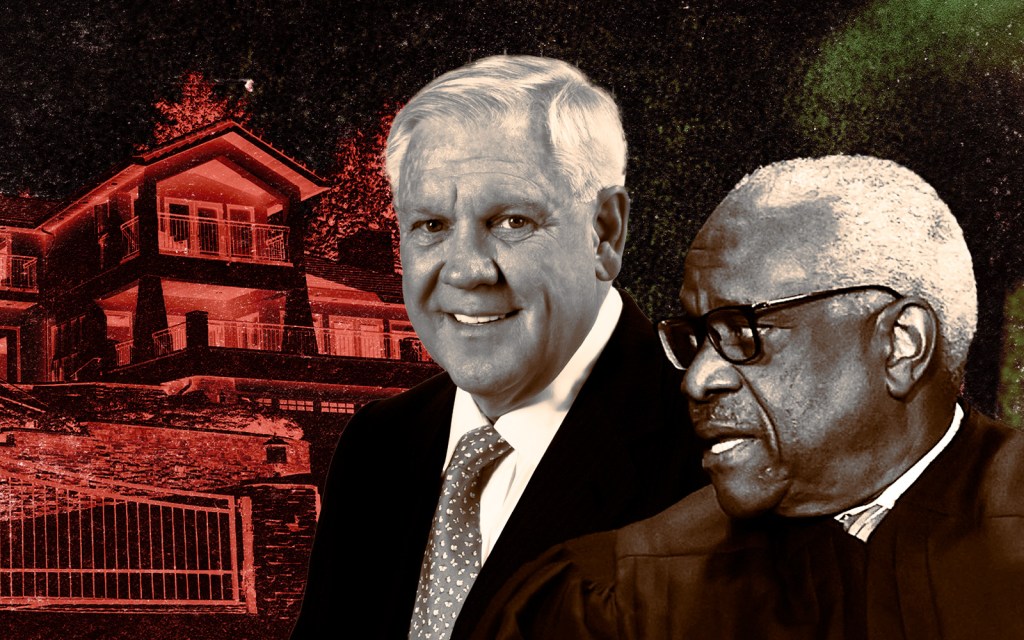
And the biggest eyebrow raiser was the presence of Justice Clarence Thomas among this crew. One is compelled to wonder whether Justice Thomas might have had a little talk with his bosom buddy and traveling companion Harlan Crow, a Republican megadonor who megadonates to a lot of Republicans not named Donald Trump.