Maine’s Senate race has given the nation no end of agita, but it finally delivered a moment worthy of the outsize attention when Susan Collins, bragging that she’d convinced Trump to stand down on his plans to put a tariff on road salt, was hit by this rejoinderfrom her Democratic opponent, Troy Jackson: “We can’t eat road salt.” Jackson is no paragon of charisma, so we hesitate to call it a zinger. But the humble de-icing material conjured the kind of relatable, of-the-moment idea that usually eludes the grasp of an inanimate object. Could it be a game-changer? Elections have hinged on dumber things, that’s for sure.
I am a senior on Medicare. I have heard about your scheme to divert $90 for each of us from a fund intended for other purposes, in a transparent, frowuppy attempt to bribe us to vote for your side in the coming election.
SIR, they say that every man has his price. I don’t know whether that’s true. Nor can I be sure whether I, too, have my price.
But SIR, as surely as God made little green apples, and as surely as it DOES rain in Indianapolis in the summertime, my price, SIR, is not goddamn ninety dollars, SIR.
If I ever get my $90, SIR, it will go immediately to support for Democratic candidate—whose first objective, SIR, will be to impeach your fat ass, SIR.
Because, SIR, among your extraordinary list of faults, you, SIR, are a ninny and an incompetent nincompoop, SIR.
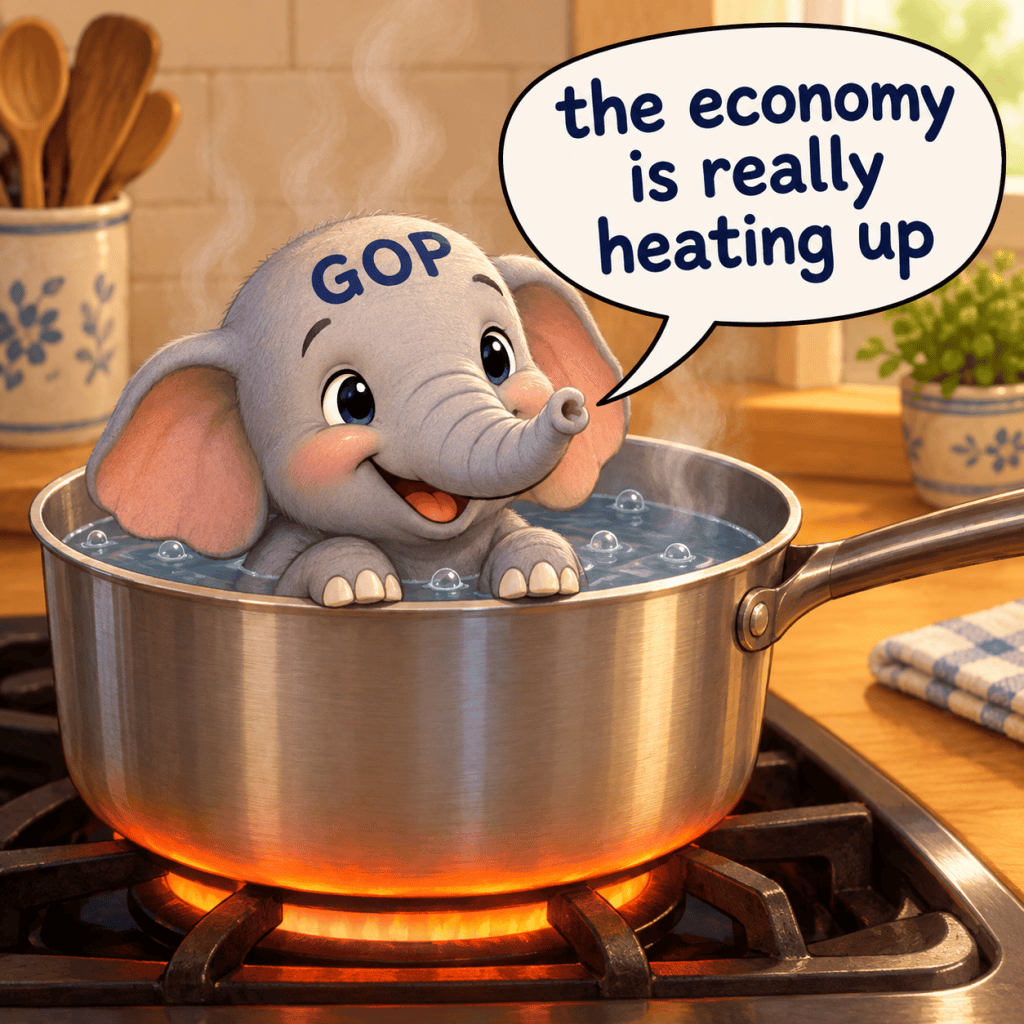
Thanks to my old friend Clarence Darrow, who created this image with AI. Personally, I think the elephant looks too cheerful, but I suppose that is part of the image’s charm.
Meantime, whitehouse.gov presents a “Welcome to the Golden Age!” complete with exclamation mark. For me, Morning Joe’s act is getting stale, but I thought he did a good job this morning on colossal absurdity of a White House celebration of our glorious economic prosperity:
Prof. Mearscheimer has been teaching international relations at the University of Chicago since 1982. He is well respected, but some of his analyses are highly controversial.
Here, Prof. Mearscheimer provides a remarkably comprehensive, granular, and detailed analysis of the United States’ current predicament in Iran. The subject lends itself to thinking in bumper sticker slogans; if that is your preferred way of thinking, then you will have no interest in this video. On the other hand, if fact-based thinking is your preference, then this video is for you.
Why Hasn’t Trump Surrendered to Iran?
I have argued that surrender is the least bad of Trump’s various bad options. I remain of that view. 100 percent. Maybe 200 percent. Watch the 57 minutes of this video and you will see why—in enormous detail.
So, why hasn’t he surrendered? And what will happen if he persists in this attitude?
First of all, let me acknowledge that far greater men than Donald John Trump have failed to understand that they were screwed, blued, and tattooed, and that their best option was to take their losses and amscray.
Second, with the June, 2026, memorandum of understanding he tried, sort of, to semi-surrender. In my view, it didn’t work (1) because elements within Iran did not want peace, even on terms that were favorable to Iran and (2) because Trump wasn’t willing to accept the full consequences of his very bad hand.
As Mearscheimer points out, Trump has specifically articulated a fear that the Iran war will cause a depression—and that he will be remembered as another Herbert Hoover.
With that thought in mind, with so few cards to play, and with his extraordinarily warped view of reality, I think there is a good chance he is going to nuke Iran.
That, I think, is what he means when he keeps blathering about “annihilation.”
Trump is the world’s worst gambler—a vital skill about which he has no clue.
Justice Kavanaugh does not deserve having a star pinned to his chest for following the rule of law, even though following the rule of law in this instance was contrary to the immediate political interests of his fellow Republicans. Nor do the rest of the Court, including Justices Alito and Thomas deserve a medal for letting Justice Kavanaugh do what he did.
That said, in our depraved day and age, a judicial result compelled by legal precedent and logic, against the political and ideological interests of a court, seems like a Man Bites Dog story, even though it should be a Dog Bites Man headline.
Today, in “Justice Kavanaugh stands up for state constitutional law in the Missouri congressional case,” SCOTUSblog explains it all:
A crucial case decided yesterday on the Supreme Court’s emergency docket will likely mean that in the upcoming November election Republicans will win only 6 of 8 Missouri congressional seats in the new House of Representatives, rather than 7 of 8, as they were hoping for.
In this case, Hoskins v. von Glahn, Republicans wanted the Supreme Court to jump in and second-guess a state supreme court on what is essentially a matter of state constitutional law. It would have been both legally wrong and politically damaging for the court to have done so. Late yesterday, Justice Brett Kavanaugh spurned the poisoned chalice without explanation. No justice dissented, at least not publicly. (Kavanaugh in fact denied the request himself, without referring it to the whole court; he would not have acted unilaterally unless he knew a majority of the court wanted no part of this request.)
We applaud this outcome, and we offer a few quick points of elaboration.
Under both the U.S. Constitution’s Article I, section 4, and a clear congressional statute on the books, Missouri’s single-member districting lines for Congressional districts are to be determined by state law – including, of course, state constitutional law, as definitively determined by the state supreme court. The Missouri Supreme Court had already weighed in on the relevant state-law issues in Hoskins. (For the details, see Amy’s recent explainer.) There was thus no proper role for the U.S. Supremes at this point. Such is the square command of the court’s landmark ruling in the 2023 Moore v. Harper – a ruling involving congressional districting in North Carolina in which the court aligned with our amicus brief in that case (co-written with Steve Calabresi) and also built squarely on an earlier Roberts court precedent, Arizona v Independent Redistricting Commission, involving congressional districting in Arizona.
Some prominent commentators in 2023 opined that the Moore court had left the door open for U.S. Supreme Court intervention seeking to second-guess state supreme courts in a broad range of future congressional districting cases. We thought that these commentators misread Moore, and we said so back in 2023. Since then – consistent with our reading of the case, and contra the predications of these other commentators – the U.S. Supreme Court has yet to second-guess a single state supreme court state-law ruling involving congressional districting.
In Hoskins, the state supreme court was unanimous. It essentially ruled for Democrats even though a strong majority of that court had been appointed by Republican governors. This is what law looks like.
Here is another thing that law looks like: What’s sauce for a Democratic goose in Virginia is sauce for a Republican gander in Missouri. When sore-loser Democrats tried to use the Supreme Court’s emergency docket to second-guess the Virginia Supreme Court on a state-law issue in a recent congressional districting case, the Supreme Court shot down the Virginia Democrats unanimously and immediately. Yesterday, the court quite properly did the same thing on the same brisk timeline to Missouri Republicans.
The state of Missouri, via its constitution, has chosen to allow the people of the state, in certain specified situations, to weigh in directly on congressional districting before any ordinary state law changing the districting rules may go into effect. This is surely a choice Missouri is allowed to make under the 10th Amendment, the Republican Government Clause, Erie, and the Moore v. Harper line of cases. If the people of Missouri don’t like this system, they are of course free to change their state constitution. The state constitutional provisions at issue in Hoskins have a long and distinguished pedigree. The Missouri Constitution could clearly have prevented the state legislature from implementing ANY optional districting change absent two legislative votes separated by an intervening general election. Given that, the Missouri Constitution can surely take the lesser step of pausing new legislative districting rules in some situations, where opposition among the electorate is particularly intense and seemingly widespread, while allowing new legislative districting rules to take immediate effect in other, calmer and less partisan situations.
Under the so-called Purcell principle, the Supreme Court has admonished that federal courts should not upset state-law election rules and practices on the eve of an election, absent a very clear violation of federal law. …
Hooray for Justice Kavanaugh! Hooray for the court! …
But There is Someone in this Story Who Deserves Special Recognition
That would by one Denny Hoskins, the Missouri Secretary of State, who is under order to to show up in court tomorrow morning and explain why his ass should not be held in contempt of court.
I hope that Secretary Hoskins will be given the award that he so richly merits.