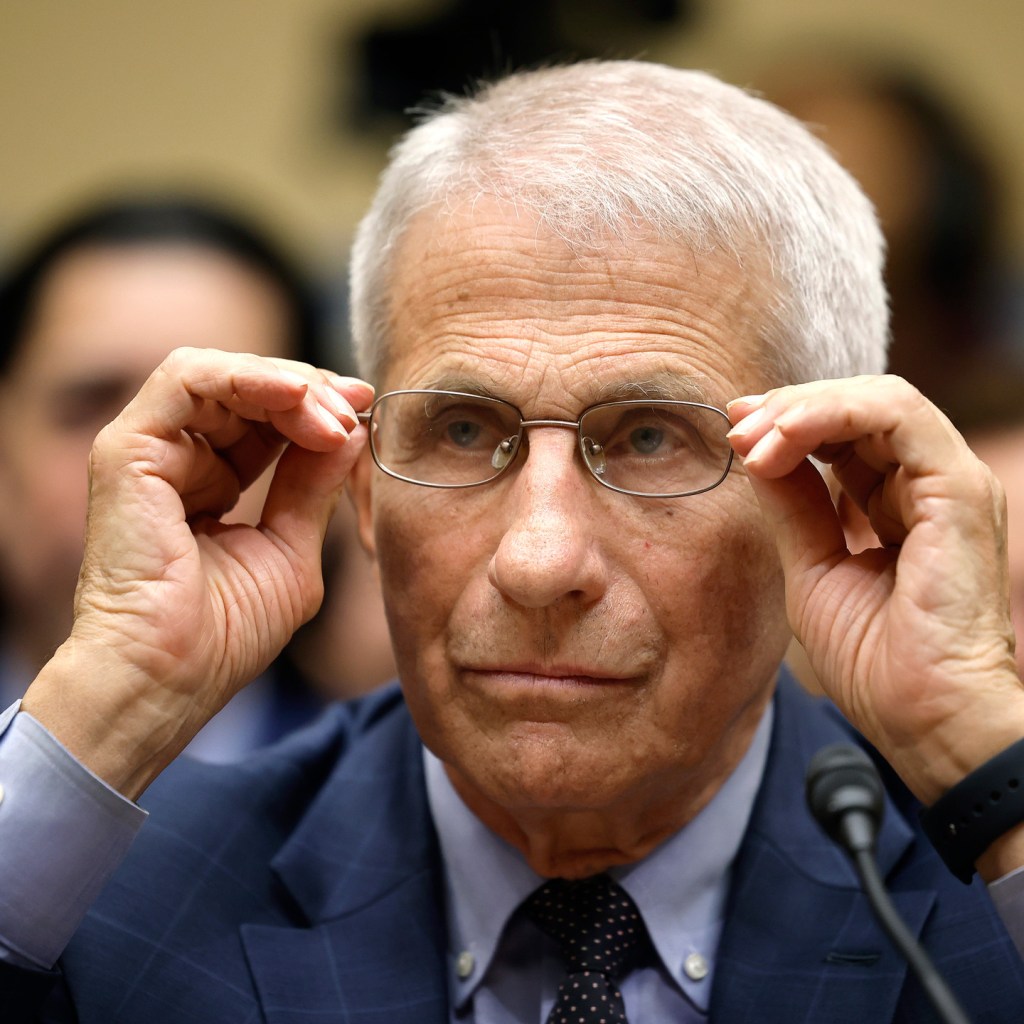
Fauci Takes the Fifth

Yesterday’s hearing was an unedifying spectacle. In this post I will not, as Kinky Friedman used to say, cast asparagus, either at the good doctor, or at the odious Rand Paul, or in the direction of anyone else. I will not editorialize on anyone’s personality, or on anyone’s scientific acumen, or on public policy questions such as when schools should have been reopened after the covid epidemic began to abate. Nor will I pontificate about whether it’s a good idea to write candid thoughts on a government computer and then, when you leave office, to leave your candid thoughts on said computer, for your many enemies to find. 

I will say some things about the Fifth Amendment, and I will say those things in Q&A format. And I’ll also pass along some lucid observations I read in the news today.

Fauci Takes the Fifth: Some Questions and Some Answers

WHEN TESTIFYING UNDER OATH BEFORE A CONGRESSIONAL COMMITTEE, IS IT LAWFUL TO TAKE THE FIFTH BECAUSE YOU DON’T LIKE THE QUESTION OR BECAUSE THE SENATOR POSING THE QUESTION IS A BLOVIATING ASSHOLE?

No, it is not. You have to answer the question.

WHEN TESTIFYING UNDER OATH BEFORE A CONGRESSIONAL COMMITTEE, UNDER WHAT CIRCUMSTANCES IS IT LAWFUL AND PROPER TO PLEAD THE FIFTH AND THUS REFUSE TO GIVE A SUBSTANTIVE STANDARD?

When the witness has a reasonable belief that a truthful answer to the question would risk criminal prosecution.

DID YOU SAY RISK OF PROSECUTION OR RISK OF CONVICTION?

It’s risk of prosecution. If the witness thinks any such prosecution would be in bad faith, and that he would probably escape conviction, he may still refuse to answer if he reasonably fears prosecution. 

IN DETERMINING THE REASONABLENESS OF THE WITNESS’S FEAR OF PROSECUTION, IS IT LAWFUL TO TAKE INTO ACCOUNT THAT THE CURRENT ADMINISTRATION IS ON A CAMPAIGN OF BASELESS PROSECUTIONS OF PEOPLE IN THE MUCH SAME POSITION AS THE WITNESS?

I don’t have a case on point, nor have I done any legal research. But yes, the logical answer should be that, if a pattern of bad faith prosecutions is under way, the witness may take that current situation into account.

IN DETERMINING THE REASONABLENESS OF THE WITNESS’S FEAR OF PROSECUTION, IS IT LAWFUL TO TAKE INTO ACCOUNT THAT THE EXAMINING SENATOR HAS REPEATEDLY SAID THAT THE WITNESS SHOULD BE BEHIND BARS—AND THAT THERE IS EVERY REASON TO BELIEVE THAT SENATOR INTENDS TO LAY A PERJURY TRAP FOR THE WITNESS?

Yes. 

HOW DOES DR. FAUCI’S PARDON RELATE TO HIS LAWFUL INVOCATION OF HIS FIFTH AMENDMENT RIGHTS?

Dr. Fauci’s pardon was (paraphrasing and shortening slightly) for any criminal acts that he might have committee in the course of his government service between January 1, 2014 and January 19, 2025. It would not cover perjured testimony given in 2026, even if that false testimony related to previous acts that are within the scope of the pardon. 

WHY DID DR. FAUCI REFUSE TO ANSWER ABOUT THE COLOR OF HIS TIE?

Lawyers who advise witnesses invoking the Fifth to testify only as to name, rank, and serial number, in order not to risk waiving their Fifth Amendment protection. Sen. Hawley’s question was grandstanding for the cheap seats.

DID DR. FAUCI’S OPENING STATEMENT WAIVE HIS FIFTH AMENDMENT RIGHTS?

In general, it is not lawful for a witness to invoke the Fifth Amendment in a selective way, so that he can testify about facts that make him look good and avoid testifying about facts that make him look bad. Courts would call that a waiver of constitutional rights.

I expect that Sen. Paul and his posse will try their best to make a big damn deal about the opening statement as an alleged waiver of rights. All I can say now is that I’m confident that the matter was considered in great depth by Dr. Fauci’s legal team.

SEN. RAND PAUL SAYS HE WANTS TO SEE DR. FAUCI PROSECUTED FOR CONTEMPT OF CONGRESS. HOW WOULD THAT WORK?

It’s a complicated question, but—very broadly and somewhat inadequately—intentional obstruction of a legitimate congressional investigation would be a legal basis for contempt of Congress. 

Sen. Paul only needs for the Senate to act on a contempt resolution. It does not require approval in the House or by the President. If the Senate passes such a resolution, it will be referred to the Department of Justice. The Justice Department maintains that it is not legally required to act on such a referral, but, in this case, they would eagerly take the matter to a grand jury and attempt to get an indictment. If the case proceeds this way, the legal issue in a criminal contempt proceeding would be whether Dr. Fauci can be shown beyond a reasonable doubt to have tried to obstruct a lawful congressional inquiry by unlawful means, including an unlawful assertion of his Fifth Amendment rights. The issue of his reasonable fear of prosecution would be front and center. 

WHO IS DR. FAUCI’S LAWYER AND IS HE OR SHE ANY GOOD?

His lead counsel is David Schertler, who enjoys a stellar reputation as a white collar criminal defense attorney. In a world of great uncertainty, we may be highly confident that Dr. Fauci received top notch legal counsel. In fact, all things considered, I think it might have been legal malpractice to advise Dr. Fauci to do anything other than plead the Fifth. 

The Washington Post’s “Takeaway” on Dr. Fauci and the Fifth

Today’s WaPo offers five “takeaways” on yesterday’s spectacle, of which Takeaway Number 4 related to the subject of this post. It reads as follows:

4. Paul’s threat to hold Fauci in contempt raises new legal questions

The chairman said his committee plans to hold a vote next week on whether Fauci was in contempt of Congress. But he and his colleagues acknowledged legal uncertainty about how to proceed, complicated by President Joe Biden’s preemptive pardon for Fauci before Biden left office.

Lankford asked Paul if there is guidance on whether Fauci could be held in contempt for refusing to answer questions after making an opening statement. Lankford noted a 2013 episode in the House in which an IRS official made an opening statement and then invoked her Fifth Amendment right to not answer questions about whether her agency had wrongly targeted conservative groups. The GOP-led House concluded that the official had waived her Fifth Amendment rights by making an opening statement, and she was ultimately found in contempt.

Paul said that was among the legal questions lawmakers would consider. He added that the courts may need to settle whether, with “a presidential pardon that offers you complete immunity, you can still claim that you need protection” in a congressional hearing.

“Dr. Fauci isn’t liable for anything as long as he tells the truth,” Paul added.

Some past congressional witnesses have also repeatedly pleaded the Fifth. Martin Shkreli, a controversial pharmaceutical investor, refused to answer questions in front of a House Oversight Committee hearing in 2016, annoying lawmakers with his smirking. While lawmakers discussed holding Shkreli in contempt of Congress, they ultimately did not. 

Regina Wallace-Jones, the head of the Democratic fundraising engine ActBlue, also repeatedly invoked the Fifth Amendment during a congressional hearing last month in which Republicans pressed her on the platform’s process for vetting foreign donations.

“It is the only reasonable response to a proceeding that from the beginning has been about harassing a political opponent’s fundraising platform, not genuine oversight,” she wrote in The Washington Post.

House Republicans have threatened to hold ActBlue in contempt.
It’s Almost TACO Time! Time for Trump to Make the Least Bad Deal He Can Make—and Then Cut and Run.

Today in the New York Times, heavy hitter David Sanger, assisted by reporting from heavy hitters Jonathan Swan and Eric Schmitt, elucidate in calm and rational prose, in excruciating detail, the Iran dilemma in which Trump finds himself. From one point of view, the piece is brilliant. From another point of view, it reads like a parody of the distinguished New York Times covering a shit storm, followed by a dumpster fire. 

For a long time now, it has been apparent to anyone of the meanest intelligence that, on Iran, Trump is up that famous tributary without a means of locomotion. But Trump’s intellectual acumen does not reach the level of a person of the meanest intelligence. So … he is only now realizing that he is well and truly screwed, blued, and tattooed. 

A couple of observations, before we get to the estimable prose of Mr. Sanger. Firstly, it is welcome news to learn that Trump still has the mental ability to come to terms with reality, however belatedly and imperfectly. I thought he probably retained that I ability, but I was far from sure. 

Secondly, if Trump wanted to walk through Door Number One and begin a program of massive war crimes amounting to genocide, he would have faced one obstacle that Sanger does not address, namely, Trump would have had to give the order and the United States military would have had to obey the order. My suspicion is that the Joint Chiefs whispered a few thoughts in Trump’s shell-like ear apropos of the duty to disobey illegal orders.

Thirdly—and you already knew this, but isn’t it fun to hold the thought in your mind?—when Trump, inevitably, cuts and runs, leaving Iran in control of the Strait and in possession of whatever nuclear assets it now how, his base is going to be well and truly pissed.

With those thoughts in mind, let’s read what David Sanger has to say:

Trump Seems Trapped by Iran War, Even as He Wields the World’s Biggest Hammer: A president who thought there were no limits to his power has discovered several, leaving him more frustrated and erratic.

President Trump often celebrates his unpredictability, declaring that it keeps allies and adversaries alike off balance.

By his telling, his willingness to bomb Iranian nuclear sites 13 months ago, and send Delta Force commandos in to snatch President Nicolás Maduro of Venezuela from his bed in early January, reflected his determination to execute military operations that would have made his predecessors blanch. He told The New York Times he was limited only by “my own morality,” as he wielded the world’s biggest hammer.

But in recent weeks, he has seemed trapped, his presidency gradually consumed by a war he cannot find his way out of.

He has discovered limits on his power that he could have scarcely imagined as he began full combat operations on Feb. 28, when he set out goals for a swift end to Iran’s nuclear program and the overthrow of the country’s government.

Five months later, those goals remain almost entirely unaccomplished. And Mr. Trump, once confident that overwhelming force would enable him to pursue in Iran what he proudly called the “Venezuela model” — a change of government to one amenable to U.S. control — is now hesitant to plunge back into major combat operations that his intelligence agencies assess are unlikely to work as well in Tehran.

He has been unable to control surging oil prices, or their effects on the stock market.The shipping that crawled to a stop in the Strait of Hormuz, then was opened for a few short weeks, is back to a trickle, with a second choke point, between the Red Sea and the Gulf of Aden, now threatened. And while the president has threatened to take Kharg Island, where Iran ships oil, or to seize its underground stores of enriched uranium, he has said publicly that he knows there is no appetite for sending in ground troops.

Those limits have left him deeply frustrated, his aides say, and have made him more erratic, even by Trumpian standards. Last week alone, Mr. Trump’s energy secretary signed a historic pact with Saudi Arabia to provide civil nuclear power to the kingdom, before the president undercut the deal less than 24 hours later, stunning the Saudis by declaring that the agreement, negotiated over 18 months, was dead unless the country joined the Abraham Accords and recognized Israel.

Aaron David Miller, a former U.S. diplomat with long experience in the Mideast, said that Mr. Trump again “alienated the Saudis, delighted Benjamin Netanyahu and gave Iran strong talking points as to why cutting deals with U.S. is a fool’s errand, bound to be betrayed.”

The next day, he declared that the “original Deal” on the $4.5 billion Gordie Howe International Bridge, a cross-border project named for the hockey star beloved on both sides of the border with Canada, was dead. He imposed 50 percent tariffs on a range of Canadian goods, in what appeared to be a blatant violation of the U.S.-Mexico-Canada Agreement that Mr. Trump negotiated in his first term and now wants to scrap.

Not surprisingly, Canada disinvited Americans from ceremonies to mark the completion of the bridge, which opens to traffic on Monday.

Mr. Trump’s rewriting of deals, out of anger or frustration, has extended to his party’s domestic priorities. Republicans had assembled chairs at the Capitol for the signing ceremony of a major housing bill — a rare bipartisan agreement celebrated by the White House — when Mr. Trump stunned them by refusing to sign it. His only priority, he said, was the SAVE America Act, his effort to change voting laws, which did not have enough Republican support.

The ceremony was canceled. The bill became law without Mr. Trump’s signature — and also without a chance for his party to get the photo opportunity of action to ease affordability for new homeowners.

Not all of Mr. Trump’s frustrations, people close to the president say, are driven by the war, now so unpopular that only 29 percent of Americans polled by The Washington Post and Ipsos approved of his handling of the conflict. But much of it is. And the angst is clear as he promises to stop Iran’s nuclear program at any cost, while his allies at home want out.

“We got to wrap it up,” Speaker Mike Johnson said last week, voicing a sentiment heard increasingly from Mr. Trump’s most enthusiastic supporters.

But the president does not have a clear way to accomplish that goal. Having entered the conflict with little strategy for victory, he now is struggling for a face-saving way to exit.

A month ago, he exuded confidence that he had found the way to declare victory. On June 17, Mr. Trump signed with a flourish — at the Palace of Versailles, where World War I officially ended in 1919 — a hastily written, 14-point cease-fire agreement.

At the time, Mr. Trump said that a new, more “reasonable” set of Iranian leaders had seen the light, and were being driven by economic interests.

“I believe they have had enough,” Mr. Trump said in an interview with The Times on June 14. He argued that he was able to get the deal because he was threatening a massive attack, prompting Iran to fold.

“We were going in for the big one, and they said, ‘Please don’t do it, we will make a deal.’ And we made a deal right after that,” he said.

It lasted only two weeks.

The Iranians who negotiated the deal appeared to have been in conflict with the Islamic Revolutionary Guard Corps, whose forces opened fire on ships that refused to use the channel of the Strait of Hormuz that Iran controls. While Mr. Trump said in the recent interview with The Times that Iranian leaders wanted billions of dollars in Iranian overseas funds unfrozen and oil shipments flowing, the Iranian Revolutionary Guard Corps seems more interested in demonstrating control.

Now Mr. Trump has three main options: military escalation, economic crackdown or declaring victory and getting out. Each has been debated in recent weeks in meetings with Vice President JD Vance; Defense Secretary Pete Hegseth; the chairman of the Joint Chiefs of Staff, Gen. Dan Caine; his son-in-law Jared Kushner; and his special envoy, Steve Witkoff.

Each option seems unpalatable, for different reasons.

On Friday, after signaling all week that he was planning a return to major combat operations in Iran, he pulled back. In briefings, according to several officials, aides cast doubt on whether a massive bombardment, one that cut off electricity and went after Iran’s resilient missile capability, would result in Iran’s return to meaningful negotiations.

And the price would be high. Mr. Trump was told that attacks of that magnitude could lead to huge civilian casualties and mass starvation among the very Iranians he once promised to protect from their own government. When he was asked in the Oval Office on Friday whether he was hesitant to blow up power plants and bridges, because that could constitute war crimes, he said, “I won’t respond to that question.”

But his real hesitation may come from the fact that the war has depleted U.S. stockpiles of missile interceptors. In April, the Center for Strategic and International Studies estimated that half the U.S. inventories of some key interceptors might have already been used. After 13 consecutive nights of attacks and counterattacks this month, those numbers, some officials say, have reached critically low levels, and were a factor in Mr. Trump’s decision in recent days to hold off on a major escalation in the war. 

U.S. officials now worry that President Vladimir V. Putin of Russia and Xi Jinping of China could be factoring the shortages into calculations of their next moves, in Ukraine and Europe for Mr. Putin and perhaps against Taiwan for Mr. Xi.

Mr. Trump’s second option is to let sanctions sink in, hoping that further crackdowns on oil exports, enforced by the renewed blockade of shipments into and out of the Strait of Hormuz, will have their intended effect.

But those are slow, and Mr. Trump has been predicting economic collapse in Iran since he first pulled out of the Obama-era nuclear deal in 2018 and imposed what he called crushing controls on Iran. Eight years later, the regime lives, under a new leader who could be more dedicated to a covert nuclear program.

That strategy may yet work. But it will require a costly, continuous U.S. military presence, and the possibility of on-again, off-again exchanges of fire that risk more American lives and more attacks on Gulf allies.

The third option is to declare victory and go home. Mr. Trump seemed to be headed that way a month ago, when he said he had chosen a cease-fire and negotiations because he did not want to risk a depression that would invite comparisons to Herbert Hoover.

“He was always the one I didn’t want to be,” Mr. Trump said of the 31st president, who presided over the crash that ushered in the Great Depression. “I didn’t want to see economic catastrophe.” He later noted that if the war continued, the world would have begun to run out of oil stockpiles.

But exiting comes with costs. If Mr. Trump leaves Iran with its near-bomb grade nuclear fuel buried under rubble and with the Strait of Hormuz under de facto Iranian control, he will have failed to address the problem that triggered his attack and created a vast new one for energy markets.

It would define his legacy. And it would make clear that there are more constraints on his power than he believed in January, when he declared that his reach was limitless.

General Hertling on the Iran War Today

IMHO, you won’t find a more informative military analysis than that of the general.

Wikipedia reports that

Mark Phillip Hertling (born September 29, 1953) is a retired United States Army Lieutenant General. From March 2011 to November 2012, he served as the Commanding General of United States Army Europe and the Seventh Army. Hertling served in armor, cavalry, planning, operations and training positions, and commanded every organization from platoon to field army. He commanded the 1st Armored Division and Task Force Iron/Multinational Division-North in Iraq during the troop surge of 2007 to 2008.

What My Crystal Ball Tells Me

One. The people who are in control in Iran want to put Trump in a position where his only choices are (a) a ground invasion of Iran or (b) abject surrender.

Two. The people who are in control in Iran are not afraid of a U.S. ground invasion. To the contrary, they would welcome a U.S. ground invasion.

Three. This is where it gets interesting. Many say Trump’s ego will lead him to take the ground invasion option. That may happen. But I think it’s more likely that he will surrender. 

For all his bluster and bullshit, Trump sometimes recognizes that he has lost, and he sometimes backs down. Remember Trump Taco Tuesday?

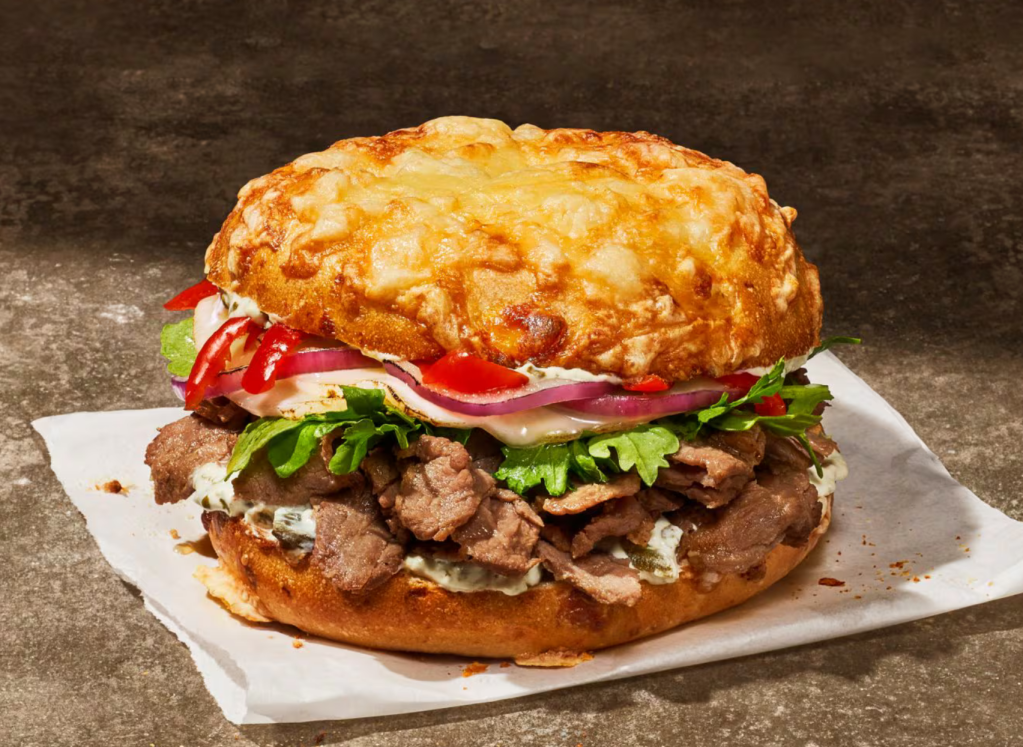
Trump possesses a basic animal cunning. Plus, he continues to imagine that he can sell a shit sandwich as the latest premium offering on the Panera menu. 

He Shot Himself in the Foot

Eight Observations

  1. The reason why he presented “evidence” that contradicts the argument he wants to make is that he has a severe mental defect that prevents him from understanding the information he is given. He cannot keep himself from making illogical arguments because he is mentally incapable of distinguishing a logical argument from an illogical argument. 
  2. In his old age, this severe mental defect is getting even worse.
  3. Trump is an evil person. In other words, a sociopath.
  4. We are morally justified in hating and despising Trump. But that said, I am inclined to think that our best public strategy is to exhibit pity for Trump. 
  5. Every sentient person has observed that Trump wants to use last night’s speech as the predicate for a variety of forms of election interference. Every sentient person is right in that regard. But his malevolence is greatly inhibited by his incompetence.
  6. As a talking head said recently of his Iran strategy, the problem is not that he strategy is mistaken. The problem is that he does not know what strategy is. When all else fails, he may order a military coup. I don’t think it will work, but I am afraid we may find out whether it works or not.
  7. The American people unwisely reelected a proven traitor. They wanted lower consumer prices. They got higher consumer prices—along with a firehose of ridiculous lies about consumer prices. They wanted no more wars. They got the war in Iran—along with a firehose of ridiculous lies about the Iran war. 
  8. Although Trump is fortunate to have legions of uneducated and gullible followers, the environment he has created—higher consumer prices and a war in the Middle East—is not propitious for his gullible followers’ acceptance of his firehose of lies about the election. He has cried “Wolf!” way too many times. 

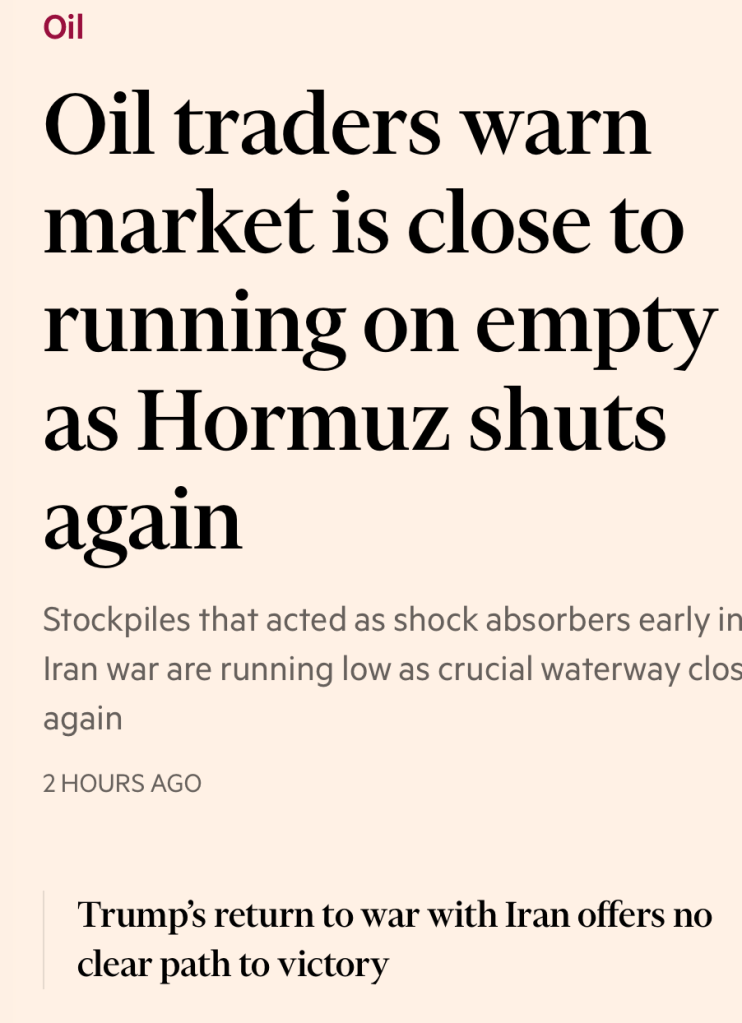
Oil Market Running on Empty. No Plan. No Concept of a Plan. Just Hallucination and Bullshit. 

From this evening’s Financial Times:

Peter Baker on how Trump, utterly misunderstanding Iran, has screwed himself to a fare-thee-well:

In Iran, Trump Has Found an Opponent He Cannot Easily Dominate

The president is accustomed to forcing other countries to bend to his will. But he is struggling to come up with a strategy to extract Iranian concessions as the cease-fire he brokered collapses.

Published July 14, 2026 Updated July 15, 2026, 4:14 p.m. ET

On the 136th day of his war against Iran, President Trump came up with a new plan. He would impose tolls on ships traversing the Strait of Hormuz in exchange for protecting them from Iranian forces.

But that was then. On Day 137, he had another new plan. No tolls after all.

Mr. Trump’s 180-degree reversal this week in the face of protests from his Arab allies who were not so excited about paying tolls reflected how adrift he seems to be in prosecuting his war against Iran. What was supposed to be a clean four-to-six-week operation is now in its messy 20th week. Improvisation and impulse are not working.

A president who has made flexing his power on the world stage a hallmark of his second term has found in Iran an opponent that so far will not bend to his will and a geopolitical conflict that cannot be won through nasty social media posts or tariff threats. The memorandum of understanding that he brokered with Tehran last month to halt the fighting turns out to have been a memorandum of misunderstanding, and Mr. Trump now seems to have neither a clear military nor diplomatic strategy.

“He’s encountered a country that is not willing to play by his set of rules, which is you bend and kiss the ring and tell him how great he is and try to get whatever concession he’s willing to give,” said Vali Nasr, a professor at the Johns Hopkins University School of Advanced International Studies who has advised presidents and secretaries of state on the Middle East.

Mr. Trump’s no-end-in-sight venture in the Middle East has become a fresh lesson in why the region has been a sinkhole for presidential ambition for generations. The instruments of power that help advance U.S. interests elsewhere around the globe do not necessarily work there, as many of Mr. Trump’s predecessors have discovered.

It has been especially frustrating for Mr. Trump, who has reveled in getting his way since returning to office last year and even boasted that he might be the most powerful man in world history. But while he has successfully pressured NATO allies into increasing military spending, extracted concessions from trading partners and essentially took over Venezuela with a one-night surgical commando raid, it is not clear that he can get his way in the Persian desert.

“Trump’s forceful approach to the world in his second term has benefited from some luck and the occasional willingness of other states to facilitate an off-ramp,” said Suzanne Maloney, vice president and director of foreign policy at the Brookings Institution. “Nothing in the past 47 years should have led him to believe that Tehran would follow that route.”

John Hannah, a former national security adviser to Vice President Dick Cheney and now a senior fellow at the Jewish Institute for National Security of America, in the past has supported the limited use of military force to stop Iran from building a nuclear weapon. But he said that by going for “a massive decapitation strike,” Mr. Trump had clearly underestimated the theocratic power structure that took power in the 1979 Iranian revolution and overestimated American capacity to topple it.

“In retrospect, this was clearly a war based on fatally flawed assumptions,” Mr. Hannah said, “none more damaging than the president’s apparent conviction that Iran’s revolutionary regime was a flimsy house of cards ready to collapse in a hail of American airstrikes and bellicose Truth Social posts.”

“Compounding the error,” he added, “there was no rigorous national security apparatus around the president prepared to speak truth to power and subject his wrongheaded assumptions to systematic questioning based on the knowledge and experience of real foreign policy, defense and intelligence professionals.”

The cease-fire that has now collapsed amid nightly strikes was not even a particularly far-reaching agreement. It was meant to be a stopgap to quiet the guns for 60 days so that the two sides could negotiate the truly thorny disputes, particularly the future of Iran’s nuclear program. If a temporary deal cannot last, it is hard to see how the two sides can get to a permanent accord requiring painful compromises.

Mr. Trump seems uncertain how to proceed. He has turned back to the use of military force and ordered the resumption of a naval blockade in the Strait of Hormuz. He has threatened to take “a nice, big fat shot” at Pickaxe Mountain, a fortified site near one of Iran’s main nuclear facilities. He vowed to “knock out all their power plants” and “knock out all their bridges unless they get to the table and negotiate.”

But for all the saber rattling, he has given little indication that he is willing to resume the sort of full-fledged bombardment that marked the beginning of the war, given popular opinion against escalated conflict.

At the same time, he has suggested there will be further negotiations but has not articulated how talks that failed before could succeed now. In fact, he has expressed deep skepticism that they could, although of course that might simply be a way of lowering expectations. Instead, Mr. Trump seems to think that he can outlast the Iranians because their economy is in dire shape while the Iranians seem to think that they can outlast him because of the politics of gas prices heading into midterm elections at home.

“Trump’s in a box, and he’s facing a brutal and tenacious adversary whose objectives — maintaining leverage over the strait and a newfound desire for hegemony over the Gulf —now hold him hostage,” said Aaron David Miller, a former Middle East peace negotiator who served presidents of both parties and is now a senior fellow at the Carnegie Endowment for International Peace.

“Iran consumed and tarnished the legacy of one president,” he added, referring to Jimmy Carter and the 1979-81 hostage crisis. “And the way it appears now, with time on Iran’s side, not on Trump’s, it could very well tarnish or ruin the legacy of another.”

Other foreign policy experts rejected the analogy and cautioned against overstating the impact of the Iran war on Mr. Trump’s presidency.

“I don’t think Iran has destroyed Trump’s agenda, which is a broad one,” said Elliott Abrams, a national security official in multiple Republican administrations, including Mr. Trump’s first term. “As long as Americans are not dying, Iran will be a secondary issue for most Americans.”

Other foreign policy challenges like Ukraine, Cuba and China “don’t depend on Iran,” he added, so everyone should “keep Iran in perspective.”

Mr. Abrams noted that Democrats appear increasingly at odds with each other over Israel and the Palestinians, a divide that has played a major factor in some congressional primaries this season. “It’s the Democrats who are in danger of having a Middle East issue, namely Israel, swallow up their agenda,” he said.

The abrupt flip-flop on tolls underscored how much Mr. Trump is ad libbing these days. In announcing that he would charge 20 percent on cargo to protect shipping in the Strait of Hormuz on Monday, he contradicted his own administration’s position that tolls were an unacceptable violation of international law.

His decision to cancel them on Tuesday after calls from anxious Gulf Arab leaders made clear that he had not bothered to consult his allies before announcing the new tolls or disregarded their concerns. He covered for the shift with a face-saving if barely plausible explanation that the Gulf leaders had promised “trade and investment deals” instead.

What investments he did not say, nor were there further details to suggest any concrete commitments. “They’re going to be making massive investments into the U.S., and I like that much better,” Mr. Trump told reporters. “I don’t like the concept of a fee,” he said a day after calling it a simple “matter of fairness.”

It was hardly the only contradiction of recent days. When Mr. Trump sealed the cease-fire agreement last month, he praised Iranian negotiators. “We’re dealing with people that I think are very rational people,” he said then. “They were nice to deal with. They were strong people, smart people.”

By last week, he had changed his mind. “They’re scum,” he complained. “They’re sick people. They’re led by sick people.” Asked what had changed in just three weeks, Mr. Trump said, “I got to know them.” Which of course begged the question of why he did not know who he was dealing with in the first place.

“I don’t think he has a strategy on Iran,” said Abbas Milani, director of Iranian studies at Stanford University and a research fellow at the conservative Hoover Institution. “That’s the key problem. He approaches these things instinctively and he approaches them with two contradictory goals. On the one hand, he keeps saying, ‘We want to make a deal with you guys and make Iran a thriving economy.’ And on the other hand, he says, ‘I’m going to obliterate your civilization.’”

Mr. Milani said he agreed with Mr. Trump that Iran actually does want a peace agreement, and in fact he believes it is “desperate for a deal” because its economy is in free-fall. But he faulted the president for sending negotiators who are not steeped in the region and do not grasp its intricate history and details.

“I don’t think he ever really understood the nature of this regime,” Mr. Milani said of Mr. Trump. “He still doesn’t understand it. It’s not like any other. It always does the unexpected and will go to any limit to keep itself in power.”

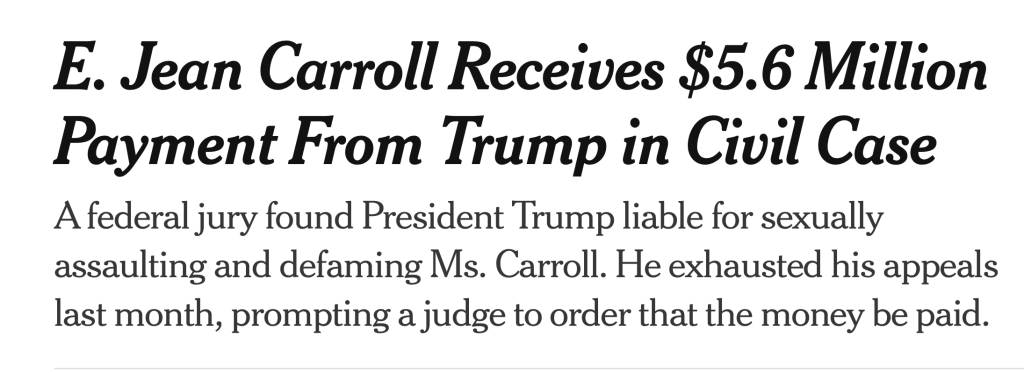
E. Jean Carroll Gets Her Money, and None Too Soon

She also won $83.3 million in a later defamation case. A federal appeals court upheld that judgment in 2025, but Trump’s crack legal team is still flailing around, trying to avoid paying up. 

And, you know what? If Trump defames her some more, she’s going to sue him again. 

Lastly, with my apologies, a point of personal privilege. Back in the day, it was my great honor to work with Lewis Kaplan—now a senior federal judge, and the person who presided over the two E. Jean Carroll/Trump lawsuits, then a litigation partner at Paul Weiss. Together with my colleague Rick Holwell of White & Case, we achieved victory in a landmark antitrust case, Consolidated Gold Fields v. Minorco, see https://law.justia.com/cases/federal/district-courts/FSupp/698/487/2356328/

Mr. Kaplan was a gentleman and a scholar back then, and one hell of a litigator, and he remains today one hell of a federal judge. 

Unlike his unworthy successors at Paul Weiss, Kaplan knows how you have to deal with someone like Mango Mussolini. Congratulations to the judge. Well done. 

I Read Yet Another Headline About “Three Things Democrats Have to Do if They Actually Want to Win.” It Proposes an “Ideological Exorcism.”

I would, of course, have taken a pass on the op-ed, except that it was written by Thomas Edsall, who is nobody’s fool.

The first part of Mr. Edsall’s article, in today’s New York Times, reads as follows:

Even now, according to a new survey by the left-leaning group Data for Progress, the Democratic Party has a net negative rating of minus 29 percentage points among swing voters, worse than the minus 25 for the Republican Party. Democrats seeking to restore their party’s credibility with the electorate as a whole, but especially among those crucial swing voters, might consider adding three planks — on immigration, urban disorder and transgender issues — to the 2028 Democratic platform.

Why? Because it is these three issues that serve to reinforce the perception that Democrats are willing to sacrifice the interests of the working and middle classes in favor of special interest constituencies.

I am more than a little queasy making these suggestions, but I think the Democratic Party needs to perform a kind of brutal surgery on itself.

The hard-edge character and language of what I am proposing is specifically designed to function as a public renunciation of the Democratic Party’s liabilities, its ties to special interest groups and its readiness to succumb to progressive orthodoxy.

The proposals amount, then, to an ideological exorcism.

On immigration, I would suggest — with plenty of room for amendment — the following:

Democrats will firmly enforce laws on illegal immigration, including tough border enforcement and deportation of unauthorized immigrants who commit crimes.

Unauthorized immigrants with no criminal record who have been in this country for at least five years, along with Dreamers, should be offered green cards with a path toward citizenship. More recent arrivals should be deported.

On crime:

The Democratic Party supports aggressive prosecution of those accused of violent crime, those who engage in crowdsourced “teen takeovers” of stores, as well as all forms of child abuse.

The party backs restoration of bail requirements in the case of felonies, lifetime sentences for offenders convicted of multiple violent crimes, tough enforcement of child support laws and the death penalty if supported by the voters in a state and endorsed by a jury.

Transgender and gender dysphoria:

There are two sexes: men and women.

A man can claim an identify as a woman, and the same in reverse for a woman. They have every right to do so. Their claim should be respected and they should be protected from any form of discrimination for their choice.

Their claim does not, however, alter their biological sex.

Consequently, it is legitimate in areas such as sports where a transgender person would have a competitive advantage over non-trans people to bar such participation. Similarly, a claim to a sexual identity does not give a trans woman the right to incarceration in a woman’s prison.

Finally, the debate over gender affirming surgery and hormone treatments is fraught with contradictory assertions. For now, because there are credible scientific claims of irreversible harms, such treatments for those under 18 should be barred pending further study.

There are some other planks I would add, including a strong commitment to free speech and an adamant rejection of all forms of cancel culture; an endorsement of equality of opportunity based on merit; the repudiation of socialism in favor of a free and open market accompanied by government regulation to prevent exploitation, monopolization and unfair trade practices. …

In exploring these issues with Democratic strategists, I was surprised to find significant support — with differences over language — from a variety of sources, albeit accompanied by a harsh rejection from a communications specialist for a firm headed by a major Democratic campaign strategist. …

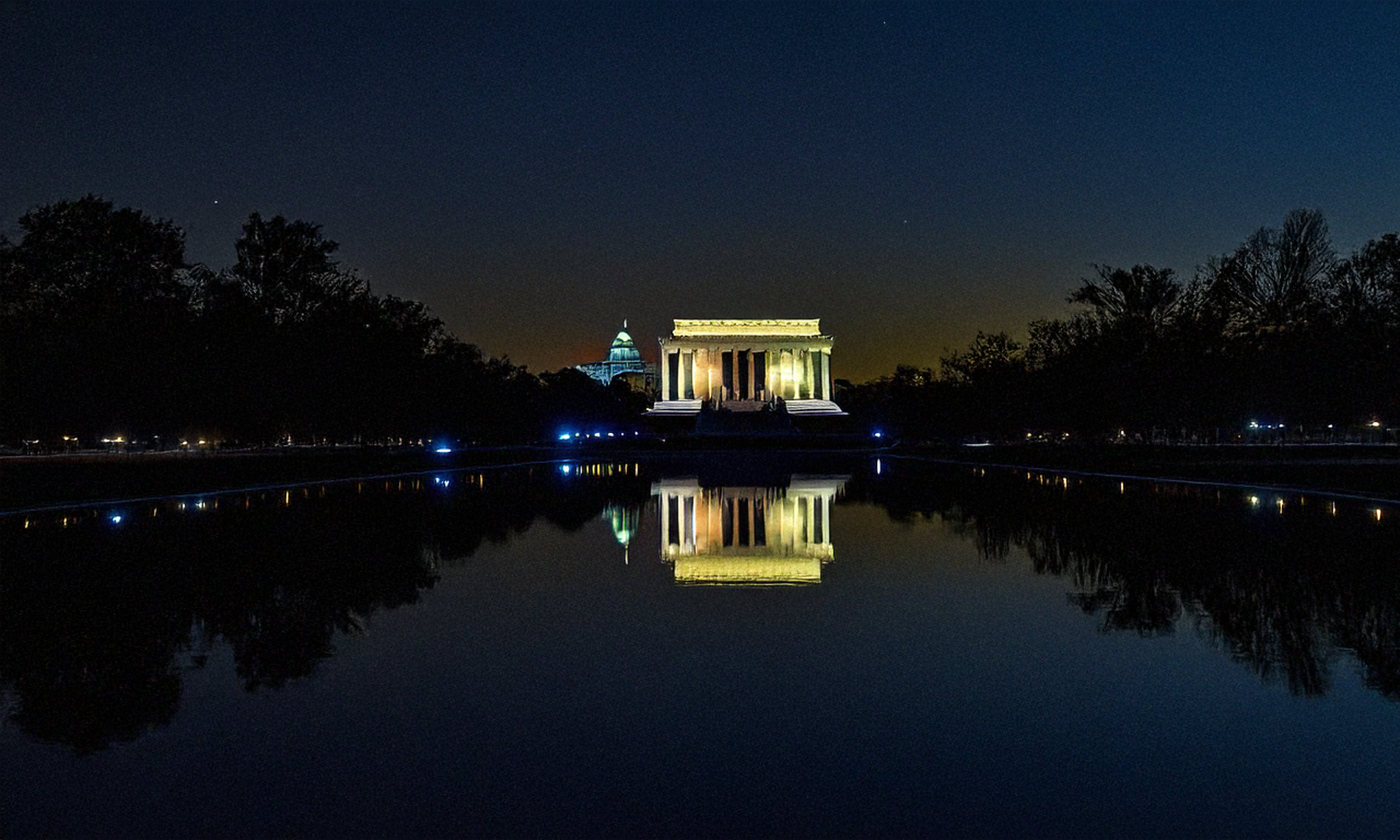
The Iran War Participation Trophy on the National Mall Today

A Headline from Today’s Wall Street Journal

I have posted several times about the two-pronged dilemma Trump faces in the Iran War that he started: either try to finish it off with a ground invasion of Iran, and thus royally piss off his base, by starting another endless land war in the Middle East, or supinely acquiesce to Iran’s strategic victory.

Some think the ground invasion may be inevitable, and of course they might be right. I say that supine acquiescence will probably be Trump’s final choice, because he really, really does not a land war in the Middle East; because he fears his base; and because he has a naïve faith in his ability to bullshit his way out of any problem that he creates for himself.

For completeness, I should have added that his final choice between these two alternative courses will be down the road a little bit. In the meantime, he will bluff and bluster and try to find some better third alternative. That is what’s happening right now. 

He still thinks that bluster and bullshit will make whoever is in charge of Iran bend to his will. That will not happen. He is deathly afraid of a ground invasion of Iran. I actually think the Iranian leadership would welcome a ground invasion. 

For several reasons, a big one being that Shi’a Islam is all about martyrdom. 

Iran: The Fork in the Road

The Australian Broadcast Corporation interviews Richard Pape, professor of political science at the University of Chicago and director of the Chicago Project on Security and Threats. Prof. Pape’s discussion illuminates the two—and only two—alternatives for the Iran War. 

Prof. Pape is a very smart man, and he knows ten times as much as I know about international security. I believe he’s right about the two, and only two, alternatives: (1) acquiescence in Iran’s regional hegemony, control of the Strait of Hormuz, and continued nuclear program or (2) a much wider war, including a ground invasion. 

However, despite his impressive credentials and wisdom, I think Pape is wrong to predict that Trump will pick Door Number 2, a massive land war. I think Trump will pick Door Number 1, acquiescence in defeat, which he will try, clumsily and unpersuasively, to disguise with his usual hallucinatory bullshit. That’s mainly because, (a) he knows his base will desert him if there is another land war in the Middle East and (b) he has a childlike faith in his ability to con the rubes.