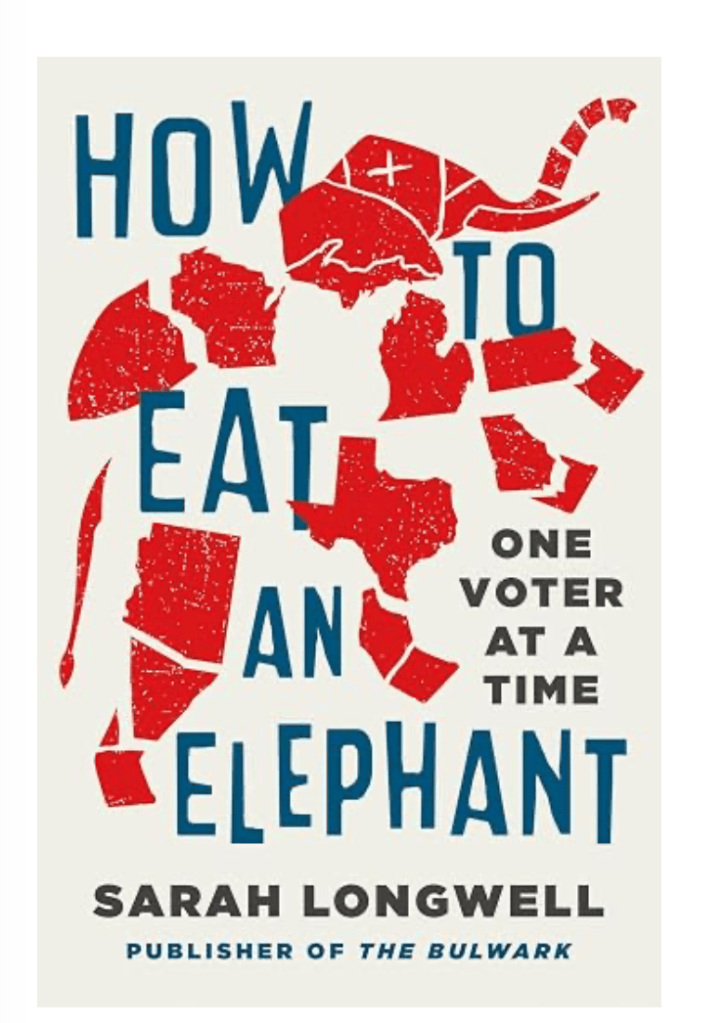
Sarah Longwell’s new book, How to Eat an Elephant, is now available.

With clear eyes, hard facts, critical thinking, new political strategy, empathy, and a soupçon of Schadenfreude
Strategic thinking, with emphasis on reshaping the coalition that makes up the Democratic Party
Sarah Longwell’s new book, How to Eat an Elephant, is now available.
Sarah Longwell and John Guida, ‘Trump Voters Are Finally Starting to Sour on Him’ (N.Y. Times, Aug. 28, 2026):
Ms. Longwell is the founder and publisher of The Bulwark and host of “The Focus Group” podcast. Mr. Guida is an editor in Times Opinion.
Even longtime political professionals are still muddling through the Trump era. They are trying to make sense of what voters want, how politicians communicate and how the parties are evolving.
A former Republican strategist now supporting Democrats, Sarah Longwell, the founder and publisher of The Bulwark and author of the forthcoming “How to Eat an Elephant: One Voter at a Time,” has organized focus groups of voters for years to grasp their thinking and inform her knowledge of American politics. That has shaped how she approaches political communication.
She explored the state of American politics in a written conversation with John Guida, an editor in Times Opinion. It has been edited for length and clarity.
John Guida: Among Democrats, the word we hear most often is “fighter.” As in, that’s what they want in their politicians. What does that mean exactly? What form does it or should it take?
Sarah Longwell: Democratic voters want their leaders to stop acting like peacetime diplomats, recognize the Republican Party for the threat it is and mount an effective counteroffensive. They are deeply frustrated by years of their politicians saying that Trump is an existential threat to democracy, but not acting like democracy is truly at stake.
If democracy is at stake, you don’t consider nominating an unpopular 81-year-old for president. It’s one reason the Democratic establishment has lost so much trust among voters.
Guida: Do you see a connection between that quality (“fight”) and the desire for a younger generation of leaders?
Longwell: Absolutely. I’ve said that voters’ concerns over age aren’t about just age — they’re a stand-in for much larger issues. They think the old guard won’t fight because it’s too sclerotic and stuck in the past. And to a large extent, they’re right about that.
This is paired with a feeling among Democrats that the older generation of leaders simply doesn’t have a grasp on the challenges facing young people today: Artificial intelligence-driven economic disruption, data center construction, the rewiring of our brains by social media.
Guida: You have described the need for Democrats to adapt “narrative dominance” as a political communications tool. What is that, and how do you build it?
Longwell: The right achieved narrative dominance by discrediting established, fact-based media and replacing it with an always-on communications infrastructure that exists to carry a unified MAGA message. Republicans don’t tune into right-wing influencers primarily to get their “take” on the day’s news; they rely on these people to find out what’s happening in the world in the first place. It’s a self-contained information bubble.
To better compete in the attention economy, Democrats are going to need to rethink how they do communications from top to bottom — with much less reliance on mainstream media to carry their message. They have to build new communications and media platforms. This is especially true of the center-left, which is getting lapped by far-left progressives who have been much more aggressive about building new media infrastructure.
Guida: How does this apply to candidates?
Longwell: They need much more aggressive communications strategies. “Everything Everywhere All at Once” is a movie I hated, but a communications strategy I endorse. Talk like a normal human being about issues that matter to a vast majority of voters, which are generally the issues tied to material well-being: jobs, health care, education, crime.
But this works only if you have high-level communicators going into these spaces. Charismatic leaders like Jon Ossoff, Zohran Mamdani, Alexandria Ocasio-Cortez, Josh Shapiro and Pete Buttigieg are the Democrats’ strongest messengers. Notice that this has less to do with these candidates’ individual politics — some are centrists, others are progressives — and more to do with their ability to be authentic.
Guida: What role does persuasion play in today’s politics? For instance, President Trump has been criticized for his lack of effort in this regard on the Iran war and now on the trade war with Canada.
Longwell: I reject the notion that Americans are so hopelessly polarized that they are incapable of shifting perspective on a given issue. Trump proved this in his first campaign and term as president. On a host of issues, Trump persuaded Republicans to abdicate everything they once claimed they believed. They abandoned free trade, America’s role as leader of the free world, our democratic allies, the notion that character matters in politics, any whiff of fiscal responsibility and succeeded in convincing a majority of Republicans that the 2020 election was stolen.
In his second campaign he persuaded people he could magically lower grocery prices and he wouldn’t get America into any foreign wars. But since he was elected in 2024, he appears rather freed from the obligations of persuasion and is instead using the coercive levers of government to achieve his aims, with little regard for public or congressional opinion.
Guida: What issue or preoccupation has surprised you most from people in your focus groups this year?
Longwell: There are two: data centers and Jeffrey Epstein. Voters, even those we would call “low-information,” are tapped into data center construction and, for the most part, forcefully oppose it in their communities. What I hear in focus groups tracks with Gallup polling that shows that 71 percent of Americans oppose new data center construction in their areas — and Republican and Democratic groups can sound remarkably similar.
Vicki, a Texas Republican, said that “they don’t care about the land” and she thinks “they’ll make their money and leave a big mess.” Adam, a Wisconsin Democrat, said data centers are “jacking my power, dirtying my water, dirtying my air, pissing in my soil, incredibly loud, unnecessarily jacking up the price of things.”
Epstein cuts across both Republican and Democratic groups as an issue voters are tracking closely. It gets brought up unprompted all the time, because it strikes at the core of voters’ mistrust of the “establishment” — it’s a story of powerful elites conspiring to cover up despicable behavior.
Guida: Certain issues — the Reflecting Pool or the destruction of the East Wing — have broken through in ways that others — the national debt, for instance — haven’t. How do you think about how certain political issues capture voters’ imaginations and others don’t?
Longwell: It’s not that voters specifically care about the East Wing demolition or the Reflecting Pool. It’s that they think Trump is focused on these projects at the expense of the issues that matter to them — like improving the economy — and that Trump promised he would take care of as president.
Guida: Many Democrats portray Trump as a unique threat to liberal democracy. You have expressed similar views. In your focus groups, have you heard voters express these types of concerns? And if not, how do you thread the needle of “fighter” politics, rising to what you see as such a grave threat, with the politics of the material concerns you mentioned earlier? Are they in conflict?
Longwell: They are absolutely not in conflict. In fact, the best way for Democrats to win elections and discredit the authoritarian right is to focus on the politics of material concerns and make a compelling case that their policies will improve American lives.
Democrats and independents and Republicans all want to vote for candidates who they think are going to make their lives materially better. Democrats who focus relentlessly on plans for how to give Americans better access to jobs, upward economic mobility, a better education, safer streets and products that don’t have to be kept behind glass at the drugstore will have a better chance to win elections.
Guida: You are a former Republican now trying to help Democrats beat Republicans. What differences between the two parties have surprised you the most?
Longwell: Republicans are from Mars and Democrats are from Venus. Here is the biggest difference at the operative level: Republicans as a class are mercenary and entrepreneurial, more focused on building than hand-wringing. Democrats are more geared toward fairness and inclusion and tend to be overcautious in their approach.
At the voter level, Republicans approach politics from an “I am” standpoint — I am a Christian, a law-and-order person, etc. Democrats come from an “I believe” standpoint.
This creates an asymmetry between the parties. For all the talk about Democrats being ruled by identity politics, it’s actually Republicans for whom politics is most tied to identity. Which is why Trump could upend the G.O.P.’s policy framework and voters didn’t really care. For Democrats it’s more tied to policies, and the relationship to voters can be more transactional. Which is why if a Democratic politician gets out of step with the base on a policy issue, their voters will punish them for it.
Guida: What’s your sense of enthusiasm among Republican voters this year?
Longwell: I think some Trump voters are finally starting to sour on him. We always ask voters in the groups to give a letter grade on Trump’s performance in office, and recently more Republicans have been giving C’s or D’s, instead of the usual A’s. That’s because, midway through his second term, he’s still not delivering on his core promises on the economy (lower prices) and foreign policy (no new wars).
Guida: Have you seen any signs or hints about the future of the G.O.P. in the developments of the midterms this year? The consensus seems to be that the party is not going back to a Reaganite disposition. Any sense of where it is going?
Longwell: Republican voters are incredibly clear about one thing: Despite Trump’s sagging poll numbers, the overwhelming majority of Republicans have no interest in going back to the Reagan-Bush-McCain-Romney party. They view leaders who are cut from this cloth as being part of the uniparty (even if they don’t use that word), and they supported Trump because he pitched himself as a wrecking ball who would blow it all up.
Here’s Rick, a North Carolina Republican, who speaks for many of the Republicans I’ve heard from throughout the Trump era when he talks about the party: “I think it’s changed for the better,” he said. “It’s not the old, same old, same old. Because frankly, I think between the two parties, you could put them in a sack, shake them up, and dump them out. You really couldn’t tell the difference in them.”
Guida: As a matter of political practice, what’s wrong with using the word “democracy”?
Longwell: First of all, most voters don’t think a ton about democracy qua democracy. To the extent they do, the term “democracy” itself has become polarized for voters. Democratic voters tell me Republicans are a threat to democracy, and Republicans claim the inverse.
Democrats should stop talking about democracy, which is an abstract term for voters, and instead simply talk about America — which is the place where American voters practice democracy. Voters know democracy by its fruits, not its roots. Free speech, free markets, pluralism, rule of law, free and fair elections — voters care about the particular things American democracy confers, but are not necessarily animated about the concept itself.
Guida: We are more or less at the end of the primary season and heading into the fall stretch ahead of midterm Election Day. You point to the “Bush line” as a marker. What is it, and why is it important?
Longwell: George Bush’s approval rating was in the low 30s at the time of the 2008 election, setting the stage for Barack Obama and the Democrats to win the biggest popular majority since Reagan, and sweep control of the White House and Congress.
If the Democrats can drive Trump’s approval down into the 20s and keep it there, it presents a real opportunity to not just brand Trump as a failed president, but to discredit Trumpism and the MAGA movement. Right now Trump’s approval is hovering around 38 percent. Democrats need to hammer him again and again for his policy failures and explain to voters his shameless corruption until Trump is below the Bush line.
Guida: Who are swing voters?
Longwell: I think of them as six distinct species of swing voters, each motivated by a different stew of emotions. These are gleaned from my years of listening to voters in focus groups, roughly half of which have been with swing voters like these, who ultimately decide our elections:
Guida: Trump has built a particular kind of Republican Party. Looking ahead, do you see anyone who could hold it together?
Longwell: Trump is going to keep the party and the public guessing for as long as possible about what he’ll do in 2028. It’s why he keeps raising the possibility of running for a third term. He’s doing this to freeze the field, and stop an heir apparent from emerging, because he can’t bear to not be at the center of our politics and our attention spans.
Of the current front-runners — JD Vance and Marco Rubio — I’ve written that Rubio is looked at by Republican voters as the more capable, serious candidate. Vance has also burned a lot of his “America First” credibility on the catastrophic war in Iran.
But I’m not convinced that either of these guys have the juice to hold together Trump’s coalition, or that voters won’t throw them overboard once they get a closer look at them. Remember Ron DeSantis 2024?
Guida: Now that the primaries are largely complete, how are you thinking about the electoral impact of progressive groups such as the Democratic Socialists of America?
Longwell: Democratic socialists need to demonstrate they can win in a competitive race versus a Republican. We haven’t seen them do this yet. While he isn’t a D.S.A. member, Abdul El-Sayed’s Senate race in Michigan will be a useful test case for the viability of this brand of politics. True, many of the party’s most gifted stars — like Zohran Mamdani and Alexandria Ocasio-Cortez — are democratic socialists, but they didn’t have to win over Republicans. The proposition is still largely untested.
On the whole, though, Democratic voters in my groups tend to reject the “more moderate versus more progressive” frame. They just want the party to be aggressive in fighting against Republicans.
Guida: We are about to enter the post-Labor Day sprint to the midterms. The outlook of many political observers at the moment is that Democrats will win a House majority. The Senate is up in the air. Do you agree with that consensus?
Longwell: I do agree. As unpopular as the Democratic Party is, there’s a real enthusiasm gap between the voters in both parties. Democrats are excited to put a check on Trump’s agenda. Republicans don’t share the same enthusiasm because they’re demoralized by Trump’s failures and high prices.
Taking the Senate requires some big upsets. Not only do Democrats have to hold Michigan and Georgia (Georgia is much easier than Michigan because of candidate quality), but they have to win three states Trump won — Ohio, Alaska and North Carolina — as well as Maine, where Susan Collins has a record of beating the odds. This is doable but by no means assured. Still, I’m cautiously optimistic that Democrats can flip it.

I would, of course, have taken a pass on the op-ed, except that it was written by Thomas Edsall, who is nobody’s fool.
The first part of Mr. Edsall’s article, in today’s New York Times, reads as follows:
Even now, according to a new survey by the left-leaning group Data for Progress, the Democratic Party has a net negative rating of minus 29 percentage points among swing voters, worse than the minus 25 for the Republican Party. Democrats seeking to restore their party’s credibility with the electorate as a whole, but especially among those crucial swing voters, might consider adding three planks — on immigration, urban disorder and transgender issues — to the 2028 Democratic platform.
Why? Because it is these three issues that serve to reinforce the perception that Democrats are willing to sacrifice the interests of the working and middle classes in favor of special interest constituencies.
I am more than a little queasy making these suggestions, but I think the Democratic Party needs to perform a kind of brutal surgery on itself.
The hard-edge character and language of what I am proposing is specifically designed to function as a public renunciation of the Democratic Party’s liabilities, its ties to special interest groups and its readiness to succumb to progressive orthodoxy.
The proposals amount, then, to an ideological exorcism.
On immigration, I would suggest — with plenty of room for amendment — the following:
Democrats will firmly enforce laws on illegal immigration, including tough border enforcement and deportation of unauthorized immigrants who commit crimes.
Unauthorized immigrants with no criminal record who have been in this country for at least five years, along with Dreamers, should be offered green cards with a path toward citizenship. More recent arrivals should be deported.
On crime:
The Democratic Party supports aggressive prosecution of those accused of violent crime, those who engage in crowdsourced “teen takeovers” of stores, as well as all forms of child abuse.
The party backs restoration of bail requirements in the case of felonies, lifetime sentences for offenders convicted of multiple violent crimes, tough enforcement of child support laws and the death penalty if supported by the voters in a state and endorsed by a jury.
Transgender and gender dysphoria:
There are two sexes: men and women.
A man can claim an identify as a woman, and the same in reverse for a woman. They have every right to do so. Their claim should be respected and they should be protected from any form of discrimination for their choice.
Their claim does not, however, alter their biological sex.
Consequently, it is legitimate in areas such as sports where a transgender person would have a competitive advantage over non-trans people to bar such participation. Similarly, a claim to a sexual identity does not give a trans woman the right to incarceration in a woman’s prison.
Finally, the debate over gender affirming surgery and hormone treatments is fraught with contradictory assertions. For now, because there are credible scientific claims of irreversible harms, such treatments for those under 18 should be barred pending further study.
There are some other planks I would add, including a strong commitment to free speech and an adamant rejection of all forms of cancel culture; an endorsement of equality of opportunity based on merit; the repudiation of socialism in favor of a free and open market accompanied by government regulation to prevent exploitation, monopolization and unfair trade practices. …
In exploring these issues with Democratic strategists, I was surprised to find significant support — with differences over language — from a variety of sources, albeit accompanied by a harsh rejection from a communications specialist for a firm headed by a major Democratic campaign strategist. …
In my opinion, this story from today’s Wall Street Journal is significant for three reasons:
No, ladies and germs, you can’t message your way out of the fact that the top 1% hold 32% of all household wealth, while low and middle income families fall further and further behind.
No, messaging your way out of this will not cut the mustard.
Instead, you need to begin by remembering that pigs get fed while hogs get slaughtered.
In any event, the WSJ writes,
Wall Street Realizes It Needs More Than Money to Counter Mamdani: After big primary wins by the mayor’s progressive allies, New York’s business elites are rewriting their political strategy
New York City became Mamdani’s town on Tuesday night, after his preferred slate of far-left candidates for congressional House seats beat incumbents backed by the business community and political institutions. The Democratic Socialists of America picked up even more victories for local races, signaling that an anticapitalist and anti-Israel message was winning over voters in much of the city.
“It’s actually a very, very scary outcome, and I think it serves as an awakening for people,” said Steven Fulop, chief executive of the Partnership for New York City, a business group that advocates for companies such as Pfizer and JPMorgan Chase.
In an election where money was a central issue—namely, who has it and who is spending it—the wealthy business elites are now confronted with a city whose voters doubled down on the Democrats’ hard-left flank.
In calls among donors and political strategists, the postmortem analysis was stark: Money alone can’t save candidates with a weak ground game and a muddled message. Where to go next, though, is unclear.
One longtime strategist has floated a kind of political-giving organization that functions like the Robin Hood Foundation—the poverty-focused nonprofit whose board is stacked with finance luminaries—and gathers money to support moderate causes and candidates. Others described a desire to fund the otherwise unglamorous work of get-out-the-vote campaigns and candidate development. The name of at least one CEO was raised as a future challenger, as if just mentioning him could will a mayoral campaign into existence.
Whether any of it will make a difference remains to be seen.
The shift in power was palpable Thursday afternoon. The mayor gave a speech at a fundraiser in Midtown Manhattan for the Police Athletic League, which is chaired by John Catsimatidis, the billionaire businessman whose New York City radio station 77 WABC has become an outpost for antisocialist sentiment.
After Mamdani’s talk, Catsimatidis took to the lectern to address the rankled crowd.
“The mayor is an important component of New York City right now,” Catsimatidis said, “and he’s become a very popular person.”
For over a decade until 2013, there was practically a mind meld between New York City government and the finance industry under the reign of billionaire Michael Bloomberg, who even rearranged government offices to more closely resemble trading floors.
Now, those on Wall Street and in the business community worry they are seeing the twilight of their influence.
It doesn’t help them that the mayor has been everywhere during a buoyant June. Mamdani attended a World Cup match in New Jersey and followed the New YorkKnicks as the team won its first National Basketball Association championship in 53 years, boosting his popularity among younger, more educated voters.
But those voters have struggled to make ends meet. Support for Israel, which remains strong in the finance industry, has proved either toxic or irrelevant to voters outside rarefied circles.
Rep. Dan Goldman, who holds a House seat in a district that includes lower Manhattan and parts of Brooklyn, was defeated by Mamdani ally Brad Lander, who criticized Goldman’s acceptance of donations through a website run by the American Israel Public Affairs Committee.
“The DSA’s message was pretty simple: Aipac is bad, Israel is committing genocide and we need to throw the bums out,” said Chris Coffey, CEO of Tusk Strategies, who has advised more-moderate Democrats. “The establishment’s message was harder to galvanize around.”
Establishment Democrats and their financial backers have, in effect, become the target. Darializa Avila Chevalier, one of Mamdani’s picks, drew criticism for speaking harshly of former Vice President Kamala Harris—whose presidential campaign maintained close ties to Wall Street and Big Law.
Donors and strategists say the party’s moderate wing is struggling to articulate a message that isn’t just “we’re not Trump.” They add that Democrats’ lack of a ground game allowed the DSA, with its promises to freeze the rent and expand city-run child care, to outflank traditional candidates.
Optimists say it wasn’t a total loss. Micah Lasher, an establishment Democrat who most recently worked for Gov. Kathy Hochul, beat more liberal candidates, including a Kennedy scion, to represent the Upper East and Upper West Sides of Manhattan.
Sen. Chuck Schumer and Rep. Hakeem Jeffries both occupy party leadership positions and still enjoy broad support from wealthy moderate Democrats. Operatives see several potential challengers to the mayor, including Jessica Tisch, the police commissioner; Julie Menin, the City Council speaker; and U.S. Rep. Ritchie Torres, who represents New York’s 15th Congressional District in the Bronx.
Fulop said establishment Democrats should pivot to an optimistic message that emphasizes more jobs and better opportunities.
Some institutions have already tried. Earlier this year, Citigroup pledged $60 billion in financing for more affordable housing over five years.
“While a socialist agenda expanding its reach in the capital of capital may be a bit ironic, it’s another example of how front and center the issue of affordability is,” said Edward Skyler, a former deputy mayor under Bloomberg, who is now an executive at Citigroup. “But there are opportunities for the public and private sectors to work together as banks do when they finance affordable housing in New York and throughout the country.”
Appropriately, this post ends with future Senator Murphy doing one of classic song and dance routines.
Four points:
One. I think he sounds a lot better in person or on video than when I just read his words on paper.
Two. I don’t know all the things he’s accused of doing or saying. I don’t know which of those things he actually did or said. He has expressed remorse; I don’t know how much of his remorse is real or feigned. He has also claimed that at least some of his youthful bad behavior was caused by PTSD arising from military action in Iraq and Afghanistan, but I don’t know how much of that is true.
I do know that when I was young I was a very great expert on which bad behavior could have been controlled and was therefore blameworthy, and which bad behavior grew out of an irresistible urge and was therefore excusable. I also know that, as I approach my 80th birthday, I have lost that expertise.
Three. Republicans apparently plan to make it a big damn deal that he has allegedly acted badly toward women.
That is rich.
Four. This November, Maine voters will decide between two people who should be disqualified for the office of senator. One should be disqualified for letting Roe v. Wade get overturned, for supporting Trump, and for bringing immiseration to Maine voters. The other is Graham Platner, who has the wrong tattoo.

Bottom line, at the end of five minutes of trenchant analysis: “Tariffs as an instrument of arbitrary power have been dismantled.”
Feel free to visit Krugman’ substack—it’s behind a paywall—if you so choose.
Meanwhile, in a world of great uncertainty, a couple of things are certain: Trump will continue to try to abuse whatever tariff power he may have, there will be lots and lots of litigation, and some of those cases will reach the Supreme Court in the coming months.
Among progressives, opinions differ—as do kneejerk reactions—about the likelihood of any degree of success by Team Trump. International trade law is not my field, and I have no crystal ball. But I do like this analysis by someone whose handle is EricAZ (not otherwise known by me from Adam’s housecat), who posted this yesterday on Daily Kos:
Trump’s Decision to Beat a Dead Horse on Tariffs Will Hasten His Fall
A smart person would take his lumps and move on. Trump is not a smart person. Let’s assume that the “best people” that Trump brought to his Cabinet and the White House picked the statute most favorable to his tariff plans. One of the most conservative Supreme Courts since the Civil War beat him with a stick.
Now, Trump is preparing to work his way through other statutes looking for support for his tariff plans. (Keep in mind that the U.S. Constitution says tariffs are under the control of Congress. And the Supreme Court just upheld that fact.)
Having been told, “Don’t let the screen door hit you,” Trump wants to try his luck again. Never mind that the public does not like tariffs, does not like paying higher taxes, does not like a loser and has dropped its esteem for Trump to a level somewhere between Nixon and a road-Kill skunk.
But here the valiant Donald prepares to make his stand.
Here is the list of statutes the president can use to regulate trade:
Section 232 of the Trade Expansion Act of 1962: Allows the president to impose tariffs if imports threaten national security. Pam Bondi can argue that avacados and plastic toys threaten national security. Even with Pete Hegseth guarding the coast, we probably can withstand avacado imports.
Section 201 of the Trade Act of 1974: Enables the president to impose tariffs if an import surge threatens a U.S. domestic industry. Pretty narrow in focus. Imaginary ballrooms are not an important domestic industry.
Section 122 of the Trade Act of 1974: Allows the president to impose tariffs to address international payments problems, with no cap on the level of duties or duration. Despite Trump’s best efforts, we still don’t have an international payments problem.
Section 301 of the Trade Act of 1974: Allows the president to investigate unfair trade practices and impose tariffs, with no limits on the size of the tariffs. Having tried to impose tariffs on the entire world, including uninhabited islands, it will be hard to make a case that the entire world is engaged in unfair trade practices. Especially when Trump claims to have made trade agreements with most of the world.
International Emergency Economic Powers Act (IEEPA): Provides the president with broad authority to impose tariffs in response to economic emergencies. Been there, done that. The court said no.
Many people expect Trump to use one or more of these statutes to repeat the long process he has gone through with his failed IEEPA effort.
One thing the justices really hate, is doing work. Especially repeating work that they or some other judge has already done.
Most likely, any new version of Trump tariffs would be thrown out at the District Court level very quickly. The court would likely leave an injunction against the new tariffs in place until the case works its way to the Supreme Court. At this level, there are no do-overs. The High Court would decline to hear the case and the injunction would stand.
All this happens against a background of Trump’s declining numbers and people’s distaste for high prices and unnecessary tariff taxes at the grocery store. Political parties sometimes survive immense blunders and sometimes they don’t.
Here’s Rachel from last night:
I applaud her analysis and agree with much of it, though I think the optimism is premature. Let’s see what happens today. Let’s see what happens in the coming days on the streets of Minneapolis. Let’s see what happens in Congress with funding for the Department of Homeland Security.
As Rachel emphasizes, Democratic pushback will be responsible for whatever good comes out of this disaster. That said, be it remembered that the Stephen Miller/Kristi Noem/Kash Patel/Greg Bongino team’s clusterfuck represents a signal achievement on their part—and a big reason why things are looking up today.
The progressives are riled up.
Lots of ordinary people are riled up.
Not only that: big business is riled up.
With big business riled up, the Republican empty suit politicians are beginning to speak up.
Even the Second Amendment wingnuts are fit to be tied, because of the suggestion that folks lawfully carrying a firearm deserve to be mowed down with impunity.
Thank you, Miller, Noem, Patel, Bongino. Thank you. Thank you. Thank you.
One of the early morning talking heads pointed out that, with Homan in Minneapolis allegedly reporting directly to Trump—thus, allegedly, bypassing and cutting the Miller/Noem gang—“Trump will personally own whatever happens next in Minneapolis.”
That sounds right. And I would add this: to get out of this mess with some dignity, Trump would need to be a Washington or a Lincoln or a Roosevelt.
Trump is not a Washington or a Lincoln or a Roosevelt. Instead, Trump is best compared to Jubilation T. Cornpone.
Dr. Richardson is a prominent historian and professor at Boston College.
I think the whole video is worth watching, even if you are generally aware of what’s going on in this country. Some of the relevant points:
First Minute: HCR puts some of Trump’s outrageousness in historical context, in light of a Republican intellectual triumphalism—“We’re right and, guess what, you’re wrong!” We saw a lot of that beginning with Reagan’s election. I remember it well.
Third Minute: She doesn’t use the phrase, but others rightly call it “herrenvolk democracy”: any Democratic victory is inherently illegitimate.
Sixth Minute: A concerted effort to destroy rules-based order.
Eighth Minute: He thinks only people like himself should be in power.
Ninth Minute: He’s no compos mentis. It appears they’re giving him psychiatric drugs. It’s a behind-the-scenes effort to control him.
Eleventh Minute: No, J.D. Vance would not be worse.
Twelfth Minute: It’s extremely difficult to tell what’s happening in this Administration.
Fourteenth Minute: What appears to have just happened in Venezuela.
End of Seventeenth Minute: A work of genius by the Venezuelan regime and its allies.
As historians know, invasion of your country greatly helps to unify your people.
Nineteenth Minute: Trump’s oil fantasy.
Twenty-first Minute: Shrinkage from a global power to a regional power. Jettisoning the benefits of the rules-based international order.
Twenty-third Minute: Greenland.
Twenty-fourth Minute: A fundamental misunderstanding of the nature of American power.
Twenty-sixth Minute: Russia gets Ukraine, we get Venezuela. Sort of like the eve of World War I, but this time with nuclear weapons.
Twenty-seventh Minute: Oil is the technology of the past. The future lies in semi-conductors. We’re giving Xi permission to take over Taiwan—which makes 60% of the world’s semi-conductors. And Trump doesn’t understand this.
Twenty-eighth Minute: Destruction of the rules-based international order. A demented president, no longer operating in reality. Magical thinking is a hallmark of this moment.
Twenty-ninth Minute: Don’t follow grandpa down this road. Time to speak up.
/
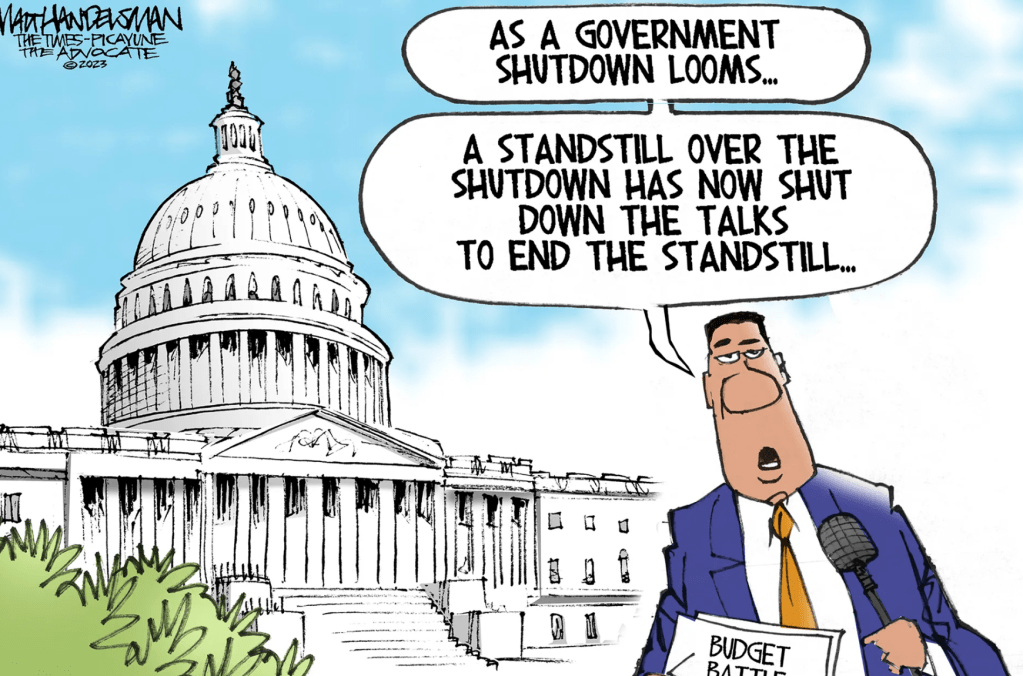
Ezra Klein (N.Y. Times), What Were Democrats Thinking?
As far as I can tell, the headline is intended to be read in a straightforward way—“WHAT were Democrats thinking?”—not in a sarcastic tone of voice—“What were Democrats THINKING?”
In any event, as per usual, Ezra Klein has a dozen or so really interesting things to say—some of which might not have occurred to you and me—and it’s best to let him speak for himself.
But as a preamble, two brief comments from me. First, some of the eight senators who joined the Republicans are political heavyweights, and people not known for an inclination to wimp out. So, before your knee jerks and you hurl criticism at them for wimping out, please think twice.
Second, among the really interesting things one might say about this putrid mess, the most interesting, IMHO, is that Republicans are now set up to cast spectacularly unpopular votes to screw a large portion of the public on the health insurance costs.
Ezra Klein writes,
Back in September, when I was reporting an article on whether Democrats should shut down the government, I kept hearing the same warning from veterans of past shutdown fights: The president controls the bully pulpit. He controls, to some degree, which parts of the government stay open and which parts close. It is very, very hard for the opposition party to win a shutdown.
Which makes it all the more remarkable that Democrats were winning this one. Polls showed that most voters blamed Republicans, not Democrats, for the current shutdown — perhaps because President Trump was bulldozing the East Wing of the White House rather than negotiating to reopen the government. Trump’s approval rating has been falling — in CNN’s tracking poll, it dipped into the 30s for the first time since he took office again. And last week, Democrats wrecked Republicans in the elections and Trump blamed his party’s losses in part on the shutdown. Democrats were riding higher than they have been in months.
Then, over the weekend, a group of Senate Democrats broke ranks and negotiated a deal to end the shutdown in return for — if we’re being honest — very little.
The guts of the deal are this: Food assistance — both SNAP and WIC, I was told — will get a bit more funding, and there are a few other modest concessions on spending levels elsewhere in the government. Laid-off federal workers will be rehired and furloughed federal workers given back pay. Most of the government is funded only until the end of January. (So get ready: We could be doing this again in a few months.) Most gallingly, the deal does nothing to extend the expiring Affordable Care Act tax credits over which Democrats ostensibly shut down the government in the first place. All it offers is a promise from Republicans to hold a vote on the tax credits in the future. Of the dozen or so House and Senate Democrats I spoke to over the past 24 hours, every one expected that vote to fail.
To understand why the shutdown ended with such a whimper, you need to understand the strange role the A.C.A. subsidies played in it. Democrats said the shutdown was about the subsidies, but for most of them, it wasn’t. It was about Trump’s authoritarianism. It was about showing their base — and themselves — that they could fight back. It was about treating an abnormal political moment abnormally.
T he A.C.A. subsidies emerged as the shutdown demand because they could keep the caucus sufficiently united. They put Democrats on the right side of public opinion — even self-identified MAGA voters wanted the subsidies extended — and held the quivering Senate coalition together. You shut the government down with the Democratic caucus you have, not with the Democratic caucus you want.
The shutdown was built on a cracked foundation. There were Senate Democrats who didn’t want a shutdown at all. There were Senate Democrats who did want a shutdown but thought it strange to make their demand so narrow: Was winning on health care premiums really winning the right fight? Should Democrats really vote to fund a government turning toward authoritarianism so long as health insurance subsidies were preserved?
And what if winning on the health care fight was actually a political gift to Donald Trump? Absent a fix, the average health insurance premium for 20 million Americans will more than double. The premium shock will hit red states particularly hard. Tony Fabrizio, Trump’s longtime pollster, had released a survey of competitive House districts showing that letting the tax credits expire might be lethal to Republican efforts to hold the House. Why were Democrats fighting so hard to neutralize their best issue in 2026?
The political logic of the shutdown fight was inverted: If Democrats got the tax credits extended — if they “won” — they would be solving a huge electoral problem for Republicans. If Republicans successfully allowed the tax credits to expire — if they “won” — they would be handing Democrats a cudgel with which to beat them in the elections.
This is why Senator Chuck Schumer’s compromise, which offered to reopen the government if Republicans extended the tax credits for a year, struck many Democrats as misguided. Morally, it might be worth sacrificing an electoral edge to lower health insurance premiums. But a one-year extension solved the Republicans’ electoral problem without solving the policy problem. Why on earth would they do that?
In any case, Republicans were not interested in Schumer’s offer. Trump himself has shown no interest in a deal. Rather than negotiating over health care spending, Trump has been ratcheting up the pain the shutdown is causing. Hundreds of thousands of federal workers have been furloughed or fired. The administration has been withholding food assistance from Americans who desperately need it. Airports are tipping into chaos as air traffic controllers go without pay.
More than anything else, this is what led some Senate Democrats to cut a deal: Trump’s willingness to hurt people exceeds their willingness to see people get hurt. I want to give them their due on this: They are hearing from their constituents and seeing the mounting problems and they are trying to do what they see as the responsible, moral thing. They do not believe that holding out will lead to Trump restoring the subsidies. They fear that their Republican colleagues would, under mounting pressure, do as Trump had demanded and abolish the filibuster. (Whether that would be a good or a bad thing is a subject for another column.) This, in the end, is the calculation the defecting Senate Democrats are making: They don’t think a longer shutdown will cause Trump to cave. They just think it will cause more damage.
If I were in the Senate, I wouldn’t vote for this compromise. Shutdowns are an opportunity to make an argument, and the country was just starting to pay attention. If Trump wanted to cancel flights over Thanksgiving rather than keep health care costs down, I don’t see why Democrats should save him from making his priorities so exquisitely clear. And I worry that Democrats have just taught Trump that they will fold under pressure. That’s the kind of lesson he remembers.
But it’s worth keeping this is perspective: The shutdown was a skirmish, not the real battle. Both sides were fighting for position, and Democrats, if you look at the polls, are ending up in a better one than they were when they started. They elevated their best issue — health care — and set the stage for voters to connect higher premiums with Republican rule. It’s not a win, but given how badly shutdowns often go for the opposition party, it’s better than a loss.

