Waving the White Flag

Let me begin by apologizing to those who could not view the preceding post because they are not premium members of The Bulwark. I am almost 80, and this was my first mistake. At least I didn’t start a stupid, unwinnable war.

And BTW, you might want to consider paying some bucks to support The Bulwark. I find it to be money well spent. 

Meanwhile, the Wall Street Journal Editorial Board continues to tell it like it is:

Iran Is Winning the Battle of Hormuz: Tehran is using force to gain control over traffic through the Strait

Iran then hit a tanker carrying Qatari crude. The U.S. retaliated again against Iranian military sites and has escorted oil tankers with heavy air cover. Iran then fired drones and missiles at civilian targets and U.S. bases in Bahrain and Kuwait.

“It is very possible that they will never learn,” Mr. Trump wrote of Iran’s regime on Saturday night. Or is it U.S. decision makers who never learn? Vice President JD Vance has been touting Iran’s “transformed” Islamic Revolutionary Guard Corps leaders ready to “turn over a new leaf” with the U.S. He even reached “gentlemen’s agreements” with them outside the memorandum, Mr. Vance assured critics.

Well, these are no gentlemen. It’s the same terrorist regime, and this is the Battle of Hormuz that Mr. Trump thought he had ducked. In case there was any doubt, foreign minister Abbas Araghchi said Sunday that Iran is solely responsible for managing the Strait under the memorandum. He said “no other country has any responsibility in that regard.” Mr. Araghchi is Iran’s chief negotiator with Mr. Vance. 

It wasn’t enough that Mr. Trump gave Iran an oil sanctions waiver without safeguards, promised billions of dollars in frozen assets and stopped sanctions enforcement. The regime wants to conquer the Strait and turn it into a toll booth, with transit by permission only. On a ship-by-ship basis, Iranian foreign policy would determine who crosses. This is the opposite of free navigation and provides no security for energy flows.

Force is the regime’s means to make the world bend. Without it, shippers refused to heed Iran’s dictates for Hormuz during the deal’s early days. Vessels sailed out via the Strait’s southern, Omani lane. Tehran’s demands that ships transit only through the Iranian lane, request access two days in advance, and sign up for special Iranian “insurance” were ignored. Oil prices fell far faster than most experts expected.

In short, the Strait wasn’t going Iran’s way. It was becoming free again—hence the regime’s resort to force. Iran is intimidating Oman and other Gulf states. It may also offer them a cut of the spoils from a tolled Strait, but that hardly sweetens the foul deal for the rest of the world.

The question is why Iran still gets the cash, selling its oil free of sanctions and repatriating the revenue to fund its Revolutionary Guard. If Mr. Trump isn’t ready to resume the U.S. blockade, he can amend Treasury’s sanctions-relief license to require that all proceeds from Iranian oil sales be placed in escrow. 

The U.S. needs the leverage for nuclear negotiations, and it was never wise to give Iran a blank check. All the more so now that the regime isn’t respecting the deal, which mandates a cease-fire as well as Iran’s “best efforts for the safe passage of commercial vessels.” That means don’t shoot at them, for starters.

More U.S. “love taps” against Iranian targets won’t impress the hard men in Tehran. They behave as if they have escalation dominance because they think Mr. Trump won’t return to war before the midterm elections. They don’t believe Mr. Trump’s social-media bluster because they see his reluctance to enforce the cease-fire terms. 

In the bigger strategic picture, the regime is leaving the President a choice: surrender Hormuz to Iranian terror or fight for it, like he always should have once he started the war, and reopen the Strait by force.
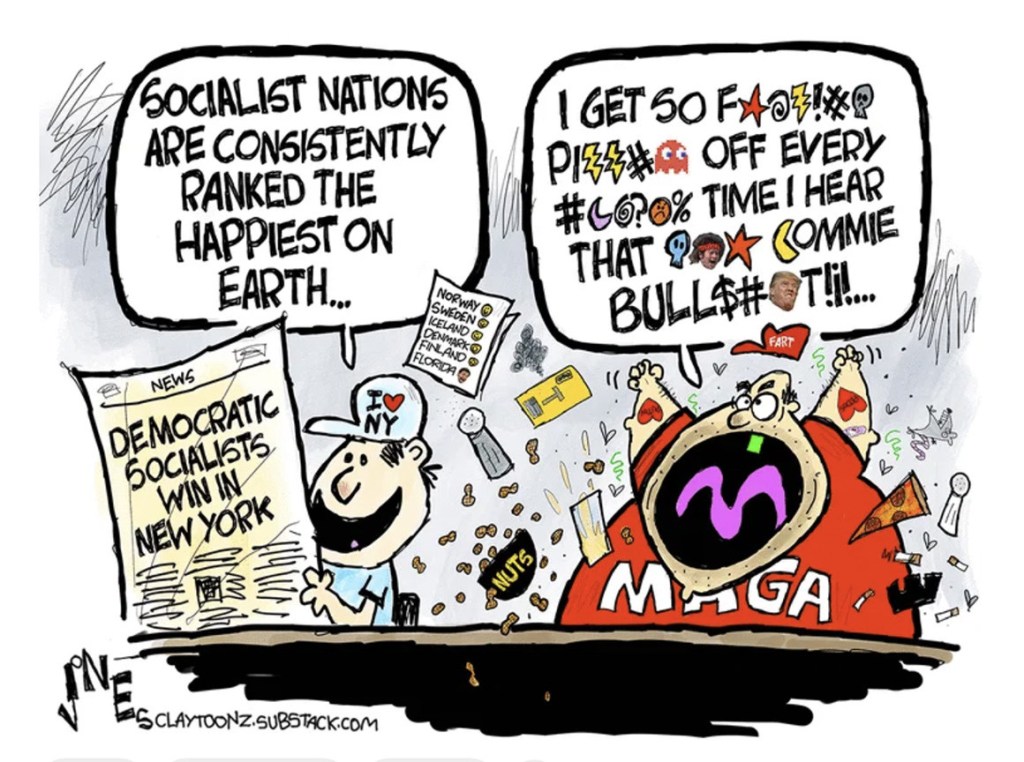
The Plutocrats Have Discovered That Their Old Song and Dance Isn’t Working

In my opinion, this story from today’s Wall Street Journal is significant for three reasons:

  1. Because it’s from the Wall Street Journal—not, say, from The New Republic;
  2. Because of what it says: essentially, that recent election outcomes, especially in New York, show that the old plutocratic political playbook is not working anymore; and 
  3. Because of what it does not say, namely, that the plutocrats who think this is only a “messaging problem” are whistling past the graveyard. 

No, ladies and germs, you can’t message your way out of the fact that the top 1% hold 32% of all household wealth, while low and middle income families fall further and further behind. 

No,  messaging your way out of this will not cut the mustard.

Instead, you need to begin by remembering that pigs get fed while hogs get slaughtered. 

In any event, the WSJ writes,

Wall Street Realizes It Needs More Than Money to Counter Mamdani: After big primary wins by the mayor’s progressive allies, New York’s business elites are rewriting their political strategy

New York City became Mamdani’s town on Tuesday night, after his preferred slate of far-left candidates for congressional House seats beat incumbents backed by the business community and political institutions. The Democratic Socialists of America picked up even more victories for local races, signaling that an anticapitalist and anti-Israel message was winning over voters in much of the city. 

“It’s actually a very, very scary outcome, and I think it serves as an awakening for people,” said Steven Fulop, chief executive of the Partnership for New York City, a business group that advocates for companies such as Pfizer and JPMorgan Chase. 

In an election where money was a central issue—namely, who has it and who is spending it—the wealthy business elites are now confronted with a city whose voters doubled down on the Democrats’ hard-left flank. 

In calls among donors and political strategists, the postmortem analysis was stark: Money alone can’t save candidates with a weak ground game and a muddled message. Where to go next, though, is unclear. 

One longtime strategist has floated a kind of political-giving organization that functions like the Robin Hood Foundation—the poverty-focused nonprofit whose board is stacked with finance luminaries—and gathers money to support moderate causes and candidates. Others described a desire to fund the otherwise unglamorous work of get-out-the-vote campaigns and candidate development. The name of at least one CEO was raised as a future challenger, as if just mentioning him could will a mayoral campaign into existence. 

Whether any of it will make a difference remains to be seen. 

The shift in power was palpable Thursday afternoon. The mayor gave a speech at a fundraiser in Midtown Manhattan for the Police Athletic League, which is chaired by John Catsimatidis, the billionaire businessman whose New York City radio station 77 WABC has become an outpost for antisocialist sentiment. 

After Mamdani’s talk, Catsimatidis took to the lectern to address the rankled crowd. 

“The mayor is an important component of New York City right now,” Catsimatidis said, “and he’s become a very popular person.” 

For over a decade until 2013, there was practically a mind meld between New York City government and the finance industry under the reign of billionaire Michael Bloomberg, who even rearranged government offices to more closely resemble trading floors.

Now, those on Wall Street and in the business community worry they are seeing the twilight of their influence. 

It doesn’t help them that the mayor has been everywhere during a buoyant June. Mamdani attended a World Cup match in New Jersey and followed the New YorkKnicks as the team won its first National Basketball Association championship in 53 years, boosting his popularity among younger, more educated voters. 

But those voters have struggled to make ends meet. Support for Israel, which remains strong in the finance industry, has proved either toxic or irrelevant to voters outside rarefied circles.

Rep. Dan Goldman, who holds a House seat in a district that includes lower Manhattan and parts of Brooklyn, was defeated by Mamdani ally Brad Lander, who criticized Goldman’s acceptance of donations through a website run by the American Israel Public Affairs Committee. 

“The DSA’s message was pretty simple: Aipac is bad, Israel is committing genocide and we need to throw the bums out,” said Chris Coffey, CEO of Tusk Strategies, who has advised more-moderate Democrats. “The establishment’s message was harder to galvanize around.”

Establishment Democrats and their financial backers have, in effect, become the target. Darializa Avila Chevalier, one of Mamdani’s picks, drew criticism for speaking harshly of former Vice President Kamala Harris—whose presidential campaign maintained close ties to Wall Street and Big Law.

Donors and strategists say the party’s moderate wing is struggling to articulate a message that isn’t just “we’re not Trump.” They add that Democrats’ lack of a ground game allowed the DSA, with its promises to freeze the rent and expand city-run child care, to outflank traditional candidates. 

Optimists say it wasn’t a total loss. Micah Lasher, an establishment Democrat who most recently worked for Gov. Kathy Hochul, beat more liberal candidates, including a Kennedy scion, to represent the Upper East and Upper West Sides of Manhattan. 

Sen. Chuck Schumer and Rep. Hakeem Jeffries both occupy party leadership positions and still enjoy broad support from wealthy moderate Democrats. Operatives see several potential challengers to the mayor, including Jessica Tisch, the police commissioner; Julie Menin, the City Council speaker; and U.S. Rep. Ritchie Torres, who represents New York’s 15th Congressional District in the Bronx.

Fulop said establishment Democrats should pivot to an optimistic message that emphasizes more jobs and better opportunities. 

Some institutions have already tried. Earlier this year, Citigroup pledged $60 billion in financing for more affordable housing over five years. 

“While a socialist agenda expanding its reach in the capital of capital may be a bit ironic, it’s another example of how front and center the issue of affordability is,” said Edward Skyler, a former deputy mayor under Bloomberg, who is now an executive at Citigroup. “But there are opportunities for the public and private sectors to work together as banks do when they finance affordable housing in New York and throughout the country.”

Appropriately, this post ends with future Senator Murphy doing one of classic song and dance routines.

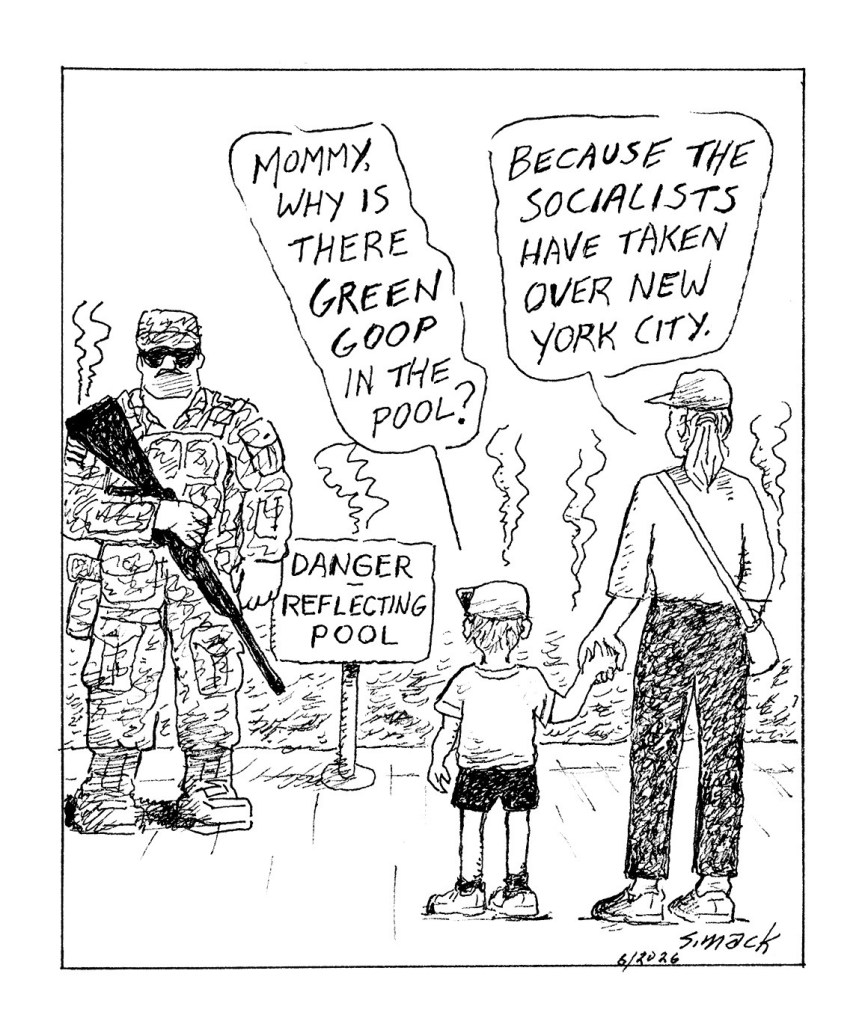
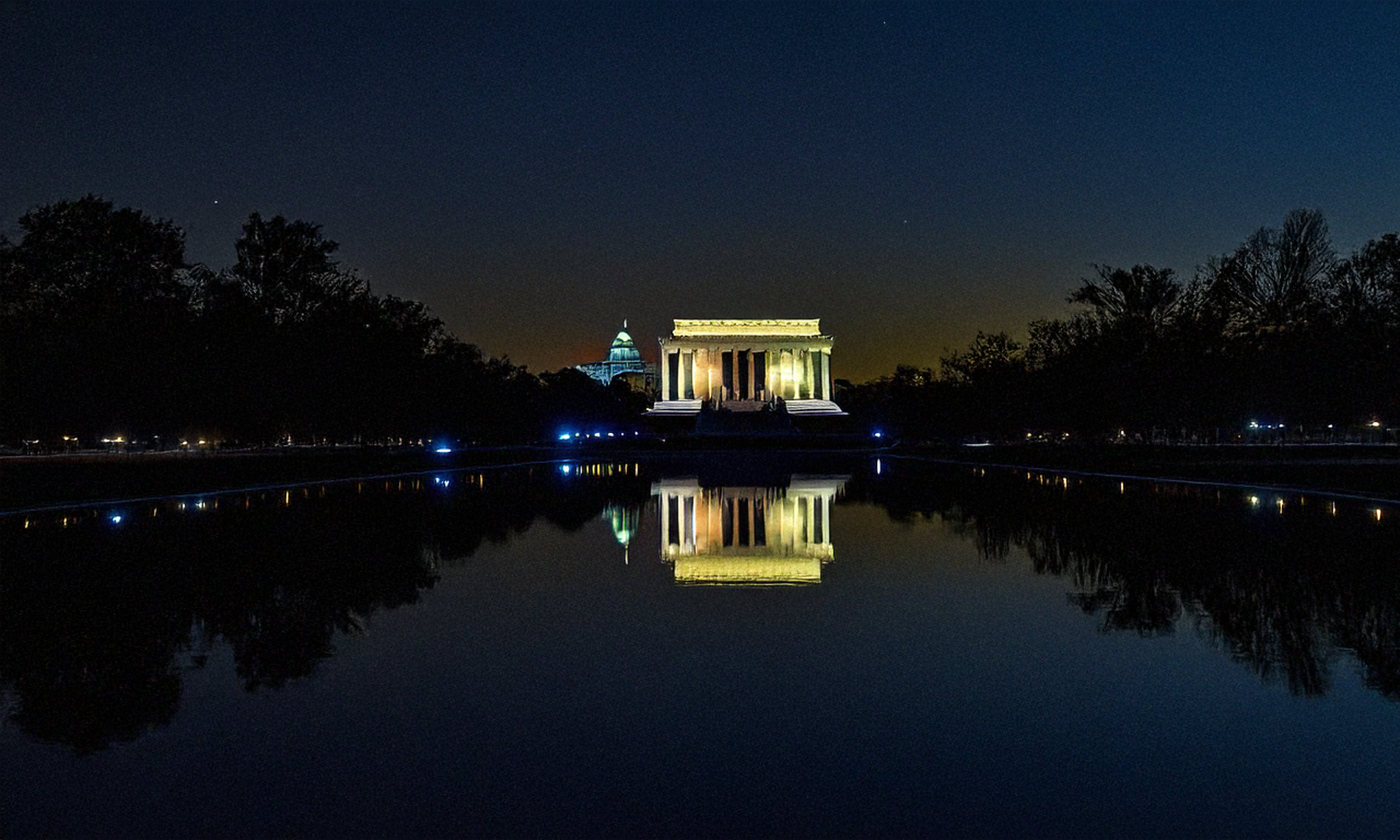
Iran Closes the Strait Again. The New Blue Paint is Peeling Off the Reflecting Pool. Trump Says Vandals are Responsible. The Vandals are Probably the Same Illegal Aliens That Vote Illegally in Our Elections.

Today’s Statement by the Iranian Joint Military Command

“In light of the United States’ clear breach of its commitments regarding the first article of the memorandum of understanding to end the war, and the Zionist regime’s continuous violations of the ceasefire in southern Lebanon, the command hereby that the Strait of Hormuz will be closed to all vessel passage.”

Today’s Statement by Malignant Narcissist Spreading Delusions About the Reflecting Pool