The Business Roundtable has about 200 members—all chief executive officers of the largest corporations in America. Trump will be meeting with them later today.
Some politicians want to distribute income upward—in other words, screwing the poor to make the rich richer.
Some politicians want to be Robin Hood—robbing the rich to help the poor.
Trump wants to screw the poor, screw the middle, and screw the rich, all at the same time.
Today, Trump said that his tariffs could lead to inflation—and maybe a recession.
He’s screwing his rich supporters, with trade wars, demolished supply chains, worthless investments due to demolished supply chains, dysfunctional government services, tanked stock portfolios, and really rotten consumer sentiment.
He’s screwing his poor idiot supporters with high inflation. Mamma’s gonna have problems getting her Social Security money. Grandma’s gonna lose her Medicaid, that pays for her nursing home. And veterans can kiss their health care goodbye.
Jesus is definitely not happy about all of this.
It’s just about time for God to anoint J.D. Vance as our next President.
Probably to ascend to the kingship sometime around mid-April.
One of the nation’s leading experts on the subject of negotiations is David Honig of Indiana University. He teaches both Fortune 500 company executives and heads of state on how to negotiate. Here’s his take on what he’s observed about Donald Trump’s style at the bargaining table…
“I’m going to get a little wonky and write about Donald Trump and negotiations. For those who don’t know, I’m an adjunct professor at Indiana University – Robert H. McKinney School of Law and I teach negotiations. Okay, here goes.
Trump, as most of us know, is the credited author of “The Art of the Deal,” a book that was actually ghost written by a man named Tony Schwartz, who was given access to Trump and wrote based upon his observations. If you’ve read The Art of the Deal, or if you’ve followed Trump lately, you’ll know, even if you didn’t know the label, that he sees all dealmaking as what we call “distributive bargaining.”
Distributive bargaining always has a winner and a loser. It happens when there is a fixed quantity of something and two sides are fighting over how it gets distributed. Think of it as a pie and you’re fighting over who gets how many pieces. In Trump’s world, the bargaining was for a building, or for construction work, or subcontractors. He perceives a successful bargain as one in which there is a winner and a loser, so if he pays less than the seller wants, he wins. The more he saves the more he wins.
The other type of bargaining is called integrative bargaining. In integrative bargaining the two sides don’t have a complete conflict of interest, and it is possible to reach mutually beneficial agreements. Think of it, not a single pie to be divided by two hungry people, but as a baker and a caterer negotiating over how many pies will be baked at what prices, and the nature of their ongoing relationship after this one gig is over.
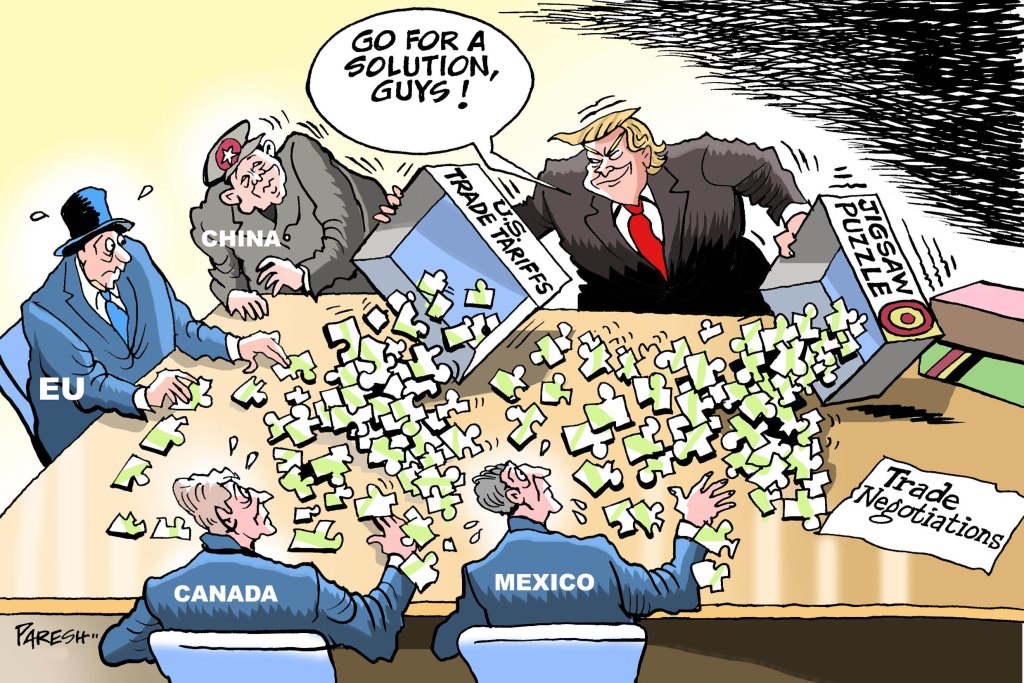
The problem with Trump is that he sees only distributive bargaining in an international world that requires integrative bargaining. He can raise tariffs, but so can other countries. He can’t demand they not respond. There is no defined end to the negotiation and there is no simple winner and loser. There are always more pies to be baked. Further, negotiations aren’t binary. China’s choices aren’t (a) buy soybeans from US farmers, or (b) don’t buy soybeans. They can also (c) buy soybeans from Russia, or Argentina, or Brazil, or Canada, etc. That completely strips the distributive bargainer of his power to win or lose, to control the negotiation.
One of the risks of distributive bargaining is bad will. In a one-time distributive bargain, e.g. negotiating with the cabinet maker in your casino about whether you’re going to pay his whole bill or demand a discount, you don’t have to worry about your ongoing credibility or the next deal. If you do that to the cabinet maker, you can bet he won’t agree to do the cabinets in your next casino, and you’re going to have to find another cabinet maker.
There isn’t another Canada.
So when you approach international negotiation, in a world as complex as ours, with integrated economies and multiple buyers and sellers, you simply must approach them through integrative bargaining. If you attempt distributive bargaining, success is impossible. And we see that already.
Trump has raised tariffs on China. China responded, in addition to raising tariffs on US goods, by dropping all its soybean orders from the US and buying them from Russia. The effect is not only to cause tremendous harm to US farmers, but also to increase Russian revenue, making Russia less susceptible to sanctions and boycotts, increasing its economic and political power in the world, and reducing ours. Trump saw steel and aluminum and thought it would be an easy win, BECAUSE HE SAW ONLY STEEL AND ALUMINUM – HE SEES EVERY NEGOTIATION AS DISTRIBUTIVE. China saw it as integrative, and integrated Russia and its soybean purchase orders into a far more complex negotiation ecosystem.
Trump has the same weakness politically. For every winner there must be a loser. And that’s just not how politics works, not over the long run.
For people who study negotiations, this is incredibly basic stuff, negotiations 101, definitions you learn before you even start talking about styles and tactics. And here’s another huge problem for us.
Trump is utterly convinced that his experience in a closely held real estate company has prepared him to run a nation, and therefore he rejects the advice of people who spent entire careers studying the nuances of international negotiations and diplomacy. But the leaders on the other side of the table have not eschewed expertise, they have embraced it. And that means they look at Trump and, given his very limited tool chest and his blindly distributive understanding of negotiation, they know exactly what he is going to do and exactly how to respond to it.
From a professional negotiation point of view, Trump isn’t even bringing checkers to a chess match. He’s bringing a quarter that he insists of flipping for heads or tails, while everybody else is studying the chess board to decide whether its better to open with Najdorf or Grünfeld.”
This is the Week When They’re Admitting that if You Elect an Actual Crazy Person, You Will Get Literally Crazy Government—and That the Crazy Person’s Supporters Will Get Exactly What They Deserve
Donald Trump is building a reputation for himself as the flip-flopper in chief — the president who, after announcing a bold new policy today, is more than likely to reverse it tomorrow.
Why it matters:In a chaotic and unpredictable world, the federal government normally acts as a stabilizing force. Under Trump, it has become the primary driver of the chaos.
The big picture:Across-the-board tariffs on Mexico and Canada — two of America’s three largest trading partners — have been on and then off and then on and then off. Colombia knowsthe feeling.
The government put 80 million square feet of its real estate up for sale, only to then take the “for sale” sign down.
He touted the use of military aircraft to carry out high-profile deportations, only to suspend the flights after finding them costly and inefficient.
For the record:“This is the art of the deal,” a White House spokesman tells Axios about the tariff reversals, adding that the General Services Administration and individual agencies, rather than Trump himself, are responsible for other executive-branch actions.
Elon Musk is also distancing himself from the firings of federal workers.
Flashback:In a matter of days,Trump denounced Ukrainian President Volodymyr Zelensky, then made up and invited him to Washington, then chastised him in the Oval Office, then expressed openness to rebuilding ties, then cut off arms and intelligence sharing.
Zoom in:Republicans in Congress have repeatedly found themselves boxed in by Trump’s flip-flops.
He spent weeks equivocating on whether Congress should pass his agenda in one bill or two — then blindsided the Senate by backing House Republicans’ one-bill approach.
He promised not to cut Medicaid, then backed a House GOP budget plan that could force exactly that in order to meet its proposed spending cuts.
He has vowed to achieve the unthinkable by balancing the budget — while endorsing trillions of dollars in tax cuts, plus new campaign promises like no tax on tips or overtime.
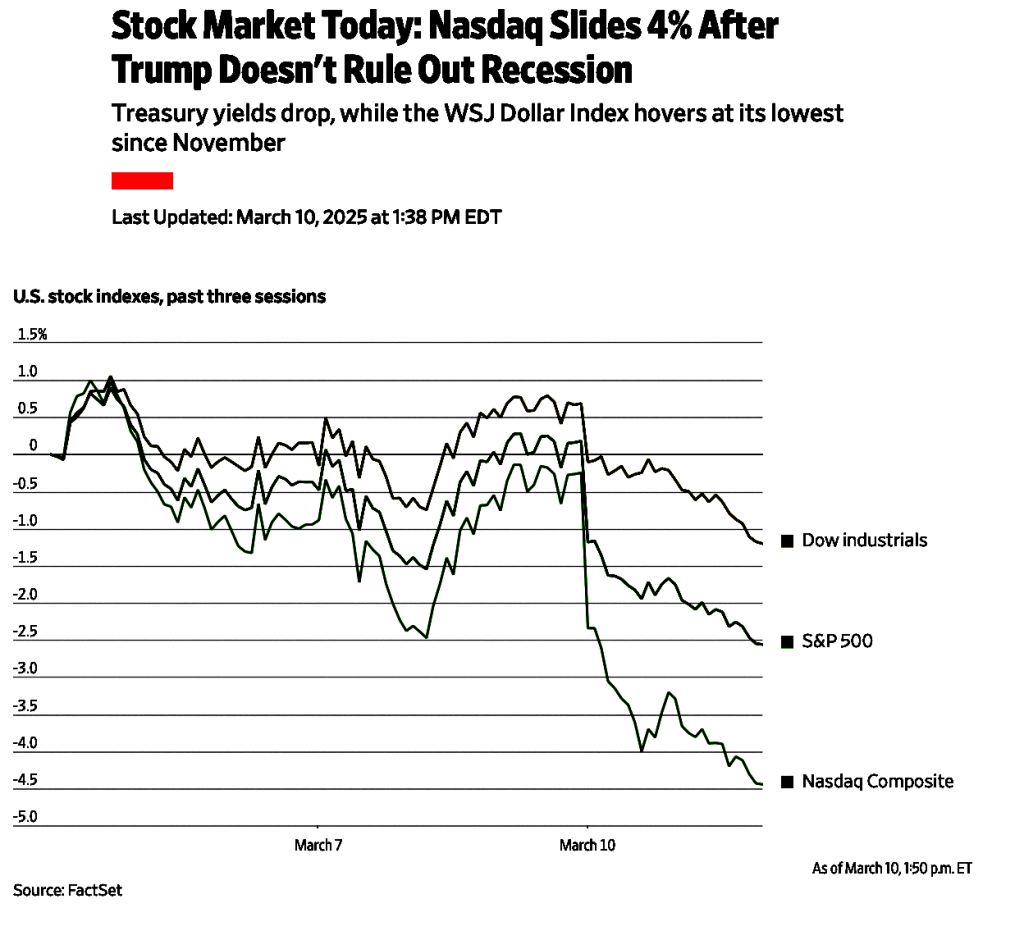
Follow the money:The stock market, for one, is tiring of such shenanigans. On Wednesday, stocks fell on news that tariffs were being imposed — and then on Thursday, when those tariffs were suspended, stocks fell again.
Foreign investors like French energy company Engie are on the record as saying that they need clarity and predictability in order to invest in the U.S. — something that’s clearly missing at the moment.
“I’m not even looking at the market,” Trump told reporters in the Oval Office Thursday, disavowing his longtime favorite metric for economic success.
Zoom out:In crypto, a rug-pull is any project that’s announced and then abandoned — often at great expense to anybody who believed the initial announcement.
Between the lines:Elon Musk — who may or may not be the head of DOGE, depending on who you ask — is at least partially responsible for the administration’s “move fast and break things” ethos.
“We will make mistakes. We won’t be perfect. But when we make a mistake, we’ll fix it very quickly,” Musk said in a Cabinet meeting last week, pointing to the reversed cancellation of Ebola funding.
DOGE has made plenty of mistakes, but has not always been transparent about fixing them — quietly pulling down billions of dollars from its online “wall of receipts” on multiple occasions.
The key to understanding this morning’s Supreme Court ruling unfreezing American foreign aid is that two different rulings are at issue here, and teasing apart those technicalities reveals a loss that is perhaps more significant for the Trump administration than is first apparent.
The two orders both come from U.S. District Court Judge Amir Ali. There’s his underlying temporary restraining order (TRO), which remains in effect (and which the government has neither tried to appeal nor sought emergency relief from), and then there’s his more specific order, which purported to enforce the TRO by obliging the government to pay somewhere from $1.5 billion to $2 billion of committed foreign-aid funds by February 26. It was that order that the government tried to appeal, and from which it sought emergency relief first in the D.C. Circuit Court and then in the Supreme Court. By issuing an “administrative stay” last Wednesday night, Chief Justice John Roberts temporarily absolved the government of its obligation to comply with that order—but not with the underlying TRO, which generally requires the government to spend money that Congress has appropriated for foreign-aid funding.
Against that backdrop, the Court’s ruling today is more than a little confusing. Let’s start with what’s clear: A 5–4 majority (with Chief Justice Roberts and Justice Amy Coney Barrett joining the three Democratic appointees) denied the government’s application to vacate Judge Ali’s enforcement order. The Court’s ruling contains only one meaningful sentence, and it is maddeningly opaque:
“Given that the deadline in the challenged order has now passed, and in light of the ongoing preliminary injunction proceedings, the District Court should clarify what obligations the Government must fulfill to ensure compliance with the temporary restraining order, with due regard for the feasibility of any compliance timelines.”
This sentence (or, perhaps, an earlier draft of it) provoked a fiery and more than a little hypocritical eight-page dissent from Justice Samuel Alito, joined in full by Justices Clarence Thomas, Neil Gorsuch, and Brett Kavanaugh. But before getting to the dissent, let me try to read a couple of tea leaves out of this cryptic but important passage.
First, I think it’s meaningful that the majority denied the government’s application rather than dismissing it as moot. In English, that is the majority signaling that the government likely still must comply with the “pay now” order—the second of the two—albeit not on the original timeline. If the majority thought that the “pay now” order was no longer live because the deadline had come and gone, then the proper disposition would have been to dismiss the application as moot, not to deny it. (Indeed, although there are good reasons to not rely upon dissents to figure out what the majority held, Alito’s dissent seems to reinforce this reading.) This may seem like a very thin reed, but it’s a distinction I can’t imagine was lost upon the justices. The majority (and, apparently, the dissent) seems to agree that the government remains under not just the general obligation of the original TRO but the specific obligation of the “pay now” order.
Second, the clause about the district court clarifying the obligations that the government must fulfill to comply with the TRO strikes me as an invitation to Judge Ali to do exactly that—to issue a more specific order that (1) identifies the particular spending commitments that he believes the government must honor to comply with the TRO and (2) gives the government at least a little more than 48 hours to do so. The upshot is that, even if the Trump administration doesn’t have to pay the money immediately, it will have to do so very soon. That’s small solace to the organizations and people who have already had their lives upended by the spending freeze, but it’s a bigger loss for the Trump administration than the text may suggest.
Third, the timing of the ruling is striking. The Court handed down the order right at 9 a.m. this morning—less than 12 hours after the end of President Donald Trump’s address to Congress last night. It is just about impossible to imagine that the ruling was still being finalized overnight (or that the chief justice was somehow influenced by his awkward moment with Trump). If not, then there appears to have been at least some choice on the Court’s part to hand down the ruling after the president’s speech and not before it at the close of business yesterday—perhaps to avoid the possibility of Trump attacking the justices while several of them were in the audience. I’ve written before about the problem of the Court timing its rulings—and how it underscores the extent to which the justices are, and ought to admit that they are, playing at least some politics even with what should be a straightforward procedure for releasing rulings when they’re ready. This at least seems like it might be another example.
And fourth, here’s that 5–4 lineup again. Back in January, I wrote about how this particular 5–4 alignment (the chief justice, Justice Barrett, and the three Democratic appointees) is starting to show up in cases “in which the Chief Justice’s elusive but not illusory institutional commitments, and Justice Barrett’s emerging independence, are separating them from the other Republican appointees. For a host of reasons that I suspect are obvious, we may see more such cases sooner rather than later.”
On one hand, it’s a bit alarming that Kavanaugh joined the dissent. On the other hand, for those hoping that the Court is going to be a bulwark against the (mounting) abuses of the Trump administration, it’s a cautiously optimistic sign that there may well be at least five votes to support lower-court rulings attempting to rein in those abuses.
In many ways, the dissent is far more illuminating than the majority’s order. As is unfortunately often the case with respect to Alito’s dissents from emergency applications, this one combines a remarkable amount of hypocrisy with statements that are either materially incorrect or, at the very least, misleading.
On page three of the ruling (page two of the dissent), for example, Alito writes that “the Government must apparently pay the $2 billion posthaste—not because the law requires it, but simply because a District Judge so ordered.” Of course, this completely misstates both the theory of the plaintiffs’ lawsuits and the gravamen of Judge Ali’s order. The whole point is that the law does require it—that Congress has mandated the spending and that the contractual obligations have been fulfilled. Indeed, Judge Ali’s “pay now” order is about work already completed for which the money was already due. If there is authority for the proposition that the government is not legally obliged to pay its bills, Alito doesn’t cite it. Yes, there may be separate questions about the courts’ power to compel the government, but that’s not the same thing as whether the “law requires” the government to pay its bills. Do the dissenters genuinely believe that the answer is no?
Alito also makes much out of the argument that sovereign immunity bars the claims against the government. But the Supreme Court has already held that relief under the Administrative Procedure Act can run to whether the government is obliged to pay expenditures to which the recipients are legally entitled. Alito asserts that actually ordering the government to pay those expenditures is something else entirely; suffice to say, I think that’s slicing the bologna pretty thin. His argument would have more force if Judge Ali’s “pay now” order was about funds for which the administrative processes haven’t fully run. But here, they have. And so it’s just a question of whether federal courts have the power to force the government to … enforce the law.
In that respect, contrast Alito’s analysis here with his dissenting 2023 opinion in United States v. Texas—in which he would have upheld an injunction by a single (judge-shopped) district judge that effectively dictated to the executive branch what its immigration-enforcement priorities must be. In explaining why the Biden administration should lose, he wrote:
“Nothing in our precedents even remotely supports this grossly inflated conception of “executive Power,” which seriously infringes the “legislative Powers” that the Constitution grants to Congress. At issue here is Congress’s authority to control immigration, and “[t]his Court has repeatedly emphasized that ‘over no conceivable subject is the legislative power of Congress more complete than it is over’ the admission of aliens.” In the exercise of that power, Congress passed and President Clinton signed a law that commands the detention and removal of aliens who have been convicted of certain particularly dangerous crimes. The Secretary of Homeland Security, however, has instructed his agents to disobey this legislative command and instead follow a different policy that is more to his liking.”
In 2023, Alito dismissed the view that courts could not push back against the president in such cases as a “radical theory.” In 2025, apparently, it’s correct. I wonder what’s changed?
Finally, Alito offers what I would euphemistically call a remarkable discussion of why the harm that the plaintiffs are suffering is insufficient to overcome the government’s case for a stay:
“Any harm resulting from the failure to pay amounts that the law requires would have been diminished, if not eliminated, if the Court of Appeals had promptly decided the merits of the Government’s appeal, which it should not have dismissed. If we sent this case back to the Court of Appeals, it could still render a prompt decision.”
In other words, the plaintiffs are being harmed not by the government’s refusal to pay them but by the D.C. Circuit’s refusal to exercise appellate jurisdiction over Judge Ali’s “pay now” order. I don’t even know what to say about this argument other than that, if that’s how irreparable harm worked, well, emergency relief (and the role of intermediate appellate courts) would look a heck of a lot different.
Alito closes by accusing the majority of imposing “a $2 billion penalty on American taxpayers.” This comes back to the central analytical flaw in the dissent: The “penalty” to which Alito is referring is the government’s underlying legal obligation to pay its debts. Debts aren’t a penalty; they are the literal cost of doing business. And if this is the approach that these four justices are going to take in all of the spending cases to come, that’s more than a little disheartening.
As for what comes next, well, I’m not entirely sure. We know that Judge Ali is scheduled to hold a preliminary injunction hearing tomorrow. It is very possible that before then (or shortly thereafter) he will reimpose some kind of “pay now” mandate that, with the hints from the Supreme Court majority, is a bit more specific and has a slightly longer timeline. Of course, the government could seek emergency relief from that order, too, but I take today’s ruling as a sign that, so long as Judge Ali follows the Court’s clues, at least five justices will be inclined to deny such relief. That doesn’t do anything immediately for the plaintiffs and other foreign-aid recipients who are continuing to suffer debilitating consequences. But it does suggest that, sometime soon, the government really is going to have to pay out at least some of the money at issue in these cases (and, as important, perhaps other funding cases too).
The broader takeaway, though, is that this is now the second ruling (the first was Dellinger) in which the Court has, in the same ruling, moved gingerly but at the same time denied the relief that the Trump administration was seeking. Two cases are, obviously, a small data set. But for those hoping that even this Supreme Court will stand up, at least in some respects, to the Trump administration, I think there’s a reason to see today’s ruling as a modestly positive sign in that direction.
Yes, the Court could do even more to push back in these cases. But the fact that Trump is already 0–2 on emergency applications is, I think, not an accident, and a result that may send a message to lower courts, whether deliberately or not, to keep doing what they’re doing.
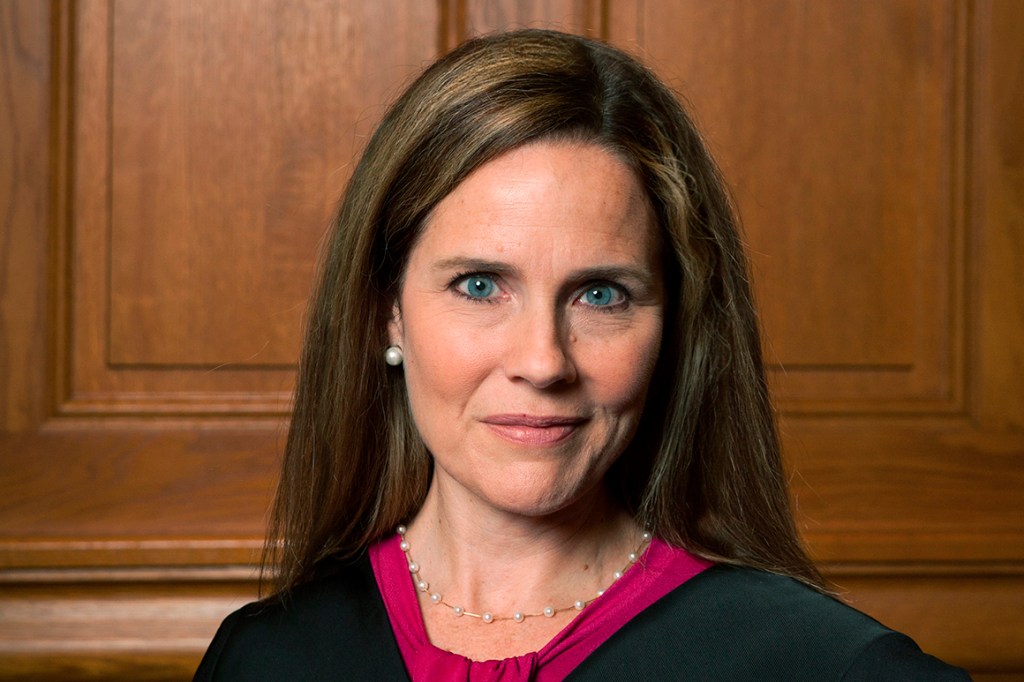
This image provided by Rachel Malehorn shows Judge Amy Coney Barrett in Milwaukee, on Aug. 24, 2018. (Rachel Malehorn, rachelmalehorn.smugmug.com, via AP)
If you want to dig in the weeds, please do so; the two sources above, along with many others, will help.
Big picture: the issue presented by the case is whether it is A-OK for Trump to spit on the Constitution by exercising kingly power to destroy a federal agency created and funded by Congress—particularly in a situation where the destruction of said agency will lead to unimaginable loss of life.
In a dissenting opinion written by Justice Alito—who has been drinking a whole lot of Kool-Aid lately—and joined by Justices Thomas, Gorsuch, and Kavanaugh, the four justices seemed to take it as self-evident that Trump need not obey the Constitution and that it was a grievous act of “judicial hubris” for a lowly federal district judge to think that Trump has any obligation to the Constitution.
But one of the three Trump-appointed justices, Amy Coney Barrett, has been tapering off the Kool-Aid lately. She joined with Justice Roberts and with the three liberals in a short, unsigned opinion, indicating that the lowly federal district judge in question could bloody well go right ahead and order Trump to pay up. (That is, it’s OK for the judge to order Trump to pay pending a final resolution of the case.)
If you read the opinion—and I hope you do—you will see that I have oversimplified. You will see that this onion has a lot of layers. But I do not think I have oversimplified in a misleading way. And my guess is that it’s going to be Constitution, 5, Dictatorship, 4, from here on.
I did say “guess.” There is a difference, you know, between a guess and a prediction.
And, by the way, as Trump becomes increasingly unpopular, I would’nt be shocked if we peel off Kavanaugh.




 Facing MAGA