It is common ground that, on Friday night, the ACLU sounded the alarm, got the justices out of bed, told them that the Trump Administration had put a bunch of immigrants on buses, that the buses were headed to the airport, where a plane was headed for El Salvador, and that seven of the nine justices believed the ACLU and issued the Midnight Order.
The main issue, for purposes of the weekend, was whether the ACLU was just throwing sand in the Court’s eye, or whether the Administration really was trying to pull a fast one, tying the courts up in the niceties of their own procedures while a bunch of immigrants were headed to the gulag.
Now, as I said, the Solicitor General filed a 15-page weekend brief. And what, pray tell, did the Solicitor General say about the main issue?
He said nothing whatsoever about the main issue. And that is because there was nothing he could say, without either lying through his teeth or expressing open contempt for the Supreme Court.
Ladies and gentlemen, when you are compelled to file a brief that says nothing at all about the key issue then you are indeed having a horrible, terrible, no good, very bad day.
Part of the Solicitor General’s problem was that the Fake News Media had video of the immigrants on the buses – which passed by the exit to the Abilene, Texas, airport, turned around, and delivered the prisoners back to their Texas prison!
Unlike some in the Administration, the Solicitor General has enough sense to know that “who’re you gonna believe, me or your lying eyes?” is not an argument you should make to the Supreme Court.
As leaders of America’s colleges, universities, and scholarly societies, we speak with one voice against the unprecedented government overreach and political interference now endangering American higher education. We are open to constructive reform and do not oppose legitimate government oversight. However, we must oppose undue government intrusion in the lives of those who learn, live, and work on our campuses. We will always seek effective and fair financial practices, but we must reject the coercive use of public research funding.
America’s system of higher learning is as varied as the goals and dreams of the students it serves. It includes research universities and community colleges; comprehensive universities and liberal arts colleges; public institutions and private ones; freestanding and multi-site campuses. Some institutions are designed for all students, and others are dedicated to serving particular groups. Yet, American institutions of higher learning have in common the essential freedom to determine, on academic grounds, whom to admit and what is taught, how, and by whom. Our colleges and universities share a commitment to serve as centers of open inquiry where, in their pursuit of truth, faculty, students, and staff are free to exchange ideas and opinions across a full range of viewpoints without fear of retribution, censorship, or deportation.
Because of these freedoms, American institutions of higher learning are essential to American prosperity and serve as productive partners with government in promoting the common good. Colleges and universities are engines of opportunity and mobility, anchor institutions that contribute to economic and cultural vitality regionally and in our local communities. They foster creativity and innovation, provide human resources to meet the fast-changing demands of our dynamic workforce, and are themselves major employers. They nurture the scholarly pursuits that ensure America’s leadership in research, and many provide healthcare and other essential services. Most fundamentally, America’s colleges and universities prepare an educated citizenry to sustain our democracy.
The price of abridging the defining freedoms of American higher education will be paid by our students and our society. On behalf of our current and future students, and all who work at and benefit from our institutions, we call for constructive engagement that improves our institutions and serves our republic.
Signed,
Jonathan Alger, President, American University
Suzanne Ames, President, Peninsula College
Carmen Twillie Ambar, President, Oberlin College
Denise A. Battles, President, SUNY Geneseo
Ian Baucom, Incoming President, Middlebury College
Allan Belton, President, Pacific Lutheran University
Hubert Benitez, President, Saint Peter’s University
Joanne Berger-Sweeney, President, Trinity College (CT)
Michael A. Bernstein, President, The College of New Jersey
Audrey Bilger, President, Reed College
Erik J. Bitterbaum, President, SUNY Cortland
Sarah Bolton, President, Whitman College
Mary H. Bonderoff, President, SUNY Delhi
Eric Boynton, President, Beloit College
Elizabeth H. Bradley, President, Vassar College
Brian Bruess, President, College of Saint Benedict and Saint John’s University
Adam Bush, President, College Unbound
Alison Byerly, President, Carleton College
Wendy Cadge, President and Professor of Sociology, Bryn Mawr College
Nancy Cantor, President, Hunter College CUNY
Alberto Jose Cardelle, President, SUNY Oneonta
Brian W. Casey, President, Colgate University
Ana Mari Cauce, Professor and President, University of Washington
Andrea Chapdelaine, President, Connecticut College
Thom D. Chesney, President, Southwestern College (NM)
Bryan F. Coker, President, Maryville College
Ronald B. Cole, President, Allegheny College
Jennifer Collins, President, Rhodes College
John Comerford, President, Otterbein University
Marc C. Conner, President, Skidmore College
La Jerne Terry Cornish, President, Ithaca College
Grant Cornwell, President, Rollins College
Isiaah Crawford, President, University of Puget Sound
Gregory G. Dell’Omo, President, Rider University
Kent Devereaux, President, Goucher College
Jim Dlugos, Interim President, Landmark College
Bethami Dobkin, President, Westminster University
Harry Dumay, President, Elms College
Christopher L. Eisgruber, President, Princeton University
Michael A. Elliott, President, Amherst College
Jane Fernandes, President, Antioch College
Damian J. Fernandez, President, Warren Wilson College
David Fithian, President, Clark University
Lisa C. Freeman, President, Northern Illinois University
Robert Gaines, Acting President, Pomona College
Alan M. Garber, President, Harvard University
Michael H. Gavin, President, Delta College
Mark D. Gearan, President, Hobart and William Smith Colleges
Melissa Gilliam, President, Boston University
Jorge G. Gonzalez, President, Kalamazoo College
Jonathan D. Green, President, Susquehanna University
David A. Greene, President, Colby College
William R. Groves, Chancellor, Antioch University
Jeremy Haefner, Chancellor, University of Denver
Yoshiko Harden, President, Renton Technical College
Anne F. Harris, President, Grinnell College
James T. Harris, President, University of San Diego
Marjorie Hass, President, Council of Independent Colleges
Richard J. Helldobler, President, William Paterson University
Wendy Hensel, President, University of Hawaii
James Herbert, President, University of New England
Doug Hicks, President, Davidson College
Mary Dana Hinton, President, Hollins University
Jonathan Holloway, President, Rutgers University
Robin Holmes-Sullivan, President, Lewis & Clark College
Robert H. Huntington, President, Heidelberg University
Nicole Hurd, President, Lafayette College
Wolde-Ab Isaac, Chancellor, Riverside Community College District
Karim Ismaili, President, Eastern Connecticut State University
J. Larry Jameson, President, University of Pennsylvania
Garry W. Jenkins, President, Bates College
Paula A. Johnson, President, Wellesley College
John E. Jones III, President, Dickinson College
Cristle Collins Judd, President, Sarah Lawrence College
David L. Kaufman, President, Capital University
Colleen Perry Keith, President, Goldey-Beacom College
Julie Johnson Kidd, President, Endeavor Foundation
Jonathan Koppell, President, Montclair State University
Sally Kornbluth, President, Massachusetts Institute of Technology
Julie Kornfeld, President, Kenyon College
Michael I. Kotlikoff, President, Cornell University
Paula Krebs, Executive Director, Modern Language Association
Sunil Kumar, President, Tufts University
Bobbie Laur, President, Campus Compact
Frederick M. Lawrence, Secretary and CEO, Phi Beta Kappa Society
Hilary L. Link, President, Drew University
Patricia A. Lynott, President, Rockford University
Heidi Macpherson, President, SUNY Brockport
John Maduko, President, Connecticut State Community College
Lynn Mahoney, President, San Francisco State University
Daniel Mahony, President, Southern Illinois University
Maud S. Mandel, President, Williams College
Christine Mangino, President, Queensborough Community College
Amy Marcus-Newhall, President, Scripps College
Felix V. Matos-Rodriguez, Chancellor, City University of New York (CUNYAnne E. McCall, President, The College of Wooster
Richard L. McCormick, Interim President, Stony Brook University
Michael McDonald, President, Great Lakes Colleges Association
James McGrath, President and Dean, Cooley Law School
Patricia McGuire, President, Trinity Washington University
Maurie McInnis, President, Yale University
Elizabeth M. Meade, President, Cedar Crest College
Scott D. Miller, President, Virginia Wesleyan University
Jennifer Mnookin, Chancellor, University of Wisconsin–Madison
Robert Mohrbacher, President, Centralia College
Chris Moody, Executive Director, ACPA-College Student Educators International
Tomas Morales, President, California State University San Bernardino
Milton Moreland, President, Centre College
Kathryn Morris, President, St. Lawrence University
Ross Mugler, Board Chair and Acting President and CEO, Association of Governing Boards of Universities and Colleges
Krista L. Newkirk, President, University of Redlands
Stefanie D. Niles, President, Cottey College
Claire Oliveros, President, Riverside City College
Robyn Parker, Interim President, Saybrook University
Lynn Pasquerella, President, American Association of Colleges and Universities
Laurie L. Patton, President, American Academy of Arts and Sciences
Beth Paul, President, Nazareth University
Christina Paxson, President, Brown University
Rob Pearigen, Vice-Chancellor and President, University of the South
Deidra Peaslee, President, Saint Paul College
Eduardo M. Peñalver, President, Seattle University
Ora Pescovitz, President, Oakland University
Darryll J. Pines, President, University of Maryland
Nicola Pitchford, President, Dominican University of California
Kevin Pollock, President, Central Carolina Technical College
Susan Poser, President, Hofstra University
Paul C. Pribbenow, President, Augsburg University
Vincent Price, President, Duke University
Robert Quinn, Executive Director, Scholars at Risk Network
Wendy E. Raymond, President, Haverford College
Christopher M. Reber, President, Hudson County Community College
Suzanne M. Rivera, President, Macalester College – Saint Paul, MN ( MBR )
Michael S. Roth, President, Wesleyan University
James Ryan, President, University of Virginia
Vincent Rougeau, President, College of the Holy Cross
Kurt L. Schmoke, President, University of Baltimore
Carol Geary Schneider, Acting Executive Director, Civic Learning and Democracy Engagement Coalition
Sean M. Scott, President and Dean, California Western School of Law
Zaldwaynaka Scott, President, Chicago State University
Philip J. Sisson, President, Middlesex Community College (MA)
Suzanne Smith, President, SUNY Potsdam
Valerie Smith, President, Swarthmore College
Paul Sniegowski, President, Earlham College
Barbara R. Snyder, President, Association of American Universities
Stephen Snyder, Interim President, Middlebury College
Weymouth Spence, President, Washington Adventist University
Terri Standish-Kuon, President and CEO, Independent Colleges of Washington
G. Gabrielle Starr, President, Pomona College
Karen A. Stout, President, Achieving the Dream
Tom Stritikus, President, Occidental College
Julie Sullivan, President, Santa Clara University
Aondover Tarhule, President, Illinois State University
Glena Temple, President, Dominican University
Steven J. Tepper. President, Hamilton College
Kellye Y. Testy, CEO, Association of American Law Schools
Tania Tetlow, President, Fordham University
Strom C. Thacker, President, Pitzer College
Scott L. Thomas, President, Sterling College
Deborah Trautman, President and CEO, American Association of Colleges of Nursing
Satish K. Tripathi, President, University at Buffalo, SUNY
Kyaw Moe Tun, President, Parami University
Brad Tyndall, President, Central Wyoming College
LaTanya Tyson, President, Carolina Christian College
Matthew P. vandenBerg, President, Ohio Wesleyan University
James Vander Hooven, President, Mount Wachusett Community College
Laura R. Walker, President, Bennington College
Yolanda Watson Spiva, President, Complete College America
Michaele Whelan, President, Wheaton College
Manya C. Whitaker, Interim President, Colorado College
Julie A. Manley White, Chancellor and CEO, Pierce College
Kim A. Wilcox, Chancellor, University of California, Riverside
Late this afternoon, Harvard filed suit against Team Trump. The complaint is here. The gist is found in paragraph 3, which reads as follows:
On April 11, 2025, citing concerns of antisemitism and ideological capture, the Government identified ten conditions Harvard must satisfy to receive federal research funding already committed to by the Governmentand relied on by Harvard, its researchers, and its affiliates (the “April 11 Letter,” attached as Exhibit A). Ex. A at 2,4. The Government dictated that Harvard “reform and restructur[e]” its governance to “reduc[e] the power” ofcertain students, faculty, and administrators. Id. at 2. It required that Harvard hire a third-party to conduct an“audit” of the viewpoints of Harvard’s student body, faculty, and staff. Id. at 3-4. Then, based on the results ofthis university-wide viewpoint audit, Harvard must “hir[e] a critical mass of new faculty” and “admit[] a critical mass of students” to achieve “viewpoint diversity” in “each department, field, or teaching unit”—to the Government’s satisfaction as determined in the Government’s sole discretion. Id. And the Government has demanded that Harvard terminate or reform its academic “programs” to the Government’s liking. Id. at 4. All told, the tradeoff put to Harvard and other universities is clear: Allow the Government to micromanageyour academic institution or jeopardize the institution’s ability to pursue medical breakthroughs, scientific discoveries, and innovative solutions.
The complaint alleges violation of the First Amendment in multiple ways, violation of the Administrative Procedures Act in multiple ways, and violation of statutory and constitutional authority.
Harvard’s Lawyers
The complaint identifies Harvard’s attorneys as individual partners of the Quinn Emanuel and King & Spalding firms—the two people who are known to have represented Harvard in discussions with Team Trump—along with four attorneys at Ropes & Gray, a distinguished old line Boston firm, and nine attorneys from four offices of Lehotsky Keller Cohn LLP, described as an elite litigation boutique firm.
The Lehotsky firm is well connected in conservative legal circles. One of the Lehotsky lawyers on the case was president of the Federalist Society at Harvard Law School.
Mr. Lehotsky, the first named partner of the firm, and the only attorney whose physical signature appears on the complaint, clerked for Justice Scalia and, at one point, directed litigation strategy for the United States Chamber of Commerce, where he was known for slaying regulatory dragons.
Harvard Alumni on the Supreme Court
Chief Justice Roberts, along with Justice Gorsuch and Justice Jackson, took their undergraduate degrees from Harvard College and their law degrees from Harvard Law School. Justice Kagan came to Harvard Law by way of Princeton.
I think sounds of silence signal that the legal part of Team Trump is having a terrible, horrible, no good, very bad weekend.
Meanwhile, an insightful op-ed in the N.Y. Times speaks of a recently invented right wing legal principle—the major questions doctrine, newly discovered as a conservative cure for perceived liberal excesses—that requires “clear congressional authorization” when the bureaucrats make decisions of great “economic and political significance.” Otherwise, bye-bye liberal policy adventuresomeness.
Now, Orange Mussolini is the poster child for one who makes decisions of great economic and political significance without a ghost of a shadow of congressional authorization.
On April the 18th of 75—that would be 1775—Paul Revere took a midnight ride. Around midnight on April the 18th of 2025, seven justices of the Supreme Court issued an order. The order was addressed to His Most High Excellency, and it declared, in words or substance, “Yo! Numbnuts! Don’t deport no more undocumented aliens without due process! And, by the way, we’re telling you this at midnight on Good Friday, after unusual and truncated legal procedure, because we don’t trust your fat ass any further than we can throw your fat ass. And that ain’t very far. Have a nice day. Love and kisses, The Supreme Court.”
Justices Alito and Thomas dissented, and promised a written opinion. Two days later the written opinion has appeared over the transom.
The First Question About the Dissent
Back on April 7, in Trump v. J.G.G., Justice Kavanagh wrote,
I agree with the Courts per curiam opinion. Importantly, as the Court stresses, the Court’s disagreement with the dissenters is not over whether the detainees receive judicial review of their transfers—all nine Members of the Court agree that judicial review of their transfers—all nine Members of the Court agree that judicial review is available. The only question is where that judicial review should occur. That venue question turns on … [yadda, yadda, yadda, yadda].
But was Justice Kavanagh telling the truth about the actual views of “all nine Members of the Court”? After all, Justices Alito and Thomas are—how to put this?—often idiosyncratic in their views. And their stated dissent to the Midnight Ruling left open the possibility that they might have dissented because they agreed with the Trump Administration on its dictatorial interpretation of the Alien Enemies Act.
The Answer to the First Question
Well, who knows what Alito and Thomas might do or say at some future time. But, as of this afternoon, we do know what they did not say. Their dissent offers no scintilla of support for Trump’s basic claim, or for any hint that Justice Kavanagh might have misdescribed their views of due process and judicial review.
None. Zero. Not a smidgen. Not a soupçon. Bupkis. Rien. Nada.
The Second Question About the Dissent
The second question is: What are we to glean from the fact that the Alito/Thomas dissent goes on, and on, and on, about how the Supreme Court’s Midnight Ruling is inconsistent with a whole variety of arcane rules of civil procedure?
The Answer to the Second Question
The answer is that seven justices do not Trump’s fat ass any further than they can throw Trump’s fat ass.
And they bloody well want him to know that they don’t trust his fat ass.
And they want him to know that if he goes ahead and puts the next fifty Venzuelans on a plane for El Salvador, without notice and a hearing, then the long anticipated full blown constitutional crisis will be upon us.
The Third Question About the Dissent
Well, then, why did Alito dissent?
The Answer to the Third Question
Alito writes, “ I refused to join the Court’s order because we had no good reason to think that, under the circumstances, issuing an order at midnight was necessary or appropriate.”
Translation? Not entirely clear, but one supposes that it wasn’t “appropriate” because it was in such tension with established procedural laws and precents—and it wasn’t “necessary” because, surely, Trump wasn’t going to play games and put those 50 guys on a plane before the Supreme Court could act.
Let me say that, if Justice Alito actually believes that Team Trump wasn’t trying to make a mockery of the Supreme Court, then I have a very nice bridge in Brooklyn that I am prepared to sell, at a very reasonable price.
The Dissent’s Addendum
The dissent ends thusly:
Both the Executive and the Judiciary have an obligation to follow the law. The Executive must proceed under the terms of our order in Trump v. J.G.G., 604 U.S. ___ (2025) (per curiam), and the Court should follow established procedures.
And what, ladies and germs, is “our order in Trump v. J.G.G.”—the order that Justices Alito and Thomas so warmly embrace?
Why, it is, to quote the exact language of the Supreme Court decision, that detainees under the Alien Enemies Act “must receive notice … that they are subject to removal under the Act. The notice must be afforded within a reasonable time and in such a manner as will allow them to actually seek habeas relief in the proper venue before such removal occurs.”
A cry of defiance, and not of fear, A voice in the darkness, a knock at the door, And a word that shall echo forevermore! For, borne on the night-wind of the Past, Through all our history, to the last, In the hour of darkness and peril and need, The people will waken and listen to hear The hurrying hoof-beats of that steed, And the midnight message of Paul Revere.
Paul Revere’s Ride, by Henry Wadsworth Longfellow
Listen, my children, and you shall hear Of the midnight ride of Paul Revere, On the eighteenth of April, in Seventy-Five: Hardly a man is now alive Who remembers that famous day and year.
He said to his friend, “If the British march By land or sea from the town to-night, Hang a lantern aloft in the belfry-arch Of the North-Church-tower, as a signal-light,— One if by land, and two if by sea; And I on the opposite shore will be, Ready to ride and spread the alarm Through every Middlesex village and farm, For the country-folk to be up and to arm.”
Then he said “Good night!” and with muffled oar Silently rowed to the Charlestown shore, Just as the moon rose over the bay, Where swinging wide at her moorings lay The Somerset, British man-of-war: A phantom ship, with each mast and spar Across the moon, like a prison-bar, And a huge black hulk, that was magnified By its own reflection in the tide.
Meanwhile, his friend, through alley and street Wanders and watches with eager ears, Till in the silence around him he hears The muster of men at the barrack door, The sound of arms, and the tramp of feet, And the measured tread of the grenadiers Marching down to their boats on the shore.
Then he climbed to the tower of the church, Up the wooden stairs, with stealthy tread, To the belfry-chamber overhead, And startled the pigeons from their perch On the sombre rafters, that round him made Masses and moving shapes of shade,— By the trembling ladder, steep and tall, To the highest window in the wall, Where he paused to listen and look down A moment on the roofs of the town, And the moonlight flowing over all.
Beneath, in the churchyard, lay the dead, In their night-encampment on the hill, Wrapped in silence so deep and still That he could hear, like a sentinel’s tread, The watchful night-wind, as it went Creeping along from tent to tent, And seeming to whisper, “All is well!” A moment only he feels the spell Of the place and the hour, and the secret dread Of the lonely belfry and the dead; For suddenly all his thoughts are bent On a shadowy something far away, Where the river widens to meet the bay,— A line of black, that bends and floats On the rising tide, like a bridge of boats.
Meanwhile, impatient to mount and ride, Booted and spurred, with a heavy stride, On the opposite shore walked Paul Revere. Now he patted his horse’s side, Now gazed on the landscape far and near, Then impetuous stamped the earth, And turned and tightened his saddle-girth; But mostly he watched with eager search The belfry-tower of the old North Church, As it rose above the graves on the hill, Lonely and spectral and sombre and still. And lo! as he looks, on the belfry’s height, A glimmer, and then a gleam of light! He springs to the saddle, the bridle he turns, But lingers and gazes, till full on his sight A second lamp in the belfry burns!
A hurry of hoofs in a village-street, A shape in the moonlight, a bulk in the dark, And beneath from the pebbles, in passing, a spark Struck out by a steed that flies fearless and fleet: That was all! And yet, through the gloom and the light, The fate of a nation was riding that night; And the spark struck out by that steed, in his flight, Kindled the land into flame with its heat.
He has left the village and mounted the steep, And beneath him, tranquil and broad and deep, Is the Mystic, meeting the ocean tides; And under the alders, that skirt its edge, Now soft on the sand, now loud on the ledge, Is heard the tramp of his steed as he rides.
It was twelve by the village clock When he crossed the bridge into Medford town. He heard the crowing of the cock, And the barking of the farmer’s dog, And felt the damp of the river-fog, That rises when the sun goes down.
It was one by the village clock, When he galloped into Lexington. He saw the gilded weathercock Swim in the moonlight as he passed, And the meeting-house windows, blank and bare, Gaze at him with a spectral glare, As if they already stood aghast At the bloody work they would look upon.
It was two by the village clock, When he came to the bridge in Concord town. He heard the bleating of the flock, And the twitter of birds among the trees, And felt the breath of the morning breeze Blowing over the meadows brown. And one was safe and asleep in his bed Who at the bridge would be first to fall, Who that day would be lying dead, Pierced by a British musket-ball.
You know the rest. In the books you have read, How the British Regulars fired and fled,— How the farmers gave them ball for ball, From behind each fence and farmyard-wall, Chasing the red-coats down the lane, Then crossing the fields to emerge again Under the trees at the turn of the road, And only pausing to fire and load.
So through the night rode Paul Revere; And so through the night went his cry of alarm To every Middlesex village and farm,— A cry of defiance, and not of fear, A voice in the darkness, a knock at the door, And a word that shall echo forevermore! For, borne on the night-wind of the Past, Through all our history, to the last, In the hour of darkness and peril and need, The people will waken and listen to hear The hurrying hoof-beats of that steed, And the midnight message of Paul Revere.
My friends and I from Happy Acres will be at the barricades in just a few minutes.
Meanwhile …
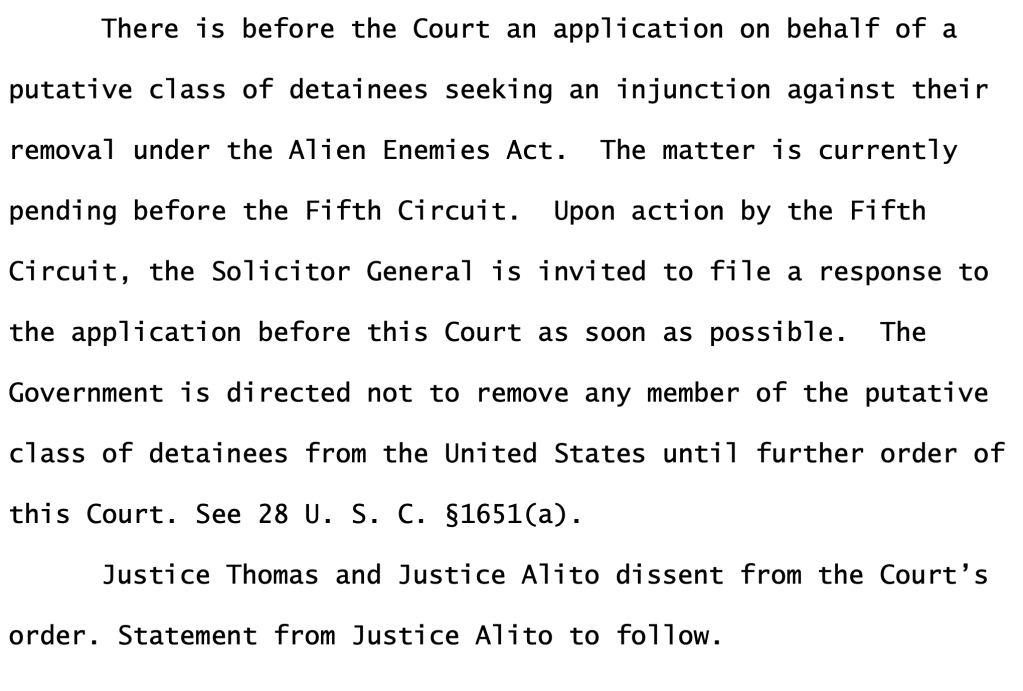
As I write, it’s about twelve hours after the Supreme Court issued its 1 AM order—the one that said, “The Government is directed not to remove any member of the putative class of detainees from the United States until further order of this Court.”
As of this hour, not a peep have we heard from His Most High Excellency, nor from our legally blonde Attorney General, nor, for that matter, from the American Civil Liberties Union.
And Isn’t This Just Too Special for Words?
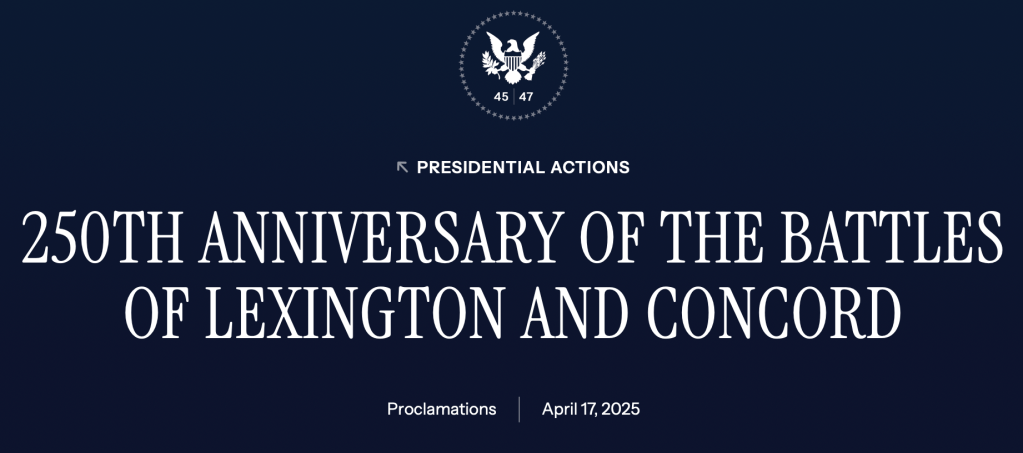
His Most High Excellency has solemnly proclaimed today as a day of commemoration of the Battles of Lexington and Concord.


 Facing MAGA