
Next Week’s Oval Office Visit by Chancellor Merz
With clear eyes, hard facts, critical thinking, new political strategy, empathy, and a soupçon of Schadenfreude
Executive Order, Addressing Risks from Susman Godfrey
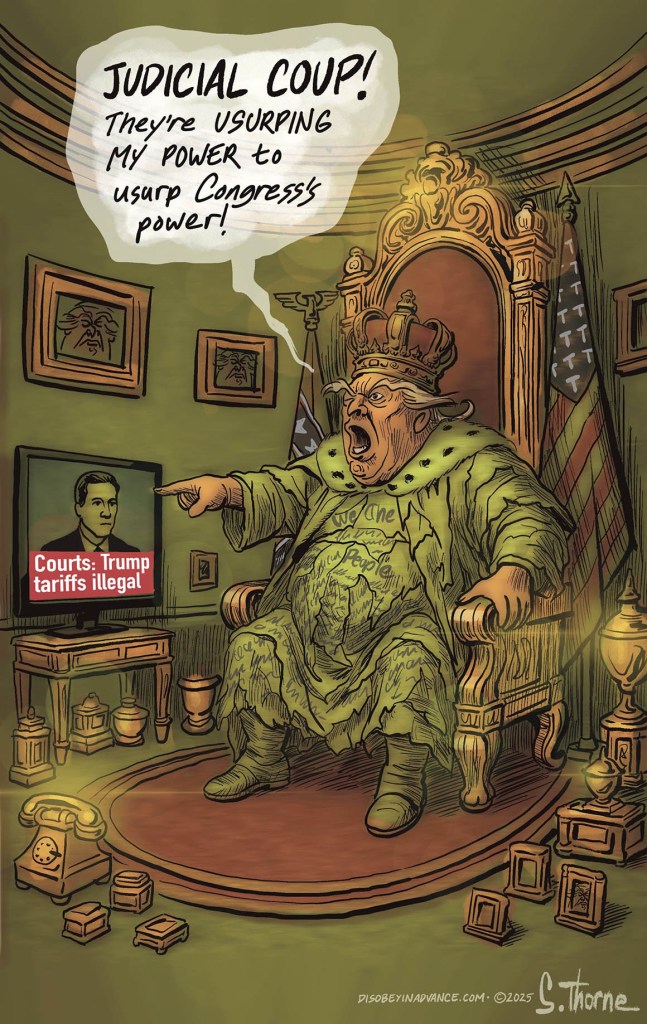
During Trump 1.0, because he thinks like a mob boss, Trump thought he was filling the federal judiciary with sycophants who would always rule his way, no matter about the facts, no matter about the law.
Federalist Society lawyers did a splendid job of conning Trump into thinking they were doing his bidding in their judicial selections.
Now, it has become apparent even to those of the meanest intelligence that most of the Federalist Society judges will not bend the knee to Trump, regardless of the facts, and regardless of the law.
Because Trump is a person of the meanest intelligence, he has now figured this out, and is busy this week throwing a hissy fit.
Specifically: where the law affords discretion to the President, it appears the Supreme Court will probably allow him to exercise that lawful discretion, even if he’s acting stupidly, in bad faith, with bad judgment, in ways that harm vast numbers of people.
BUT … BUT … BUT there is good reason to anticipate that the Supreme Court, along with the majority of the lower courts, will not endorse Trump’s actions when he or his agents
Throughout the four dreadful months of Trump 2.0, Team Trump has repeatedly—relying only on ipse dixit—asserted that it has legal powers that it does not actually have. It’s metaphysically possible that Trump has just acted without any legal advice at all. And it’s metaphysically possible that Trump has received legal advice, but decided to ignore it. That sort of thing does happen.
But I don’t think he actually acted without legal advice, or that he decided just to ignore the advice he received. It seems much more likely that he got legal advice, but that that advice was deeply flawed. If so, why? Are Trump’s legal counselors merely incompetent—or, on the other hand, are they intentionally maneuvering him into a place where the Supreme Court tells him to back down?
Take the Susman Godfrey executive order cited above. Who the hell drafted that thing? Who the hell told him it was a good idea? Who the hell told him that the courts would go along with him.
Read it. It might as well say, in all caps boldface type, at the top of the page, “THIS EXECUTIVE ORDER IS AN ATTEMPT TO PUNISH CITIZENS FOR EXERCISING THEIR CIVIL RIGHTS, AND TO DETER THEM FROM DOING SO, IN VIOLATION OF THE UNITED STATES CONSTITUTION.”
The current White House Counsel, David Warrington, is a Trump loyalist but has good credentials and has apparently never been subject to legal discipline.
Pam Bondi, the Attorney General, received her law degree from the number 98 ranked school in the country. Her lengthy Wikipedia biography reveals an astonishing number of regrettable circumstances in her legal career—notably, her exuberant embrace of the 2020 stolen election claim.
My thoughts: I don’t care that she’s the Attorney General. If you have the bad sense to ask Pam Bondi for legal advice, then you deserve what you get.
And then, of course, there is Vice President J.D. Vance—a Yale Law graduate who has come to believe Trump should just ignore Marbury v. Madison (decided in 1803, holding that “It is emphatically the province and duty of the judicial department to say what the law is”).
I don’t know whether anyone is duping Trump about the legal underpinnings of his various attempted usurpations—and, if anyone is doing so, who it is. As I implied above, maybe it’s just Trump gaslighting himself.
I do know that if any lawyer told Trump he was likely to prevail on, for example, the Susman Godfrey executive order, then that lawyer needs to be disbarred, and that right soon.
And I suspect that when the dust settles and we learn the truth, the chief culprits are going to be Bondi and Vance. And I think the evidence will show they conned Trump, intentionally misleading him about his chances with the Supreme Court–all with the goal of provoking a constitutional crisis.
[1] And then there are the tariffs. Trump purports to rely on a squinty-eyed interpretation of the International Emergency Economic Powers Act. As a matter of statutory interpretation and application, Team Trump has the legally weaker position, and his adversaries have the stronger position. But his legal case is not so ridiculous that his attorneys should be disbarred for asserting it.
Nature, Harvard researchers devastated as Trump team cuts nearly 1,000 grants
Wall Street Journal, Harvard Digs In for Battle, but Trump’s Blows Are Landing
Harvard has two lawsuits pending against Team Trump. The first one challenges the draconian cuts in federal research grants—said by Team Trump to be justified by the university’s purported “antisemitism,” its purported discrimination against white people, and a hodgepodge of other bellyaches, some vague and hard to pin down. I wrote about it on April 22.
The Harvard legal team elected not to ask for a temporary restraining order and preliminary injunction, but instead to demand a highly, highly expedited summary judgment process. Judge Burroughs’ order of April 28 indicates that Team Trump agreed to the schedule, leading up to oral argument on July 21—and presumably a district court decision by the end of the summer.
That means that teams of lawyers are reviewing evidence that probably runs to hundreds of thousands of pages and distilling it into legal briefs and accompanying exhibits.
In a normal case, one could expect the process to take several years. Here, it is scheduled to take only several months.
I count 17 lawyers on the Harvard legal team. It’s a little top heavy, but, that said, there are a lot of spear carriers, too. They have been getting very little sleep these past few weeks.
Been there, done that.
And a related point: wholly apart from the fact that Team Trump’s legal position eats shit, I very strongly suspect that the government’s legal team is being outmanned, outthought, and outgunned by Team Harvard.
But we shall see.
As you may know, this is a separate lawsuit. On May 22, Secretary Kristi Noem—that’s the person who doesn’t know what habeas corpus means—revoked Harvard ability to have any foreign students. Harvard obviously saw that one coming a mile away. The next day, May 23, it filed a new lawsuit, asked for a temporary restraining order, and received its TRO within just a few hours.
That was just a few days ago. I assume that a preliminary injunction will soon be granted, that the First Circuit Court of Appeals will rule promptly In Harvard’s favor, and that the case will reach the Supreme Court next fall.
In the meantime, though, it’s reasonable to expect that a fair number of the 6,800 foreign students normally to be found on campus—often as teaching assistants and lab assistants—will take flight.
For the second case, Harvard modified its team. Once again, Steven Lehotsky, of Lehotsky Keller Cohn LLP—revered litigator for Federalist Society causes—signed the complaint and identified a number of his partners and associates as helpers in the case. Once again, one partner each from Quinn Emanuel and King & Spalding are on the case. But Ropes & Gray is out, in the new case, replaced by a team of very heavy hitters from Jenner & Block.
As far as I can tell, Ropes & Gray is still on the first case, the one about grants. I expect their lawyers are overwhelmed with that case. Also, the head of the Ropes & Gray team has an excellent reputation, but he seems to know a lot about white collar crime, not constitutional law.
With luck, the new folks on Team Harvard from Jenner & Block will well and truly give ‘em hell.
There are about 320,000 living alumni of Harvard University. They tend to be richer than average. An estimated 18,000 of them are believed to have more than $30 million in wealth. Of those 18,000 very wealthy alumni, the average net worth is said to exceed $300 million.
OK, folks, time to stand up for Harvard.
I wonder how many of the thousand West Point graduates thought they got something useful out of this rant.
The Economist, Trump’s attack on science is growing fiercer and more indiscriminate: It started as a crackdown on DEI. Now all types of research are being cancelled:
Scientists in America are used to being the best. The country is home to the world’s foremost universities, hosts the lion’s share of scientific Nobel laureates and has long been among the top producers of influential research papers. Generous funding helps keep the system running. Counting both taxpayer and industrial dollars, America spends more on research than any other country. The federal government doles out around $120bn a year, $50bn or so of which goes towards tens of thousands of grants and contracts for higher-education institutions, with the rest going to public research bodies.
Now, however, many of America’s top scientific minds are troubled. In the space of a few months the Trump administration has upended well-established ways of funding and conducting research. Actions with the stated goal of cutting costs and stamping out diversity, equity and inclusion (dei) initiatives are taking a toll on scientific endeavour. And such actions are broadening. On May 15th it emerged that the administration had cancelled grants made to Harvard University for research on everything from Arctic geochemistry to quantum physics, following a similar move against Columbia. The consequences of these cuts for America’s scientific prowess could be profound.
Under the current system, which was established soon after the second world war, researchers apply to receive federal funding from grant-making agencies, namely the National Institutes of Health (NIH) and the National Science Foundation (NSF) as well as the Departments of Defence (DOD) and Energy (DOE). Once a proposal has been assessed by a panel of peers and approved by the agency, the agreed money is paid out for a set period.
This setup is facing tremendous upheaval. Since Mr Trump’s return to the White House, somewhere in the region of $8bn has been cancelled or withdrawn from scientists or their institutions, equivalent to nearly 16% of the yearly federal grant budget for higher education. A further $12.2bn was rescinded but has since been reinstated by courts. The NIH and the NSF have cancelled more than 3,000 already-approved grants, according to Grant Watch, a tracking website run by academics (see chart 1); an unknown number have been scrapped by the doe, the dod and others. Most cancellations have hit research that Mr Trump and his team do not like, including work that appears associated with dei and research on climate change, misinformation, covid-19 and vaccines. Other terminations have targeted work conducted at elite universities.
Much more is under threat. The president hopes to slash the NIH budget by 38%, or almost $18bn; cut the NSF budget by $4.7bn, more than 50%; and scrap nearly half of NASA’s Science Mission Directorate. All told, the proposed cuts to federal research agencies come to nearly $40bn. Many have already gone under the knife. In March the Department for Health and Human Services (HHS), which includes the NIH, announced it would scrap 20,000 jobs, or 25% of its workforce. According to news reports, about 1,300 jobs, or more than 10%, have been lost at the National Oceanic and Atmospheric Administration (NOAA), which carries out environmental and climate research. Staff cuts were reportedly also due to start at the NSF, but have been temporarily blocked by courts. To save more money, the NIH, the NSF, the DOE and the DOD have launched restrictive caps on so-called indirect grant costs, which help fund facilities and administration at universities. (These limits have also been partly blocked by courts.)
The administration says it has a plan. Mr Trump entered office on a mission to cut government waste, a problem from which the scientific establishment is not immune. On May 19th Michael Kratsios, his scientific adviser, stood up in front of the National Academies of Sciences and defended the administration’s vision. It wants to improve science by making it better and more efficient, he said—to “get more bang for America’s research bucks”. To do so, funding must better match the nation’s priorities, and researchers should be freed from groupthink, empowered to challenge each other more freely without fear of convention and dogma.
Shaking things up
He is right that science has a number of stubborn problems that can hardly be solved by a business-as-usual approach. Scientific papers are less disruptive and innovative than they used to be, and more money has not always translated into speedier progress. In the pharmaceutical sciences, new drug approvals have plateaued in recent years despite ever larger budgets. Researchers also spend much too long writing grant proposals and completing similar administrative tasks, which keeps them away from their laboratories.
Some of Mr Trump’s proposals are, in fact, overdue. Many NASA watchers, for example, would agree with his plan to find commercial alternatives for the Space Launch System, a giant rocket being built to take people to the Moon and beyond but which is years behind schedule and billions of dollars over budget.
It would be hard, if not impossible, to improve the science funding system without some disruption. The problem, however, is that the administration’s cuts are broader and deeper than they first appear, and its methods more chaotic. Take the focus on dei, which the administration bemoans as a dangerous left-wing ideology. The agencies are targeting it because of an executive order banning them from supporting such work. But dei is notoriously ill-defined. Programmes that are being cancelled are not just inclusive education schemes, but also projects that focus on the health of at-risk groups.
Though it is mostly unclear why specific projects have been cancelled, Grant Watch keeps track of words that could have landed researchers in trouble. “Latinx”, for example, is a term for Hispanic people flagged as a telltale sign of DEI by Ted Cruz, a Republican senator. The NIH has cancelled a project on anal-cancer risk factors, the abstract of which uses the word Latinx. Another cancelled project concerns oral and throat cancer, for which gay men are at higher risk. Its abstract uses the phrase “sexual and gender minority”. There are many such examples.
Other cuts may do more damage. Some NIH-funded research on vaccines has been cancelled, as have $11bn-worth of special funds from the Centres for Disease Control and Prevention (CDC) for pandemic-related research. In March Ralph Baric, an epidemiologist at the University of North Carolina at Chapel Hill who helped test the Moderna mrna vaccine for covid-19, had several vaccine grants terminated. One project aimed to develop broad-spectrum vaccines for the same family of viruses that sars-cov-2 comes from; scientists fear other strains might cross from animals to humans. Both the CDC and NIH justified such cuts by saying that the covid-19 pandemic is over. But this is short-sighted, argues Dr Baric, given the number of worrying viruses. “We’re in for multiple pandemics” in the future, he says. “I guess we’ll have to buy the drugs from the Chinese.”
Even for scientists who have not been affected by cuts, other changes have made conducting research more challenging. For example, the NIH and NSF have both delayed funding new grants. Jeremy Berg, a biophysicist at the University of Pittsburgh who is tracking the delay in grant approvals, wrote in his May report that the NIH has released about $2.9bn less funding since the start of the year, relative to 2023 and 2024. According to media reports, the NSF has stopped approving grants entirely until further notice.
At the NIH itself, the largest biomedical research centre in the country, lab supplies have become more difficult to procure. Department credit cards have been cut back and the administrative staff who would normally place orders and pay invoices have been fired. Scientists report shortages of reagents, lab animals and basic equipment like gloves. All these factors are destabilising for researchers—labs need a steady, predictable flow of cash and other resources to continue functioning.
If next year’s cuts to federal agencies are approved, more pain could be coming (see chart 2). The nsf’s budget cuts, for instance, will hit climate and clean energy research. And, according to leaked documents, the research arm of noaa would most probably cease to exist entirely. That would almost certainly mean defunding the Geophysical Fluid Dynamics Laboratory at Princeton University, “one of the best labs in the world for modelling the atmosphere”, says Adam Sobel, a professor at Columbia University’s Lamont-Doherty Earth Observatory. nasa’s Earth-observation satellites would likewise take a beating, potentially damaging the agency’s ability to keep track of wildfires, sea-level rises, surface-temperature trends and the health of Earth’s poles. Those effects would be felt by ordinary people both in America and abroad.
And as Mr Trump increasingly wields grant terminations as bludgeons against institutions he dislikes, even projects that his own administration might otherwise have found worthy of support are being cancelled. Take his feud with Columbia. His administration has accused the institution of inaction against antisemitism on campus after Hamas’s attack on October 7th 2023 and Israel’s subsequent war in Gaza. On March 10th the nih announced on X that it had terminated more than 400 grants to Columbia on orders from the administration, as a bargaining chip to get the university to take action. Some $400m of funding has been withheld, despite Columbia having laid out what it is doing to deal with the administration’s concerns. Those grants include fundamental research on Alzheimer’s disease, schizophrenia and HIV—topics that a spokesperson confirmed to The Economist represent priority areas for the NIH.
Columbia is not alone. The administration is withholding $2.7bn from Harvard University, which has responded with a lawsuit. Within hours of Harvard refusing the administration’s demands, scientists at some of the university’s world-leading labs received stop-work orders. The administration has since said that Harvard will be awarded no more federal grants. Letters from the nih, the nsf, the dod and the doesent to Harvard around May 12th seem to cancel existing grants as well.
While it is too soon to say exactly how many grants are involved, 188 newly terminated nsf grants from Harvard appeared in the Grant Watch database on May 15th, touching all scientific disciplines. A leaked internal communication from Harvard Medical School, the highest-ranked in the country, says that nearly all its federal grants have been cancelled. Cornell University says it too has received 75 stop-work orders for dod-sponsored research on new materials, superconductors, robotics and satellites. The administration has also frozen over $1.7bn destined for Brown, Northwestern and Princeton universities and the University of Pennsylvania.
As these efforts intensify, scientists are hoping that Congress and the courts will step in to limit the damage. Swingeing as the budget plan is, the administration’s proposals are routinely modified by Congress. During Mr Trump’s first term, similar proposals to squeeze scientific agencies were dismissed by Congress and he might meet opposition again.
Susan Collins, the Republican chairwoman of the Senate appropriations committee, which is responsible for modifying the president’s budget, has expressed concern that Mr Trump’s cuts will hurt America’s competitiveness in biotech and yield ground to China. Katie Britt, a Trump loyalist and senator for Alabama, has spoken to Robert F. Kennedy junior, the health secretary, about the the need for research to continue. (The University of Alabama at Birmingham is among the top recipients of NIH money.) When on May 14th Mr Kennedy appeared before lawmakers to defend the restructuring of the HHS, Bill Cassidy, the Republican chairman of the Senate health committee, asked him to reassure Americans that the reforms “will make their lives easier, not harder”.
Courts will have their say as well. On May 5th 13 universities sued the administration over the NSF’s new indirect-cost cap, and the American Association of University Professors has likewise sued Mr Trump over his treatment of Harvard and Columbia. Harvard’s suit is ongoing. Dr Baric is one researcher who has had his grant terminations reversed in this manner. His state of North Carolina, alongside 22 other states and the District of Columbia, sued the HHS over the revoked CDC funding for vaccine research. On May 16th the court ruled that the federal government had overstepped and not followed due process, and ordered the HHS to reinstate the funding.
Reversing more cuts will take time, however. And the uncertainty and chaos in the short term could have lasting effects. A country where approved grants can be terminated before work is finished and appealing against decisions is difficult becomes a less attractive place to do science. Some researchers may consider moving abroad. American science has long seen itself as the world’s best; today it faces its gravest moment ever.
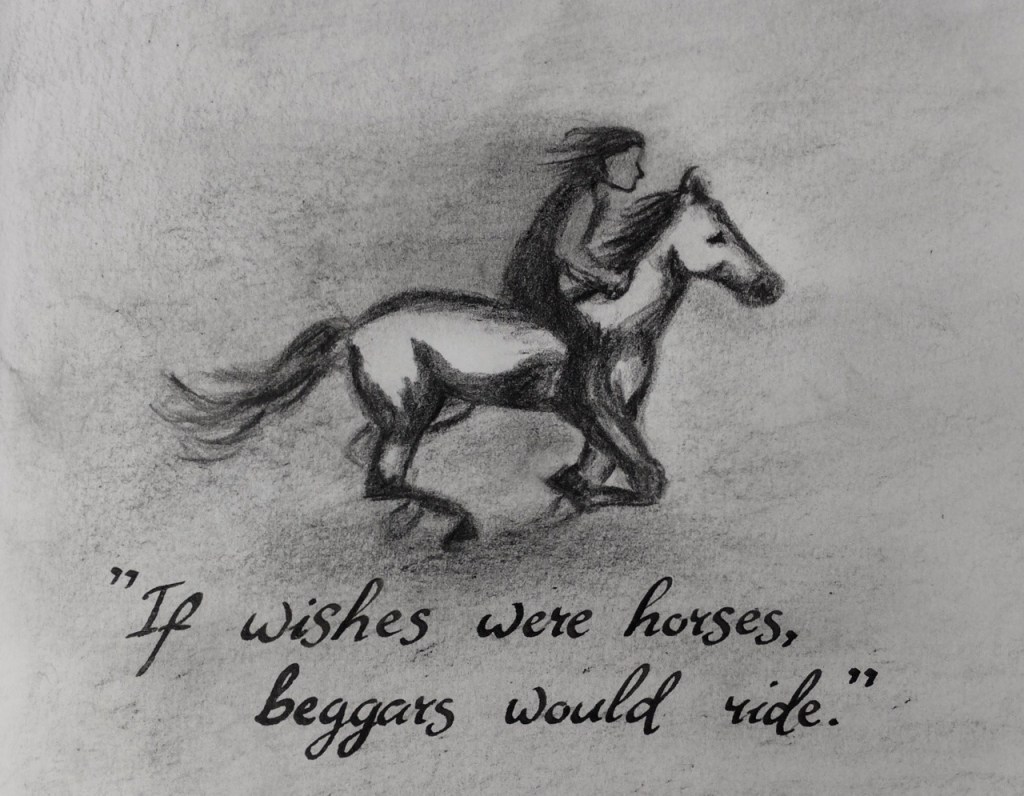
Four top litigation partners at Paul, Weiss have walked out the, together with their associates, their paralegals, their secretaries, and their book of business. In my experience, this sort of thing happens all the time at the big firms, even without cowardly deals capitulating to a would-be tinpot dictator. I wish I were persuaded that the walkout was over the Trump deal—and that it presages severe harm to the Cowardly Nine firm—but if wishes were horses, we’d all take a ride.
And if you don’t like my hot take on the matter, then ask perplexity.ai “Does the departure of four litigation partners at Paul Weiss mean anything?” Their AI chatbot’s opinion is quite different from mine.
According to statutory law, a president cannot fire, without cause, a member of the National Labor Relations Board or of the Merit Systems Protection Board. Trump did it anyway. The lower courts told him to reinstate the two individuals, pending a final decision on the merits. Over the dissent of the three liberals, the rest of the court ordered that, until the case is decided on the merits, the two fired officials can stay fired.
The legal issues are a teense complex, and if you’re interested, check out this article from SCOTUSblog.
My hot take: A majority of the Supreme Court seems to be getting ready to shitcan a century of precedent, and to destroy the independent status of heretofore independent agencies like the Federal Trade Commission.
Nothing good for Trump. Harvard filed a new lawsuit against Team Trump, challenging the Administration’s refusal to allow any foreign students next year. The judge granted Harvard a preliminary injunction so fast that he barely had time to read the papers.
Another judge granted Jenner & Block’s request for a preliminary injunction against Trump. And a third judge ruled that Trump had acted illegally against the United States Institute of Peace.
Finally, Prof. Mitchell Berman of the University of Pennsylvania reminds us that No, Trump can’t force his agenda on U.S. entities. They have rights: The government cannot withhold benefits because it doesn’t like how people exercise their rights.
 Facing MAGA