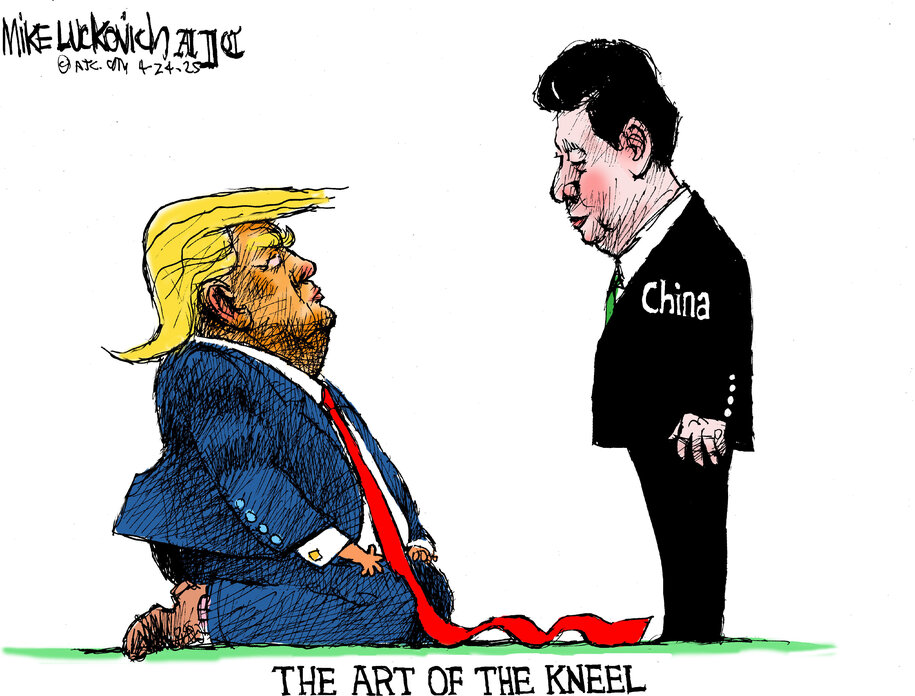
President Donald Trump said Friday that the United States could lower tariffs on China to 80 percent [instead of 145 percent] ahead of a meeting this weekend between his top aides and their counterparts from Beijing. …
The president’s apparent eagerness to get a deal reflects the mounting economic damage from the tariffs he has imposed thus far. China said its exports to the United States dropped 21 percent in April from a year before, and economists have forecast an increased likelihood of a U.S. recession. White House officials have grown alarmed by Chinese curbs on exports of rare earth minerals, used to make military drones, consumer electronics, electric cars and other important products.
The Constitution has this to say about the presidential oath of office:
Before he enter on the Execution of his Office, he shall take the following Oath or Affirmation: – “I do solemnly swear (or affirm) that I will faithfully execute the office of President of the United States, and will to the best of my ability, preserve, protect and defend the Constitution of the United States.”
The Constitution has this to say about the role of the courts:
The Judicial Power of the United States, shall be vested in one supreme Court, and in such inferior Courts as the Congress may from time to time ordain and establish. The Judges, both of the supreme and inferior Courts, shall hold their Offices during good Behavior … The Judicial Power shall extend to all Cases, in Law and Equity, arising under this Constitution [or] the Laws of the United States …
Meanwhile, the New York Times explains in some detail how “a deep bench of conservative lawyers” are working for Harvard. I touched on this topic in an earlier post, but the Times has more resources to fill out the story in detail, as compared with one old guy like me sitting in his man cave with a computer and an internet connection.
For what it’s worth, I disagree with the last paragraph of the Times article, wherein someone is quoted as saying that judges might feel “manipulated” if someone hires lawyers with whom they agree ideologically and who are their friends. Well, I suppose that could happens. And I suppose there could come a time when God stops making little green apples and it stops raining in Indianapolis in the summertime.
In other news, also good, Abbe Lowell, Esquire, has left Winston & Strawn (a Big Law firm known as a business litigation powerhouse) and formed a new firm to represent people and institutions targeted by Trump. Some of the associates in his new firm, Lowell & Associates, come from big firms that have bowed the knee to Mango Mussolini.
A big news item on Friday evening was Judge Beryl Howell’s 100+ page opinion granting summary judgment to Perkins Coie in its suit to undo Trump’s executive order against it. Dog Bites Man: no, said the judge, to a Team Trump ignorant of the basic rules of constitutional law, it won’t do to retaliate against a person or an institution for exercising their constitutional rights, said the judge. And, she added, “If the founding history of this country is any guide, those who stood up in court to vindicate constitutional rights and, by so doing, served to promote the rule of law, will be the models lauded when this period of American history is written.”
I said I would let you know when we get to the Man Bites Dog news. We’re here. And that news is all good, too.
The American Civil Liberties Union represented the people about to be deported. I have not seen their brief, but I strongly suspect they argued their case in terms designed to appeal to the district judge, to the Fifth Circuit Court of Appeals, and to the majority of the Supreme Court.
Good for the ACLU. They’re arguing to win their case—not to make themselves popular in the faculty lounge at Harvard Law School or at the progressive table here at Happy Acres.
Finally, some will say it would have been better if Judge Rodriguez had enjoined Team Trump throughout the nation, not just in the Southern District of Texas. But the judge may have believed those who argue that he lacked jurisdiction to issue a nationwide injunction. Or, he may have just wanted to keep the issue really, really simple, as the case moves forward on appeal.
In any event, the case is ripe and ready for appeal, as is Judge Howell’s decision in the Perkins Coie litigation.
When big law firms attacked by President Trump decided to make a deal with him rather than fight, many did so because their leaders feared that clients would abandon a firm caught on the administration’s bad side.
Now that logic may be getting less compelling. A major company, Microsoft, has dropped a law firm that settled with the administration in favor of one that is fighting it. …
On April 22, several attorneys at the law firm Simpson Thacher & Bartlett informed the Delaware Court of Chancery that they would no longer be representing Microsoft in a case related to the company’s 2023 acquisition of the video game giant Activision Blizzard, according to court filings.
Simpson Thacher reached a deal with the White House last month in which the firm committed to perform $125 million in free legal work for causes acceptable to the Trump administration. In a joint statement with other firms making similar agreements, Simpson Thacher said the pro bono work would be on behalf of “a wide range of underserved populations.”
On the same day that the Simpson Thacher lawyers filed paperwork withdrawing from the Microsoft case, at least three partners at the firm Jenner & Block informed the court that they would be representing Microsoft in the case. Jenner is fighting in court to permanently block a Trump administration executive order targeting its business. …
In some cases, a client may worry that a law firm that has reached a deal with the White House has a conflict of interest that prevents it from aggressively representing the client. For example, the client may be a defendant in a lawsuit brought by the federal government and worry that a settling law firm would be reluctant to stand up to the administration.
Other clients may have broader concerns. A senior partner at another firm that does not have an agreement with the White House said his firm was beginning to attract clients from firms that had settled with the administration. The partner, who was not authorized to discuss client matters publicly, said prospective clients had indicated that they had lost confidence in settling firms for not standing up to an attack on the rule of law.
Some firms challenging the administration have sought to capitalize on this frustration, suggesting that their pushback reflects a commitment to fight on behalf of their clients as well.



 Facing MAGA