Rahm Emmanuel Analyzes the Manosphere—and Lays Out His Campaign Platform for a Presidential Run

Rahm Emmanuel (Washington Post), What’s really depressing America’s young men: The U.S. has two overlapping problems: the housing crisis and despondency in young men. Emmanuel writes,

The United States today is engaged in two conversations that appear, at first blush, to be entirely unconnected.

The first focuses on men and boys. As Richard Reeves, founder of the American Institute for Boys and Men, has highlighted, younger-generation American males are increasingly despondent. The stereotype is of young men perpetually playing video games in their parents’ basements, too depressed and shut in to ask women out. But such exaggeration shouldn’t eclipse the broader and more subtle reality. You don’t have to be an incel to believe that the “system” is fundamentally broken and rigged against your success.

Separately, city and state leaders everywhere are focused on the housing crisis — specifically homeownership. Rents are too high, and even the most ordinary houses are astronomically expensive. Zoning is exclusive, interest rates are too high, and the legacy of redlining lives on. Worse, new home construction has dropped to a five-year low. We’re not building enough homes to keep up with demand, and even if we were, those just starting off wouldn’t be able to comfortably afford them.

These patterns are two sides of the same coin. Just 30 years ago, the median age of first-time home buyers was 28. Today, it’s 38. In 2000, the typical price of a single-family home was three times a family’s annual income; today, it’s six times. The effects are clear: In Germany and Spain, where real estate prices have climbed more modestly over the past 30 years, the percentage of young adults who report regularly experiencing worry, sadness and anger has largely remained steady. In the United States, however, where home prices have risen 85 percent, one-third of young adults now report a sense of despondency.

This is, of course, a problem for all Americans — men and women alike. But, unpopular as it might be to say in some quarters of my party, the crisis affects one gender with particular potency. Like it or not, American men are still raised to believe that their role is to act as providers and protectors. And when men whose self-worth is tied up in that aspiration realize they’ll never be able to buy a home, they’re bound to feel shame and anger.

The American Dream can’t live up to its name when only a tenth of the population has a shot at it. The dream has become unaffordable and inaccessible in a way that Democrats should declare unacceptable. Democrats talk all the time about democracy being on the ballot. But the solution won’t be found only in registering more voters or making mail-in balloting universal. The problem is that real generation-over-generation prosperity is harder to achieve today. This shouldn’t be some mystery: American democracy became unstable at almost exactly the same time the American Dream became unaffordable. And because that’s not a coincidence, we need to tackle the homeownership challenge head-on.

This isn’t a marketing problem. It’s not just a matter of Democrats finding our own Joe Rogan, or making better use of TikTok, or using more “authentic” language. Of the necessities for which prices keep rising — gasoline, groceries, health care — housing is first among equals. And if Democrats want to save our democracy while simultaneously fighting against economic inequality, we need to address the primary source of half the country’s humiliation and anger.

This challenge didn’t emerge overnight. To understand its roots, look no further than the 2008 financial crisis. As the mortgage bubble burst, millions of families lost their homes explicitly because Wall Street had rigged the system. And yet the bankers who participated in the rigging demanded their annual bonuses — and in most cases received them.

As White House chief of staff under President Barack Obama, I advocated Old Testament justice. I wanted to hold the bankers who sold liar loans accountable. But my arguments on a Saturday afternoon in the Roosevelt Room were overruled, perhaps wisely, so that Democrats could first pursue health care reform. Though we later instituted the Dodd-Frank financial reforms, no one ever went to prison — adding insult to injury. You can draw a straight line from that outrage to the tea party and, eventually, to the candidacy of Donald Trump, who promised to be an instrument of “your justice [and] retribution.”

If there’s any silver lining to the housing crisis, it’s that, unlike so many of our national challenges, it’s solvable. Unlike the rise of China, or the specter of AI, or the scourge of global climate change, we don’t need a new batch of policy tools or institutions to help working-class families purchase their first homes. We’ve done this before.

A century ago, mortgages were unaffordable to the broad mass of potential buyers. President Franklin D. Roosevelt and the New Deal responded by engineering a system that made 30-year fixed-rate loans that amortized the principal accessible to most home buyers — an effort that then evolved to encompass Fannie Mae and Freddie Mac. Not long thereafter, the government enacted the GI Bill for World War II veterans. Details of the housing market are different today, but the fundamentals are the same. So let’s apply the lessons.

First, much as we treat veterans as a population apart when it comes to home-buying, we should treat first-time home buyers as their own class. To make it easier for them to reach that first crucial rung on the ladder to economic prosperity, we should reinstitute the Obama administration’s $8,000 homebuyer’s tax credit, triple it to reflect present market conditions and index the benefit to inflation. Second, we should explore ways to make it possible for first-time home buyers to take out mortgages at favorable interest rates.

Third, in learning from the recent successes Texas and California have had with state-level reforms making land cheaper and zoning more streamlined, we should champion federal policies that incentive housing production. Texas now allows housing on land zoned for commercial use statewide; California just enacted a bill making infill housing much easier to construct. As Sens. Elizabeth Warren (D-Massachusetts) and Tim Scott (R-South Carolina) have proposed, the federal government should be rewarding states and localities that embrace supply-side solutions.

Tackling homeownership head-on is poised to be the ultimate example of how good policy turns out to be good politics. As data expert David Shor found in his analysis of the 2024 presidential race, the best moment of Kamala Harris’s campaign coincided with the decision to air television spots focused on housing costs. Today, the stock market is near an all-time high, CEOs are paid nearly 300 times the wage of average workers, and the uber-rich are building personalized spaceships. Yet young couples can’t afford a down payment for their first home.

The vast majority of Americans once believed they could enter the middle class by working hard and playing by the rules. Now, a burgeoning percentage of young people feel as though they’re running in place and getting nowhere fast. The hope of owning a little slice of the future is woven deeply into our national psyche. And the Democratic Party’s success hinges on our ability to enable men in particular to realize that hope and ensure their own success.

J.D. Vance is an Inveterate Liar. Happily, He is also the World’s Most Incompetent Liar.

The Guardian, JD Vance’s attempt to link Democrats to Epstein renews calls to ‘release the files’: Vice-president tries to deflect criticism and blames Biden for doing ‘absolutely nothing’ about convicted sex offender. The Guardian writes,

Four days after JD Vance reportedly asked top Trump administration officials to come up with a new communications strategy for dealing with the scandal around the late convicted sex offender Jeffrey Epstein, he appears to have put his foot in it, sparking a new round of online outrage even as he tried to defuse the furor.

In an interview with Fox News broadcast on Sunday, the vice-president tried to deflect criticism of the administration’s refusal to release the Epstein files by blaming Democrats. He accused Joe Biden of doing “absolutely nothing” about the scandal when he was in the White House.

“And now President Trump has demanded full transparency from this. And yet somehow the Democrats are attacking him and not the Biden administration, which did nothing for four years,” he said. Epstein’s former girlfriend, Ghislaine Maxwell, was convicted of conspiring with Epstein to sexually abuse multiple minor girls and sentenced to 20 years in federal prison during the Biden administration.

If Vance’s attempt to switch public blame onto Democrats was the big idea to emerge from his strategy meeting with attorney general Pam Bondi and FBI director Kash Patel, which according to CNN he convened at the White House last week, then their labours appear to have backfired. (Vance denied to Fox that they had discussed Epstein at all, though he did acknowledge the meeting took place.)

Within minutes of the Fox News interview being broadcast, social media began to hum with renewed cries of “release the files!”

Clips of Vance smearing Democrats quickly began to circulate on X. “We know that Jeffrey Epstein had a lot of connections with leftwing politicians and leftwing billionaires … Democrat billionaires and Democrat political leaders went to Epstein island all the time. Who knows what they did,” he said. Vance also repeated Trump’s previously debunked claim that Bill Clinton had visited Epstein’s private island dozens of times. Clinton has acknowledged using Epstein’s jet, but denied ever visiting his island.

“Fine. Release all the files,” was the riposte from Bill Kristol, the prominent conservative Never Trumper who urged the documents to be made public with “no redactions of clients, enablers, and see-no-evil associates”.

Jon Favreau, Barack Obama’s former head speechwriter, replied: “Release the names! Democrats, Republicans, billionaires, or not. What are you afraid of, JD Vance?”

Favreau added that Trump’s name “is in the Epstein files”. That was an apparent reference to a report in the Wall Street Journal last month that a justice department review of the documents conducted under Bondi had found that the president’s name did appear “multiple times”.

Other social media users used the Fox News interview as an excuse to re-run video of Trump in the hosting Epstein and Maxwell at Mar-a-Lago.

Epstein died in August 2019, during Trump’s first presidency, while the financier and socialite was awaiting trial in a Manhattan jail; the death was ruled a suicide.

The White House has been caught in a bind over the Epstein affair which spawned conspiracy theories among many of Trump’s supporters, which now senior figures in the administration had actively encouraged during the 2024 campaign.

In July the justice department announced that there was no Epstein client list and that no more files would be made public, a decision that clashed with earlier statements from top Trump officials, including Bondi’s statement in February that a client list was “sitting on my desk right now to review”. The decision triggered an immediate and ongoing uproar that crossed the partisan political divide.

Among the most viral clips in the aftermath of that reversal was video of Vance himselftelling the podcaster Theo Von, two weeks before the election: “Seriously, we need to release the Epstein list, that is an important thing.”

In his Fox News interview Vance also warned that “you’re going to see a lot of people get indicted” after Trump accused Obama of “treason” and called for his predecessor to be prosecuted.

The director of national intelligence, Tulsi Gabbard, has passed documents to the justice department that she claims show that the Obama administration maliciously tried to hurt Trump by linking Russian interference in the 2016 election to him.

Obama has dismissed Trump’s call for his prosecution as weak and ridiculous.

How J.D. Vance Sees the Base:

What the Base is Actually Thinking:

Ghislaine’s Life at Club Fed—And an Observation on Minimum Security Prisons and Flight Risk Inmates

A Flight Risk

Ghislaine asked the judge for bail, before her sex trafficking trial. The judge said no, describing Maxwell as “the very definition of a flight risk,” citing

  • prior evasion of law enforcement,
  • vast wealth, from undisclosed sources,
  • multiple passports, and
  • the seriousness of the charges.
A Minimum Security Prison

Club Fed—the women’s prison camp at Bryan, Texas, is a minimum security facility. There are fences, but they aren’t very high. Sometimes the inmates, or at least the well behaved ones, are allowed outside. 

I would not be shocked if Ghislaine just disappears, after a time. 

Meanwhile, her life will be greatly improved. Thanks to Drudge for referring is to this reporting from The Telegraph:

Puppy prison: Inside Ghislaine Maxwell’s new home

British socialite will have freedom to roam expansive grounds, earn money to spend on cosmetics and train dogs to become service animals

When Ghislaine Maxwell was convicted of sex trafficking underage girls to the paedophile Jeffrey Epstein in December 2021, her victims rejoiced, no doubt imagining the British socialite under lock and key, wearing orange overalls.

But the reality of Maxwell’s life behind bars is very different.

Having been transferred to a minimum security prison in Texas from Florida, Epstein’s ex-girlfriend can spend the rest of her 20-year sentence cuddling puppies and pampering herself with anti-ageing face creams.

Similar to the upmarket retreats she no doubt grew accustomed to during her former life of luxury, the Federal Prison Camp (FPC) Bryan in Texas offers yoga classes and a fully-stocked gym.

Described as a “luxury” facility by her victims, Maxwell will be rubbing shoulders with other wealthy inmates and can spend the earnings from her prison jobs on cosmetics.

Bryan grants its female prisoners the freedom to roam the facility’s expansive grounds with limited to no perimeter fencing to pen them in. There are gardening opportunities for the green-fingered criminals.

The 37-acre all-female facility, located 100 miles outside of Houston, is home to 635 inmates, according to the prison’s website, most of whom are serving time for non-violent offences and white-collar crimes.

Inmates sleep in bunk beds with four people per room.

Julie Howell, 44, who self-surrendered in July to serve time at Bryan, said that the prison is “nothing like you see on TV or in the movies because it’s a camp, which only houses non-violent offenders”.

Since arriving, she has enroled in the “puppy programme”, which involves playing with a 12-week old Labrador all day and even sleeping in the same room as each other, she wrote on Facebook.

The prison has a partnership with Canine Companions for Independence, which allows prisoners to train dogs to become service animals and is said to “boost the inmates’ morale, provide them with a sense of responsibility and improve overall behaviour”, according to the programme’s website.

“We do water and mud play and keep them busy from morning until night with some kennel rests in between,” Mrs Howell said.

“This is my ‘job’ while I’m here and it’s literally 24/7 as the puppies stay in the room with us. It’s me, my bunkie, and a puppy and we have to supervise the puppy at all times…I absolutely love it.”

Besides Maxwell, the prison’s celebrity clientele includes Elizabeth Holmes, the founder of Theranos, who is serving an 11-year sentence for defrauding investors by falsely claiming her company’s blood-testing technology was revolutionary.

Jen Shah, the Real Housewives of Salt Lake City star, is also doing a six-year stretch for conspiracy to commit wire fraud.

Other high-profile inmates include Michelle Janavs, the Hot Pockets heiress, who served five months in Bryan for bribing university officials to inflate her daughters’ exam scores.

Lea Fastow, the wife of Enron chief executive and fellow convicted felon Andrew Fastow, also spent 11 months at the facility in 2005 for tax fraud after the Texas energy company collapsed.

Holmes and Shah have each been pictured exercising in the prison camp’s grounds, with the latter’s team sharing an image of her skipping in May while wearing grey workout gear.

“I am in great spirits and well,” she captioned the post. “I wanted to share a personal image that I mailed to my team of one of my shah-mazing workouts.”

The facility is among the best in the country for convicts to serve time in, according to multiple lists compiled by inmates’ rights groups.

According to the prison handbook, life at the prison is centred around work, with prisoners earning up to $1.15 an hour for their jobs – many of which involve food service and factory work. These can even be off-site opportunities, for the best behaved prisoners.

They can spend up to $360 a month of their earnings during assigned shopping days at a commissary, which sells beauty products including L’oreal Revita anti-ageing cream for $26.00, a Kerasal nailcare product for $20, and chest binders for trans prisoners for $26.

Beyond work, inmates may take classes on foreign languages, gardening and beautification. They can play sports, watch television and attend religious services. They are also granted freedoms not available in most low security prisons, including more relaxed visiting hours and more time outside, and lower guard-to-inmate ratios.

For inmates trying to trim down, the prison has a gym kitted out with treadmills, elliptical trainers, stairmasters and a range of weights.

Outside, convicts can take part in sports including football, table tennis, softball, volleyball, weightlifting, yoga, Pilates and the Jumpstart weight loss programme. There are also picnic tables, bleachers and televisions available for prisoners to wind down.

The Bryan prison camp also subscribes to rehabilitation programmes, such as one called “assert yourself for female offenders”, where “women learn to be assertive without trampling the rights of others”, according to a DoJ document from 2020.

As she embarks on life at the new facility, Maxwell will rise at 6am each day for a roll-call with the other female inmates and will have to dress in a prison-issue khaki shirt and fatigues, according to the handbook.

Inmates are permitted to have one approved radio or MP3 player and can wear minimal jewellery, such as a plain wedding band or a chain worth under $100.

Breakfast consists of a choice of a hot or continental-style breakfast, while the lunch and dinner menu offers standard federal prison fare consisting of chicken, hamburgers, hotdogs, macaroni and tacos.

Inmates are also allowed visitors during weekends and holidays, but along with other inmates, Maxwell would be allowed only limited physical contact with friends and family.

Maxwell’s victims blasted the decision to allow her to move prisons, saying the move “smacks of a cover up”.

“Ghislaine Maxwell is a sexual predator who physically assaulted minor children on multiple occasions, and she should never be shown any leniency. Yet, without any notification to the Maxwell victims, the government overnight has moved Maxwell to a minimum security luxury prison in Texas,” the statement said.

“The American public should be enraged by the preferential treatment being given to a pedophile and a criminally charged child sex offender.

“The Trump administration should not credit a word Maxwell says, as the government itself sought charges against Maxwell for being a serial liar. This move smacks of a cover up. The victims deserve better.”

The reason for her move to the less secure facility remains unclear, but comes a week after she was interviewed by Todd Blanche, Donald Trump’s deputy attorney general, about information she holds on the Epstein Files.

Capitalising on the recent attention her case has drawn, Maxwell’s legal team have said she is willing to testify before Congress in exchange for a presidential pardon or having her sentence commuted – a possibility Mr Trump has not ruled out.

Ghislaine Moves to Club Fed

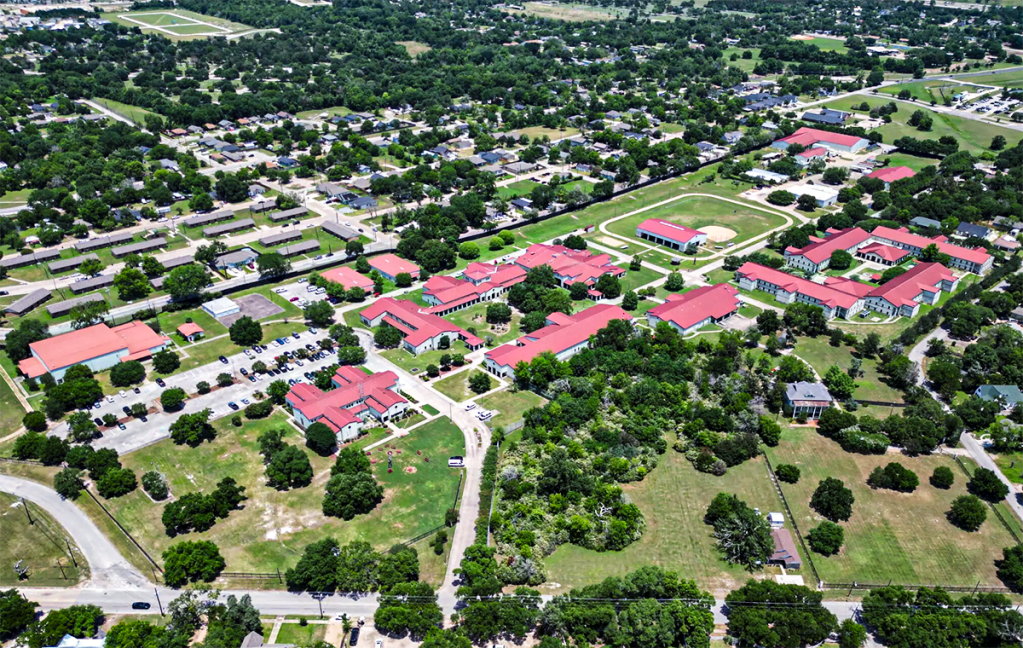
Pictured above is Ghislaine Maxwell’s new home—the federal women’s prison officially called the Federal Prison Camp, Bryan [Texas] and unofficially known as Club Fed. 

On December 21, 2021, Ms. Maxwell was convicted of five counts of sex trafficking—charges that could have resulted in 65 years’ imprisonment. The prosecutors asked for 30 years. The judge gave her 20. In July, 2022, she began serving her sentence at the Federal Correction Institution, Tallahassee. 

CNN writes,

Maxwell’s transfer to a minimum-security prison is relatively uncommon, as those convicted of sex offenses are almost always deemed too high of a risk to public safety. That means that those inmates are at best assigned to a low-security prison. …

The move comes a week after Maxwell met in private with Deputy Attorney General Todd Blanche at the US attorney’s office in Tallahassee. Details of that meeting have not been made public, though her lawyer has said that Maxwell “honestly answered every question that Mr.  Blanche asked.”

Murphy declined to give any explanation for Maxwell’s move. The Justice Department has not responded to questions from CNN. …

A minimum-security prison camp, like in Bryan, is the least-restrictive type of facility among federal prisons, housing inmates considered to be low-risk, non-violent and unlikely to escape. Camps have very little or no fencing containing the inmates, and inside they are able to move relatively freely.

Other inmates in the camp for women include Jen Shah, who was on the TV show “Real Housewives of Salt Lake City,” and Elizabeth Holmes, formerly of the blood-testing company Theranos.

For an inmate like Maxwell to be transferred into a minimum-security prison, a top official inside of the Bureau of Prisons would need to conclude that her risk to public safety has lowered based off recommendations from prison staff or good behavior. That official, the administrator of the Designation and Sentence Computation Center, makes those determinations, according to the BOP.

The agency declined to explain the specifics of how Maxwell’s reassignment was handled.

Maxwell’s new facility, a federal prison camp, has limited perimeter fencing, a low staff-to-inmate ratio, and is “work- and program-oriented,” according to the [Bureau of Prisons] website.

So, Club Fed is the Quid—But What’s the Quo?

Thing things about Ghislaine and her new prison home. Thing One: It’s a damn sight better for her than her old prison in Tallahassee. Thing Two: It’s a favor that Trump and his minions can take back at any time. Thing Three: The fact that Trump granted the favor—without any explanation or plausible reason, and given the ongoing Epsteingate saga—makes Trump look really, really bad. 

In sum: big upside for Ghislaine, but downside for Orange Mussolini.

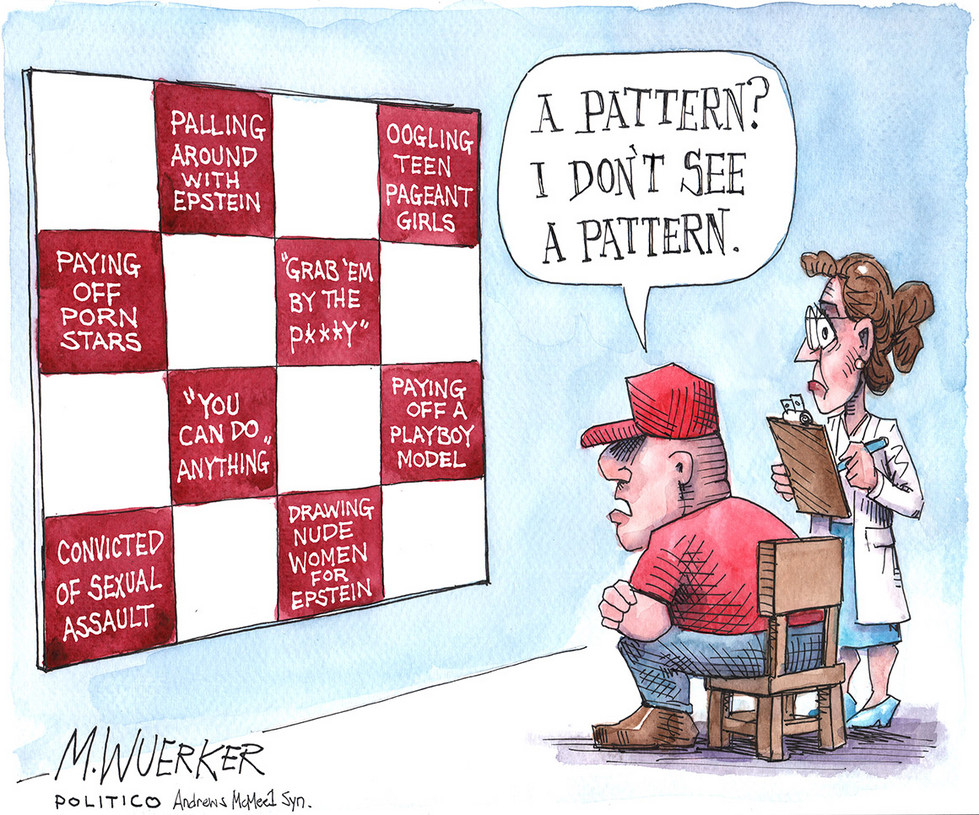
For those who shave with Occam’s razor, there’s only one possible explanation: Trump needs Ghislaine to zip her lips and keep ‘em zipped, because she knows things that would, at the very least, be seriously embarrassing to His Most High Excellency. 

But Orange Mussolini, it must be remembered, is a man virtually without shame. He shamelessly admits to groping women by the genitalia. He shamelessly admits to barging into the dressing room at the Miss Teenage USA Pageant and taking a good look. 

The mind boggles at what new shameful information might concern him now. It must be a hell of a secret.

The Wall Street Journal Editorial Board Would Like to Let You Know That the Trump Economy is Stumbling

The Journal’s Editorial Board writes, 

The Trump Economy Stumbles

The President has his new world tariff order in place, but jobs and growth don’t look so good.

President Trump has now imposed his new tariff regime on the world, and the triumphalism is palpable in MAGA land. But maybe hold the euphoria, as this week’s reports on jobs and the economy suggest the new golden age may take a while to appear. 

Friday’s labor report arrived with a particular jolt, with a mere 73,000 net new jobs in July. Even more bearish were the downward revisions of 258,000 jobs in May and June. Job gains over the last three months are barely more than 100,000.

The details in the report provide little solace. The jobless rate ticked up only to 4.25% from 4.1%, but that was in part because the labor force continued to shrink. The labor participation rate fell again to 62.2% and is now down half a percentage point in a year.

Employers aren’t laying off workers, but they have all but stopped new hiring. Notably, most of the new jobs are in healthcare and social assistance, which rely heavily on government spending. This continues the Biden-era trend that Trumponomics was supposed to change. Not so far.

The much-advertised rebirth of U.S. manufacturing also hasn’t arrived. The economy shed 11,000 manufacturing jobs in July, following a loss of 26,000 in May and June. The ISM Manufacturing Index fell again in July to 48, the fifth straight month below 50. 

One labor market problem may be the crackdown on migrant workers. The foreign-born workforce has fallen by about a million since Mr. Trump took office. The National Foundation for American Policy, a nonpartisan think tank, says immigrants accounted for over half of the labor force increase in each of the last three decades. Fewer workers means fewer new jobs as employers conclude they can’t fill them.

***

How much of this jobs and growth slowdown owes to Mr. Trump’s tariffs? It’s hard to say for sure. But it has occurred in the wake of Mr. Trump’s April 2 tariff shock, his rapid backtrack from the highest rates, and then his willy-nilly threats and deal-making with the world. The policy uncertainty has surely affected business hiring and investment. How can you hire or invest if you don’t know what your cost of goods will be, or from which supplier you will be able to buy at a competitive price?

On that score, Mr. Trump’s latest tariff blast this week hasn’t put an end to the uncertainty. Much of the world will now pay 15%, if Mr. Trump sticks to his deals. But some of the biggest U.S. trading partners—Mexico, Canada, China and India—remain in tariff limbo. Brazil will pay 50%, though it has a trade surplus with the U.S. And what did Switzerland ever do to Mr. Trump to deserve 39%? Charge too much for a watch?

Mr. Trump and his supporters are hailing the trade deals as the dawn of a new world trading order that will be better for American workers. And it’s true that the rest of the world has declined to retaliate, China excepted. The U.S. market is so large that these countries seem willing to absorb the 15% tariff hit rather than risk even higher tariffs from Mr. Trump if they did retaliate.

But what matters will be the economic results over time. The U.S. economy is resilient, and perhaps it can absorb a new average tariff rate from 15%-20%, up from 2.4% when he took office in January. There will also be a clamor for wide exceptions.

But the tariff tax increase in dollar terms at Mr. Trump’s current rates will be close to $360 billion a year. That’s among the largest tax increases in recent history. Republicans have spent decades building credibility as the antitax party, but now they’re going along with Mr. Trump’s tariffs on the fiction that only foreigners will pay them. Let’s see how well that plays when prices on tariffed goods increase.***

Mr. Trump seems to understand that the jobs report signals trouble because on Friday he ordered the firing of the head of the Bureau of Labor Statistics. He claims the numbers are being politically manipulated, but he offered no proof. BLS has its problems, but the timing suggests he’s shooting the messenger. There are bound to be monthly revisions when tariff and deportation policies are so volatile.

Mr. Trump’s other scapegoat is the Federal Reserve, which he says has been too late to cut interest rates. Maybe that will prove to be true, but the Fed also has to navigate Mr. Trump’s tariff uncertainty and the large fact that inflation is still above its 2% target. Every public opinion poll says voters remain unhappy about the price increases they’re paying.

A saving grace, we hope, is that the new tax law and deregulation will reduce business costs and lift investment. But Mr. Trump can help by stopping his trade war. If he won’t roll back his tariffs, at least he can declare that he’s content with where they are and has no plans for more.

Alternative Facts

Megan McArdle (Washington Post), Trump should heed, not hide, the jobs numbers: Firing the Bureau of Labor Statistics commissioner won’t improve the U.S. economy

Business owners use labor statistics in making decisions about planning, hiring, and setting wages. From now on, these kinds of decisions will be based on unreliable data—or, certainly, data that are perceived as unreliable.

Politicians, and everyone concerned with politics, relies on labor statistics to inform them about whether the economy is healthy, unhealthy, or mediocre and as an essential source of information for setting monetary and fiscal policy. From now on, they will lack an important source of reliable information on which to base their decisions.

Career counselors, students, job seekers, and workers use BLS data as a significant source of information about salaries and job prospects. From now on, their ability to plan will be materially diminished.