
A Trigger Warning—and Some Disclaimers
The Trigger Warning: Some readers will be triggered by prose that, read superficially, might sound sympathetic to Chief Justice Roberts and to his sidekicks, Justices Coney Barret and Kavanaugh. Such readers may want to skip this post. In any event, they are requested not to throw food in my direction. Or, if they must, please pick the corn muffins we’re getting tonight, and take a pass on the bean soup and the pistachio pudding.
The Multiple Disclaimers: In this post, I’m not in the moralizing business, I’m not in the mind reading business, and I’m not in the prediction business. Not that moralizing, mind reading, and prediction are unimportant. They’re just not what I’m trying to do here. Here, I’m in the hypothesizing business. I’m in the trying-to-understand business.
The Three Court Factions
You can generally count on the three liberal justices to do the right thing. If you bet that Justices Thomas, Alito, and Gorsuch will do the wrong thing—and that Justice Gorsuch will camouflage the wrong thing with extensive verbiage made to superficially resemble legal scholarship—then you’re likely to win your bet. In the middle, that leaves the Chief Justice, along with Justices Coney Barrett and Kavanaugh. These three generally decide who’s going to win the case.
And, by the way, when I say “middle faction,” the word “middle” is not intended to be either favorable or pejorative. It just means they’re literally in the middle of the other two factions.
The Supreme Court and Trump’s Multiple Power Grabs
It appears that the rubber will soon meet the road, and that the Supreme Court is going to make some definitive rulings on, among other things,
- the proper construction of the emergency economic powers act that Trump has employed to justify his massive restructuring of American trade and world trade,
- Trump’s endeavor to rewrite the Constitution by fiat to eliminate birthright citizenship,
- Trump’s many violations of statutory law and constitutional due process in connection with immigration roundups,
- the Administration’s usurpation of the power of the purse, which, under the Constitution, belongs to Congress,
- Trump’s attempt to destroy the United States Civil Service,
- Trump’s attempts to use the National Guard and the military to take over big cities, and
- Trump’s effort to do away with the independence of independent agencies like the Federal Trade Commission.
The Vexed Question of the Shadow Docket
In introduced this topic in the immediately preceding post, which you may wish to read now, before proceeding further.
There are many reasons why it’s a vexed question. In the first place, the Court’s behavior contradicts what we learned in civics class—back when they taught civics in high school. We have checks and balances. When the president violates the law, the courts are supposed to check him. And indeed, lots of district courts and courts of appeal HAVE been checking Trump—but without a lot of support from the Supreme Court on its shadow docket.
Relatedly, the shadow docket is a vexed question from a technical legal standpoint. The Court is ruling on the validity of lower court decision on whether to grant a preliminary injunction pending trial and appeal, and that p.i. issue, in turn, is supposed to depend, in large measure, on “likelihood of success on the merits.” If the district court grants a p.i. against some Trump outrage, and if the court of appeals affirms, and if the Supreme Court majority then reverses the ruling, so that Trump can go on engaging in whatever horseshit he wants, pending trial, does that mean that the Supreme Court thinks Trump is right on the law and all the lower court judges are wrong?
Does it mean that the Supreme Court majority doesn’t give a tinker’s damn about checks and balances?
Does it mean that the majority wants to live in a country governed like Russia and Hungary?
Well, maybe it does mean some or all of those things.
Or—Possibly—Something Else is Going On
I continue to focus here on the middle faction of the Supreme Court—Justices Roberts, Coney Barrett, and Kavanaugh—not on the three wingnuts, and not on the three liberals. An alternative hypothesis to explain the middle faction’s strange behavior would go something like this.
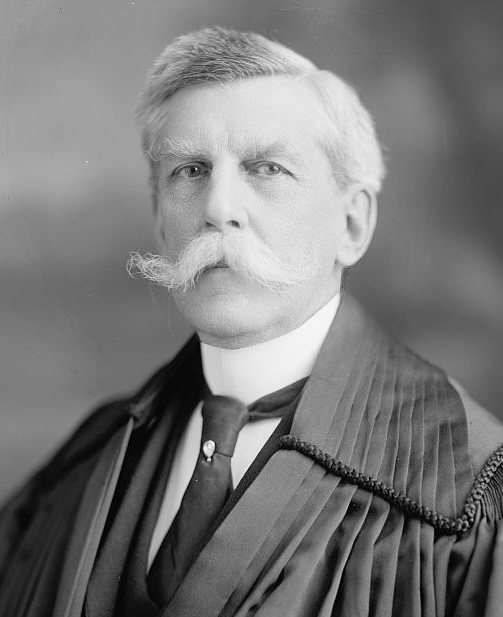
The middle faction would prefer to live in a constitutional republic governed under law, not in Hungary or Russia, but they are mindful that, to achieve that end, they have to preserve a certain level of public deference to court decisions. And, as Justice Oliver Wendell Holmes, Jr. (pictured above) said a century ago, the Court reads the newspapers.
Having read the newspapers, the middle faction knew that a reelected, pumped up Trump was going to try to grab power in all sorts of ways. They knew that if the Supreme Court intervened immediately and forcefully, there would likely follow an immediate and grave constitutional crisis.
The hypothesis continues: The middle faction reasoned that, instead of an immediate constitutional crisis, it would be better to wait a season; let the whole country, including the MAGA base, get a full taste of Trump’s policies; and let Trump’s political support dissipate.
2026, not 2025, would be right year for strong action to preserve the rule of law. Or so they thought, in the hypothesis presented here.
Remember, Y’all, It’s a Hypothesis
Remember, y’all, it’s a hypothesis. There’s no mind reading, there’s no moralizing, and there’s no prediction about how the Court will actually decide all those issues I mentioned above.
As far as predictions go, to quote the sage observation of President Eisenhower, “The future lies ahead.”
 Facing MAGA