
Ed Luce of the Financial Times writes,
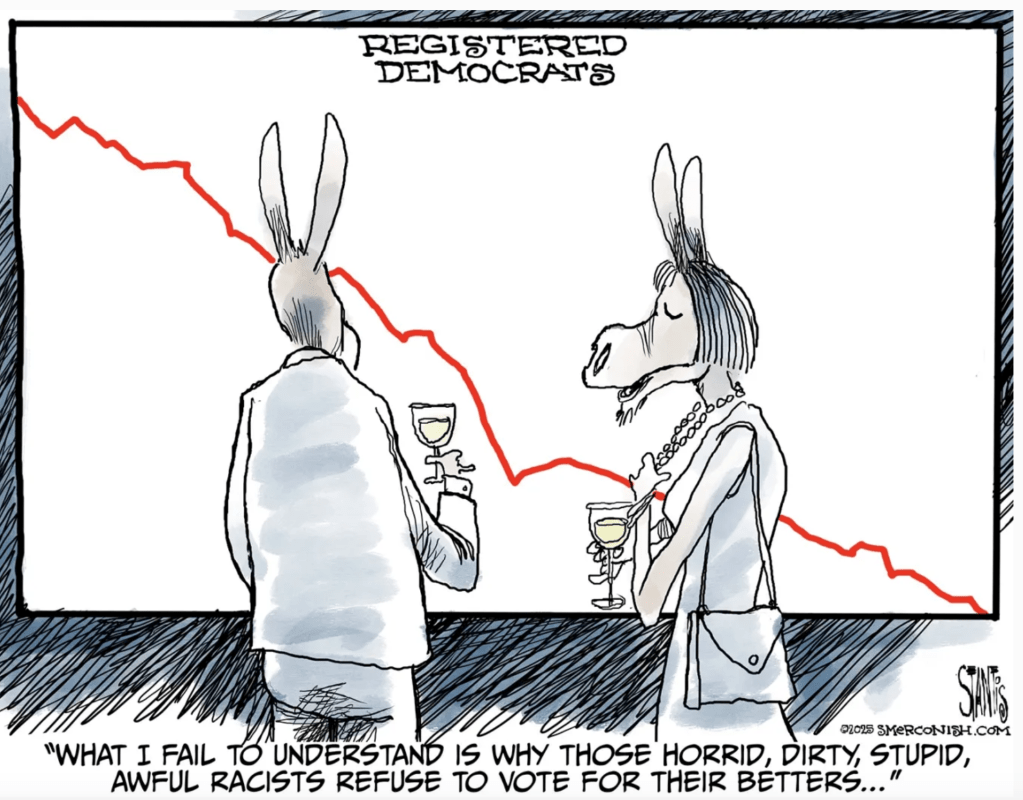
America has a conservative establishment. Its formal name is the Democratic party. Whether it be the federal government, universities, welfare or the regulatory state, Democrats fight to preserve the world as it is or was. “America is already great,” liberals cry, which is another way of saying that things were fine until Donald Trump came along. Their lodestar was Joe Biden, who personified nostalgia. Much of the party is now nostalgic for Biden. You have to be imprisoned in old ways of thinking to believe this is how US liberalism will rebound.
An invigorated US opposition would now be making hay. Trump’s team maintains a “promises kept” tally sheet. To be sure, he has in effect closed the border, demolished DEI quota culture, assaulted the deep state and launched trade wars against the rest of the world. But a big chunk of those who voted for Maga saw these moves as the means of lifting their economic prospects. The opposite is happening, which is why Trump’s numbers are in steady decline. Yet the fall in Democrats’ approval rating is even steeper. In relative terms, Trump’s political dominance has thus grown. Do not bet on a weakening economy changing that picture.
Trump’s genius is to keep pushing Democrats into reactive conservatism. That, plus the average age of the party’s leadership, makes Democrats look like permanently outraged grandparents. Trump’s assaults on pretty much every constitutional norm are indeed terrifying and outrageous. But they are remarkably inoculated against political backlash. To all intents and purposes, opposition to Trump has been reduced to a default outrage machine.
What is the solution? Democrats are a party of America’s professional elites plus various interest groups. And given that Trump won a majority of blue-collar voters, they are no longer the natural home of the working class. Any Democratic recovery would thus start by grappling with the latter’s worldview. The practical difficulty is that the party is shaped by elite professions, particularly law, government, media and academia. Such types often have a hard time concealing their distaste for those who voted for Trump. This is a poor starting point.
Democrats also face a deeper philosophical problem. Nobody knows how to reinvent 20th-century liberalism. In the US that was Franklin D Roosevelt’s 1930s New Deal, with updates over the next couple of generations. FDR built that world with “bold persistent experimentation”. His would-be heirs are stuck in a timid, persistent conservatism. They do not “welcome the hatred” of financial and business monopolists as Roosevelt did. They are the party of corporate America. No party in history could ever boast of so many expert fundraisers and humane philanthropists.
Lack of fresh ideas and cloistered demography are definitions of conservatism. If Trump did not exist, would Democrats want to reform the US administrative state? They should want to reinvent it but are now its militant defenders. A system that is so riddled with veto points that it takes years to execute simple projects and requires a PhD to navigate the tax system does not deserve to be defended. The same goes for a housing market that has priced younger voters out of the American dream and elite universities that are biased towards the children of alumni and donors. If Trump is attacking something, it must be defended to the hilt.
That Trump’s actions are destructive is no excuse. As political scientist Ruy Teixeira recently warned, Democrats are placing their chips on the “fool’s gold of midterm success”. Rather than seeking ways of reinventing a system in which America has lost faith, Democrats are betting on Trump’s defeat in next year’s congressional elections. The odds are that Republicans will lose the House of Representatives in 2026 and retain control of the Senate. Such midterm success would be a pyrrhic victory for Democrats. Biden based his 2024 re-election bid on his party’s relative success in the 2022 midterms. Look where that led.
A second piece of fool’s gold is to wait for Trumpism to die out with Trump. Even assuming that he does not launch a coup in 2028, Democrats would be unwise to think their problem will end with Trump. Familiarity with other democracies — Britain’s clueless Labour party, Germany’s moribund Social Democrats, France’s withered Socialists — shows that there is nothing unique to American populism.
The challenge for Democrats is to do what they should be doing were Trump not to exist. His superpower is to stop them from reaching that epiphany.



 Facing MAGA