Today, many talking heads are talking about the events in Los Angeles as a step on the road to authoritarianism—and an attempt to distract from Team Trump’s many failures.
All true.
And yet there remains an elephant in the room for Team Blue.
As a movement, we do not yet have a coherent and politically viable answer about
How to deal with the undocumented people currently present here,
or about
What the rules and procedures for political asylum ought to be,
or about
Apart from people with legitimate asylum claims, how many—and who—should be permitted to enter the United States.
Not to have coherent and politically viable answers to these questions is political malpractice.
Well, yeah. But the headline writer mistakenly assumes there’s a discernible goal toward which Trump has an actual strategy.
It is said that Christopher Columbus made three mistakes.
When he started out, he didn’t know where he was going.
When he got there, he didn’t know where he was.
When he came back, he didn’t know where he had been.
If you have no idea where you are going, it’s not meaningful to talk about your strategy for getting there. The ever insightful Ed Luce—who writes behind a pricey paywall—analyses the situation beautifully.
Smart money says that Donald Trump’s upside is that you know where he stands. That may be true on his love of grift and loathing of immigrants and trade deficits. When it comes to Trump and China, however, economists should drop their caveat about “all things being equal”.
Nothing to do with Trump’s China policy is predictable, let alone equal. Does he care about Taiwan? Let’s toss a coin. Does he want the US to decouple from China? Spin the roulette wheel. Trump’s supposed coming phone call with China’s President Xi Jinping is unlikely to lift our confusion. China is the ultimate Trump riddle.
You can hardly blame the Chinese for being wary of talking to him. In late April, Trump told Time that Xi had called him — “and I don’t think that’s a sign of weakness on his behalf”. No call had taken place.
Any reading by Trump of Xi’s psychology should thus be put down to an AI-style hallucination. China’s foreign ministry accused Trump of “misleading the public”, which by today’s standards was polite. But we should not mistake Xi’s avoidance of “wolf warrior” invective for submission to Trump in the tariffs war. China is not the UK. The Chinese are as confused about Trump’s endgame as everyone else.
If Xi does finally agree to a call with Trump — the first since he was inaugurated — the duelling Washington-Beijing readouts would make for interesting reading. It is almost impossible to imagine Xi agreeing to sit down for one of Trump’s reality TV Oval Office specials. That crapshoot has had big downside impacts on Ukraine’s Volodymyr Zelenskyy and South Africa’s Cyril Ramaphosa, and proved helpful to Canada’s Mark Carney and arguably to Britain’s Keir Starmer. Xi will never agree to run that gauntlet. Nor should he.
The China-US component of Trump’s on-again off-again trade war is in a category of its own. The rest are based on exaggerated or imaginary complaints. The EU is no likelier to concede that its value added tax is a trade barrier than Canada will admit to exporting fentanyl to the US. Both are fictions. By contrast, China’s dual-use technological ambitions pose a big geopolitical conundrum to America. How Trump addresses those — whether he scraps Joe Biden’s “small yard, high fence” restrictions on semiconductor trade with China — matters to everyone.
Yet we have little clue how much they concern Trump. The leverage goes both ways. The US could continue to restrict China’s access to AI technology and chips. But Trump has already relaxed some of this. Nvidia’s chief executive Jensen Huang is an influential advocate with Trump of further relaxation. On the other side, China has a stranglehold on the world’s rare earth supply that is critical to a wide range of US production. Trump claims China has reneged on last month’s deal to resume its exports of rare earths to the US. In that pause, Trump reduced his 145 per cent tariff on China to 30 per cent.
Will he ratchet tariffs up again if China does not lift its embargo? There is no way of knowing. Once upon a time Trump thought that the China-owned TikTok was a threat to US national security. Now he is keeping the social media app alive — with a possible view of a forced sale to a Trump business partner — against the wishes of Congress and the Supreme Court. As goes TikTok, so might go Trump’s China policy.
The same confusion reigns over Taiwan. Many voices in Trump’s administration urge a hardline defence of Taiwan. Pete Hegseth, the US defence secretary, said last week: “The threat China poses [to Taiwan] is real. And it could be imminent.” But few in the US or around the world take Hegseth seriously. Trump hired him to play Pentagon chief on TV. China is widely believed to be getting ready to launch an invasion of Taiwan by 2027. Hegseth could well have been speaking the truth. But you cannot assume he is credible. Trump has thus created a real national security risk by having a secretary of defence cry wolf.
Trump’s China uncertainty is also a tax on the global economy. France’s Emmanuel Macron spoke for many last week when he said: “We don’t want to be instructed on a daily basis what is allowed, what is not allowed, and how our life will change because of the decision of a single person.”
That was one way of putting it. Here is another from JPMorgan’s Jamie Dimon: “China is a potential adversary . . . But what I really worry about is us.” Dimon was tactful not to name the US president. On the conundrum posed by Trump’s erraticism, China and the rest of the world are as one.
Support for the law firms that didn’t make deals has been growing inside the offices of corporate executives. At least 11 big companies are moving work away from law firms that settled with the administration or are giving—or intend to give—more business to firms that have been targeted but refused to strike deals, according to general counsels at those companies and other people familiar with those decisions.
Among them are technology giant Oracle, investment bank Morgan Stanley, an airline and a pharmaceutical company. Microsoft expressed reservations about working with a firm that struck a deal, and another such firm stopped representing McDonald’s in a case a few months before a scheduled trial.
In interviews, general counsels expressed concern about whether they could trust law firms that struck deals to fight for them in court and in negotiating big deals if they weren’t willing to stand up for themselves against Trump. The general counsel of a manufacturer of medical supplies said that if firms facing White House pressure “don’t have a hard line,” they don’t have any line at all. …
Not long after Latham struck a deal in April, the firm’s chair, Richard Trobman, met with Morgan Stanley’s chief legal officer, Eric Grossman, people familiar with the meeting said. Grossman heard him out about the firm’s reasoning for striking a deal and acknowledged that companies have to do what is best for themselves.
Soon after that meeting, Grossman and other Morgan Stanley lawyers communicated to law firms targeted by the White House that hadn’t signed deals that they were looking to give them new business, the people familiar with the meeting said. …
A top legal executive at another company said she called partners at Paul Weiss before it cut its deal to reassure the firm she would remain loyal, even though doing so risked millions in government contracts. She was shocked when the firm chair Brad Karp announced a deal, she said, and her company has plans to move work away from Paul Weiss.
The day after Paul Weiss struck its deal, female general counsels gathered for a conference in Washington. During a panel at the Women’s General Counsel Network event, a lawyer stood up and said her company had taken steps that morning to pull its business from Paul Weiss. The lawyer received thunderous applause.
About two weeks later, McDonald’s told a court that star Paul Weiss lawyer Loretta Lynch was withdrawing as its attorney in a high-profile lawsuit accusing the fast-food giant of discrimination against Black-owned media companies. Lynch, who had served as attorney general under former President Barack Obama, had been involved with the case for several years. It is unusual for companies to shake up representation close to trial. …
Emotions have run high inside some firms that struck deals, particularly among younger lawyers. At Skadden, Simpson, Latham and Kirkland, some associates have quit over the deals. One associate leaving Simpson wrote in his departure email, shared on LinkedIn, that he refused to “sleepwalk toward authoritarianism.” Partners, too, have left some of the firms that made deals.
At Sullivan & Cromwell, some lawyers have bristled at the role that co-chair Robert Giuffra played in facilitating a deal for Trump to drop an executive order against rival firm Paul Weiss. Giuffra, one of Trump’s personal lawyers, participated by phone in an Oval Office discussion with the Paul Weiss leader, who was there to work out a deal.
The New York Times Does a Deep Dive Into the Legal Issues Raised by Trump’s Purported Invocation of the International Economic Emergency Powers Act
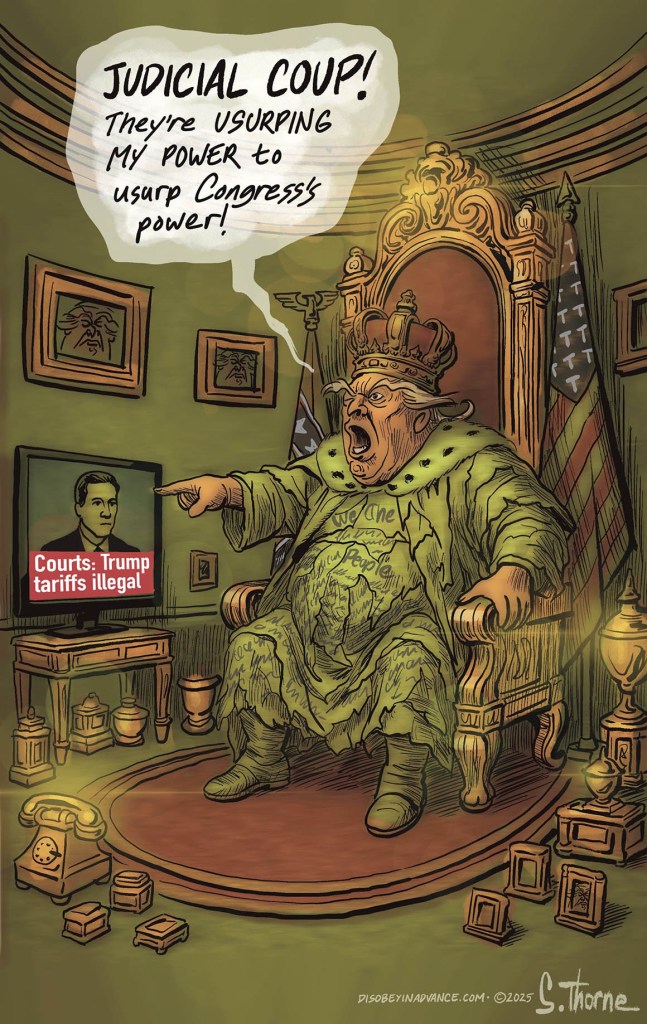
This is a legally sophisticated yet understandable exposition of the legal issues. Despite the Times’ headline, the article shows how there is a large degree of bipartisan agreement among legal scholars that Trump’s tariffs are unconstitutional.
That bipartisan agreement should help the Supreme Court if and when it rules against Trump on the tariffs.
And, apart from the legal niceties, there is the fact that the tariffs are sending the economy to hell in a handbasket.
During Trump 1.0, because he thinks like a mob boss, Trump thought he was filling the federal judiciary with sycophants who would always rule his way, no matter about the facts, no matter about the law.
Federalist Society lawyers did a splendid job of conning Trump into thinking they were doing his bidding in their judicial selections.
Now, it has become apparent even to those of the meanest intelligence that most of the Federalist Society judges will not bend the knee to Trump, regardless of the facts, and regardless of the law.
Because Trump is a person of the meanest intelligence, he has now figured this out, and is busy this week throwing a hissy fit.
Specifically: where the law affords discretion to the President, it appears the Supreme Court will probably allow him to exercise that lawful discretion, even if he’s acting stupidly, in bad faith, with bad judgment, in ways that harm vast numbers of people.
BUT … BUT … BUT there is good reason to anticipate that the Supreme Court, along with the majority of the lower courts, will not endorse Trump’s actions when he or his agents
unconstitutionally refuse to spend money appropriated by Congress,
unconstitutionally dismantle federal agencies, without congressional authorization,
unconstitutionally deprive persons present in the United States of life, liberty, or property without due process of law, or
unconstitutionally use the powers they have—or claim powers they do not in fact possess—to punish people for the exercise of their civil rights, including free speech, freedom of the press, freedom of association, and freedom to petition for redress of grievances (and note that the latter freedom encompasses the freedom to file lawsuits).[1]
The Second Con
Throughout the four dreadful months of Trump 2.0, Team Trump has repeatedly—relying only on ipse dixit—asserted that it has legal powers that it does not actually have. It’s metaphysically possible that Trump has just acted without any legal advice at all. And it’s metaphysically possible that Trump has received legal advice, but decided to ignore it. That sort of thing does happen.
But I don’t think he actually acted without legal advice, or that he decided just to ignore the advice he received. It seems much more likely that he got legal advice, but that that advice was deeply flawed. If so, why? Are Trump’s legal counselors merely incompetent—or, on the other hand, are they intentionally maneuvering him into a place where the Supreme Court tells him to back down?
Take the Susman Godfrey executive order cited above. Who the hell drafted that thing? Who the hell told him it was a good idea? Who the hell told him that the courts would go along with him.
Read it. It might as well say, in all caps boldface type, at the top of the page, “THIS EXECUTIVE ORDER IS AN ATTEMPT TO PUNISH CITIZENS FOR EXERCISING THEIR CIVIL RIGHTS, AND TO DETER THEM FROM DOING SO, IN VIOLATION OF THE UNITED STATES CONSTITUTION.”
The current White House Counsel, David Warrington, is a Trump loyalist but has good credentials and has apparently never been subject to legal discipline.
Pam Bondi, the Attorney General, received her law degree from the number 98 ranked school in the country. Her lengthy Wikipedia biography reveals an astonishing number of regrettable circumstances in her legal career—notably, her exuberant embrace of the 2020 stolen election claim.
My thoughts: I don’t care that she’s the Attorney General. If you have the bad sense to ask Pam Bondi for legal advice, then you deserve what you get.
And then, of course, there is Vice President J.D. Vance—a Yale Law graduate who has come to believe Trump should just ignore Marbury v. Madison (decided in 1803, holding that “It is emphatically the province and duty of the judicial department to say what the law is”).
I don’t know whether anyone is duping Trump about the legal underpinnings of his various attempted usurpations—and, if anyone is doing so, who it is. As I implied above, maybe it’s just Trump gaslighting himself.
I do know that if any lawyer told Trump he was likely to prevail on, for example, the Susman Godfrey executive order, then that lawyer needs to be disbarred, and that right soon.
And I suspect that when the dust settles and we learn the truth, the chief culprits are going to be Bondi and Vance. And I think the evidence will show they conned Trump, intentionally misleading him about his chances with the Supreme Court–all with the goal of provoking a constitutional crisis.
[1] And then there are the tariffs. Trump purports to rely on a squinty-eyed interpretation of the International Emergency Economic Powers Act. As a matter of statutory interpretation and application, Team Trump has the legally weaker position, and his adversaries have the stronger position. But his legal case is not so ridiculous that his attorneys should be disbarred for asserting it.


 Facing MAGA