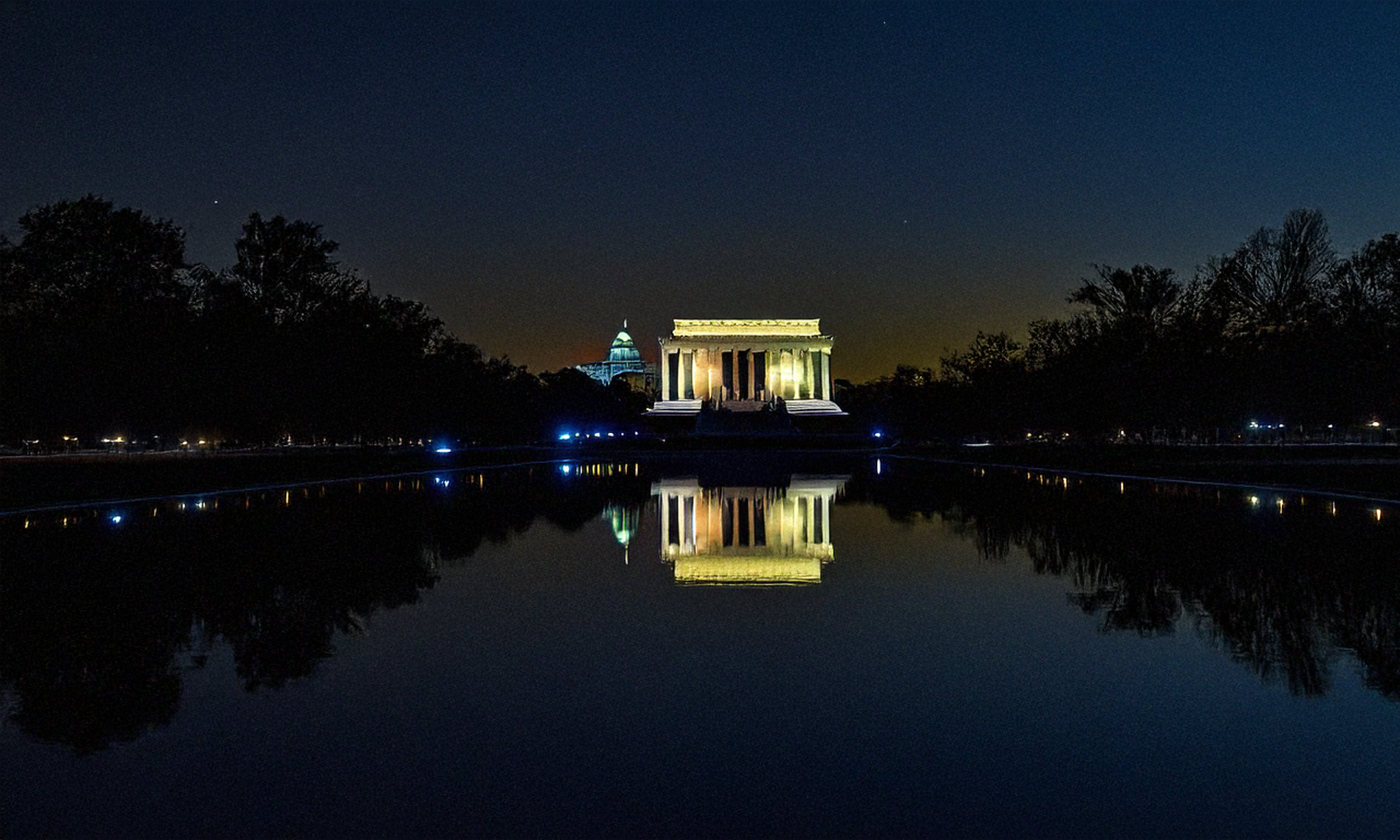
Trump Negotiates Tariffs at the International House of Pancakes
They Always Knew Who Donald Trump Was, But They Thought They Bought Him Off
From Ed Luce’s Lips to God’s Ears: “There is no school of foreign policy realism, or trade mercantilism, that could explain Trump’s actions. If you want to forecast the world, study his psychology. While Trump is in charge, stay short on America.”

Edward Luce (Financial Times), Trump has no idea what he has unleashed
Ed Luce of the Financial Times, acute student of America, and sometime guest on Morning Joe, writes today’s thought piece (particularly choice passages underlined):
We should trust in Donald Trump’s instincts, says Mike Johnson, Speaker of the House of Representatives. Alternatively, Johnson and his caucus should run screaming in the opposite direction. It is too late for Republicans to revert to being a normal party — belief in Trump is their organising principle. But they could play the loyalist by coaxing Trump off the ledge. In addition to their jobs, the future of the global economy, and every American’s retirement fund, depends on it.
Their task is complicated by the fact that Trump still thinks he is on to a winner. Try to stand in his shoes. From his 2011 Obama foreign birth conspiracy to his 2024 conviction as a felon, and so many points in between, Trump has almost annually been left for dead. But his phoenix keeps rising. Trump is a fantasist whose deepest-lodged fantasy — that he is an unstoppable champion — keeps coming true. Why would a little market turmoil stop him?
The starting point is that Trump is a hammer and the rest of the world, as well as half of America, is a nail. Sometimes the hammer can focus on select nails, or soften its blow, but he is always a hammer. That some of Trump’s closest backers, such as the New York hedge fund manager Bill Ackman, are surprised by his global tariff war is a mystery. Trump vowed in almost every single campaign speech to unleash the trade war we are now in.
He has been blaming foreigners for ripping off America since the mid-1980s. Note, his obsession was with Japan, not the Soviet Union. Trump has always been angriest with allies and friends. His deepest contempt is now reserved for Europe and Canada. Psychologists extrapolate from the estate settlement Trump tried to impose on his own siblings. If your instinct is to rip people off, including those closest to you, assume that is everyone’s method.
The mystery is why so many — from Ackman’s fellow billionaires to Florida-based Venezuelans — have bent over backwards to miss who Trump is. A trillion comments have been wasted accusing the wrong people of Trump derangement syndrome. The real TDS afflicts those who keep seeing a rational actor, or an economic chess game, where none exists. The whole market arguably suffers from this syndrome. Shortly after plummeting on Monday morning, a fake news release surfaced that said Trump would announce a pause on his tariffs this week. The markets more than erased their opening losses. All those gains, in turn, were wiped out when the White House issued a denial.
If an online meme can turn a bear market into a bull recovery in the space of a minute, and back again, Trump has the world in his palm. The merest rumour that he might be sane can trigger a buying frenzy. Roman emperors would envy the finger-crooking sway of one man. Yet at some point, possibly imminent, Trump could be forced to pause at least some of his “liberation day” duties. That will trigger a big relief rally. But his pause will be no surer than stray driftwood. The same might apply to his threats of a new 50 per cent tariff escalation on China.
Markets will cheer any hints of bilateral deals Trump plans to strike with more influential demandeurs — Japan, China and India should be closely watched. Investors should also pay heed to the fact that such deals will be struck between foreign governments and Trump personally, not his administration. The departments of Treasury, commerce and the US trade representatives are often out of the loop. Given the lack of boundary between Trump’s public role and private investments, the scope for non-trade-related bartering is great.
The idea that Trump’s impact will be limited to the goods-traded economy is also wishful thinking. Foreigners own a critical share of US Treasury debt. Continued high demand for an asset in whose issuer the world is losing trust is the difference between a Trump recession and a Trump depression. On this, Europe’s governments seem to have better instincts than the equity and fixed-income markets. Rather than escalate the trade war, the EU is mulling only a modest toolkit of retaliations. This is not because Brussels thinks Trump is likely to embrace comity. It is because it fears a tit-for-tat trade spiral will break the global financial system.
Either way, this teachable moment is needlessly belated. Trump’s sane-washers have forfeited their credibility. There is no school of foreign policy realism, or trade mercantilism, that could explain Trump’s actions. If you want to forecast the world, study his psychology. While Trump is in charge, stay short on America.
The Tariff Lawsuit: Koch and Leo Versus Trump

Complaint in Simplified v. Trump et al. (filed in U.S. District Court for the Northern District of Florida)
Forbes, Lawsuit Could End Trump Tariffs And Stock Market Rout
This follows up on my post yesterday. I have a few more points about this interesting development.
The Federalist Society Angle
Trump 1.0 saw the appointment of around 250 federal judges. Most were vetted and approved by the Federalist Society. One of the guiding lights of the Federalist Society was and is Leonard Leo, who is also one of the instigators of the litigation under discussion here—litigation premised on the claim that Trump acted lawlessly in imposing his Liberation Day tariffs, the centerpiece of his administration’s economic policy.
The Merits of the Case
Who’s right on the merits may bear some tangential relevance to who is likely actually to win the case.
The central issue is this: Trump relied on the International Emergency Economic Powers Act in decreeing his Liberation Day tariffs. But that act don’t say nothing about no tariffs. Trump was obviously trying to do an end run around a number of other statutes and regulations that do address the imposition of tariffs. So, says the plaintiff, along with Messrs. Koch and Leo, Trump acted lawlessly–outside the scope of his lawful powers.
That central issue raises, in turn, a host of other legal issues, and I am not an expert on any of them. The Forbes article quotes some people who are actually qualified to speak, who say that the case appears to have merit. And that is my untutored view as well.
How Long Will It Take to Decide the Case?
Plaintiff has not as of yet, and may not, ask for either a temporary restraining order or a preliminary injunction. Plaintiff and her counsel may well think that asking for this preliminary relief could slow things down.
Moreover, the case appears to be almost purely about issues of law, not fact; there would seem to be little need for witness depositions or document review. It could go quickly, if the district court judge and the Eleventh Circuit Court of Appeals choose to move it along.
And why wouldn’t the lower courts move it along? Like everybody else, they’re watching as their stock market investments go glug, glug, glug, down the old shitter.
An “Exit Ramp” for Trump?
As the pressure on Trump grows, it’s possible—not likely, in my view, but remotely possible—that he might start looking for a way out of his decision to crash the world economic order. Should he want to take an exit ramp, a decision by the Supreme Court ordering him to drop his tariffs could do the trick.
The Incentive/Disincentive to “Onshore” Manufacturing
Finally, if there is any business, anywhere, that is seriously considering building manufacturing capacity in the United States, based on Trump’s Liberation Day tariffs, the pendency of this litigation gives them yet another reason to hesitate. As many have observed, you’re only going to spend the money to build a U.S. plant if you think the tariffs are going to last a long time. The lawsuit is yet one more reason, among many others, to question whether that’s a good bet.
You Don’t Say!

The Confessions of David Brooks
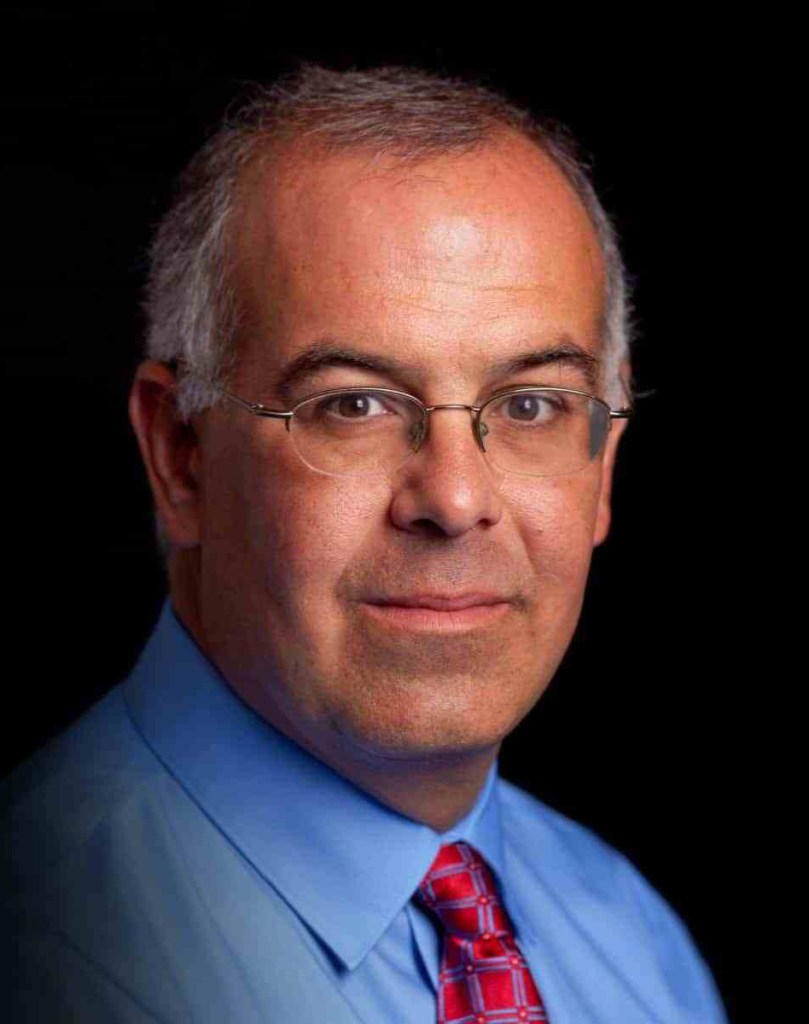
David Brooks (The Atlantic), I SHOULD HAVE SEEN THIS COMING: When I joined the conservative movement in the 1980s, there were two types of people: those who cared earnestly about ideals, and those who wanted only to shock the left. The reactionary fringe has won.
Brooks writes (some choice passages underlined for emphasis),
Charles de Gaulle began his war memoirs with this sentence: “All my life I have had a certain idea about France.” Well, all my life I have had a certain idea about America. I have thought of America as a deeply flawed nation that is nonetheless a force for tremendous good in the world. From Abraham Lincoln to Franklin D. Roosevelt to Ronald Reagan and beyond, Americans fought for freedom and human dignity and against tyranny; we promoted democracy, funded the Marshall Plan, and saved millions of people across Africa from HIV and AIDS. When we caused harm—Vietnam, Iraq—it was because of our overconfidence and naivete, not evil intentions.Until January 20, 2025, I didn’t realize how much of my very identity was built on this faith in my country’s goodness—on the idea that we Americans are partners in a grand and heroic enterprise, that our daily lives are ennobled by service to that cause. Since January 20, as I have watched America behave vilely—toward our friends in Canada and Mexico, toward our friends in Europe, toward the heroes in Ukraine and President Volodymyr Zelensky in the Oval Office—I’ve had trouble describing the anguish I’ve experienced. Grief? Shock? Like I’m living through some sort of hallucination? Maybe the best description for what I’m feeling is moral shame: To watch the loss of your nation’s honor is embarrassing and painful.
George Orwell is a useful guide to what we’re witnessing. He understood that it is possible for people to seek power without having any vision of the good. “The Party seeks power entirely for its own sake,” an apparatchik says in 1984. “We are not interested in the good of others; we are interested solely in power. Not wealth or luxury or long life or happiness: only power, pure power.” How is power demonstrated? By making others suffer. Orwell’s character continues: “Obedience is not enough. Unless he is suffering, how can you be sure that he is obeying your will and not his own? Power is in inflicting pain and humiliation.”
Russell Vought, Donald Trump’s budget director, sounds like he walked straight out of 1984. “When they wake up in the morning, we want them to not want to go to work, because they are increasingly viewed as the villains,” he said of federal workers, speaking at an event in 2023. “We want to put them in trauma.”
Since coming back to the White House, Trump has caused suffering among Ukrainians, suffering among immigrants who have lived here for decades, suffering among some of the best people I know. Many of my friends in Washington are evangelical Christians who found their vocation in public service—fighting sex trafficking, serving the world’s poor, protecting America from foreign threats, doing biomedical research to cure disease. They are trying to live lives consistent with the gospel of mercy and love. Trump has devastated their work. He isn’t just declaring war on “wokeness”; he’s declaring war on Christian service—on any kind of service, really.
If there is an underlying philosophy driving Trump, it is this: Morality is for suckers. The strong do what they want and the weak suffer what they must. This is the logic of bullies everywhere. And if there is a consistent strategy, it is this: Day after day, the administration works to create a world where ruthless people can thrive. That means destroying any institution or arrangement that might check the strongman’s power. The rule of law, domestic or international, restrains power, so it must be eviscerated. Inspectors general, judge advocate general officers, oversight mechanisms, and watchdog agencies are a potential restraint on power, so they must be fired or neutered. The truth itself is a restraint on power, so it must be abandoned. Lying becomes the language of the state. …
We used to live in a world where ideologies clashed, but ideologies don’t seem to matter anymore. The strongman understanding of power is on the march. Power is like money: the more the better. Trump, Russian President Vladimir Putin, and the rest of the world’s authoritarians are forming an axis of ruthlessness before our eyes. Trumpism has become a form of nihilism that is devouring everything in its path.
The pathetic thing is that I didn’t see this coming even though I’ve been living around these people my whole adult life. I joined the conservative movement in the 1980s, when I worked in turn at National Review, The Washington Times, and The Wall Street Journal editorial page. There were two kinds of people in our movement back then, the conservatives and the reactionaries. We conservatives earnestly read Milton Friedman, James Burnham, Whittaker Chambers, and Edmund Burke. The reactionaries just wanted to shock the left. We conservatives oriented our lives around writing for intellectual magazines; the reactionaries were attracted to TV and radio. We were on the political right but had many liberal friends; they had contempt for anyone not on the anti-establishment right. They were not pro-conservative—they were anti-left. I have come to appreciate that this is an important difference. …
A prominent publisher of right-wing authors once told me that the way to sell conservative books is not to write a good book—it’s to write a book that will offend the left, thereby causing the reactionaries to rally to your side and buy it. That led to books with titles such as The Big Lie: Exposing the Nazi Roots of the American Left, and to Ann Coulter’s entire career. Owning the libs became a lucrative strategy.
Of course, the left made it easy for them. The left really did purge conservatives from universities and other cultural power centers. The left really did valorize a “meritocratic” caste system that privileged the children of the affluent and screwed the working class. The left really did pontificate to their unenlightened moral inferiors on everything from gender to the environment. The left really did create a stifling orthodoxy that stamped out dissent. If you tell half the country that their voices don’t matter, then the voiceless are going to flip over the table. …
The MAGA elite rode to power on working-class votes, but—trust me, I know some of them—they don’t care about the working class. Trump and his crew could have taken office with actual plans to make life better for working-class Americans. An administration that cared about the working class would seek to address its problems, such as the fact that the poorest Americans die an average of 10 to 15 years younger than their higher-income counterparts, or that by sixth grade, many of the children in the poorest school districts have fallen four grade levels behind those in the richest. An administration that cared about these people would have offered a bipartisan industrial policy to create working-class jobs.
These faux populists have no interest in that. Instead of helping workers, they focus on civil war with their left-wing fellow elites. During Trump’s first months in office, one of their highest priorities has been to destroy the places where they think liberal elites work—the scientific community, the foreign-aid community, the Kennedy Center, the Department of Education, universities.
It turns out that when you mix narcissism and nihilism, you create an acid that corrodes every belief system it touches.
This Trumpian cocktail has eaten away at Christianity, a faith oriented around the marginalized. Blessed are the meek. Blessed are the poor in spirit. The poor are closer to God than the rich. Again and again, Jesus explicitly renounced worldly power.
But if Trumpism has a central tenet, it is untrammeled lust for worldly power. In Trumpian circles, many people ostentatiously identify as Christians but don’t talk about Jesus very much; they have crosses on their chest but Nietzsche in their heart—or, to be more precise, a high-school sophomore’s version of Nietzsche.
To Nietzsche, all of those Christian pieties about justice, peace, love, and civility are constraints that the weak erect to emasculate the strong. In this view, Nietzscheanism is a morality for winners. It worships the pagan virtues: power, courage, glory, will, self-assertion. The Nietzschean Übermenschen—which Trump and Musk clearly believe themselves to be—offer the promise of domination over those sick sentimentalists who practice compassion.
Two decades ago, Michael Gerson, a graduate of Wheaton College, a prominent evangelical institution, helped George W. Bush start the U.S. President’s Emergency Plan for AIDS Relief, which has saved 25 million lives in Africa and elsewhere. I traveled with Gerson to Namibia, Mozambique, and South Africa, where dying people had recovered and returned to their families, and were leading active lives. It was a proud moment to be an American. Vought—Trump’s budget director, who also graduated from Wheaton—championed the evisceration of PEPFAR, which has now been set in motion by executive order, effectively sentencing thousands to death. Project 2025, of which Vought was a principal architect, helped lay the groundwork for the dismantling of USAID; its gutting appears to have ended a program to supply malaria protection to 53 million people and cut emergency food packages for starving children. Twenty years is a short time in which to have traveled the long moral distance from Gerson to Vought.
Trumpian nihilism has eviscerated conservatism. The people in this administration are not conservatives. They are the opposite of conservatives. Conservatives once believed in steady but incremental reform; Elon Musk believes in rash and instantaneous disruption. Conservatives once believed that moral norms restrain and civilize us, habituating us to virtue; Trumpism trashes moral norms in every direction, riding forward on a tide of adultery, abuse, cruelty, immaturity, grift, and corruption. Conservatives once believed in constitutional government and the Madisonian separation of powers; Trump bulldozes checks and balances, declaiming on social media, “He who saves his Country does not violate any Law.” Reagan promoted democracy abroad because he thought it the political system most consistent with human dignity; the Trump administration couldn’t care less about promoting democracy—or about human dignity.
How does this end? Will anyone on the right finally stand up to the Trumpian onslaught? Will our institutions withstand the nihilist assault? Is America on the verge of ruin?
In February, about a month into Trump’s second term, I spoke at a gathering of conservatives in London called the Alliance for Responsible Citizenship. Some of the speakers were pure populist (Vivek Ramaswamy, Mike Johnson, and Nigel Farage). But others were center-right or not neatly ideological (Niall Ferguson, Bishop Robert Barron, and my Atlantic colleague Arthur C. Brooks).
In some ways, it was like the conservative conferences I’ve been attending for decades. I listened to a woman from Senegal talking about trying to make her country’s culture more entrepreneurial. I met the head of a charter school in the Bronx that focuses on character formation. But in other ways, this conference was startlingly different.
In my own talk, I sympathized with the populist critique of what has gone wrong in Western societies. But I shared with the audience my dark view of President Trump. Unsurprisingly, a large segment of the audience booed vigorously. One man screamed that I was a traitor and stormed out. But many other people cheered. Even in conservative precincts infected by reactionary MAGA-ism, some people are evidently tired of Trumpian brutality.
As the conference went on, I noticed a contest of metaphors. The true conservatives used metaphors of growth or spiritual recovery. Society is an organism that needs healing, or it is a social fabric that needs to be rewoven. A poet named Joshua Luke Smith said we needed to be the seeds of regrowth, to plant the trees for future generations. His incantation was beatitudinal: “Remember the poor. Remember the poor.”
But others relied on military metaphors. We are in the midst of civilizational war. “They”—the wokesters, the radical Muslims, the left—are destroying our culture. There were allusions to the final epochal battles in The Lord of the Rings. The implication was that Sauron is leading his Orc hordes to destroy us. We are the heroic remnant. We must crush or be crushed.
The warriors tend to think people like me are soft and naive. I tend to think they are catastrophizing narcissists. When I look at Trump acolytes, I see a swarm of Neville Chamberlains who think they’re Winston Churchill.
I understand the seductive power of a demagogue who tells you that the people who look down on you are evil. I understand the seductive power of being told that your civilization is on the verge of total collapse, and that everything around you is degeneracy and ruin. This message gives you a kind of terrifying thrill: The stakes are apocalyptic. Your life has meaning and urgency. Everything is broken; let’s burn it all down.
I understand why people who feel alienated would want to follow the leader who speaks about domination and combat, not the one who speaks about healing and cooperation. It doesn’t matter how many times you’ve read Edmund Burke or the Gospel of Matthew—it’s still tempting to throw away all of your beliefs to support the leader who promises to be “your retribution.”
America may well enter a period of democratic decay and international isolation. It takes decades to develop strong alliances, and to build the structures and customs of democracy—and only weeks to decimate them, as we’ve now seen. And yet I find myself confident that America will survive this crisis. Many nations, including our own, have gone through worse and bloodier crises and recovered. In Upheaval: Turning Points for Nations in Crisis, the historian and scientist Jared Diamond provides case studies—Japan in the late 19th century, Finland and Germany after World War II, Indonesia after the 1960s, Chile and Australia during and after the ’70s—of countries that came back stronger after crisis, collapse, or defeat. To these examples, I’d add Britain in the 1830s and ’40s, and the 1980s, and South Korea in the 1980s. Some of these countries (such as Japan) endured war; others (Chile) endured mass torture and “disappearances”; still others (Britain and Australia) endured social decay and national decline. All of them eventually healed and came back.
America itself has already been through numerous periods of rupture and repair. Some people think we’re living through a period of unprecedented tumult, but the Civil War and the Great Depression were much worse. So were the late 1960s—assassinations, riots, a failed war, surging crime rates, a society coming apart. From January 1969 until April 1970, there were 4,330 bombings in the U.S., or about nine a day. But by the 1980s and ’90s—after getting through Watergate, stagflation, and the Carter-era “malaise” of the ’70s—we had recovered. As brutal and disruptive as the tumult of the late 1960s was, it helped the country shake off some of its persistent racism and sexism, and made possible a freer and more individualistic ethos.
But the most salient historical parallel might be the America of the 1830s. Andrew Jackson is the American president who most resembles Trump—power-hungry, rash, narcissistic, driven by animosity. He was known by his opponents as “King Andrew” for his expansions of executive power. “The man we have made our President has made himself our despot, and the Constitution now lies a heap of ruins at his feet,” Senator Asher Robbins of Rhode Island said. “When the way to his object lies through the Constitution, the Constitution has not the strength of a cobweb to restrain him from breaking through it.” Jackson brazenly defied the Supreme Court on a ruling about Cherokee Nation territory (a defiance, it should be noted, that Vice President Vance has explicitly endorsed). “Though we live under the form of a republic,” Supreme Court Justice Joseph Story wrote, “we are in fact under the absolute rule of a single man.”
But Jackson made the classic mistake of the populist: He overreached. Fueled by personal hostility toward elites, he destroyed the Second Bank of the United States, an early precursor to the Federal Reserve System, and helped spark an economic depression that ruined the administration of his chosen successor, Martin Van Buren.In response to Jackson, the Whig Party arose in the 1830s to create a new political and social order. Devoutly anti-authoritarian, the Whigs were a cultural, civic, and political force all at once. They emphasized both traditional morality and progressive improvements. They agitated for prison reform and for keeping the Sabbath, for more women’s participation in politics and for a strong military, for government-funded public schools and for pro-business government policies. They were opposed to Jackson’s monstrous Indian Removal Act, and to the Democratic Party’s reactionary, white-supremacist social vision. Whereas Jacksonian Democrats emphasized negative liberty—get your hands off me—the Whigs, who would turn into the early Republican Party of Abraham Lincoln, emphasized positive liberty, empowering Americans to live bigger, better lives with things such as expanded economic credit, free public education, and stronger legal protections including due process and property rights.
Though we’ve come to call the early-to-mid-19th century the Age of Jackson, the historian Daniel Walker Howe notes that it was not Jackson but the Whigs who created the America we know today. “As economic modernizers, as supporters of strong national government, and as humanitarians more receptive than their rivals to talent regardless of race and gender,” Howe writes, the Whigs “facilitated the transformation of the United States from a collection of parochial agricultural communities into a cosmopolitan nation integrated by commerce, industry, information, and voluntary associations as well as by political ties.” Looking back, Howe concludes, we can see that even though they were not the dominant party of their time, the Whigs “were the party of America’s future.” To begin its recovery from Trumpism, America needs its next Whig moment.
Yes, we have reached a point of traumatic rupture. A demagogue has come to power and is ripping everything down. But what’s likely to happen is that the demagogue will start making mistakes, because incompetence is built into the nihilistic project. Nihilists can only destroy, not build. Authoritarian nihilism is inherently stupid. I don’t mean that Trumpists have low IQs. I mean they do things that run directly against their own interests. They are pathologically self-destructive. When you create an administration in which one man has all the power and everybody else has to flatter his voracious ego, stupidity results. Authoritarians are also morally stupid. Humility, prudence, and honesty are not just nice virtues to have—they are practical tools that produce good outcomes. When you replace them with greed, lust, hypocrisy, and dishonesty, terrible things happen.
The DOGE children are doubtless brilliant in certain ways, but they know as much about government as I know about rocketry. They announced an $8 billion cut to an Immigration and Customs Enforcement contract—though if they had read their own documents correctly, they would have realized that the cut was less than $8 million. They eliminated workers from the National Nuclear Security Administration, apparently without realizing that this agency controls nuclear security, and had to undo some of those cuts shortly thereafter. Trump seems to be trying to give a bunch of Sam Bankman-Frieds access to America’s nuclear arsenal and IRS records. What could go wrong?
When Trump creates an unnecessary crisis, it’s unlikely to be a small one. The proverbial “adults in the room” who contained crises in Trump’s first term are gone. Whatever the second-term crisis—runaway inflation? a global trade war? a cratered economy and plummeting stock market? an out-of-control conflict in China? botched pandemic management? a true hijacking of the Constitution precipitated by defiance of the courts?—it is likely to crater his support and shift historical momentum.
But although Trumpism’s collapse is a necessary condition for national recovery, it is not a sufficient one. Its demise must be followed by the hard work necessary to achieve true civic and political renewal.
Progress is not always a smooth or merry ride. For a few decades, nations live according to one paradigm. Then it stops working and gets destroyed. When the time comes to build a new paradigm, progressives talk about economic redistribution; conservatives talk about cultural and civic repair. History shows that you need both: Recovery from national crisis demands comprehensive reinvention at all levels of society. If you look back across the centuries, you find that this process requires several interconnected efforts.
First, a national shift in values. In the late 19th century, for example, as the country went through the wrenching process of industrialization, America was traumatized by severe recessions and mass urban poverty. In response, social Darwinism gave way to the social-gospel movement. Social Darwinism, associated with thinkers such as Herbert Spencer, valorized survival of the fittest and claimed that the poor are poor because of inferior abilities. The social-gospel movement, associated with theologians such as Walter Rauschenbusch, emphasized the systemic causes of poverty, including the Gilded Age’s concentration of corporate power. By the early 20th century, most mainline Protestant denominations had signed on to the Social Creed of the Churches, which called for, among other things, the abolition of child labor and the creation of disability insurance.
Second, nations that hang together through crisis have a strong national identity—they return to their roots. They have a leader who replaces the amoralism of the nihilists, or, say, the immorality of slavery, with a strong redefinition of the nation’s moral mission, the way Lincoln redefined America at Gettysburg.
Third, a civic renaissance. After the social gospel took root, Americans in the 1890s and early 1900s launched and participated in a series of social movements and civic organizations: United Way, the NAACP, the Sierra Club, the settlement-house movement, the American Legion.
Fourth, a national reassessment. As Jared Diamond notes, nations that turn around don’t catastrophize. Rather, they develop a clear-eyed view of what’s working and not working, and they pursue careful, selective change. According to Diamond’s research, the leaders of successful reform movements also take responsibility for their part in the crisis. For instance, Germany’s leaders accepted responsibility for the country’s Nazi past; Finland’s leaders took responsibility for an unrealistic foreign policy before World War II, when they had to deal with a looming Soviet Union on their border; and Australia’s leaders took responsibility in the 1970s for a political culture and foreign policy that had become overly dependent on Britain.
Fifth, a surge of political reform. In 1830s and ’40s Britain—racked by social chaos, bank failures, a severe depression, riots, and crushing wealth inequality—Prime Minister Robert Peel, a leader of great moral rectitude, built the modern police force, reduced tariffs, pushed railway legislation that literally laid the tracks for British industrialization, and helped pass the Factory Act of 1844, which regulated workplaces. In early-20th-century America, Progressives produced a comparable flurry of effective reforms that pulled the country out of its industrialization crisis.
Part of political reform is an expansion of the circle of power. What that would require in America today is, among other things, a broad effort to include working-class and conservative voices in what have traditionally been cultural bastions of elite progressivism—universities, the nonprofit sector, the civil service, the mainstream media.
Finally, economic expansion. Economic growth can salve many wounds. Pursuing a so-called abundance agenda—a set of policies aimed at reducing government regulation and increasing investment in innovation, and expanding the supply of housing, energy, and health care—is the most promising way to achieve that expansion.
In the long term, Trumpism is doomed. Power without prudence and humility invariably fails. Nations, like people, change not when times are good but in response to pain. At a moment when Trumpism seems to be devouring everything, the temptation is to believe that this time is different.
But history doesn’t stop moving. Even now, as I travel around the country, I see the forces of repair gathering in neighborhoods and communities. If you’re part of an organization that builds trust across class, you’re fighting Trumpism. If you’re a Democrat jettisoning insular faculty-lounge progressivism in favor of a Whig-like working-class abundance agenda, you’re fighting Trumpism. If you are standing up for a moral code of tolerance and pluralism that can hold America together, you’re fighting Trumpism.
Over time, changes in values lead to changes in relationships, which lead to changes in civic life, which eventually lead to changes in policy and then in the general trajectory of the nation. It starts slow, but as the Book of Job says, the sparks will fly upward.
Leonard Leo and Charles Koch Oppose Penguin Tariffs. They’re Unconstitutional!
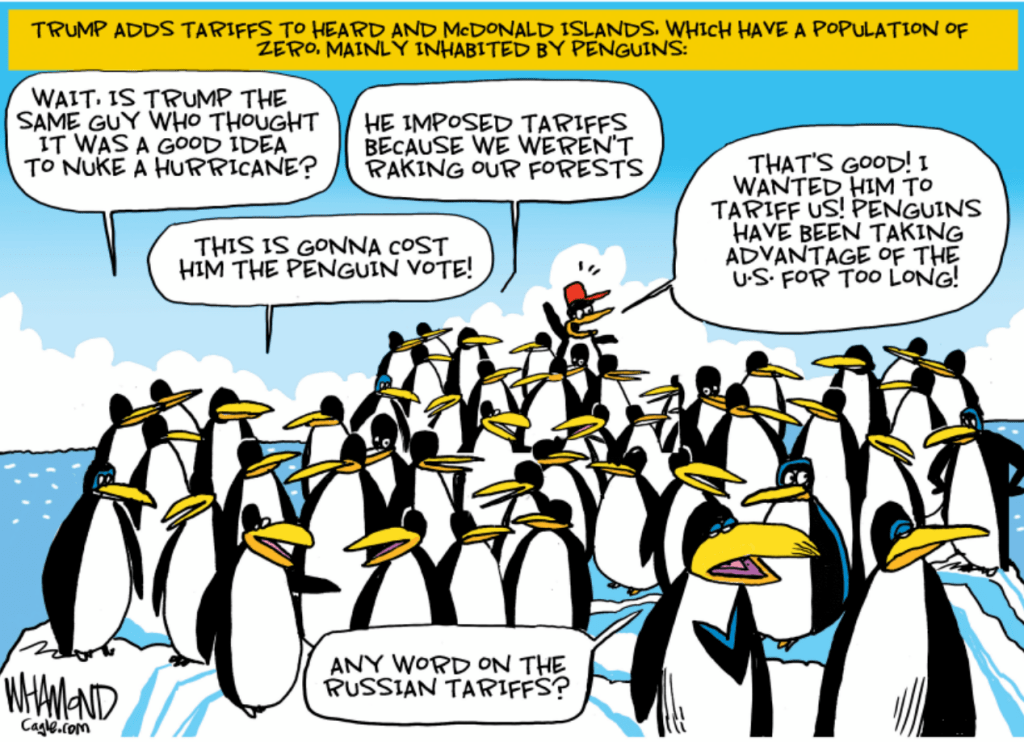
You can read all about it at https://nclalegal.org. I looked for a Donations page. Didn’t find it. Guess you don’t need donations from peons when you’re financed by Koch and Leo.
Wonder what they’ll say when they win in the Supreme Court and the Very Stable Genius tells the Court and their organization to go screw themselves.
Stable Genius Imposes Tariffs on Penguins
Jonathan Chait (The Atlantic), Trump Has Already Botched His Own Bad Tariff Plan: Once you’ve said you might negotiate, nobody is going to believe you when you change your mmind and say you’ll never negotiate.
To summarize: Trump has two alternative strategies. One is to “reshore” American manufacturing. But that would require, at a minimum, that investors believe that the draconian tariffs are going to last a long time. The other is to negotiate country-by-country deals resulting in more favorable terms for American exporters.
Each strategy is highly problematic in its own right.
But, in addition, the two strategies are mutually inconsistent.
Bottom line: Confusion worse confounded. Idiocy cubed.
Wall Street Journal, China Wanted to Negotiate With Trump. Now It’s Arming for Another Trade War.
The Journal knows a lot of the senior people in China. And it knows even more of the people who know the senior people in China. Long article. Deeply reported.
Bottom line (for me): China expected negotiations, beginning with Trump’s inauguration. China wanted negotiations. China got stiff-armed by the Trump Administration. Xi had no real option but the retaliate. The standoff with China is going to last a long time.
Politico Magazine, Why Trump May Get Away With His Tariff Trauma: Other countries encounter the ‘prisoner’s dilemma’ as they weigh how to respond.
Helpful article. Poor headline. Poor, because the actual topic of the article is why a lot of countries are not immediately retaliating, but are instead about reaching out to Trump to try to negotiate.
There’s no paywall at Politico, so read it for yourself. My own take, for what it’s worth: Yeah, I get the “prisoner’s dilemma” issue. But I also suspect that a lot of foreign leaders are thinking that the tariffs are going to be so hard on American consumers and businesses of all sizes, and hence on Republican politicians, that, over the medium term, the tariffs are going to go away regardless of who does or does not negotiate.
Plus which: most foreign leaders actually studied economics back in college. So they know that imposing tit-for-tat tariffs harms their own economies.
Why We Respond to the Authoritarian Project the Way We Do: The Fundamental Explanation
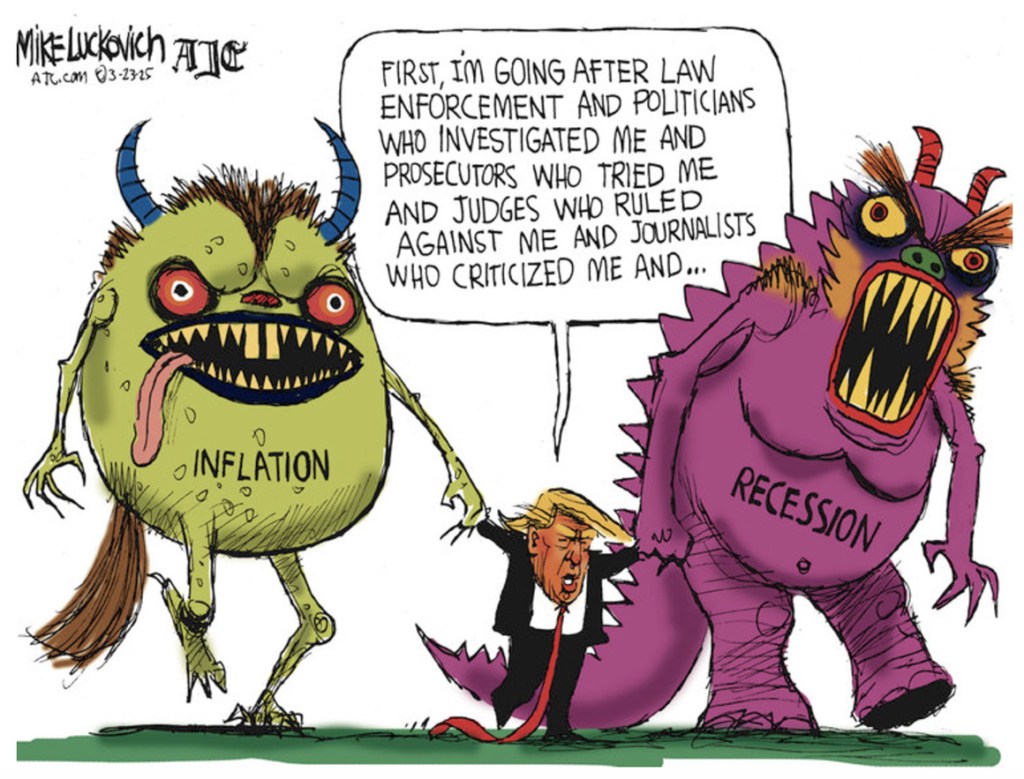
Erwin Chemerinsky (Washington Post), Trump is targeting law firms and academia. Why don’t they speak up?
Lawrence H. Summers (N.Y. Times), If Powerful Places Like Harvard Don’t Stand Up to Trump, Who Can?
Dean Chemerinsky is a distinguished constitutional scholar and dean of the law school at U.C. Berkeley. Prof. Summers is many things, including former Secretary of the Treasury and former president of Harvard University. Each of them bemoans the failure of many rich law firms, and many prestigious universities, to stand up to Trump.
And good for them. Let us all bemoan the cowardice.
And let the record reflect that I, Ronald W. Davis, who attended Princeton, Harvard, and Columbia, hereby bemoan Harvard’s and Columbia’s failure to stand firm. And I hereby celebrate the position of Princeton’s president. I hope and expect he and the university will continue to stand firm, and, if they do, when Annual Giving rolls around, I will do the right thing. As, I believe, will my fellow alumni.
At the same time, I suggest that we all spend about 2% of our time bemoaning this or that and the remaining 98% of our time in hard-headed analysis and strategizing. And, here in the real world—not the one we wish we lived in—I suggest that for most people, most of the time, the most salient questions are
Is the authoritarian project going to take root, in which case I and my organization had best accommodate to it?
Or is the authoritarian project going down the shitter, in which case I and my organization can just keep our heads down and wait it out?
To help answer those questions, you might want to look to the town halls, the election results on Tuesday, and the condition of the financial markets this afternoon.
 Facing MAGA