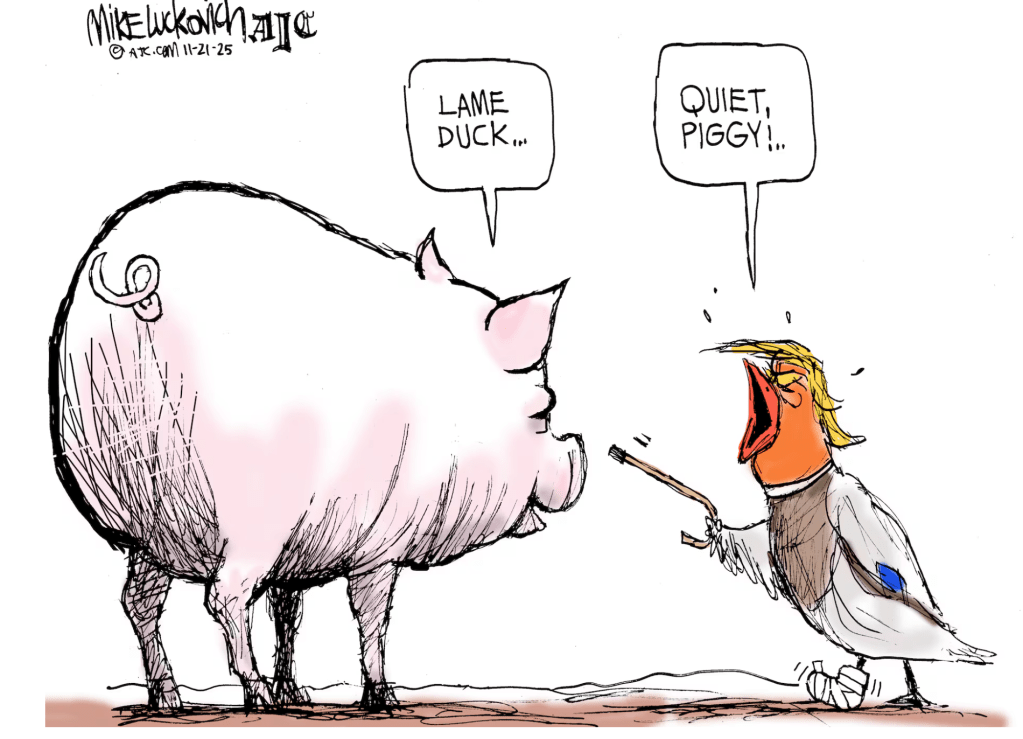
Thankful on Thanksgiving Day for Trump’s Collapse

With clear eyes, hard facts, critical thinking, new political strategy, empathy, and a soupçon of Schadenfreude


The Wall Street Journal has a few choice observations.
Under the law, when a U.S. Attorney’s office becomes vacant, a President may temporarily fill the job for 120 days, after which the district court is supposed to get the power to fill the role. Congress wrote the law that way to ensure the Justice Department wouldn’t be left short-handed, while also protecting the Senate’s advise-and-consent power over nominees.
In January, after Mr. Trump’s inauguration, the Administration named Erik Siebert as interim prosecutor for Eastern Virginia. Once his three-month lease was set to expire, the judges of the district chose to retain him. But Mr. Siebert was reluctant to charge Mr. Comey and Ms. James, as Mr. Trump demanded, and he stepped down in September. Then the Administration purported to install Ms. Halligan, who had no experience as a prosecutor.
In the White House’s view, Mr. Siebert’s exit gave Mr. Trump the opportunity to name another interim prosecutor for a new three-month term. But that isn’t what the law says, according to Monday’s analysis by Judge Cameron McGowan Currie. As he explains, that interpretation would let the President “evade the Senate confirmation process indefinitely by stacking successive 120-day appointments.”
The vacancy law is designed for a temporary fill-in, not Senate circumvention. Ms. Halligan “has been unlawfully serving,” the judge concludes, and her efforts on indicting Mr. Comey and Ms. James were “unlawful exercises of executive power.” This is what happens when officials don’t follow legal procedure. They lose cases. Mr. Trump was so eager to indict his enemies, and Attorney General Pam Bondi was so quick to go along, that it all unraveled at the pull of one legal thread.
The Trump Administration could refile the charges, though the statute of limitations may have expired in Mr. Comey’s case. If Mr. Trump tries again, he might end up with cases that are two-time legal losers.
/

The Democratic officials who put out the video on illegal orders were clearly implying that
But the officials did not explicitly say what orders they considered illegal—obviously a conscious and considered omission.
One could plausibly argue that this omission was cowardly. More to the point, one could plausibly argue that the failure to specify exactly what illegal orders they were talking about could create confusion in the minds of military personnel. Indeed, some have made plausible arguments along these lines, and the controversy will continue to grow.
However, our President, Mango Mussolini
Afflicted by these mental lacunae, Mango Mussolini cannont begin to devise a workable plan to make the Democratic officials pay for their failure to identify the illegal orders of which they spoke. Instead, he can only bluster and threaten—in this case, threaten to order his minions (1) to arrest the Democratic officials for the crime of referring to the Uniform Code of Military Justice and then (2) to procure their execution following trial in the federal criminal justice system.
First of all, pretty much everyone who plays in the arena of politics or business knows that it’s a bad idea to take the hostage if you are not prepared to kill the hostage. That’s because your extreme threat, followed by supine inaction, makes you look like a blustering fool.
And, by the way, the reason why you look like a blustering fool is that you are in fact a blustering fool.
On the other hand, what if the Justice Department does arrest Senator Slotkin, get Lindsey Halligan to indict her for treason, and put her on trial in a United States district court? Well, guess what? It isn’t illegal, let alone treasonous, for someone to make a general reference to a provision of law—here, the Uniform Code of Military Justice, Title 10 of the United States Code, Section 892, and the related case law.
Conclusion? Either course of action—blustering followed by inaction, or blustering followed by a ridiculous prosecution in federal court—leads inexorably to failure by Trump.
The logical next step would be for Trump to tell the Proud Boys to get our their guns and go after Senator Slotkin and the rest of the crew.
President Donald Trump accused a group of Democratic lawmakers on Thursday of “seditious behavior” and called for their arrest for appearing in a video in which they reminded members of the U.S. military and intelligence community that they are obligated to refuse illegal orders.
“It’s called SEDITIOUS BEHAVIOR AT THE HIGHEST LEVEL,” Trump wrote on Truth Social. “Each one of these traitors to our Country should be ARRESTED AND PUT ON TRIAL. Their words cannot be allowed to stand.”
The video released Tuesday features a group of six Democrats who served in the military and intelligence community. Addressing active service members, they caution active-duty military members that “threats to our Constitution aren’t just coming from abroad, but from right here at home.”
“Our laws are clear,” Sen. Mark Kelly (Arizona), a Navy veteran, says in the video. “You can refuse illegal orders.”
“You must refuse illegal orders,” adds Rep. Chris Deluzio (Pennsylvania), who also served in the Navy.
The video does not specify particular orders that might be unlawful. But some of the lawmakers have relayed this week that they are hearing concerns from service members about the legality of strikes that have targeted people the Trump administration alleges are trafficking narcotics by sea.
The Pentagon did not respond Thursday morning to questions about the Pentagon’s post. Traditionally, the U.S. military adheres to the Uniform Code of Military Justice, which holds that service members must obey lawful orders, whether they agree with them or not. They are obligated to not follow “manifestly unlawful orders,” but such situations are rare and legally fraught. Members of the military take an oath to the Constitution, not the president.
The video, organized by Sen. Elissa Slotkin (Michigan) — who previously worked as a CIA analyst, also features Reps. Maggie Goodlander (New Hampshire), a former Navy reservist; Chrissy Houlahan (Pennsylvania), a former Air Force officer; and Jason Crow (Colorado), a former Army Ranger.
On his social media platform Thursday, Trump echoed other Republicans who have called for the Democrats to be removed from office, dishonorably discharged from the military and charged with treason — a crime punishable by death.
The stark punishment was not lost on Trump, who wrote in another post on Thursday: “SEDITIOUS BEHAVIOR, punishable by DEATH!”
He also reposted a post from a Truth Social user proclaiming: “HANG THEM GEORGE WASHINGTON WOULD !!”
The White House declined to comment on the record.
Democrats sharply criticized Trump’s threats.
“The administration should never try to force our servicemembers to carry out an illegal order,” Sen. Chris Coons (D-Delaware) said on social media. “Calling for the execution of senators and Congressmembers for reminding our troops of that is chilling behavior. Every one of my Republican colleagues needs to swiftly condemn this.”
Trump has repeatedly accused different groups and individuals of treason going back to his first presidential term, but has never followed through with prosecution, lobbing attacks on Black Lives Matter, the news media, former FBI director James B. Comey and former president Barack Obama with the claim.
Trump campaigned on prosecuting his political opponents and dispensing with the 50-year custom of insulating federal law enforcement from political influence. This year he has grown increasingly explicit in demanding specific investigations against people who have criticized him, leading directly to action by his appointees at the Justice Department.
In September, Trump pushed out a federal prosecutor in Virginia who declined to bring charges against New York Attorney General Letitia James (D) and replaced him with his own personal lawyer, Lindsey Halligan. Halligan then indicted James as well as Comey, whom Trump fired in 2017. On Wednesday, prosecutors acknowledged in court that a grand jury did not review the final indictment, a defect that Comey’s lawyers argued should cause the judge to dismiss the case.
The U.S. attorney in Miami is pursuing a broad probe against Obama administration officials, including former CIA director John Brennan and former director of National Intelligence James R. Clapper Jr. related to the investigation of Russian interference in the 2016 election. Trump officials have also initiated investigations at the president’s urging against Rep. Adam Schiff (D-California), who led the first impeachment inquiry against Trump in 2019, and Lisa Cook, a Federal Reserve governor he has sought to remove.
And on Friday, Trump directed the Justice Department to investigate prominent Democrats’ ties to Jeffrey Epstein, the wealthy sex offender who killed himself in jail in 2019. Bondi said she would proceed with that case, four months after saying the department’s review of the case found no information to pursue additional charges.
The Justice Department, Pentagon and the offices for Democratic lawmakers in the video did not immediately respond to requests for comment.
 Facing MAGA