“Just Because Trump is a Product of American Rage Does not Mean he is a Solution to It”

Derek Thompson (The Atlantic), The Political Right of the Century: For the first time in decades, America has a chance to define its next political order. Trump offers fear, retribution, and scarcity. Liberals can stand for abundance.

Derek Thompson is the co-author, along with Ezra Klein, of the new book Abundance. I strongly recommend the whole article. If you don’t subscribe to The Atlantic, then you really should. 

Here are some highlights:

Donald Trump has promised a “golden age of America.” But for all his bluster about being the champion of an American century, Trump’s actual policies point to something different: not an expansive vision of the future, but a shrunken vision of the present.

Throughout the opening months of his administration, the Trump White House has consistently pointed to existing shortages to demand new sacrifices. The administration says America cannot afford its debt, and therefore we cannot afford health care for the poor. The administration says America doesn’t have a healthy economy, and therefore we have to accept economic “hardship.” The administration says America doesn’t have enough manufacturing, and so we must suffer the consequences of less trade. The administration says America doesn’t have enough housing, and so we need fewer immigrants. The administration says American scientists aren’t focused on the right research, and so we have to gut our federal science programs. Again and again, Americans are being fed the line that everything that we don’t have requires the elimination of something that we need.

The MAGA movement might try to justify its wrecking-ball style by arguing that its extreme approach is commensurate with the level of anger that voters feel about the status quo. But just because Trump is a product of American rage does not mean he is a solution to it.

In housing, for example, Americans have every right to be furious. Home construction has lagged behind our national needs for decades. Today, the median age of first-time homebuyers has surged to a record high of 38. Large declines in young homeownershiphave likely prevented many young people from dating, marrying, and starting a family. Although Trump was swept into office on a wave of economic frustration, his initial foray into economic policy has done little to help the situation. As the National Association of Home Builders pointed out in an alarmed March 7 memo, his persistent threat of tariffs on Mexico and Canada could drive up the cost of crucial materials, such as softwood lumber and drywall gypsum, which are “largely sourced from Canada and Mexico, respectively.” Meanwhile, Trump’s anti-immigrant policies foretell new labor shortages in the construction industry, where roughly 25 percent or more workers are foreign-born.

This is where Democrats should be able to stand up and show that they have a winning response to the less-is-less politics from the right. But in many places run by Democrats, the solution on offer is another variety of scarcity. Blue cities are laden with rules and litigation procedures that block new housing and transit construction. As my colleague Yoni Appelbaum has noted, in California cities where the share of progressives votes goes up by 10 points, the number of housing permits issued declines by 30 percent. Where the supply of homes is constricted, housing prices soar, and homelessness rises. As of 2023, the five states with the highest rates of homelessness were New York, Hawaii, California, Oregon, and Washington—all run by Democrats.

As the cost of living rises in blue states, tens of thousands of families are leaving them. But the left isn’t just losing people. It’s losing an argument. It has become a coalition of Kindness Is Everything signs in front yards zoned for single-family homes. Liberals say they want to save the planet from climate change, but in practice, many liberal areas have shut down zero-carbon nuclear plants and protested solar-power projects, leaving it to red states such as Texas to lead the nation in renewable-energy generation. Democrats cannot afford to become the party of language over outcomes, of ever more lawn signs and ever fewer working-class families.

If Trump’s opponents are going to win at the polls, they will need to construct a new political movement, one that aims for abundance instead of scarcity. Such a movement would combine the progressive virtue of care for the working class and a traditionally conservative celebration of national greatness, while taking a page from the libertarian obsession with eliminating harmful regulations to make the most important markets work better. It would braid a negative critique of Trump’s attack on the government with a positive vision of actual good governance in America—while providing a rigorous focus on removing the bottlenecks that stand in the way.

Abundance begins with specific goals for America’s future. Imagine much more housing where it’s most in demand. An economy powered by plentiful clean energy. A revitalized national science policy prioritizing high-risk discoveries that extend lives and improve health. And a national invention agenda that seeks to pull forward technologies in transportation, medicine, energy, and beyond that would improve people’s lives. …

I can imagine somebody opposed to the MAGA movement reading all of this and thinking: Why, at a time when Trump presents such a clear threat to the American project, is it appropriate to focus such criticism on the Democratic side?

First, to make the argument for a liberal alternative to Trumpism, Democrats have to show Americans that voting for liberals actually works. … 

Second, Americans are furious about the status quo—the youngest voters are “more jaded than ever about the state of American leadership,” according to the Harvard Political Review—and liberals need a new style of politics for the age of anti-establishment anger. The right’s answer to rage is chaos in search of an agenda. MAGA acts like a drunk toddler with a chain saw, carelessly slashing through state programs with a high risk of self-harm. But Democrats should not allow the forces of negative polarization to turn them into the party that reflexively defends the status quo at every turn, even when it means refusing to reform institutions that have lost the public’s trust. Quite the opposite: Abundance should be a movement of proud, active, and even obsessive institutional renewal.

Consider U.S. science policy, an area that is under attack from the right at this moment. As the centerpiece of U.S. biomedical funding, the National Institutes of Health has accomplished extraordinary things; you will have a hard time finding many scientific breakthroughs in the past 50 years—in heart disease, genetics, epidemiology—that were not irrigated by its funding.

But many of the same factors that have infamously plagued our housing and energy markets—paperwork, bureaucratic drift, entrenched incumbent interests—have become fixtures in American science. It is practically a cliché among researchers that the NIH privileges incremental science over the sort of high-risk, high-reward investigations that would likely uncover the most important new truths. Surveys indicate that the typical U.S. researcher spends up to 40 percent of their time preparing grant proposals and filling out paperwork rather than actually conducting science. As John Doench, the director of research and development in functional genomics at the Broad Institute, told me: “Folks need to understand how broken the system is.” …

Today, we seem to be in a rare period in American history, when the decline of one political order makes space for another. This crackup was decades in the making. It started with the Great Recession, which shattered a broad belief in free and unregulated markets. It continued throughout the 2010s, as slow economic recovery fueled public resentment of inequality, and an affordability crisis gathered steam. In 2020, the pandemic obliterated many Americans’ trust in government, or what was left of it. And from 2021 to 2024, inflation brought national attention to the interlocking crises of scarcity, supply, and unaffordability. For years, the boundaries of American politics had felt fixed, even settled. But now they are falling.

“For a political order to triumph, it must have a narrative, a story it tells about the good life,” Gerstle told me. Today’s politics are suffused with pessimism about government because “a way of living sold to us as good and achievable is no longer good, or no longer achievable.” In 2016, the rise of Bernie Sanders on the left and Donald Trump on the right revealed how many Americans had stopped believing that the life they had been promised was achievable. What both the socialist left and the populist-authoritarian right understood was that the story that had been told by the establishments of both parties, the story that had kept their movements consigned to the margins, had come to its end.

Political movements succeed when they build a vision of the future that is imbued with the virtues of the past. Franklin D. Roosevelt pitched his expansive view of government as a sentinel for American freedoms: of speech, of worship, from want, from fear. Decades later, Ronald Reagan recast government as freedom’s nemesis rather than its protector. Abundance, too, is about redefining freedom for our own time. It is about the freedom to build in an age of blocking; the freedom to move and live where you want in an age of a stuck working class; the freedom from curable diseases that come from scientific breakthroughs. Trump has defined his second term by demolition and deprivation. America can instead choose abundance.


In the Cold Light of Morning: A Government Shutdown Would Have Been the Wrong Hill to Die On

To begin with, and for what little it’s worth, I want to be recorded as deploring the instinct to try to win a difficult argument by resorting to ad hominem slurs—“He’s a coward!”—against folks who disagree with you. It’s entirely illogical. It is an extraordinarily poor way to think yourself out of a hard problem. And it gives aid and comfort to the enemy.

So please don’t do it. 

If you think Chuck Schumer’s analysis is wrong, fine, but explain why.

If you think my points are wrong, fine, but explain why. Don’t hurl ad hominem slurs. 

Now to the main points, which are five.

First, a shutdown would have given extraordinary new powers to the president. See, for example, N.Y. Times, The Democratic Divide: Would a Shutdown Have Helped or Hurt Trump?

Second, as sure as God made little green apples, Trump and his minions would have used those extraordinary powers as tools to wreck the federal government.

Third, and relatedly, the extraordinary legal powers that the law purports to confer on the president during a shutdown would have been used to give what lawyers call the “color of law” to Trump’s wrecking ball. Our side is winning in court on Trump’s abuse of power. We don’t want to give ourselves another legal hoop to jump through.

Fourth, a government shutdown would have supplied Trump and his minions with a splendid “argument” to further confuse an already confused public. “It’s not Trump who’s causing your pain,” they would scream, “it’s those damn Democrats who shut down the government.” 

With no government shutdown, ALL THE CHAOS IS ON TRUMP AND HIS ENABLERS.

Fifth, because of points one, two, three, and four, there would be little incentive for Trump and the Republicans to negotiate to get out of the shutdown. 

A shutdown is to the Trumpistas as the briar patch was to Brer Rabbit. 

Senator Schumer Makes His Case Against a Shutdown

N.Y. Times, Chuck Schumer: Trump and Musk Would Love a Shutdown. We Must Not Give Them One

Senator Schumer writes, 

Over the past two months, the United States has confronted a bitter truth: The federal government has been taken over by a nihilist.

President Trump has taken a blowtorch to our country and wielded chaos like a weapon. Most Republicans in Congress, meanwhile, have caved to his every whim. The Grand Old Party has devolved into a crowd of Trump sycophants and MAGA radicals who seem to want to burn everything to the ground.

Now, Republicans’ nihilism has brought us to a new brink of disaster: Unless Congress acts, the federal government will shut down Friday at midnight.

As I have said many times, there are no winners in a government shutdown. But there are certainly victims: the most vulnerable Americans, those who rely on federal programs to feed their families, get medical care and stay financially afloat. Communities that depend on government services to function will suffer.

This week Democrats offered a way out: Fund the government for another month to give appropriators more time to do their jobs. Republicans rejected this proposal.

Why? Because Mr. Trump doesn’t want the appropriators to do their job. He wants full control over government spending.

Sign up for the Opinion Today newsletter  Get expert analysis of the news and a guide to the big ideas shaping the world every weekday morning. 

He isn’t the first president to want this, but he may be the first president since Andrew Jackson to successfully cow his party into submission. That leads Democrats to a difficult decision: Either proceed with the bill before us or risk Mr. Trump throwing America into the chaos of a shutdown.

This, in my view, is no choice at all.

For sure, the Republican bill is a terrible option. It is deeply partisan. It doesn’t address this country’s needs. But even if the White House says differently, Mr. Trump and Elon Musk want a shutdown. We should not give them one. The risk of allowing the president to take even more power via a government shutdown is a much worse path.

To be clear: No one on my side of the aisle wants a government shutdown. Members who support this continuing resolution do not want that. Members who oppose it do not want that.

Members who oppose this resolution want the Republicans to take their responsibilities more seriously and to negotiate spending bills that will address the many needs of the American people.

I respect my fellow Democrats for that. Unfortunately, this Republican Party is the party of Trump.

As bad as passing the continuing resolution would be, I believe a government shutdown is far worse.

First, a shutdown would give Mr. Trump and Mr. Musk permission to destroy vital government services at a significantly faster rate than they can right now.Under a shutdown, the Trump administration would have wide-ranging authority to deem whole agencies, programs and personnel nonessential, furloughing staff members with no promise they would ever be rehired.

The decisions about what is essential would, in practice, be largely up to the executive branch, with few left at agencies to check it.

Mr. Musk has reportedly said that he wants a shutdown and may already be planning how to use one to his advantage.

Second, if we enter a shutdown, congressional Republicans could weaponize their majorities to cherry-pick which parts of government to reopen.

In a protracted shutdown, House and Senate Republicans could bring bills to the floor to reopen only their favored departments and agencies while leaving other vital services that they don’t like to languish.

Third, shutdowns mean real pain for American families.

For example, a shutdown could cause regional Veterans Affairs offices to reduce even more of their staffs, further delay benefits processing and curtail mental health services — abandoning veterans who earned, and depend on, those resources.

A shutdown could continue to slash the administrative staffs at Social Security offices — delaying applications and benefit adjustments and forcing seniors to wait even longer for their benefits.

A shutdown could further stall federal court cases and furlough critical staff members — denying victims and defendants alike their day in court, dragging out appeals and clogging the justice system for months or years.

Finally, a shutdown would be the best distraction Donald Trump could ask for from his awful agenda.

Right now, Mr. Trump owns the chaos in the government. He owns the chaos in the stock market. He owns the damage happening to our economy. The stock market is falling, and consumer confidence is plummeting.

In a shutdown, we would be busy fighting with Republicans over which agencies to reopen and which to keep closed instead of debating the damage Mr. Trump’s agenda is causing.

I believe it is my job to make the best choice for the country, to minimize the harms to the American people. Therefore, I will vote to keep the government open.

If You Have Open Borders, Then You Always Get Far Right Politics

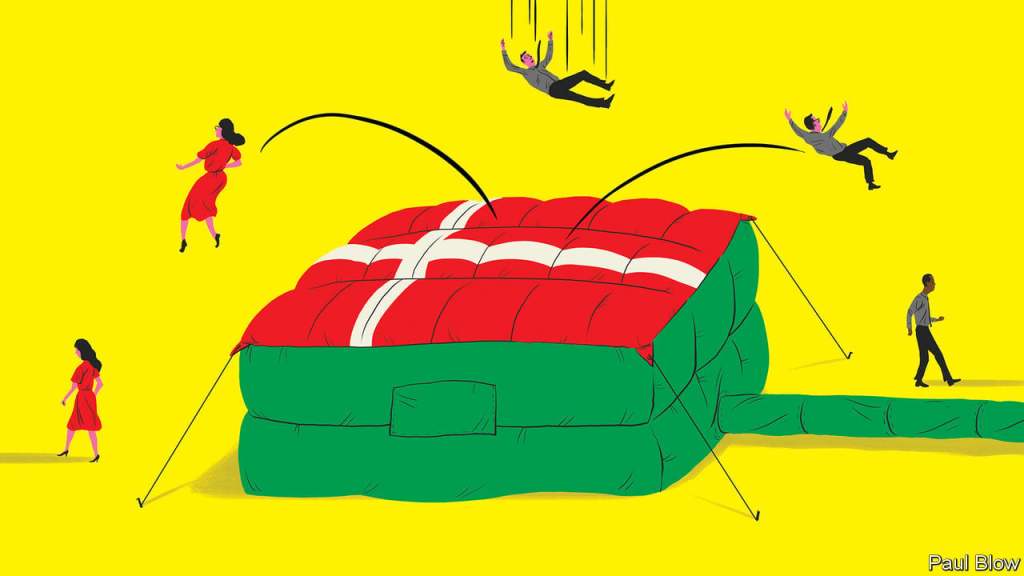
David Leonhardt, In an Age of Right-Wing Populism, Why Are Denmark’s Liberals Winning?

Around the world, progressive parties have come to see tight immigration restrictions as unnecessary, even cruel. What if they’re actually the only way for progressivism to flourish?

Mr. Leonhardt is a senior columnist for the New York Times, and the author of Ours Was the Shining Future: The Story of the American Dream.

This is a very long article from the New York Times magazine. It takes 53 ½ minutes to read it aloud. (If you would like to hear it, go here.) In support of the thesis that is the headline of this post, the article covers a great deal of ground (geographically and historically), is well researched, and argues the case in great detail.

If you think that all US working class anti-immigrant feeling is grounded in simple racism—if you believe that the Democratic Party’s position on borders is coherent, well advised, and politically saleable—then I challenge you to read this article, consider it carefully, and articulate wherein you think it goes astray. 

A central focus is the anomalous continuing political success of Denmark’s Social Democratic Party. Leonhardt writes, 

Since the Social Democrats took power in 2019, they have compiled a record that resembles the wish list of a liberal American think tank. They changed pension rules to enable blue-collar workers to retire earlier than professionals. On housing, the party fought speculation by the private-equity industry by enacting the so-called Blackstone law, a reference to the giant New York-based firm that had bought beloved Copenhagen apartment buildings; the law restricts landlords from raising rents for five years after buying a property. To fight climate change, [Prime Minister] Frederiksen’s government created the world’s first carbon tax on livestock and passed a law that requires 15 percent of farmland to become natural habitat. On reproductive rights, Denmark last year expanded access to abortion through the first 18 weeks of pregnancy, up from 12 weeks, and allowed girls starting at age 15 to get an abortion without parental consent.

All the while, the country continues to provide its famous welfare state, which includes free education through college (including a monthly stipend of about $900 for living expenses), free medical care and substantial unemployment insurance, while nonetheless being home to globally competitive companies like Novo Nordisk, the maker of the anti-obesity drug Ozempic. In 2022, Frederiksen won a second term, defying the anti-incumbent mood that has ousted incumbent parties elsewhere since the Covid pandemic. As part of her success, she has marginalized the far right in her country.

But there is one issue on which Frederiksen and her party take a very different approach from most of the global left: immigration. Nearly a decade ago, after a surge in migration caused by wars in Libya and Syria, she and her allies changed the Social Democrats’ position to be much more restrictive. They called for lower levels of immigration, more aggressive efforts to integrate immigrants and the rapid deportation of people who enter illegally. While in power, the party has enacted these policies. Denmark continues to admit immigrants, and its population grows more diverse every year. But the changes are happening more slowly than elsewhere. …

Leftist politics depend on collective solutions in which voters feel part of a shared community or nation, [the prime minister] explained. Otherwise, they will not accept the high taxes that pay for a strong welfare state. “Being a traditional Social Democratic thinker means you cannot allow everyone who wants to join your society to come,” Frederiksen says. Otherwise, “it’s impossible to have a sustainable society, especially if you are a welfare society, as we are.” High levels of immigration can undermine this cohesion, she says, while imposing burdens on the working class that more affluent voters largely escape, such as strained benefit programs, crowded schools and increased competition for housing and blue-collar jobs. Working-class families know this from experience. Affluent leftists pretend otherwise and then lecture less privileged voters about their supposed intolerance.

“There is a price to pay when too many people enter your society,” Frederiksen told me. “Those who pay the highest price of this, it’s the working class or lower class in the society. It is not — let me be totally direct — it’s not the rich people. It is not those of us with good salaries, good jobs.” She kept coming back to the idea that the Social Democrats did not change their position for tactical reasons; they did so on principle. They believe that high immigration helps cause economic inequality and that progressives should care above all about improving life for the most vulnerable members of their own society. The party’s position on migration “is not an outlier,” she told me. “It is something we do because we actually believe in it.”

The Mad King: a Tour d’Horizon

In this video, the two talking heads cover a whole lot of ground. I mostly agree with them. If you don’t, then God bless, and have a nice day. 

Toward the end, they turn to trying to suss out what’s going on in Trump’s brain. I particularly commend that part of the video. 

In case you don’t know:

Rick Wilson is a former Republican and former Republican political consultant. He currently writes political opinion pieces and is a political talking head on YouTube and elsewhere. He has written two books, including Everything Trump Touches Dies.

During the video Wilson refers, at one point, to his “misspent youth.” He may be thinking about the time he created the ad that defeated Max Cleland—a war hero paralyzed by his wounds—by implying that Cleland supported Al-Qaida.

Will Saletan has been writing on public affairs since 1996. He has also written two books. Sometimes he’s right, and sometimes he’s not. In 2003 he wrote a book arguing that conservatives had won the public debate about abortion rights. Well, if they had won it in 2003, they have lost it now; look at the headlines out of Missouri today. In 2023, he wrote The Corruption of Lindsey Graham: A case study in the rise of authoritarianism.

“The Mirage That Led Democrats Astray in 2024”

Distracted and heart sick as we are by the shit show that is the second Trump presidency, we must remember that we lost the election because of immigration and the border, and, more importantly because of the misery of the working class. Misery to which affluent center-left people like me were blind. Misery that was ruthlessly exploited by the MAGA noise machine. 

For a deep dive, please check out Eugene Ludwig, Voters Were Right About the Economy. The Data Was Wrong. Here’s why unemployment is higher, wages are lower and growth less robust than government statistics suggest (Politico, Feb. 11, 2025).

Mr. Ludwig writes,

­­ What we uncovered shocked us. The bottom line is that, for 20 years or more, including the months prior to the election, voter perception was more reflective of reality than the incumbent statistics. Our research revealed that the data collected by the various agencies is largely accurate. Moreover, the people staffing those agencies are talented and well-intentioned. But the filters used to compute the headline statistics are flawed. As a result, they paint a much rosier picture of reality than bears out on the ground.

Take, as a particularly egregious example, what is perhaps the most widely reported economic indicator: unemployment. Known to experts as the U-3, the number misleads in several ways. First, it counts as employed the millions of people who are unwillingly under-employed — that is, people who, for example, work only a few hours each week while searching for a full-time job. Second, it does not take into account many Americans who have been so discouraged that they are no longer trying to get a job. Finally, the prevailing statistic does not account for the meagerness of any individual’s income. Thus you could be homeless on the streets, making an intermittent income and functionally incapable of keeping your family fed, and the government would still count you as “employed.”

I don’t believe those who went into this past election taking pride in the unemployment numbers understood that the near-record low unemployment figures — the figure was a mere 4.2 percent in November — counted homeless people doing occasional work as “employed.” But the implications are powerful. If you filter the statistic to include as unemployed people who can’t find anything but part-time work or who make a poverty wage (roughly $25,000), the percentage is actually 23.7 percent. In other words, nearly one of every four workers is functionally unemployed in America today — hardly something to celebrate.

Ludwig goes on to analyze the flaws in other indicia, including earnings averages, inflation measures. “The resources required simply to maintain the same working class lifestyle over the last two decades,” he writes, “have risen much more dramatically than we’ve been led to believe.” Moreover,

the aggregate measure of GDP has hidden the reality that a more modest societal split has grown into an economic chasm. Since 2013, Americans with bachelor’s or more advanced degrees have, in the aggregate, seen their material well-being improve — by the Federal Reserve’s estimate, an additional tenth of adults have risen to comfort. Those without high school degrees, by contrast, have seen no real improvement. And geographic disparities have widened along similar lines, with places ranging from San Francisco to Boston seeing big jumps in income and prosperity, but places ranging from Youngstown, Ohio, to Port Arthur, Texas, falling further behind. The crucial point, even before digging into the nuances, is clear: America’s GDP has grown, and yet we remain largely blind to these disparities.

Take all of these statistical discrepancies together. What we have here is a collection of economic indicators that all point in the same misleading direction. They all shroud the reality faced by middle- and lower-income households. The problem isn’t that some Americans didn’t come out ahead after four years of Bidenomics. Some did. It’s that, for the most part, those living in more modest circumstances have endured at least 20 years of setbacks, and the last four years did not turn things around enough for the lower 60 percent of American income earners. …

In an age where faith in institutions of all sorts is in free fall, Americans are perpetually told, per a classic quote from former Sen. Daniel Patrick Moynihan, that while we may be entitled to our own opinions, we aren’t entitled to our own facts. That should be right, at least in the realm of economics. But the reality is that, if the prevailing indicators remain misleading, the facts don’t apply. We have it in our grasp to cut through the mirage that led Democrats astray in 2024. The question now is whether we will correct course.

Autopsy

Politico, New research shows the massive dole Dems are in: Even voters who previously backed Democrats cast the party as weak and overly focused on diversity and elites.

N.Y. Times, Frank Bruni, Tim Ryan; Anat Shenker-Osorio, Lis Smith, “The Democratic Brand Is in the Toilet”: 4 Writers Tell the Democrats’ Fortune

The Politico piece appears to be mostly straightforward reporting of what people said in focus groups—the people in question being several categories of wishy-washy, definitely non-elite voters. Takeaway: “In a trio of focus groups, even voters whopreviously backed Democrats cast the party as weak and overly focused on diversity and elites, according to research by the progressive group Navigator Research.”

If you care about American democracy, the N.Y. Times article is most definitely worth a read. In it, Frank Bruni of the Times moderates an email conversation among himself, Tim Ryan, the former congressman, and two others. (“Ms. Shenker-Osorio is the host of the podcast “Words to Win By.” Ms. Smith was a senior adviser to Pete Buttigieg’s presidential campaign.”)

Some highlights:

Lis Smith: The Democratic brand is in the toilet. Many of the Democrats who succeeded this cycle — our best over-performers in House races, for instance — are people who ran against the Democratic Party brand. Trump tore down the blue wall in the industrial Midwest, but he also expanded his vote the most in our bluest and most urban areas. …

Tim Ryan: The Dems got pinned as the status quo party on inflation, instability, insecurity and every other issue facing working people. Trump was the change candidate in a year when 65 percent of people thought we are on the wrong track. And they failed to redefine themselves on the culture issues on which they were on the other side of 60 percent to 70 percent of Americans. …

Anat Shenker-Osorio: … Voters, outside of hard partisans, think most politicians lie at least some of the time. I know — we just asked them in a survey. Seventy-two percent of them said this of Republican leaders and 70 percent said this of Democrats. This is astonishingly good for authoritarians. What it means, and we hear this in nearly every focus group we do, is that they discount the threats of MAGA. It sounds like this: “Well, Trump’s just saying things. He doesn’t really mean them.” So, he gets to keep his base engaged and enraged, while also seeming like the guy who’s just going to give you a personally signed check.

Meanwhile, it’s absolutely detrimental to Democrats because their purported achievements, desirable agenda and dire warnings are all not credited as real. Nationally, extrapolating from AP VoteCast data, 19 million Biden 2020 voters sat it out this time. This was mainly a lurching couch-ward, not rightward. Why? Voters here and around the world are looking around at what there is on offer and saying: not this. …

Smith: We need to look to who succeeded and overperformed this cycle and why. Some of the top overperformers in House races couldn’t have had more disparate profiles — Pat Ryan, Jared Golden, Tom Suozzi, Marie Gluesenkamp Perez, Angie Craig. What they had in common was that they were willing to run against the party brand, they met voters where they are on their frustrations with the border and public safety issues, and they talked more about their vision for the future than how bad Donald Trump is. I’d also throw in another thing — these members largely were among the first to call for Joe Biden to step down as nominee. They weren’t in the crew of Democrats who told voters not to believe what they’d seen with their own eyes in that first debate.

Shenker-Osorio: If you want to look at successes that seem to defy “conventional wisdom,” to me that’s Gov. Andy Beshear of Kentucky. He has consistently run on, not from, his values, mixing economic populism with a clear and powerful explanation for the siren song of the right wing: scapegoating, hate peddling and fear mongering. Beshear creates the biggest possible “we” and then conveys why right-wing attacks on groups that have been intentionally “othered” are Trojan horses to enable widespread harms, from taking away our freedoms, to controlling our lives, to screwing over our livelihoods. …

The largest voting bloc in the United States is almost always voter-eligible nonvoters. Folks are opting out of participation for a reason — and it’s feeling as if neither party is actually focused on making life better for working people. Democrats cannot be running as the protectors of norms and institutions, and yes, that includes democracy, because democracy never bought anyone dinner.

Bruni: I’m encouraged, in a way, that I don’t sense Democrats spoiling to fight Trump on every initiative and at every turn. Democrats cannot live on a diet of sour grapes, and that kind of blanket resistance could look less like principle than like reflexive obstructionism and haughty dismissal of election results, and could doom Democrats to failure in the fights that count the very most. Which are those? Which of Trump’s proposals must Democrats do all in their power to defeat and — maybe just as important — are there proposals or general priorities of his that aren’t awful and that Democrats should try to find ways to work with him on?

Ryan: We should be all over the Robert F. Kennedy Jr. food reform initiative. We don’t have to agree with him on everything and we can fight him on other things. It is criminal what we have allowed to happen. We are basically poisoning our own people, driving up health care costs, lowering productivity while it’s all being subsidized by the taxpayer for American farmers to grow crops that go into fake food.

We should put forward a dozen recommendations on the “department of government efficiency” effort. Our federal government is so wasteful and bloated that we should be able to come up with major reforms to save money and help government provide better services.

Smith: We don’t actually know what Trump is serious about doing as president yet. Unlike Tim, I don’t think Kennedy was picked to take on Big Ag and Big Food — I think all of that is being used as a smokescreen for his truly dangerous views on things like vaccines. We should fight Trump and Kennedy tooth and nail if they sow doubt about lifesaving vaccines for polio and M.M.R., because that will actually have life-or-death consequences for Americans (see what Kennedy did in Samoa).

But broadly, we shouldn’t just oppose things because Trump supports them. If he really wants to build more American manufacturing or cut taxes for the middle class we should be for it.

Knock! Knock! The Center for Working Class Politics Would Like Your Attention for a Moment, Please!

Dustin Guastella, The left’s best defense against Trump? Ditching limousine liberalism: An effective fight against the president-elect requires a struggle that takes the frustrations of working-class voters seriously

Mr. Guastella works for the Center for Working Class Politics, an institution not previously within my radar screen, but one that probably should be within our awareness.

The article is published by the Guardian, so you can read if for free. Its message is broadly consistent with a theme that I have been pushing: that we progressives need to listen to the non-college-educated working class once again, hear their concerns, and form a coalition with them to advance our common interests, versus the ultra-wealthy business elites. ­

After damning the Democrats and Kamala Harris for not embracing the working class, Guastella writes,

OK, so Harris represented limousine liberals, that still doesn’t explain why blue-collar voters would choose an uber-wealthy playboy like Trump, not to mention his billionaire henchman Elon Musk, over her. And, according to analyses from the Center for Working Class Politics, working-class voters did prefer Trump. But we don’t need some description of “false consciousness” to understand why this might be. The fact is working-class people do not have a genuine political home in our new Gilded Age, they are forced to ally either with billionaires in the Republican party or Democratic liberal elites in hopes that someone will allay their concerns. Fixing this requires a politics that confronts both. …

Almost all of the content of American politics – the candidates, the policies, the priorities – concerns the top 20% of the income and wealth hierarchy. Remember, less than 2% of members of Congress come from working-class backgrounds. Working-class candidates face immense political obstacles because they have neither the money, nor the credentials – won in the halls of elite schools, conferences and institutions – needed to break into the fortress of American government. Many voted for Trump in the hopes that he could take a wrecking ball to the whole thing.

Having made these important points, Guastella then segs into the argument that Democrats must reverse course not only on economic issues but also on non-economic cultural and values issues:

Though, it will not be enough for the left to protest the billionaire economy. An honest assessment of progressive liabilities is in order. Those on the left must confront the cultural elite that has pushed the party away from workers on all sorts of non-economic issues. While Trump and his billionaires won’t be able to adequately represent the economic interests of the working class, liberals must recognize that their party doesn’t represent their values. The Democrats captured by highly credentialed clerics has led them to embrace the cultural values of an aristocratic elite. From crime, to climate, to gender politics, and the border, mainstream liberal opinion is much further from the views of workers than many liberals are willing to admit. And this too is a class story.

Well, Knock! Knock! I Have Two Important Things to Say About Embracing Alleged Working Class Culture and Values.

First important thing: Yes, yes, it’s high time to reconsider some issues. For example, lots of minority people feel that aggressively pushing DEI can make them look like “token hires”—not the accomplished, fully deserving people they are. 

Second important thing: But while we’re doing all this cultural/value reconsidering, let’s insert a step: think carefully about what is the right thing to do, not the thing to do that might improve your messaging.

And here is why we need to actually consider the right thing to do: because, ladies and germs, the right thing to do will probably, at the end of the day, also be the politically expedient thing to dol. 

Posted by Ron Davis, Dec. 21, 2024