
Indraneel Sur, Esquire’s Terrible, Horrible, No Good, Very Bad Day in Court

Washington Post, Judge orders Trump administration to pay millions in USAID funds: Officials have one day to resume foreign aid payments after a contentious hearing in which a government lawyer couldn’t say if funds had been unfrozen.

Politico, Judge warns Trump administration to comply with court order on foreign aid payments

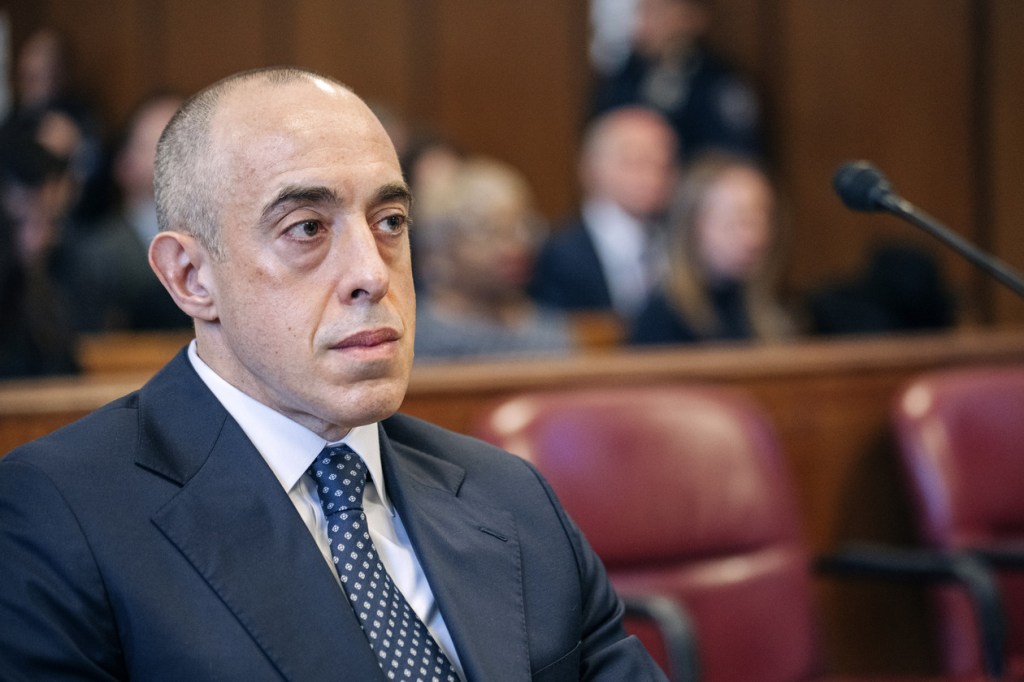
Indraneel Sur graduated from Yale, earned his law degree at the prestigious University of Pennsylvania Law School, worked as an associate at the prestigious law firm Gibson, Dunn & Crutcher, and then joined the Justice Department as an attorney. One source claims that he is a member of the Federalist Society. Yesterday, he appeared in court to defend the government’s response to the judge’s pending order to resume payments owed for supplies delivered to USAID. 

The Washington Post reports that “During the contentious 90-minute hearing, Justice Department lawyer Indraneel Sur told [the judge] he was ‘not in a position to answer’ whether the Trump administration had taken needed steps to allow the assistance to begin moving.”

Politico writes about his day in court yesterday:

During a telephone hearing, U.S. District Judge Amir Ali grew impatient with a lack of clear responses from the administration’s lawyers to claims from aid contractors that they have seen no payments from the State Department or U.S. Agency for International Development since Ali issued an emergency order Feb. 13 halting a broad freeze on aid-related programs.

“I don’t know why I can’t get a straight answer from you,” the judge lamented after Justice Department attorney Indraneel Sur repeatedly sidestepped a question about whether the Trump administration released any funds following the judge’s earlier order.

After Sur suggested that officials were holding up or canceling payments under the terms of individual contracts, Ali said he was baffled by the government’s view.

“I guess I’m not understanding where there is any confusion here,” the judge said. “It’s clear as day.”

What Seems to be Happening—and Some Friendly Advice from Your Dutch Uncle Ron

The picture will become clearer as this case proceeds—along with the many dozens of other cases involving the legality of the Trump administration’s acts. Right now, however, the picture that seems to be emerging is that someone in the administration is ordering its frontline lawyers to pull the wool over the eyes of the judges in these cases. 

So here’s a friendly piece of advice. If you have drunk freely of the Trump Kool-Aid and want to defend its contentions about its dictatorial powers, then you can probably do so without being disbarred or sent to jail. 

But do not lie to the court. If you do, you are going to be in a world of hurt. 

And the day when your boss—or his boss—orders you to lie to the court is the day you need to walk off the job.

For your own protection, if for no other reason than to protect yourself. 

Good News!

Jeff Shesol (N.Y. Times), John Roberts Has One Chance to Get This Right

In many ways, as of the last week in February, it feels as if we are all taking a trip on the Titanic, fast approaching that iceberg. Take for example the New York Times piece from today. I don’t disagree with a word in it. 

Our situation is dire, in so many ways that it’s difficult to count all of them. But … I really hope you can spare a few minutes to watch Rick Wilson’s video, to supply some needed perspective. 

And permit me to supplement Wilson’s take in the following way. Begin with several things we know for sure, or at least to a very high level of confidence, about how events are going to evolve over the next few weeks. 

Five Things We Know for Sure, or at Least to a High Level of Confidence

1. Trump, Elon Musk, and their henchmen remain high on their own supply. In very important ways, they literally do not know what they are doing. In many ways, they don’t know the harm they are causing (or are about to cause) in the lives of their own supporters. In many ways, they have a fundamental misperception of public opinion. (Yeah, lot of that going around.)

2. Trump and his crew will continue to wreck the federal government, which will produce ever increasing levels of mayhem.

3. Trump and his crew will do jack shit to combat inflation, in violation of the one campaign promise that put him over the top in 2024.

4. The process of wrecking the federal government will culminate—in maybe a month, or it could be sooner—in a true constitutional crisis, where Trump openly defies the Supreme Court.

5. Any of several pending foreign policy crises will ripen into disaster. In particular, just as Biden had his Afghanistan moment, so Trump is probably going to have his Ukraine moment. 

Now, Let Us Hazard a Cautious Prediction

Here is the prediction:

While we cannot predict the outcome when all of these situations ripen into disaster at more or less the same time, we can say with some confidence that the five trends will interact with each other.

To take an example: The number of people who might be willing, in good times, to acquiesce in Trump’s overthrow of the rule of law is smaller than the number of people who will cheer when he defies the Supreme Court at the same time that he is royally screwing over the folks who voted for him. And, at the same time, selling out America’s allies and cheering on a Russian invasion.

A First Ruling from SCOTUS on Trump 2.0—and a Reading of the Tea Leaves

The Hill, Supreme Court stiffs Trump, punts on firing whistleblower agency head

SCOTUSblog, Supreme Court sidesteps Trump’s effort to remove watchdog agency head

Trump fired someone named Hampton Dellinger as head of the Office of Special Counsel, a body that prosecutes government misconduct and protects whistleblowers. He gave no reason for his displeasure; you are free to fill in the answer for yourself.

Mr. Dellinger sued to get his job back and found a district judge who granted him a temporary restraining order (TRO) to prevent Trump from shitcanning him while the employment case proceeds.

TROs don’t last long. This one is set to expire a few days from now, February 26, by which time the parties can brief the issue and present evidence as to whether the TRO should or should not be changed into a preliminary injunction—which would allow Mr. Dellinger to keep his job until the case is tried. 

If the district judge should rule for Mr. Dellinger on the preliminary injunction question next week, then Trump can take the case to the court of appeals and on to the Supreme Court. Should that happen, the legal process will probably be as speedy as shit through a goose.

But that is not fast enough for Trump. Trump argued that it’s a red hot emergency if Dellinger gets to stay in office for another few days. That was the issue on which the Supreme Court ruled today. 

In short, the core issue in the case, though involving arcana of appellate procedure, was similar to that in State of Washington v. Trump, about which I posted yesterday. To wit, must the courts consider it a red hot emergency just because Trump claims it’s a red hot emergency?

In short, Trump was aiming for some Shock and Awe action from the High Court. He wanted the Court to smite his enemies with a mighty rod, and that right quickly, and without much thought.

That’s what he wanted. What he got instead was support from only two of the nine justices, Gorsuch and Alito.

At the other end of the ideological spectrum, Justices Sotomayor and Jackson would have ruled that Trump should just take a long walk off a short pier. 

Two at one extreme and two at the other extreme. That leaves five in the middle, at least for right now. And a motley crew they are: Chief Justice Roberts, along with Justices Kagan, Kavanaugh, Coney Barrett, and Thomas.

And the specifics of their middle position? To hold the appeal in abeyance pending until the TRO expires. 

And, in so doing, to say—along with the Federalist Society judge in State of Washington v. Trump—no, no, it’s not an emergency just because Trump claims it’s an emergency. 

And Now for the Reading of the Tea Leaves

And no, friends and neighbors, this is not a prediction. It’s just a first reading of the tea leaves, based on the first Trump 2.0 case to reach the Supreme Court.

Alito and Gorsuch are not a surprise.

But a big eyebrow raiser for me was that seven members of the Court stood up to Trump’s procedural bluster and bullying.

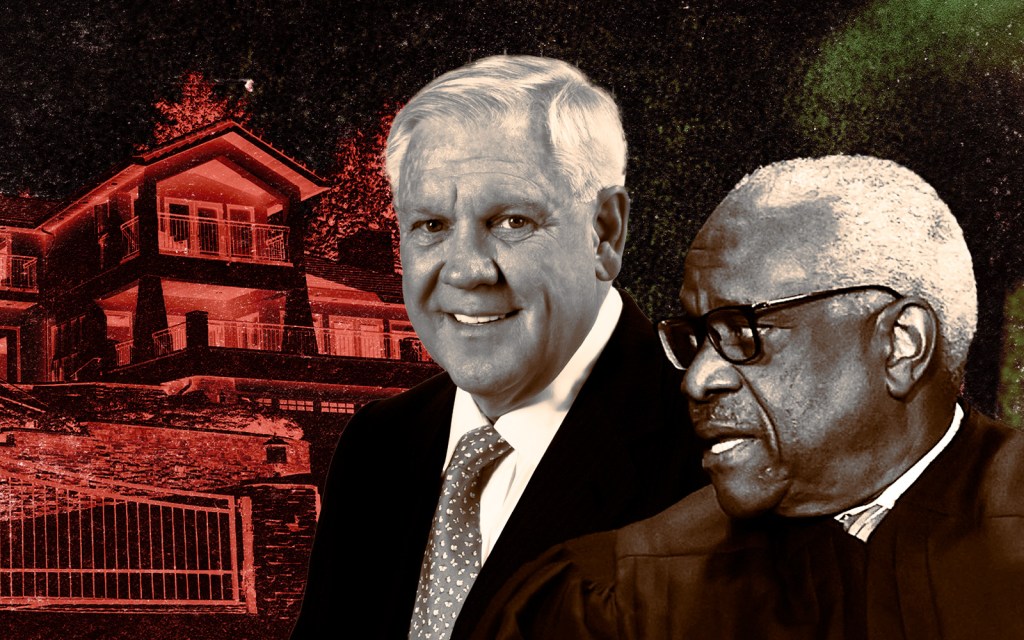
And the biggest eyebrow raiser was the presence of Justice Clarence Thomas among this crew. One is compelled to wonder whether Justice Thomas might have had a little talk with his bosom buddy and traveling companion Harlan Crow, a Republican megadonor who megadonates to a lot of Republicans not named Donald Trump. 

The Ninth Circuit Panel’s Decision in State of Washington v. Trump, One of the Birthright Citizenship Cases—Shock and Awe or Shock and Awful?

The opinion, issued on February 19, denied the Justice Department’s “emergency” request for the appeals court to overrule a district judge’s injunction against Trump’s executive order purporting to end birthright citizenship, despite the language of the Fourteenth Amendment and despite consistent judicial interpretations of the Fourteenth Amendment, going back to 1898. (If anyone cares, that district judge, who reamed out Trump and his Justice Department, was appointed by President Reagan.)

To be clear, the district court’s ruling in question was not the judge’s definitive answer to the question whether Trump was right or wrong on birthright citizenship. It was, instead, a decision ordering a “preliminary injunction” pending full briefing, trial, and argument of the case. 

Brushing away lots of legalese, the central issues at play when a judge rules on a request for a preliminary injunction are three:

  • the “likelihood of success on the merits,” in other words, what does the judge think will probably happen when all the dust settles: Is the plaintiff more likely to win, or is it the defendant who will probably prevail? and, second,
  • the harm issue—will the plaintiff be harmed if a preliminary injunction is not issued to preserve the state of play, while the issue is litigated? Or is it the defendant who will suffer harm if it is enjoined from doing what it wants to do?
  • the public interest issue—apart from the parties to the case, what about the broader public? 

In my experience, the first of these factors—“likelihood of success on the merits”—tends to be dispositive. And so it was here. Two of the three panel members of the appellate panel, Judge William Canby (appointed by Carter) and Milan Smith (appointed by Bush the Elder), joined in a terse, one page decision, declining to overrule the district court, because Team Trump did not make a “strong showing that [they are] likely to succeed on the merits.” 

The third judge, Danielle J. Forrest, wrote a much more expansive piece of prose, concurring in the majority’s bottom line result, but “for reasons different than relied on” by the other two members of the panel. 

Many are wondering how the Federalist Society judges, who now bestride the third branch of our federal government, will deal with Team Trump. What the Supreme Court does with birthright citizenship remains to be seen. But Judge Forrest’s treatment of the case is not without interest.

A bit of background: Judge Danielle Forrest was appointed to the bench in 2019, during Trump 1.0. Reading between the lines of her Wikipedia biography, I glean that Democratic opposition to her appointment was weak, probably on the ground that, “Well, this is about the best we can expect from a Trump appointment.”

Interestingly, her Wikipedia entry says, in black and white, that “She was a member of the Federalist Society from 2002 to 2006 and again from 2017 to present.” One might wonder whether her renewed commitment to the Federalist Society in 2017 might have had something to do with a desire for higher office—given that Trump 1.0 farmed out the judicial selection function to the esteemed Society. That said, in any event …

In her six pages of prose, Judge Forrest manfully eschewed any views on the “likelihood of success on the merits”—in other words, whether birthright citizenship is found in the Constitution, or whether it isn’t.

Instead, the very large burr in her saddle was the purported “emergency” referenced by Team Trump. The implication is that birthright citizenship has been the law of the land ever since 1866 or 1898, depending on how you count. Letting it be the law of the land for a few more weeks, or a few more months, is in no way an emergency. 

And just because Team Trump SAYS there’s an emergency does not mean there REALLY IS an emergency. 

In short, for this one Federalist Society jurisprude, Team Trump’s legal Shock and Awe is really Shock and Awful. 

A Little Context for the Preceding Post—the One About the New York City Bar Association

It’s the Incentives, Stupid

In a couple of hours, my wife will be having a pointed discussion with the local tax assessors over the value of her apartment. The condos in our building vary a whole lot in size, layout, and many other features. But guess what? It turns out that the thing that best predicts the sale price is the number of square feet in the condo. If you know that number, then you have a very good idea of the condo’s fair market value.

Why in the world make that point? Because, let me humbly submit, while people vary in all sorts of ways, the one thing that best predicts their behavior is their incentives.

I was in Big Law for a long time. Some of the people I knew were fine human beings. Some, I’m sorry to say, had the morality of a sea slug. But, like the rest of the human race, most of them were somewhere in the middle, morality-wise. 

I am confident that, for some of those who wrote and promoted the New York City Bar Association’s statement on the Adams case, promoting justice and good government was a driving concern. I am equally confident that the objective incentives of the Bar Association’s members was a driving force, as well.

Let me put it bluntly.

If the legal system breaks down, ain’t nobody gonna pay you no $2.5 million for your skilful manipulation of the legal system. 

And Now, a Word from the Big Law Firms in New York City

Back in my day, it was officially The Association of the Bar of the City of New York, its original name from back in 1870, when it was formed to fight the judicial corruption promoted by the Tammany Hall machine. Now, it’s the New York City Bar Association. Its president is a partner in a global law firm with profits per partner of $2.5 million. Its leadership includes a number of the president’s peers in other global law firms (together with others too, like professors and legal aid attorneys). 

Yesterday, the association issued this press release. 

On United States v. Eric Adams

Since its founding in 1870, the New York City Bar Association has supported the rule of law as one of its core missions – regardless of politics or ideological persuasion. “The true administration of justice is the firmest pillar of good government” is not merely an aphorism engraved in stone on courthouses but, together with the rule of law, the essence of American democracy. This mission and these values necessitate voicing our concern about the events of recent days in the ongoing federal case of United States v. Eric Adams, 24-CRIM-556 (S.D.N.Y.).

Prosecutors have a duty to act in the public interest, to perform their duties with objectivity, and to analyze all the evidence when deciding whether to pursue criminal charges. This is especially true in the prosecution of crimes allegedly committed by public officials involving abuses of power or corruption.

While the City Bar takes no position on the substantive merits of the Adams case, the numerous resignations by prosecutors from the office of the United States Attorney for the Southern District of New York and the Public Integrity Section of the United States Department of Justice, and the flurry of letters from those who have resigned and from the Acting Deputy Attorney General, command the City Bar’s attention and expression of concern.

The events of recent days are reminiscent of the Saturday Night Massacre resignations of Attorney General Elliot Richardson and Deputy Attorney General William Ruckelshaus, which precipitated the crisis of public confidence when they were ordered by President Nixon to dismiss Special Prosecutor Archibald Cox to halt the Watergate investigation.

The direction of Acting Deputy Attorney General Emil Bove III to the Southern District prosecutors to prepare and file a motion to dismiss the case against the Mayor of New York City cuts to the heart of the rule of law. The unusual form of Mr. Bove’s direction via a public memorandum buttresses arguments that the direction is based on pretextual grounds.

The letter from Acting United States Attorney Danielle Sassoon and Mr. Bove’s response give every indication that the dismissal of Mayor Adams’ case, without prejudice, is predicated on his agreeing to increase New York City’s assistance in the Trump administration’s immigration enforcement efforts. When the proposed dismissal is made “without prejudice” to the charges possibly being reinstated at some future date, the entire proposal raises serious questions involving both the potential quid pro quo and prosecutorial weaponization of our justice system.

Indeed, the justification offered by Mr. Bove for his decision expressly avoids any consideration of the merits of the prosecution, instead resting on a rationale which is expressly political. In particular, Mr. Bove suggests that dismissal is predicated upon Mr. Adams’s continuing agreement to use the power of his office as mayor to facilitate the administration’s immigration enforcement policies. The policy choices of the government of New York City cannot be dependent on or appear to be dependent on the decision of the Justice Department to prosecute or withhold prosecution of corruption charges against the mayor.

Against such a backdrop, the City Bar commends Ms. Sassoon for her courageous decision to offer her resignation from a post she assumed a few short weeks ago. Whatever the merits of the underlying case against Mayor Adams, her letter reflects the proper course of conduct for a prosecutor seeking to adhere to her oath to pursue justice without fear or favor. Her letter reflects integrity and a principled commitment to the rule of law and democracy. The City Bar likewise applauds Assistant United States Attorney Hagan Scotten, Acting Chief of the Criminal Division Kevin Driscoll, Acting Chief of the Public Integrity Section John Keller, and the other attorneys at the Department of Justice who chose to resign rather than acquiesce to a decision raising profound questions of legality, morality, and legal ethics.

The interests of the public are best served by the continuation of the prosecution of Mr. Adams. In any event, the Department of Justice’s motion to dismiss the charges must be resolved on the basis of a complete record, which should include a searching inquiry into the nature of the bargain struck and a determination of its benefit to the public. If, as Mr. Bove contends, the prosecution of Mayor Adams was brought for improper political purposes, such an allegation can and should be adjudicated in the District Court. There is precedent for the District Court’s appointment of amicus curiae to obtain input from an independent counsel. See United States v. Flynn, No. 20-5143 (D.D.C.) (brief by former federal judge John Gleeson). In our view, the District Court should not dismiss the indictment against Mayor Adams without hearing from an independent lawyer, as neither the Mayor’s counsel nor the lawyers from the Department of Justice can fulfill that role.

Now it is for the United States District Court for the Southern District of New York to examine whether dismissal of the charges in United States v. Eric Adams is “in the public interest” and is “not tainted by impropriety” or “bad faith.” All members of the public concerned about whether law enforcement agencies will protect the public rather than manipulate the criminal justice system for political means await the outcome. Whatever the outcome, this episode is a stark reminder of the dangers of political interference in our justice system and the potential such interference has to undermine the public’s trust and confidence in the rule of law.

About the Association
The mission of the New York City Bar Association, which was founded in 1870 and has 23,000 members, is to equip and mobilize a diverse legal profession to practice with excellence, promote reform of the law, and uphold the rule of law and access to justice in support of a fair society and the public interest in our community, our nation, and throughout the world. www.nycbar.org

Pam Bondi, Emil Bove, Danielle Sassoon, and the Thursday Afternoon Massacre

Pictured above is Emil Joseph Bove the Third, formerly criminal defense lawyer for Donald Trump and currently Acting U.S. Deputy Attorney General. Would you buy a used car from this man?

But I digress.

Many—including the Wall Street Journal Editorial Board—have applauded the actions of Danielle Sassoon,Hagan Scotten, and Justice Department attorneys who walked out the door last week, rather than sign their names to a bullshit legal filing. See, for example,

WSJ Editorial Board, The Trump Trial of Danielle Sassoon, The young prosecutor behaved well in resigning, not so her bosses at the Justice Department

Eric Lach (The New Yorker), Danielle Sassoon’s American Bravery: A conservative prosecutor in New York makes the first bold move against Donald Trump’s rampaging Presidency.

Ross Douthat (N.Y. Times), Why Picking a Fight with Danielle Sassoon Has a Downside for the Trumpists

But let me give you one lawyer’s perspective. Yes, courage and cowardice, political expediency, and common sense versus stupidity are all part of this. But, ladies and germs, there are also some rules.

On the One Hand …

The President appointed, subject to the advice and consent of the Senate, one Pamela Jo Bondi to be United States Attorney General. The Senate duly advised and consented to Ms. Bondi’s appointment, and she is now the head of the Justice Department. 

In that role, it is reported that she has reminded all of her subordinate lawyers that they have an ethical duty to represent their client zealously, within the bounds of the law. 

Now, at this point, kindly quibble me no quibbles about who “the client” is—Donald Trump poisonally, the “Office of the President,” or “the American people.” 

For the fact is that Attorney General Bondi has the right to set the legal policy of the Justice Department. And the subordinate attorneys have nothing that prevents them from leaving if they have—for whatever reason—a strong personal antipathy for arguing “zealously, within the bounds of the law,” in support of the positions they are directed to advance. 

A side note for context: Attorneys are encouraged to take unpopular causes, and to represent those causes “zealously, within the bounds of the law.” But there is no legal requirement to take on causes that are personally repugnant—for one thing, because if the cause is so damn repugnant, we probably would not do a bangup job advancing it. 

But, if we do take on a cause, then we have a duty to advance that cause “zealously, within the bounds of the law.”

So, score one for Attorney General Bondi. 

For Example …

The Attorney General might order a subordinate attorney to argue that United States v. Wong Kim Ark (Supreme Court, 1898), confirming birthright citizenship for children of Chinese immigrants, was wrongly decided and should be reversed. It would then be the subordinate’s duty EITHER to develop arguments to overrule the Wong case, whether or not the attorney thought those were persuasive arguments OR to seek other employment.

Litigators often advance argument which they do not personally believe. That is the core of the rule of legal ethics that requires us to represent our clients zealously, within the bounds of the law. 

On the Other Hand …

There is that part about “within the bounds of the law.”

For Example …

Although you can and should urge the judge to focus on the facts that favor your side and to place less importance on facts favorable to the other side, you cannot misrepresent the facts. For example, if you’re a Justice Department lawyer in a case where the judge has issued an injunction against shutting down the Department of Education, you cannot tell the judge that the government is obeying the order when the government is actually violating the order. 

Nor can you tell a judge that a case you cite stands for proposition X when the case does not stand for proposition X, it stands for something else. 

In the Thursday Afternoon Massacre situation, Emil Joseph Bove the Third order Danielle Sassoon and others to declare that the dismissal of the Eric Adams criminal prosecution was something other than a corrupt political deal. When in fact it was exactly that: a corrupt political deal. 

To Cut to the Chase …

If your boss tells you to do something grossly unethical or highly stupid, then it’s a good idea to walk out the door.

But if your boss tells you that you have to do an illegal act yourself, then you had really, really better skedaddle, and that right quickly. Because you are at risk not only of being sanctioned by your friendly local bar association, you are at also in danger of prosecution for criminal obstruction or justice or criminal contempt of court. 

“No system of ordered liberty can allow the Government to use the carrot of dismissing charges, or the stick of threatening to bring them again, to induce an elected official to support its policy objectives.”

This afternoon, Hagan Scotten, who was Danielle Sassoon’s colleague and second in command, has followed her out the door. Mr. Scotten took his law degree at Harvard, was a clerk to Brett Kavanaugh and to Chief Justice Roberts, and prosecuted the case against Eric Adams.

On the way out, Scotten took out his undated resignation letter and fired it off. It reads as follows:

BY EMAIL

Re:      United States v. Eric Adams, 24 Cr. 556 (DEH)

Mr. Bove,

I have received correspondence indicating that I refused your order to move to dismiss the indictment against Eric Adams without prejudice, subject to certain conditions, including the express possibility of reinstatement of the indictment. That is not exactly correct. The U.S. Attorney, Danielle R. Sassoon, never asked me to file such a motion,and I therefore never had an opportunity to refuse. But I am entirely in agreement with her decision not to do so, for thereasons stated in her February 12, 2025 letter to the Attorney General.

In short, the first justification for the motion—that Damian Williams’s role in the case somehow tainted a validindictment supported by ample evidence, and pursued under four different U.S. attorneys—is so weak as to be transparently pretextual. The second justification is worse. No system of ordered liberty can allow the Government to use the carrot of dismissing charges, or the stick of threatening to bring them again, to induce an elected official to support its policy objectives.

There is a tradition in public service of resigning in a last-ditch effort to head off a serious mistake. Some will view the mistake you are committing here in the light of their generally negative views of the new Administration. I do not share those views. I can even understand how a Chief Executive whose background is in business and politics might see the contemplated dismissal-with-leverage as a good, if distasteful, deal. But any assistant U.S. attorneywould know that our laws and traditions do not allow using the prosecutorial power to influence other citizens, much less elected officials, in this way. If no lawyer within earshot of the President is willing to give him that advice, then I expect you will eventually find someone who is enough of a fool, or enough of a coward, to file your motion.  But it was never going to be me.

Please consider this my resignation. It has been an honor to serve as a prosecutor in the Southern District of New York.

Yours truly, Hagan  Scotten

Assistant United States Attorney Southern District ofNew York

Take This Job and Shove It

Danielle Sassoon, Esq., a graduate of Harvard College and of Yale Law School, a former clerk for Justice Antonin Scalia, a continuing member in good standing of the Federalist Society, and—for a few weeks, following Trump’s inauguration—temporary chief federal prosecutor in Manhattan, has resigned. She took this action because she could not, in good conscience, obey her masters’ orders to go into court and ask for dismissal of the criminal case against Eric Adams, in circumstances where there was no proper legal basis for making such a request. 

Her resignation letter of February 12, addressed to Attorney General Bondi, spends 7½ pages explaining the baselessness of the position she had been ordered to advocate to the courts. The letter concludes thusly,

I Cannot in Good Faith Request the Contemplated Dismissal

Because the law does not support a dismissal, and because I am confident that Adams has committed the crimes with which he is charged, I cannot agree to seek a dismissal driven by improper considerations. As Justice Robert Jackson explained, “the prosecutor at his best is one of the most beneficent forces in our society, when heacts from malice or other base motives, he is one of the worst.” The Federal Prosecutor, 24 J. Am. Jud. Soc’y 18 (“This authority has been granted by people who really wanted the right thing done—wanted crime eliminated—but also wanted the best in our American traditions preserved.”). I understand my duty as a prosecutor to mean enforcing the law impartially, and that includes prosecuting a validly returned indictment regardless whether its dismissal would be politically advantageous, to the defendant or to those who appointed me. A federal prosecutor “is the representative not of an ordinary party to a controversy, but of a sovereignty whose obligation to govern impartially is as compelling as its obligation to govern at all.” Berger v. United States, 295 U.S. 78, 88 (1935).

For the reasons explained above, I do not believe there are reasonable arguments in support of a Rule 48(a) motion to dismiss a case that is well supported by the evidence and the law. I understand that Mr. Bove disagrees,and I am mindful of your recent order reiterating prosecutors’ duty to make good-faith arguments in support of the Executive Branch’s positions. See Feb. 5, 2025 Mem. “General Policy Regarding Zealous Advocacy on Behalf of the United States.” But because I do not see any good-faith basis for the proposed position, I cannot make sucharguments consistent with my duty of candor. N.Y.R.P.C. 3.3; id. cmt. 2 (“A lawyer acting as an advocate in an adjudicative proceeding has an obligation to present the client’s case with persuasive force. Performance of thatduty while maintaining confidences of the client, however, is qualified by the advocate’s duty of candor to the tribunal.”).

In particular, the rationale given by Mr. Bove—an exchange between a criminal defendant and the Department of Justice akin to the Bout exchange with Russia—is, as explained above, a bargain that a prosecutor should not make. Moreover, dismissing without prejudice and with the express option of again indicting Adams in the future creates obvious ethical problems, by implicitly threatening future prosecution if Adams’s cooperation with enforcing the immigration laws proves unsatisfactory to the Department. See In re Christoff, 690 N.E.2d 1135 (Ind. 1997) (disciplining prosecutor for threatening to renew a dormant criminal investigation against a potentialcandidate for public office in order to dissuade the candidate from running); Bruce A. Green & Rebecca Roiphe, Who Should Police Politicization of the DOJ?, 35 Notre Dame J.L. Ethics & Pub. Pol’y671, 681 (2021) (noting that the Arizona Supreme Court disbarred the elected chief prosecutor of Maricopa County,Arizona, and his deputy, in part, for misusing their power to advance the chief prosecutor’s partisan political interests). Finally, given the highly generalized accusations of weaponization, weighed against the strength of theevidence against Adams, a court will likely question whether that basis is pretextual. See, e.g., United States v. Greater Blouse, Skirt & Neckwear Contractors, 228 F. Supp. 483, 487 (S.D.N.Y. 1964) (courts “should be satisfiedthat the reasons advanced for the proposed dismissal are substantial and the real grounds upon which the application is based”).

I remain baffled by the rushed and superficial process by which this decision was reached, in seemingcollaboration with Adams’s counsel and without my direct input on the ultimate stated rationales for dismissal. Mr. Bove admonished me to be mindful of my obligation to zealously defend the interests of the United States and to advance good-faith arguments on behalf of the Administration. I hope you share my view that soliciting andconsidering the concerns of the U.S. Attorney overseeing the case serves rather than hinders that goal, and that we can find time to meet.

In the event you are unwilling to meet or to reconsider the directive in light of the problems raised by Mr. Bove’s memo, I am prepared to offer my resignation. It has been, and continues to be, my honor to serve as a prosecutor in the Southern District of New York.

Very truly yours,

DANIELLE R. SASSOON

United States Attorney Southern District of NewYork

“The American Bar Association Supports the Rule of Law”

A Statement by the President of the ABA: Every Lawyer’s Duty

It has been three weeks since Inauguration Day. Most Americans recognize that newly elected leaders bring change. That is expected. But most Americans also expect that changes will take place in accordance with the rule of law and in an orderly manner that respects the lives of affected individuals and the work they have been asked to perform.

Instead, we see wide-scale affronts to the rule of law itself, such as attacks on constitutionally protected birthright citizenship, the dismantling of USAID and the attempts to criminalize those who support lawful programs to eliminate bias and enhance diversity.

We have seen attempts at wholesale dismantling of departments and entities created by Congress without seeking the required congressional approval to change the law. There are efforts to dismiss employees with little regard for the law and protections they merit, and social media announcements that disparage and appear to be motivated by a desire to inflame without any stated factual basis. This is chaotic. It may appeal to a few. But it is wrong. And most Americans recognize it is wrong. It is also contrary to the rule of law.

The American Bar Association supports the rule of law. That means holding governments, including our own, accountable under law. We stand for a legal process that is orderly and fair. We have consistently urged the administrations of both parties to adhere to the rule of law. We stand in that familiar place again today. And we do not stand alone. Our courts stand for the rule of law as well.

Just last week, in rejecting citizenship challenges, the U.S. District Judge John Coughenour said that the rule of law is, according to this administration, something to navigate around or simply ignore. “Nevertheless,” he said, “in this courtroom and under my watch, the rule of law is a bright beacon which I intend to follow.” He is correct. The rule of law is a bright beacon for our country.

In the last 21 days, more than a dozen lawsuits have been filed alleging that the administration’s actions violate the rule of law and are contrary to the Constitution or laws of the United States. The list grows longer every day.

These actions have forced affected parties to seek relief in the courts, which stand as a bulwark against these violations. We support our courts who are treating these cases with the urgency they require. Americans know there is a right way and a wrong way to proceed. What is being done is not the right way to pursue the change that is sought in our system of government.

These actions do not make America stronger. They make us weaker. Many Americans are rightly concerned about how leaders who are elected, confirmed or appointed are proceeding to make changes. The goals of eliminating departments and entire functions do not justify the means when the means are not in accordance with the law. Americans expect better. Even among those who want change, no one wants their neighbor or their family to be treated this way. Yet that is exactly what is happening.

These actions have real-world consequences. Recently hired employees fear they will lose their jobs because of some matter they were assigned to in the Justice Department or some training they attended in their agency. USAID employees assigned to build programs that benefit foreign countries are being doxed, harassed with name-calling and receiving conflicting information about their employment status. These stories should concern all Americans because they are our family members, neighbors and friends. No American can be proud of a government that carries out change in this way. Neither can these actions be rationalized by discussion of past grievances or appeals to efficiency. Everything can be more efficient, but adherence to the rule of law is paramount. We must be cognizant of the harm being done by these methods. No American can be proud of a government that carries out change in this way. Neither can these actions be rationalized by discussion of past grievances or appeals to efficiency. Everything can be more efficient, but adherence to the rule of law is paramount. We must be cognizant of the harm being done by these methods.

These stories should concern all Americans because they are our family members, neighbors and friends. No American can be proud of a government that carries out change in this way. 

Moreover, refusing to spend money appropriated by Congress under the euphemism of a pause is a violation of the rule of law and suggests that the executive branch can overrule the other two co-equal branches of government. This is contrary to the constitutional framework and not the way our democracy works. The money appropriated by Congress must be spent in accordance with what Congress has said. It cannot be changed or paused because a newly elected administration desires it. Our elected representatives know this. The lawyers of this country know this. It must stop.

There is much that Americans disagree on, but all of us expect our government to follow the rule of law, protect due process and treat individuals in a way that we would treat others in our homes and workplaces. The ABA does not oppose any administration. Instead, we remain steadfast in our support for the rule of law.

We call upon our elected representatives to stand with us and to insist upon adherence to the rule of law and the legal processes and procedures that ensure orderly change. The administration cannot choose which law it will follow or ignore. These are not partisan or political issues. These are rule of law and process issues. We cannot afford to remain silent. We must stand up for the values we hold dear. The ABA will do its part and act to protect the rule of law.

We urge every attorney to join us and insist that our government, a government of the people, follow the law. It is part of the oath we took when we became lawyers. Whatever your political party or your views, change must be made in the right way. Americans expect no less.