Right now, the federal district courts are doing a good job standing up to Trump’s myriad of unconstitutional and otherwise illegal acts. And the lawyers who have the misfortune to try to defend Trump in court can’t quite decide whether to obey the injunctions, to pretend to obey the injunctions and lie to the court, or just to say, “Your Honor, fuck you and the horse you rode in on.”
Soon, the circuit courts of appeal will weigh in, and then the Supreme Court.
The New York Times spoke to a bunch of experts on constitutional law, and produced the following article summarizing the situation as of today, Monday, Feb. 10. (And please remember that among the jobs of an expert on constitutional law is to follow closely the thinking of individual justices.)
The Times reporter writes,
There is no universally accepted definition of a constitutional crisis, but legal scholars agree about some of its characteristics. It is generally the product of presidential defiance of laws and judicial rulings. It is not binary: It is a slope, not a switch. It can be cumulative, and once one starts, it can get much worse.
It can also be obvious, said Erwin Chemerinsky, dean of the law school at the University of California, Berkeley.
“We are in the midst of a constitutional crisis right now,” he said on Friday. “There have been so many unconstitutional and illegal actions in the first 18 days of the Trump presidency. We never have seen anything like this.”
His ticked off examples of what he called President Trump’s lawless conduct: revoking birthright citizenship, freezing federal spending, shutting down an agency, removing leaders of other agencies, firing government employees subject to civil service protections and threatening to deport people based on their political views.
That is a partial list, Professor Chemerinsky said, and it grows by the day. “Systematic unconstitutional and illegal acts create a constitutional crisis,” he said.
The distinctive feature of the current situation, several legal scholars said, is its chaotic flood of activity that collectively amounts to a radically new conception of presidential power. But the volume and speed of those actions may overwhelm and thus thwart sober and measured judicial consideration.
It will take some time, though perhaps only weeks, for a challenge to one of Mr. Trump’s actions to reach the Supreme Court. So far he has not openly flouted lower court rulings temporarily halting some of his initiatives, and it remains to be seen whether he would defy a ruling against him by the justices.
“It’s an open question whether the administration will be as contemptuous of courts as it has been of Congress and the Constitution,” said Kate Shaw, a law professor at the University of Pennsylvania. “At least so far, it hasn’t been.”
Vice President JD Vance struck a confrontational tone on social media on Sunday when he wrote, “Judges aren’t allowed to control the executive’s legitimate power.”Haiyun Jiang for The New York Times
Professor Shaw said a clash with the courts would only add to a crisis that is already underway. “A number of the new administration’s executive orders and other executive actions are in clear violation of laws enacted by Congress,” she said.
“The administration’s early moves,” she added, “also seem designed to demonstrate maximum contempt for core constitutional values — the separation of powers, the freedom of speech, equal justice under law.”
Pamela Karlan, a law professor at Stanford, added that a crisis need not arise from clashes between the branches of the federal government.
“It’s a constitutional crisis when the president of the United States doesn’t care what the Constitution says regardless whether Congress or the courts resist a particular unconstitutional action,” she said. “Up until now, while presidents might engage in particular acts that were unconstitutional, I never had the sense that there was a president for whom the Constitution was essentially meaningless.”
The courts, in any event, may not be inclined or equipped to push back. So much is happening, and so fast, that even eventual final rulings from the Supreme Court rejecting Mr. Trump’s arguments could come too late. After the U.S. Agency for International Development or the Consumer Financial Protection Bureau are disassembled, say, no court decision can recreate them.
In many cases, of course, the Supreme Court’s six-member conservative majority may be receptive to Mr. Trump’s arguments. Its decision in Julygranting him substantial immunityfrom prosecution embraced an expansive vision of the presidency that can only have emboldened him.
Members of that majority are, for instance, likely to embracethe president’s position that he is free to fire leaders of independent agencies.
The court may nonetheless issue an early, splashy ruling against Mr. Trump to send a signal about its power and independence. Striking down Mr. Trump’s order directing officials to deny citizenship to the children of immigrants would seem to be a good candidate, as it is at odds with the conventional understanding of the Constitution and the court’s precedents.
Such a decision would have an added benefit: It would be hard to disobey. From its earliest days, the Supreme Court has been wary of issuing rulings that might be ignored.
“I’m reminded of Marbury v. Madison, when the government did not even bother to show up before the Supreme Court to defend its position — strongly suggesting it would flout any court order against it,” said Amanda Frost, a law professor at the University of Virginia.
Even as the court ruled that the administration of Thomas Jefferson had acted unlawfully, she said, “the court carefully crafted its opinion in that case to avoid a ruling requiring executive branch compliance.”
Much has changed since that 1803 decision, and the Supreme Court’s stature and authority has grown. “Nonetheless,” Professor Frost said, “the Supreme Court may find it hard to defend the laws Congress enacted against executive usurpation when the Republican-controlled Congress refuses to do the same.”
Professor Karlan said she worried that the justices would rule for Mr. Trump for fear that he would ignore decisions rejecting his positions. “The idea that courts should preserve the illusion of power by abdicating their responsibilities would just make the constitutional crisis even worse,” she said.
Mr. Trump has already disregarded one Supreme Court decision, its ruling last monthupholding a federal law, passed by lopsided bipartisan majorities, requiring TikTok to be sold or banned. Mr. Trump instead ordered the Justice Departmentnot to enforce the law for 75 days, citing as authority for the move his “unique constitutional responsibility for the national security of the United States.”
President Dwight D. Eisenhower sent the 101st Airborne Division to Little Rock, Ark., in 1957 to enforce Brown v. Board of Education, a Supreme Court decision in 1954 that banned segregation in public schools.Associated Press
Defiance of Supreme Court decisions is not unheard-of. Southern states, for instance, for years refused to follow Brown v. Board of Education, the 1954 decision that banned segregation in public schools, engaging in what came to be known as “massive resistance.”
The Brown decision is now almost universally viewed as a towering achievement. But its enforcement required President Dwight D. Eisenhower to decide to send members of the 101st Airborne Division to Little Rock, Ark., to escort Black students through an angry white mob.
Not all presidents gave the court’s rulings the same respect. In 1832, President Andrew Jackson refused to enforce a Supreme Court decisionarising from a clash between Georgia and the Cherokee Nation. A probably apocryphal but nonetheless potent comment is often attributed to Jackson about Chief Justice John Marshall: “John Marshall has made his decision; now let him enforce it.”
Even before this weekend, Mr. Vance has saidthat Mr. Trump should ignore the Supreme Court. In a 2021 interview, he said Mr. Trump should “fire every single midlevel bureaucrat, every civil servant in the administrative state” and “replace them with our people.”
He added: “When the courts stop you, stand before the country like Andrew Jackson did and say, ‘The chief justice has made his ruling. Now let him enforce it.’”
Chief Justice John G. Roberts Jr. took note of such threats in his year-end reportin December.
“Every administration suffers defeats in the court system — sometimes in cases with major ramifications for executive or legislative power or other consequential topics,” he wrote. “Nevertheless, for the past several decades, the decisions of the courts, popular or not, have been followed, and the nation has avoided the standoffs that plagued the 1950s and 1960s.”
“Within the past few years, however,” the chief justice went on, “elected officials from across the political spectrum have raised the specter of open disregard for federal court rulings. These dangerous suggestions, however sporadic, must be soundly rejected.”
That view has many supporters, though some use caveats. “It would be an extremely grave matter for a president to defy an actual (unstayed, in-effect) order of a federal court in a case that is indisputably in the court’s jurisdiction,” Ed Whelan, a conservative legal commentator, wrote on social media.
But considering discrete clashes may be relying on an outdated paradigm.
“One way to look at the administration’s assault on legal barriers is that it is seeking to establish ‘test cases’ to litigate and win favorable Supreme Court decisions,” Bob Bauer and Jack Goldsmith wrote in their Executive Functionsnewsletter. “But the typical test case is a carefully developed, discrete challenge to statutory or judge-made law with some good faith basis.”
Mr. Goldsmith is a law professor at Harvard and a former Justice Department official in the George W. Bush administration. Mr. Bauer was White House counsel for President Barack Obama. They are students of Article II of the Constitution, which sets out the powers of the president.
Mr. Trump’s executive orders have some features suggesting that they mean to test legal theories in the Supreme Court, they wrote. “But in the aggregate,” they added, “they seem more like pieces of a program, in the form of law defiance, for a mini-constitutional convention to ‘amend’ Article II across a broad front.”
Step One. Will the federal district courts and the federal courts of appeal keep on telling Trump that he must obey the Constitution and the laws?
Step Two. When the first cases reach the Supreme Court, will the Court follow the example set by the lower courts and order the Administration to obey the Constitution and the laws, and will the Supreme Court reaffirm that Marbury v. Madison remains the law of the land? (See the post immediately below for some thoughts on that question.)
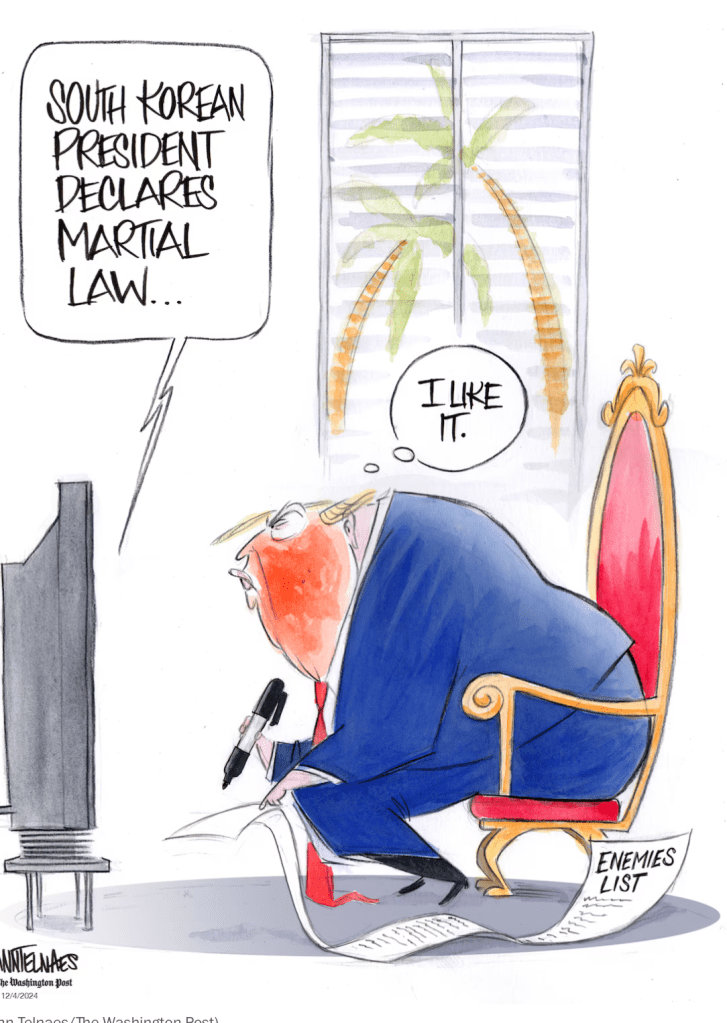
Step Three. Thus far, Mango Mussolini and some of the people aboard his clown car have been cutsy-wootsy about whether they will obey the courts. But J.D. Vance—who has some asshole buddies that hate democracy—bleated out this weekend that the Supreme Court has no authority over Trump. Soo … when the courts find some of Trump’s henchmen in contempt of court and order the U.S. Marshalls Service to go arrest them, will Trump countermand the order, or will he back down, or will he pretend to back down and play cutsy-wootsy?
Step Four. If Orange Jesus follows Vance’s advice and defies the courts, what happens then?
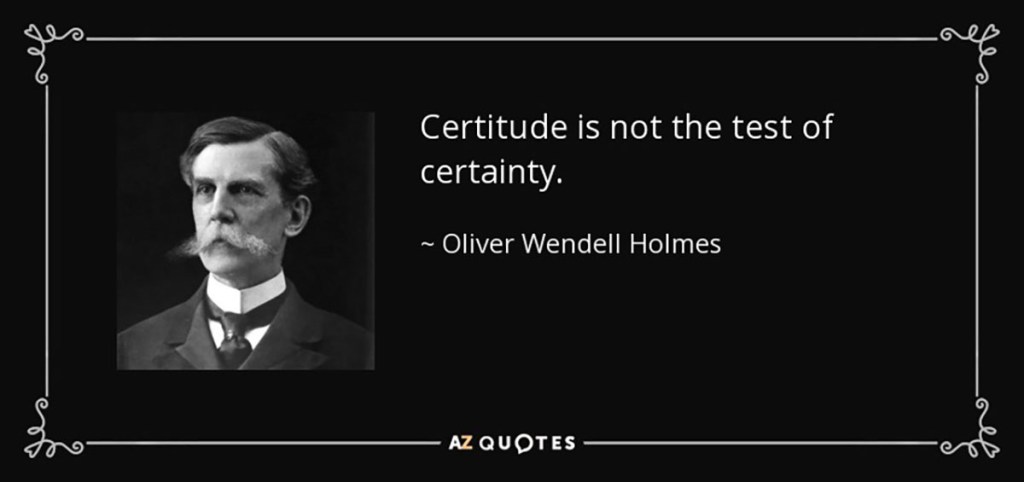
Donald Trump is certain that he knows more than any general about how to fight a war and more than any scientist about climate science. By like token, some of my friends are certain beyond rational argument that the Supreme Court will just bow down to Trump. The professional constitutional lawyers are not so certain, see my post on The Constitutional Crisis, but what do they know?
I have had some challenging conversations in the last few days.
Well, que sera sera. The Supreme Court is going to do whatever the Supreme Court is going to do. Can I predict with certainty what they will be? No, I can’t. And neither, by the way, can the dean at UC Berkeley make a certain prediction.
Certainly, the Supreme Court majority has made some awful decisions, and that’s a strong point in favor of the catastrophists imbued with certain certitude about the impending apocalypse.
On the other hand, if the Supreme Court tells Trump he need not worry about obeying the Constitution, they are telling him it’s OK to ignore the Bill of Rights, imprison anyone he wants to lock up, and declare himself President for Life and Lord of Lords.
Even if you are a very bad person, you might rationally hesitate to give someone that much power. Because—guess what?—you might be next on the list.
There are some other considerations, too. For one, the Federalist Society and its cohorts have been on a 40-year quest to take over the courts and impose their regressive views on society, all in the name of “rule of law.” During the first Trump term, their efforts were crowned with success when they got three additional seats on the Supreme Court. But if, henceforth, a judge’s order isn’t worth the paper it’s written on, then the whole Federalist Society effort—to use its version of “law” to force a right-wing agenda down our throats—goes glug glug down the drain.
And then there’s this. If law no longer matters, then a whole lot of the 1,322,649 lawyers in the United States no longer have a useful skill, and they are going to have to do something else for a living.
And, finally, there is this minor consideration. A whole lot of the crazy stuff that Trump and Elon are doing is not only unconstitutional or otherwise illegal but also economically hurtful—sometimes in disastrous ways—for Trump’s own supporters.
No, ladies and germs, there are a lot of reasons why the Supreme Court may not muster five votes to destroy the constitutional republic.
When the situation ripens to a direct conflict between Court and President, there will be conflicting voices other than Vance’s whispering into Trump’s shell-like ears. Vice President Vance will urge him to head headlong into catastrophe. Possibly, however,Orange Jesus might decide to back off. But more probably, in my view, he’ll tell John Roberts to take a long walk off a short cliff.
What then?
I saw George Conway this morning saying that Trump would order the U.S. Marshals Service not to obey the Court’s order, the Service would comply with Trump’s directive, and that would be that. Our constitutional republic would be over and done with.
I think he’s right about the Marshals Service, but predicting in predicting the imminent end of the republic, Conway might be out over his skis.
Half the country—the folks who voted for Kamala—would take to the streets.
And, remember, this would be in a context where lots of Trump voters would have started to suffer from Trump’s disastrous policies, including his unconstitutional and otherwise illegal actions. Tariffs. Trade wars. Slashing the military. Slashing funds for hospitals in rural communities. And on and on and on.
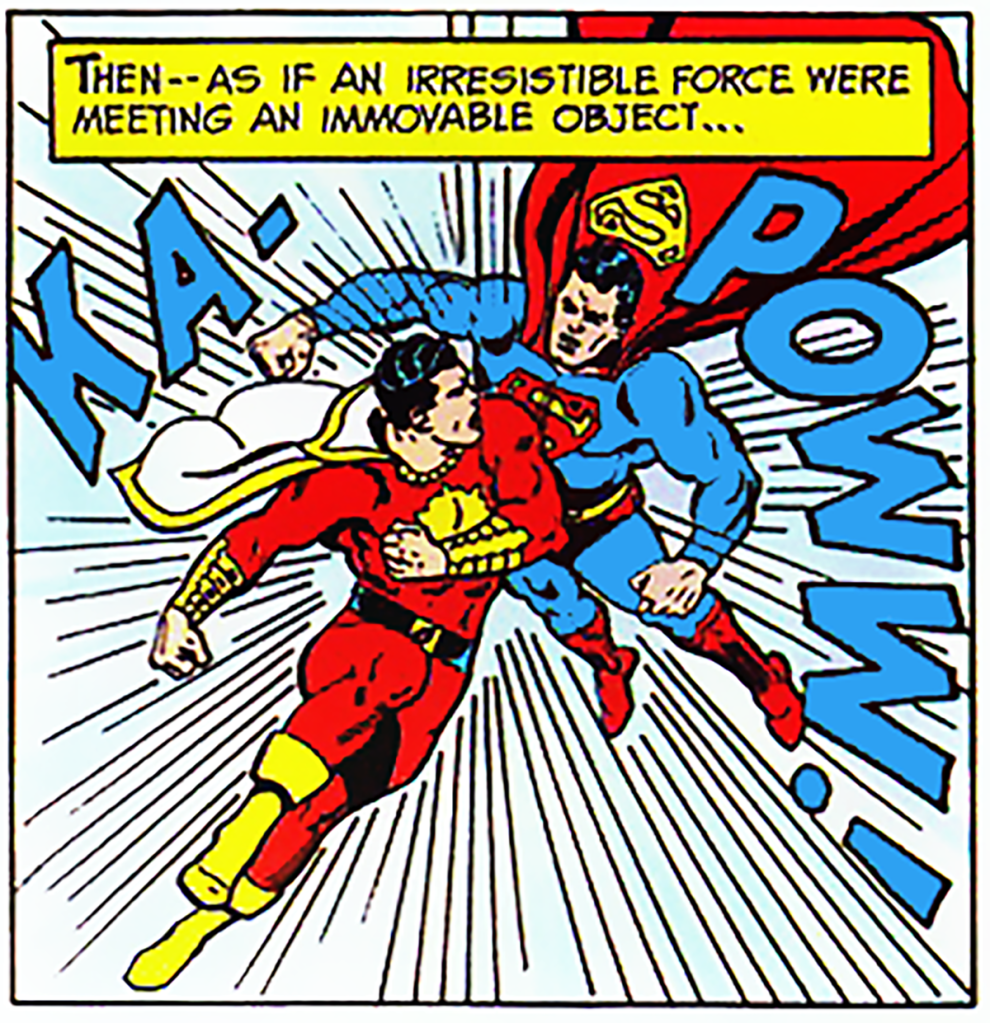
Irresistible force, meet immovable object.
It would appear that Vance and his cohorts are trying to maneuver the situation to a point where Trump has no choice but to (a) back down, bigly, or (b) declare himself Dictator for Life.
Choice (b) would be unpopular with, maybe 65% of the country.
And how will it all turn out? My crystal ball grows cloudy. But I do see blood in the streets.
The International Association of Chiefs of Police (IACP) and the Fraternal Order of Police (FOP) have had long standing and positive relationships with both President Trump and President Biden and have greatly appreciated their support of the policing profession. However, the IACP and FOP are deeply discouraged by the recent pardons and commutations granted by both the Biden and Trump Administrations to individuals convicted of killing or assaulting law enforcement officers. The IACP and FOP firmly believe that those convicted of such crimes should serve their full sentences.
Crimes against law enforcement are not just attacks on individuals or public safety — they are attacks on society and undermine the rule of law. Allowing those convicted of these crimes to be released early diminishes accountability and devalues the sacrifices made by courageous law enforcement officers and their families.
When perpetrators of crimes, especially serious crimes, are not held fully accountable, it sends a dangerous message that the consequences for attacking law enforcement are not severe, potentially emboldening others to commit similar acts of violence.
The IACP and FOP call on policymakers, judicial authorities, and community leaders to ensure that justice is upheld by enforcing full sentences, especially in cases involving violence against law enforcement. This approach reaffirms our commitment to the rule of law, public safety, and the protection of those who risk their lives for our communities.
The Virginia Statute for Religious Freedom, enacted by the Virginia Assembly, January 16, 1786, reads as follows:
An act for establishing religious Freedom.
Whereas, Almighty God hath created the mind free;
That all attempts to influence it by temporal punishments or burthens, or by civil incapacitations tend only to beget habits of hypocrisy and meanness, and therefore are a departure from the plan of the holy author of our religion, who being Lord, both of body and mind yet chose not to propagate it by coercions on either, as was in his Almighty power to do,
That the impious presumption of legislators and rulers, civil as well as ecclesiastical, who, being themselves but fallible and uninspired men have assumed dominion over the faith of others, setting up their own opinions and modes of thinking as the only true and infallible, and as such endeavouring to impose them on others, hath established and maintained false religions over the greatest part of the world and through all time;
That to compel a man to furnish contributions of money for the propagation of opinions, which he disbelieves is sinful and tyrannical;
That even the forcing him to support this or that teacher of his own religious persuasion is depriving him of the comfortable liberty of giving his contributions to the particular pastor, whose morals he would make his pattern, and whose powers he feels most persuasive to righteousness, and is withdrawing from the Ministry those temporary rewards, which, proceeding from an approbation of their personal conduct are an additional incitement to earnest and unremitting labours for the instruction of mankind;
That our civil rights have no dependence on our religious opinions any more than our opinions in physics or geometry,
That therefore the proscribing any citizen as unworthy the public confidence, by laying upon him an incapacity of being called to offices of trust and emolument, unless he profess or renounce this or that religious opinion, is depriving him injuriously of those privileges and advantages, to which, in common with his fellow citizens, he has a natural right,
That it tends only to corrupt the principles of that very Religion it is meant to encourage, by bribing with a monopoly of worldly honours and emoluments those who will externally profess and conform to it;
That though indeed, these are criminal who do not withstand such temptation, yet neither are those innocent who lay the bait in their way;
That to suffer the civil magistrate to intrude his powers into the field of opinion and to restrain the profession or propagation of principles on supposition of their ill tendency is a dangerous fallacy which at once destroys all religious liberty because he being of course judge of that tendency will make his opinions the rule of judgment and approve or condemn the sentiments of others only as they shall square with or differ from his own;
That it is time enough for the rightful purposes of civil government, for its officers to interfere when principles break out into overt acts against peace and good order;
And finally, that Truth is great, and will prevail if left to herself, that she is the proper and sufficient antagonist to error, and has nothing to fear from the conflict, unless by human interposition disarmed of her natural weapons free argument and debate, errors ceasing to be dangerous when it is permitted freely to contradict them:
Be it enacted by General Assembly that no man shall be compelled to frequent or support any religious worship, place, or ministry whatsoever, nor shall be enforced, restrained, molested, or burthened in his body or goods, nor shall otherwise suffer on account of his religious opinions or belief, but that all men shall be free to profess, and by argument to maintain, their opinions in matters of Religion, and that the same shall in no wise diminish, enlarge or affect their civil capacities. And though we well know that this Assembly elected by the people for the ordinary purposes of Legislation only, have no power to restrain the acts of succeeding Assemblies constituted with powers equal to our own, and that therefore to declare this act irrevocable would be of no effect in law; yet we are free to declare, and do declare that the rights hereby asserted, are of the natural rights of mankind, and that if any act shall be hereafter passed to repeal the present or to narrow its operation, such act will be an infringement of natural right.
So … here’s a post, mainly about Trump’s lawsuit against the Des Moines Register et al., because they published a poll that turned out to be wrong, and his allegedly forthcoming lawsuit against CBS because he didn’t like the way they edited a Sixty Minutes interview.
In my view, Tim Miller makes some good points in the video, but let me cut to the chase, as the high flyers like to say.
“Commercial Speech” or “Political Speech”?
Commercial speech is now (and has been for some years) deemed to enjoy limited First Amendment protection, but is subject to regulation, in order to prevent fraud in the sale of goods and services. One such law is the Iowa Consumer Frauds Act—the only law that Trump’s lawyer claims was violated by the newspaper and the pollster.
The legal regime that governs political speech is very different from that governing commercial speech. Political lies are generally protected from judicial scrutiny by freedom of speech and freedom of the press. A moment’s reflection will let you see the reasons for this principle: in essence, to protect the political process and to protect the courts from being politicized.
In the Iowa case, it’s unlikely in the extreme that the poll’s error was intentional, on the part of the pollster, or the newspaper, or the newspaper’s parent company. But let’s pretend we’re in law school, and let’s assume, for the sake of the discussion, that the pollster and the newspaper did lie intentionally.
Trump’s lawsuit should be summarily dismissed. First, the words of the Iowa Consumer Frauds Act don’t apply to the alleged intentional political lie. Second, it’s highly unlikely that the Iowa Legislature intended its Consumer Frauds Act to apply to political speech. Third, even if the Legislature did have such an intent, its intent to regulate political speech would violate multiple legal precedents on freedom of the press and freedom of speech.
And, By the Way, People Who Live in Glass Houses Shouldn’t Throw Stones
If Trump wins his Iowa lawsuit—which he will not—then he will have created a precedent under which he can be prosecuted for multiple violations each day, if not each hour.
Defamation, the N.Y. Times v. Sullivan Rule, and the Finer Points of Rape
“Creative” as he was—in the pejorative sense of the word—the legal genius who crafted Trump’s Iowa lawsuit did not claim defamation, because predicting that you’re going to lose an election does not reflect badly on your character.
By contrast, in the recently settled Trump case against ABC News, Trump worked himself into a high dudgeon because the jury only found he had forcefully inserted his middle finger into the victim’s vagina—not his actual dick—where has New York law on “rape” would have required penetration by the presidential pecker. Sexual assault? Yes. “Rape”? No. How dare you accuse My Excellency of rape when I only victimized her vagina with my finger!


 Facing MAGA