
The Bad News and the Good News
With clear eyes, hard facts, critical thinking, new political strategy, empathy, and a soupçon of Schadenfreude

Dr. Richardson is a prominent historian and professor at Boston College.
I think the whole video is worth watching, even if you are generally aware of what’s going on in this country. Some of the relevant points:
First Minute: HCR puts some of Trump’s outrageousness in historical context, in light of a Republican intellectual triumphalism—“We’re right and, guess what, you’re wrong!” We saw a lot of that beginning with Reagan’s election. I remember it well.
Third Minute: She doesn’t use the phrase, but others rightly call it “herrenvolk democracy”: any Democratic victory is inherently illegitimate.
Sixth Minute: A concerted effort to destroy rules-based order.
Eighth Minute: He thinks only people like himself should be in power.
Ninth Minute: He’s no compos mentis. It appears they’re giving him psychiatric drugs. It’s a behind-the-scenes effort to control him.
Eleventh Minute: No, J.D. Vance would not be worse.
Twelfth Minute: It’s extremely difficult to tell what’s happening in this Administration.
Fourteenth Minute: What appears to have just happened in Venezuela.
End of Seventeenth Minute: A work of genius by the Venezuelan regime and its allies.
As historians know, invasion of your country greatly helps to unify your people.
Nineteenth Minute: Trump’s oil fantasy.
Twenty-first Minute: Shrinkage from a global power to a regional power. Jettisoning the benefits of the rules-based international order.
Twenty-third Minute: Greenland.
Twenty-fourth Minute: A fundamental misunderstanding of the nature of American power.
Twenty-sixth Minute: Russia gets Ukraine, we get Venezuela. Sort of like the eve of World War I, but this time with nuclear weapons.
Twenty-seventh Minute: Oil is the technology of the past. The future lies in semi-conductors. We’re giving Xi permission to take over Taiwan—which makes 60% of the world’s semi-conductors. And Trump doesn’t understand this.
Twenty-eighth Minute: Destruction of the rules-based international order. A demented president, no longer operating in reality. Magical thinking is a hallmark of this moment.
Twenty-ninth Minute: Don’t follow grandpa down this road. Time to speak up.

I recently shared some observations about the Supreme Court’s shadow docket (here and here). In brief, the Supreme Court has been catching serious flack for
But in Trump v. Illinois, in a short, unsigned 6-to-3 decision, the Court majority ruled that, pending trial and appeal, Trump had to get the National Guard the hell out of Illinois, because Trump had identified no proper legal authority to send them there in the first place.
For a few days, people wondered whether Trump and his merry band of legal geniuses would either (i) tell the Supreme Court to go stick it where the sun don’t shine or (ii) claim authority under the Insurrection Act, even though there was and is no insurrection.
Trump did neither. Instead, he TACOed, surrendering in his legal attempts to keep federal troops in Los Angeles and announcing that he would withdraw the National Guard from Illinois, Los Angeles, and Portland.
So … what does it all mean?
I don’t know, and I won’t pretend to pretend that I know.
And yes, very assuredly, one swallow does not a summer make. But it cannot be a bad thing that …
… faced with a clear loss in the Supreme Court on one of his several signature issues—sending federal troops into the big cities—Trump has unambiguously backed down,
… Trump has elected, at least on this one occasion, not to put to the test whether “his” troops would or would not obey illegal orders, and that …
… a six-person majority of the Supreme Court bit the bullet, dared Trump to defy them, and came away with a famous victory.
The bet paid off.
May that trend long continue.
And this final word of speculation: as Justice Holmes said so long ago, the Court reads the newspapers. I think Chief Justice Roberts, along with his sidekicks Justices Coney Barrett and Kavanaugh, probably read the newspapers, where they grasped, one, that Trump is circling the drain, and two, that people are getting sick and tired of the Supreme Court’s fecklessness.

In recent days, widespread reports say the Justice Department has discovered more than five million new Epstein files—and that it has pressed 400 lawyers into service redacting the files.
If all of that is so, then there is a document that must exist—and therefore it does exist—namely, a written summary of criteria that the 400 lawyers are required to use when choosing that passages to redact.
I want to see that set of redaction instructions.
And I will see it. And so will we all. Sooner than you may think.
Among those who, the records show, often kept company with Jeffrey Epstein were (in alphabetical order) Woody Allen, Prince Andrew, Steve Bannon, Ehud Barak, Bill Clinton, Alan Dershowitz, Michael Jackson, Bill Richardson, Larry Sommers, and Donald Trump.
Morality aside, these people knew or should have known that close association with Jeffrey Epstein involved a risk of grave reputational and/or legal harm.
The most logical reason that could explain why they would choose to run such a risk is that they were in the grip of a virtually irresistible impulse.
The Trigger Warning: Some readers will be triggered by prose that, read superficially, might sound sympathetic to Chief Justice Roberts and to his sidekicks, Justices Coney Barret and Kavanaugh. Such readers may want to skip this post. In any event, they are requested not to throw food in my direction. Or, if they must, please pick the corn muffins we’re getting tonight, and take a pass on the bean soup and the pistachio pudding.
The Multiple Disclaimers: In this post, I’m not in the moralizing business, I’m not in the mind reading business, and I’m not in the prediction business. Not that moralizing, mind reading, and prediction are unimportant. They’re just not what I’m trying to do here. Here, I’m in the hypothesizing business. I’m in the trying-to-understand business.
You can generally count on the three liberal justices to do the right thing. If you bet that Justices Thomas, Alito, and Gorsuch will do the wrong thing—and that Justice Gorsuch will camouflage the wrong thing with extensive verbiage made to superficially resemble legal scholarship—then you’re likely to win your bet. In the middle, that leaves the Chief Justice, along with Justices Coney Barrett and Kavanaugh. These three generally decide who’s going to win the case.
And, by the way, when I say “middle faction,” the word “middle” is not intended to be either favorable or pejorative. It just means they’re literally in the middle of the other two factions.
It appears that the rubber will soon meet the road, and that the Supreme Court is going to make some definitive rulings on, among other things,
In introduced this topic in the immediately preceding post, which you may wish to read now, before proceeding further.
There are many reasons why it’s a vexed question. In the first place, the Court’s behavior contradicts what we learned in civics class—back when they taught civics in high school. We have checks and balances. When the president violates the law, the courts are supposed to check him. And indeed, lots of district courts and courts of appeal HAVE been checking Trump—but without a lot of support from the Supreme Court on its shadow docket.
Relatedly, the shadow docket is a vexed question from a technical legal standpoint. The Court is ruling on the validity of lower court decision on whether to grant a preliminary injunction pending trial and appeal, and that p.i. issue, in turn, is supposed to depend, in large measure, on “likelihood of success on the merits.” If the district court grants a p.i. against some Trump outrage, and if the court of appeals affirms, and if the Supreme Court majority then reverses the ruling, so that Trump can go on engaging in whatever horseshit he wants, pending trial, does that mean that the Supreme Court thinks Trump is right on the law and all the lower court judges are wrong?
Does it mean that the Supreme Court majority doesn’t give a tinker’s damn about checks and balances?
Does it mean that the majority wants to live in a country governed like Russia and Hungary?
Well, maybe it does mean some or all of those things.
I continue to focus here on the middle faction of the Supreme Court—Justices Roberts, Coney Barrett, and Kavanaugh—not on the three wingnuts, and not on the three liberals. An alternative hypothesis to explain the middle faction’s strange behavior would go something like this.
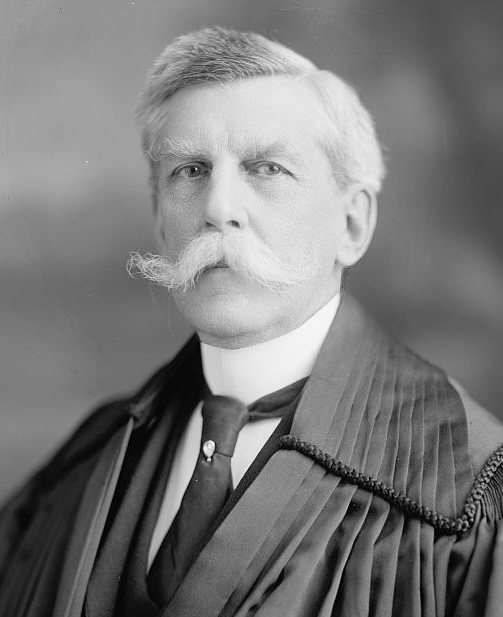
The middle faction would prefer to live in a constitutional republic governed under law, not in Hungary or Russia, but they are mindful that, to achieve that end, they have to preserve a certain level of public deference to court decisions. And, as Justice Oliver Wendell Holmes, Jr. (pictured above) said a century ago, the Court reads the newspapers.
Having read the newspapers, the middle faction knew that a reelected, pumped up Trump was going to try to grab power in all sorts of ways. They knew that if the Supreme Court intervened immediately and forcefully, there would likely follow an immediate and grave constitutional crisis.
The hypothesis continues: The middle faction reasoned that, instead of an immediate constitutional crisis, it would be better to wait a season; let the whole country, including the MAGA base, get a full taste of Trump’s policies; and let Trump’s political support dissipate.
2026, not 2025, would be right year for strong action to preserve the rule of law. Or so they thought, in the hypothesis presented here.
Remember, y’all, it’s a hypothesis. There’s no mind reading, there’s no moralizing, and there’s no prediction about how the Court will actually decide all those issues I mentioned above.
As far as predictions go, to quote the sage observation of President Eisenhower, “The future lies ahead.”
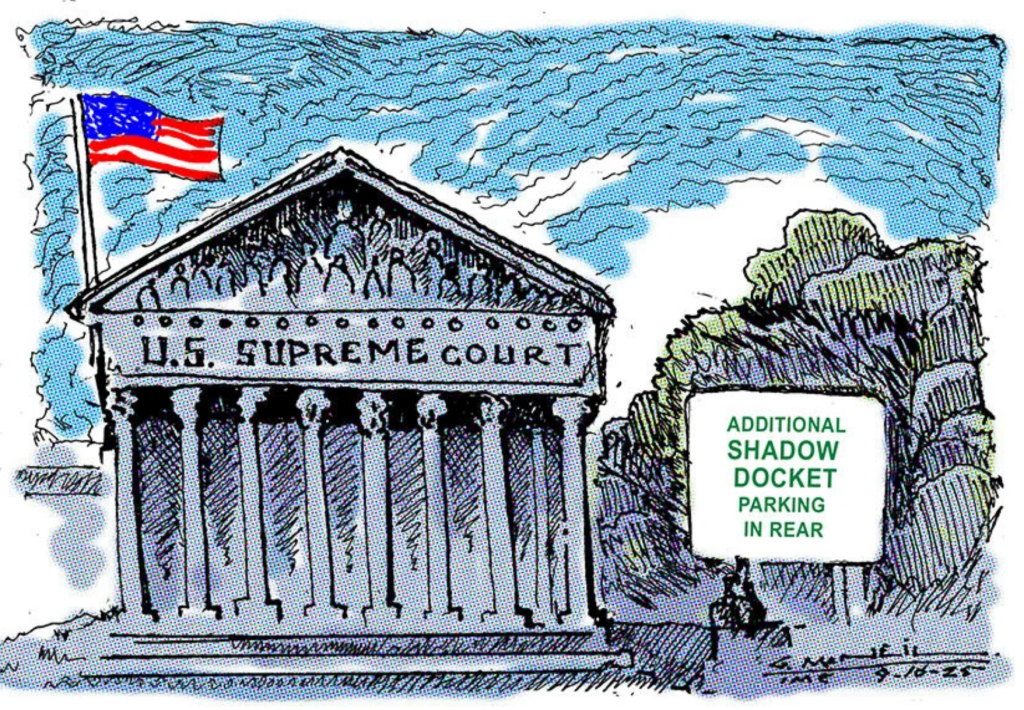
Something weird is going on at the Supreme Court. In my next post, I’m going to lay out a hypothesis about what that might be. Here, I need to lay the predicate for that discussion.
The shadow docket consists of cases where the Supreme Court reviews lower court decisions that have either granted or denied temporary relief, pending a trial, a decision on the merits, and appeal of the decision in the ordinary course.
In most of these cases, the lower courts have either granted a preliminary injunction or they have denied a preliminary injunction.
Trials take a long time, appeals take even longer, and in the meantime you may suffer a lot of harm due to behavior that you say is illegal. Your uncle may be departed to El Salvador. Trump may have fired you from the Federal Trade Commission because you are a Democrat. Your business may be going bankrupt because of high tariffs that Trump has illegally imposed.
A preliminary injunction is intended to preserve the status quo, preventing that injury, pending a final resolution of the dispute.
When a party to a case wants a preliminary injunction, the court is supposed to ask four questions.
1. Considering the facts and the law, which party is more likely to win the case, down the road?
2. If the preliminary injunction is denied, how much harm will be caused, and is that harm irreparable?
3. And what about the potential harm to the other side, if the preliminary injunction is granted?
4. Finally, in this private dispute between two parties, where does the public interest lie?
That’s the legal theory. In practice, the first factor—often called “likelihood of success on the merits”—tends to predominate.
In other words, if a district judge grants a preliminary injunction, that often means that she thinks the defendant is behaving illegally. If she denies the request, that usually implies that, in her view, the plaintiff doesn’t have a good legal case.
Yes. The Federal Rules of Civil Procedure provide that a federal district court is legally obligated to explain its reasoning in granting or denying a requested preliminary injunction. The main rationale for that rule is that, without a reasoned explanation, a court of appeals can’t make an informed decision about whether the district judge was right or wrong.
No, it is not. However, before Trump, the Court normally did explain, at least briefly, how it thought likelihood of success on the merits and the other three factors applied to the case at hand.
In a recent article, Erwin Chemerinsky, constitutional law expert and dean of the law school at U.C. Berkeley, explained,
The Supreme Court always has had an emergency docket to hear requests such as those for last-minute stays of execution in death penalty cases. But it has grown greatly in recent years, and last year saw an exponential increase in orders from the shadow docket. In the October 2023 term, the court resolved 82 matters on its emergency docket. But in the October 2024 term, by June 27, 2025—the last day opinions were handed down—it had resolved 107 matters on its emergency docket. By the time the term officially ended when the new term began on Oct. 6, 2025, the court had decided 140 matters on its emergency docket.
Some of this increase is because of the many cases involving challenges to President Donald Trump’s administration’s initial actions that made it to the Supreme Court. But that does not explain all of the dramatic increase. I think that there is a simple explanation for why the shadow docket has grown: the court’s willingness to rule on matters on its emergency docket. The more the court is willing to give relief on an emergency basis, the more parties will go to the justices for stays of lower court decisions, such as of preliminary injunctions.
There is much to be concerned about in the growth of the shadow docket. Matters are decided without full briefing and without any oral argument. Yet in 2025, the Supreme Court indicated that lower courts were obligated to follow its shadow docket rulings. In several important cases, the court handed down orders without any written opinion, giving no guidance to the lower courts and making the decisions seem an arbitrary exercise of power since no reasons were given for the conclusions. In some cases, the court appeared to disregard detailed factual findings by lower courts and abandon the usual standard for emergency relief: the need for a showing of irreparable injury. …
There have been dozens of rulings by the court on its emergency docket concerning lower-court preliminary injunctions against Trump administration actions. In almost every case, the Supreme Court—virtually always in a 6-3 ruling—has stayed the preliminary injunction and ruled in favor of President Trump. These decisions have included the Supreme Court staying lower court orders stopping the firing of agency officials, ordering the reinstatement of terminated federal grants, forbidding deportations to South Sudan of individuals with no contact with that country, preventing U.S. Immigration and Customs Enforcement agents from stopping people without reasonable suspicion, and keeping the State Department from requiring that passports list a person’s birth sex rather than gender identity. …
In a ruling on the emergency docket, in United States v. Shilling, the court, once more 6-3, stayed a district court’s preliminary injunction and allowed President Trump to bar transgender individuals from serving in the military. Neither the majority nor the dissenting justices wrote an opinion.
Michelle Goldberg (N.Y. Times), Trump Is Getting Weaker, and the Resistance Is Getting Stronger:
It has been a gruesome year for those who see Donald Trump’s kakistocracy clearly. He returned to office newly emboldened, surrounded by obsequious tech barons, seemingly in command of not just the country but also the zeitgeist. Since then, it’s been a parade of nightmares — armed men in balaclavas on the streets, migrants sent to a torture prison in El Salvador, corruption on a scale undreamed of by even the gaudiest third-world dictators and the shocking capitulation by many leaders in business, law, media and academia. Trying to wrap one’s mind around the scale of civic destruction wrought in just 11 months stretches the limits of the imagination, like conceptualizing light-years or black holes.
And yet, as 2025 limps toward its end, there are reasons to be hopeful.
That’s because of millions of people throughout the country who have refused to surrender to this administration’s bullying. When Trump began his second term, conventional wisdom held that the resistance was moribund. If that was ever true, it’s certainly not anymore. This year has seen some of the largest street protests in American history. Amanda Litman, a founder of Run for Something, a group that trains young progressives to seek local office, told me that since the 2024 election, it has seen more sign-ups than in all of Trump’s first four years. Just this month, the Republican-dominated legislature in Indiana, urged on by voters, rebelled against MAGA efforts to intimidate them and refused to redraw their congressional maps to eliminate Democratic-leaning districts.
While Trump “has been able to do extraordinary damage that will have generational effects, he has not successfully consolidated power,” said Leah Greenberg, a founder of the resistance group Indivisible. “That has been staved off, and it has been staved off not, frankly, due to the efforts of pretty much anyone in elite institutions or political leadership but due to the efforts of regular people declining to go along with fascism.”
In retrospect, it’s possible to see several pivot points. One of the first was a Wisconsin Supreme Court race in April. Elon Musk, then still running rampant at the so-called Department of Government Efficiency, declared the contest critical and poured more than $20 million into the race. Voters turned out in droves, and the Musk-backed conservative candidate lost by more than 10 points. Humiliated, Musk began to withdraw from electoral politics, at one point breaking with Trump. The tight bond between the world’s richest man and the most powerful one was eroded.
In June, Trump’s military parade, meant as a display of dominance, was a flop, and simultaneous No Kings protests all over the country were huge and energetic. A few months later, Charlie Kirk was assassinated, a tragedy that the administration sought to exploit to silence its opponents. When the late-night comedian Jimmy Kimmel made a distasteful comment on ABC that seemed to blame the right for Kirk’s killing, Disney, the network’s parent company, gave in to pressure to take Kimmel off the air. It was a perilous moment for free speech; suddenly America was becoming the kind of country in which regime critics are forced off television. But then came a wave of cancellations of Disney+ and the Disney-owned Hulu service, as well as a celebrity boycott, and Disney gave Kimmel his show back.
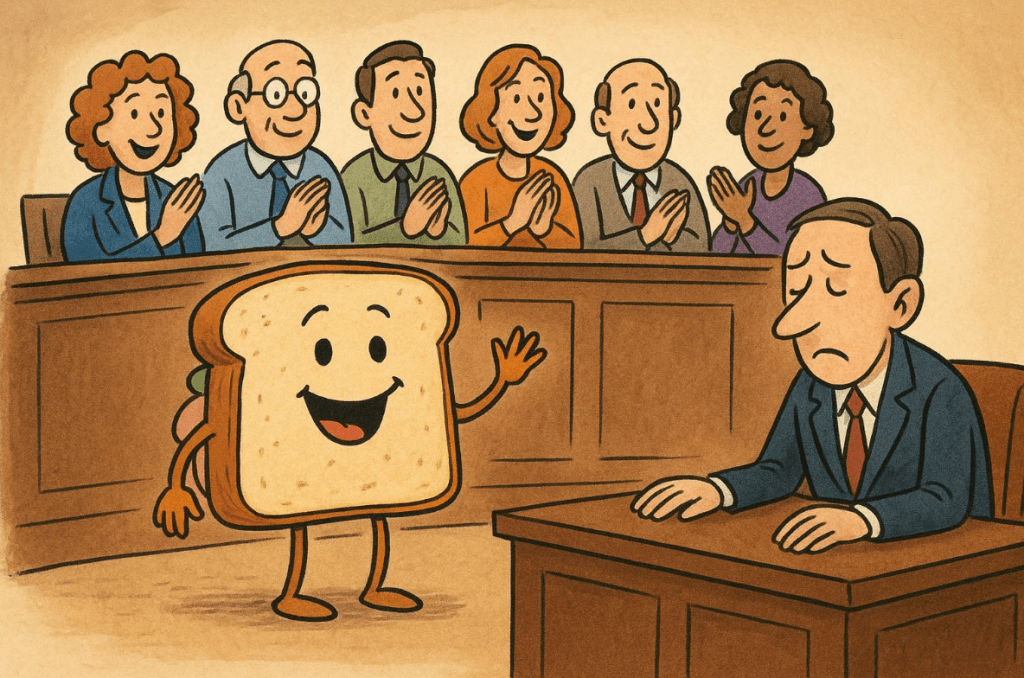
Trump has thoroughly corrupted the Justice Department, but its selective prosecutions of his foes have been thwarted by judges and, more strikingly, by grand juries. Two grand juries refused to indict Letitia James, New York’s attorney general, whom the administration has accused of mortgage fraud, with no credible evidence. After Sean Dunn, a Justice Department paralegal, tossed a sandwich at a Customs and Border Protection officer during a protest in Washington, the administration sent a team of agents in riot gear to arrest him. But grand jurors refused to indict him on a felony charge. Dunn was eventually charged with a misdemeanor, only to be acquitted by a jury. Jeanine Pirro, the former Fox News personality whom Trump made U.S. attorney in Washington, tried three times to secure a federal indictment for assault against a protester who struggled while being pushed against a wall by an immigration agent. Three times, grand juries refused.
Granted, all these grand juries were in liberal jurisdictions, but their rejections of prosecutors’ claims are still striking, since indictments are usually notoriously easy to secure. “I think you’re seeing reinvigorated grand jury processes,” said Ian Bassin, a founder of the legal and advocacy group Protect Democracy. “Nobody actually knows what’s going on in those grand juries, but the outcome of them seems to suggest that people are actually holding the government’s feet to the fire and being unwilling to simply be a rubber stamp.”
Trump ends the year weak and unpopular, his coalition dispirited and riven by infighting. Democrats dominated in the November elections. During Joe Biden’s administration, far-right victories in school board races were an early indication of the cultural backlash that would carry Trump to office. Now, however, Democrats are flipping school board seats nationwide.
Much of the credit for the reinvigoration of the resistance belongs to Trump himself. Had he focused his deportation campaign on criminals or refrained from injuring the economy with haphazard tariffs while mocking concerns about affordability, he would probably have remained a more formidable figure. He’s still a supremely dangerous one, especially as he comes to feel increasingly cornered and aggrieved. After all, by the time you read this, we could well be at war with Venezuela, though no one in the administration has bothered to articulate a plausible rationale for the escalating conflict.
But it’s become, over the past year, easier to imagine the moment when his mystique finally evaporates, when few want to defend him anymore or admit that they ever did. “I think it’s going to be a rocky period, but I no longer think that Trump is going to pull an Orban and fundamentally consolidate authoritarian control of this country the way that it looked like he was going to do in March or April,” said Bassin, referring to Prime Minister Viktor Orban of Hungary. If Bassin is right, it will be because a critical mass of Americans refused to be either cowed or complicit.
A federal grand jury has declined to indict Letitia James, the New York attorney general, on mortgage fraud charges for the second time in a week, according to a person familiar with the matter, in an embarrassing blow to the Trump justice department as the president has sought retribution against one of his political rivals.
The department has attempted to twice file new charges against James after a judge dismissed an indictment against her after determining the prosecutor handling the case had not been properly appointed.
A decision [not to indict] by a federal grand jury is extremely rare. Only prosecutors appear before a grand jury and defendants do not to offer evidence in their support of their case. There is a legal axiom that “any good prosecutor can get a grand jury to indict a ham sandwich”, underscoring the power prosecutors have over grand juries.
The justice department declined to comment.
“For the second time in seven days, the Department of Justice has failed in its clear attempt to fulfill President Trump’s political vendetta against Attorney General James. This unprecedented rejection makes even clearer that this case should never have seen the light of day,” said Abbe Lowell, a lawyer representing James. “This case already has been a stain on this Department’s reputation and raises troubling questions about its integrity. Any further attempt to revive these discredited charges would be a mockery of our system of justice.”
James was charged with one count of bank fraud and one count of making a false statement in connection with a home in Norfolk, Virginia in 2020. Prosecutors say James committed a crime because she indicated on mortgage paperwork that the purchase would serve as her second home, but then rented it out. James denies wrongdoing and experts have said the allegations are thin. The New York Times reported James’ niece lives in the home.
Career prosecutors did not think there was sufficient evidence to file charges against James and were subsequently fired. The initial case was personally presented by Lindsey Halligan, a Trump ally installed to be the acting US attorney for the eastern district of Virginia. In November, a federal judge dismissed the case after ruling that Halligan was improperly appointed to the post. The criminal case against James Comey, the former FBI director, was dismissed on similar grounds.
Nothing prevented the justice department from trying to refile the case and they did so last week before a federal grand jury in Norfolk. A career attorney brought in from Missouri to work on the case, Roger Keller, handled that presentation, which was rejected. The office could again seek to refile charges against James with a different grand jury.
It’s an important question.
Some folks sanewash Trump by claiming that he’s retaliating against his enemies by forcing them to spend time and resources to establish their innocence.
I don’t think that’s a logical explanation of his thinking. Mainly because, by doing the same thing over and over, he his making himself and his team look like the idiots they are.
No, I think it’s a lot worse than just an intention to misuse his office.
Trump does not understand that there are good legal arguments and bad legal arguments. To him, all legal analysis is a buzzing, booming confusion. Like some mad King Canute, he thinks he can bend reality with his magical bullshit. He does not understand that actions have consequences, and he is unwilling to accept advice from professionally competent individual who could correct his misunderstanding and help him to predict what the consequences of his actions will be.
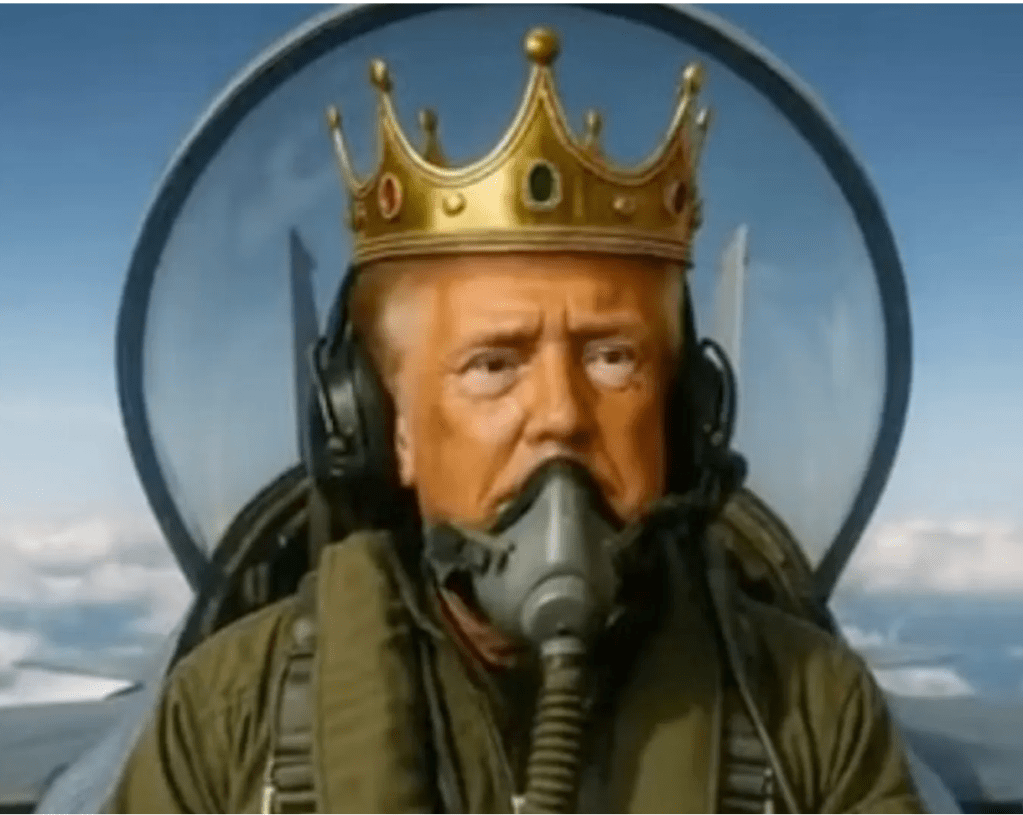
 Facing MAGA