As we have seen, the Learning Resources decision was 6 to 3, but there were three distinct factions:
the liberals, who thought that ordinary tools of statutory interpretation condemned Trumps IEEPA tariffs, and that the “major questions doctrine,” which they did not recognize, was not germane to the decision,
three of the rightwing justices, who cherished the “major questions doctrine” and thought it was of considerable relevance in ruling against Trump on the tariffs, and
the three other rightwing justices, who also cherished the “major questions doctrine” as a general matter, but who squirmed to deny its relevance to the case at bar.
In other words, at least for this case, probably for other tariff cases, and possibly for future cases on other topics, the six rightwingers have split down the middle into two opposed factions.
Justices Gorsuch and Barret, along with Chief Justice Roberts, are the swing votes. Who wins a future tariff case will turn on whether Barrett, Gorsuch, and Roberts side with the liberals or whether they side with the other three rightwingers.
And, make no mistake, there will be future tariff cases. There will be future tariff cases up the wazoo.
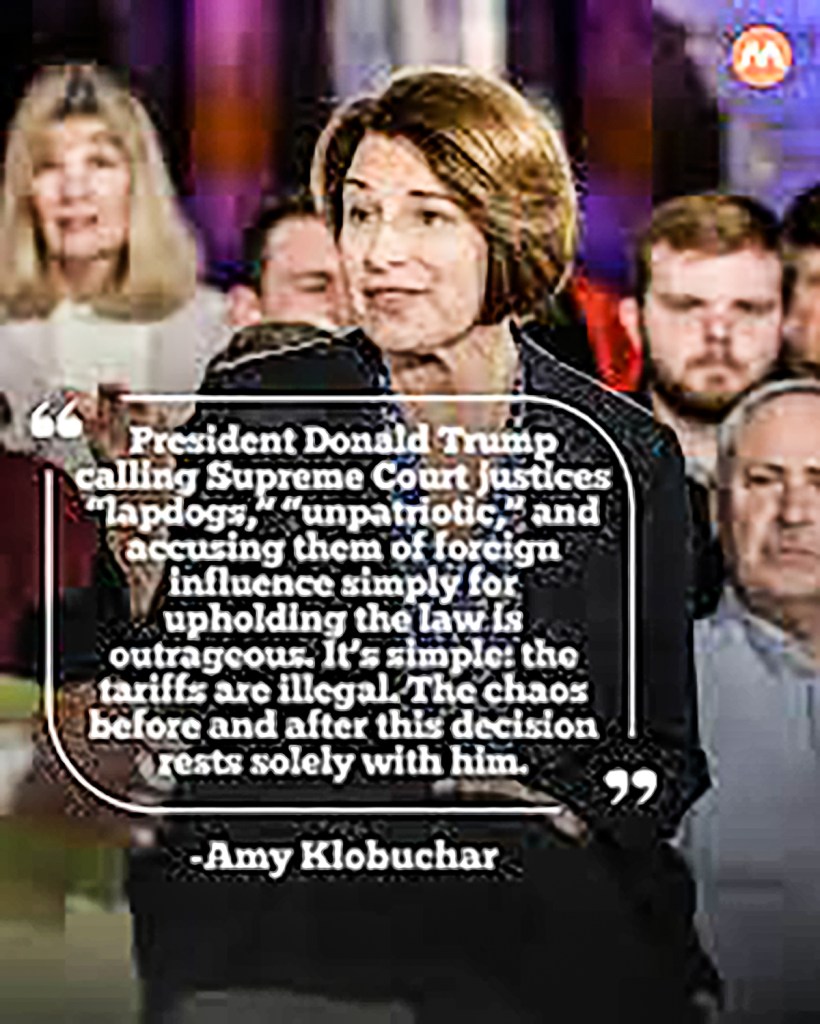
Trump’s post-decision hissy fit will do nothing to persuade its targets—who are, of course, the very three people he must persuade if he is to have an icecube’s chance in Hell of prevailing in future tariff litigation.
The hissy fit is also intended to threaten and intimidate, but I am persuaded that intimidation will not work either. Why? Because if Barrett, Gorsuch, and Roberts were going to be intimidated, I think we would already seen the effects of that intimidation.
Louisiana state House of Representatives District 60 is a rural area south of Baton Rouge. In 2024, 56 percent of its voters cast their franchise for Trump, while 43 percent voted for the Democratic ticket.
In yesterday’s special election, the Democratic candidate won 62 percent to 38 percent.
In other words, there was a 37 percent shift in favor of the Democrats between November, 2024, and February, 2026.
David French’s warning is timely and well taken. That said, I think we may all thank Orange Mussolini for sending a clear and timely signal about his intent with respect to the 2026 elections. We have a reasonable amount of time to litigate l’affaire Fulton County ballot seizure, establish beyond peradventure of doubt that Tulsi Gabbard is a blithering idiot—and that Trump’s delusions are in fact delusions, and take the preventative steps that David French encourages us to take.
It’s a sign of the times that Senator Thune recognized that “nationalizing elections” is unconstitutional, and that he did not cotton to the idea.
Georgia Republicans are shitting their pants about the special election in Marjorie Taylor Greene’s district.
Second Bonus News Report: Legal Karma
While some law firms caved to Trump, renowned plaintiffs’ firm Susman Godfrey stood tall, and walloped the living daylights out of Team Trump. See here.
This week brings reports that top lawyers at the Susman firm are now charging $4,000 per hour. See here.
Point of personal privilege: I was one of the late Steve Susman’s ten thousand closest friends. I’m confident Steve is looking down from heaven or the bardo at recent developments, and I know he’s still wearing that shit-eating grin.
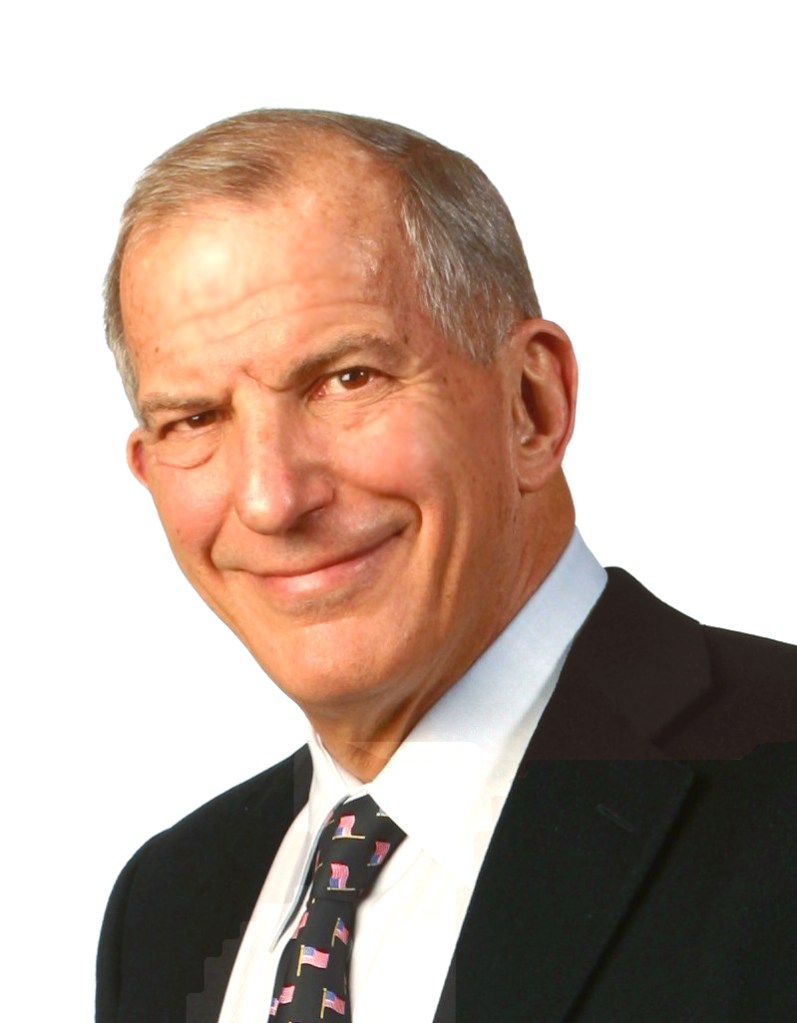
IMHO, George Will and Ross Douthat have some pretty good things to say this morning. Will sees a crisis caused by “a president’s fragile ego, as usual.” Douthat has two alternative explanations: “malignant narcissism flavored with insane Nobel Peace Prize-related self-pity” or “how Trump always negotiates.” There’s much truth in both op-eds, and you would probably do well to read them.
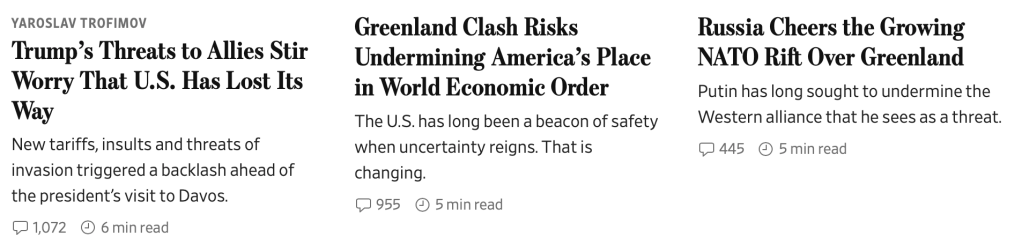
You would also do well to take a look at the online front page of the Wall Street Journal—a good source for the business/financial elites’ view of the world. Part of it is reproduced above.
The elites are worried. The thing they value most—maybe the only thing they value at all—is their money. Trump’s behavior is increasingly threatening their core values.
I’m posting right now because I have my own take on the Mad King’s current thought processes. It’s set forth in the next paragraph, which is all speculation—but reasonable speculation based on known facts, analyzed logically.
Trump has been told—probably by the Solicitor General, the unfortunately named Mr. Sauer—that he is going to lose the tariff case in the Supreme Court. Bigly. Faced with that grave forthcoming affront to his fee-fees, Orange Mussolini has devised an insane Hail Mary pass: use tariffs to force Europe to give him Greenland, thereby “demonstrating” to the Supreme Court the great “value” of his favorite play-pretty, his usurped power to bully other countries with tariffs and threats of tariffs.
In recent days, widespread reports say the Justice Department has discovered more than five million new Epstein files—and that it has pressed 400 lawyers into service redacting the files.
If all of that is so, then there is a document that must exist—and therefore it does exist—namely, a written summary of criteria that the 400 lawyers are required to use when choosing that passages to redact.
I want to see that set of redaction instructions.
And I will see it. And so will we all. Sooner than you may think.
Among those who, the records show, often kept company with Jeffrey Epstein were (in alphabetical order) Woody Allen, Prince Andrew, Steve Bannon, Ehud Barak, Bill Clinton, Alan Dershowitz, Michael Jackson, Bill Richardson, Larry Sommers, and Donald Trump.
Morality aside, these people knew or should have known that close association with Jeffrey Epstein involved a risk of grave reputational and/or legal harm.
The most logical reason that could explain why they would choose to run such a risk is that they were in the grip of a virtually irresistible impulse.
It has been a gruesome year for those who see Donald Trump’s kakistocracy clearly. He returned to office newly emboldened, surrounded by obsequious tech barons, seemingly in command of not just the country but also the zeitgeist. Since then, it’s been a parade of nightmares — armed men in balaclavas on the streets, migrants sent to a torture prison in El Salvador, corruption on a scale undreamed of by even the gaudiest third-world dictators and the shocking capitulation by many leaders in business, law, media and academia. Trying to wrap one’s mind around the scale of civic destruction wrought in just 11 months stretches the limits of the imagination, like conceptualizing light-years or black holes.
And yet, as 2025 limps toward its end, there are reasons to be hopeful.
That’s because of millions of people throughout the country who have refused to surrender to this administration’s bullying. When Trump began his second term, conventional wisdom held that the resistance was moribund. If that was ever true, it’s certainly not anymore. This year has seen some of the largest street protests in American history. Amanda Litman, a founder of Run for Something, a group that trains young progressives to seek local office, told me that since the 2024 election, it has seen more sign-ups than in all of Trump’s first four years. Just this month, the Republican-dominated legislature in Indiana, urged on by voters, rebelled against MAGA efforts to intimidate them and refused to redraw their congressional maps to eliminate Democratic-leaning districts.
While Trump “has been able to do extraordinary damage that will have generational effects, he has not successfully consolidated power,” said Leah Greenberg, a founder of the resistance group Indivisible. “That has been staved off, and it has been staved off not, frankly, due to the efforts of pretty much anyone in elite institutions or political leadership but due to the efforts of regular people declining to go along with fascism.”
In retrospect, it’s possible to see several pivot points. One of the first was a Wisconsin Supreme Court race in April. Elon Musk, then still running rampant at the so-called Department of Government Efficiency, declared the contest critical and poured more than $20 million into the race. Voters turned out in droves, and the Musk-backed conservative candidate lost by more than 10 points. Humiliated, Musk began to withdraw from electoral politics, at one point breaking with Trump. The tight bond between the world’s richest man and the most powerful one was eroded.
In June, Trump’s military parade, meant as a display of dominance, was a flop, and simultaneous No Kings protests all over the country were huge and energetic. A few months later, Charlie Kirk was assassinated, a tragedy that the administration sought to exploit to silence its opponents. When the late-night comedian Jimmy Kimmel made a distasteful comment on ABC that seemed to blame the right for Kirk’s killing, Disney, the network’s parent company, gave in to pressure to take Kimmel off the air. It was a perilous moment for free speech; suddenly America was becoming the kind of country in which regime critics are forced off television. But then came a wave of cancellations of Disney+ and the Disney-owned Hulu service, as well as a celebrity boycott, and Disney gave Kimmel his show back.
Trump has thoroughly corrupted the Justice Department, but its selective prosecutions of his foes have been thwarted by judges and, more strikingly, by grand juries. Two grand juries refused to indict Letitia James, New York’s attorney general, whom the administration has accused of mortgage fraud, with no credible evidence. After Sean Dunn, a Justice Department paralegal, tossed a sandwich at a Customs and Border Protection officer during a protest in Washington, the administration sent a team of agents in riot gear to arrest him. But grand jurors refused to indict him on a felony charge. Dunn was eventually charged with a misdemeanor, only to be acquitted by a jury. Jeanine Pirro, the former Fox News personality whom Trump made U.S. attorney in Washington, tried three times to secure a federal indictment for assault against a protester who struggled while being pushed against a wall by an immigration agent. Three times, grand juries refused.
Granted, all these grand juries were in liberal jurisdictions, but their rejections of prosecutors’ claims are still striking, since indictments are usually notoriously easy to secure. “I think you’re seeing reinvigorated grand jury processes,” said Ian Bassin, a founder of the legal and advocacy group Protect Democracy. “Nobody actually knows what’s going on in those grand juries, but the outcome of them seems to suggest that people are actually holding the government’s feet to the fire and being unwilling to simply be a rubber stamp.”
Trump ends the year weak and unpopular, his coalition dispirited and riven by infighting. Democrats dominated in the November elections. During Joe Biden’s administration, far-right victories in school board races were an early indication of the cultural backlash that would carry Trump to office. Now, however, Democrats are flipping school board seats nationwide.
Much of the credit for the reinvigoration of the resistance belongs to Trump himself. Had he focused his deportation campaign on criminals or refrained from injuring the economy with haphazard tariffs while mocking concerns about affordability, he would probably have remained a more formidable figure. He’s still a supremely dangerous one, especially as he comes to feel increasingly cornered and aggrieved. After all, by the time you read this, we could well be at war with Venezuela, though no one in the administration has bothered to articulate a plausible rationale for the escalating conflict.
But it’s become, over the past year, easier to imagine the moment when his mystique finally evaporates, when few want to defend him anymore or admit that they ever did. “I think it’s going to be a rocky period, but I no longer think that Trump is going to pull an Orban and fundamentally consolidate authoritarian control of this country the way that it looked like he was going to do in March or April,” said Bassin, referring to Prime Minister Viktor Orban of Hungary. If Bassin is right, it will be because a critical mass of Americans refused to be either cowed or complicit.

 Facing MAGA