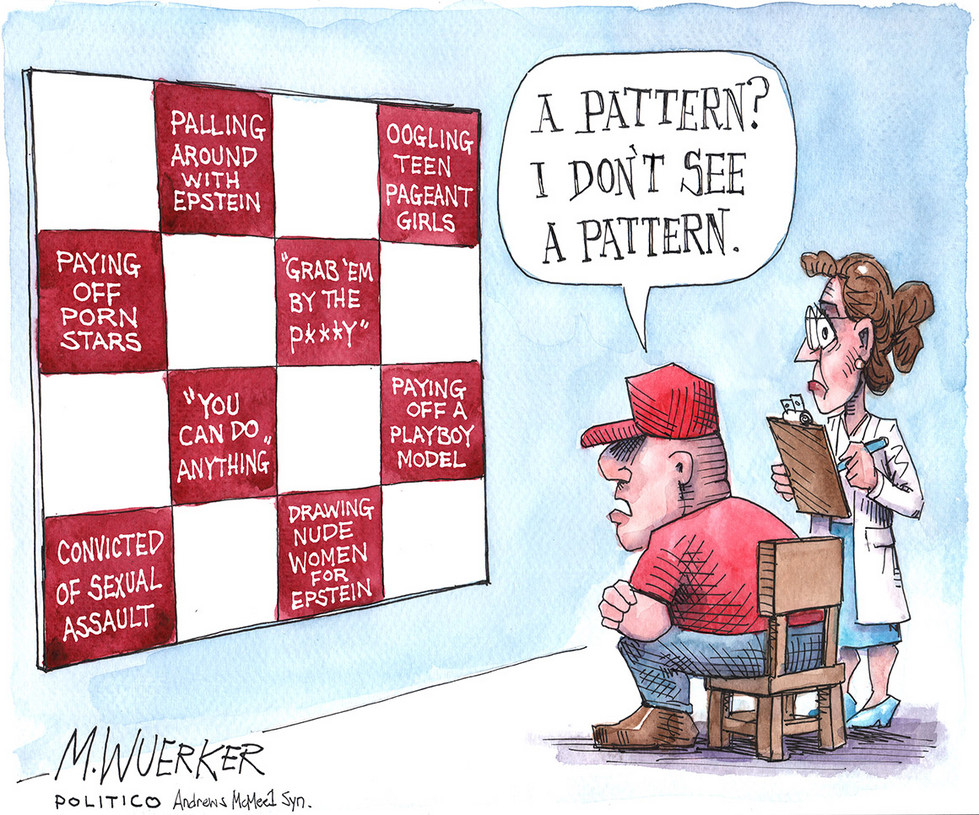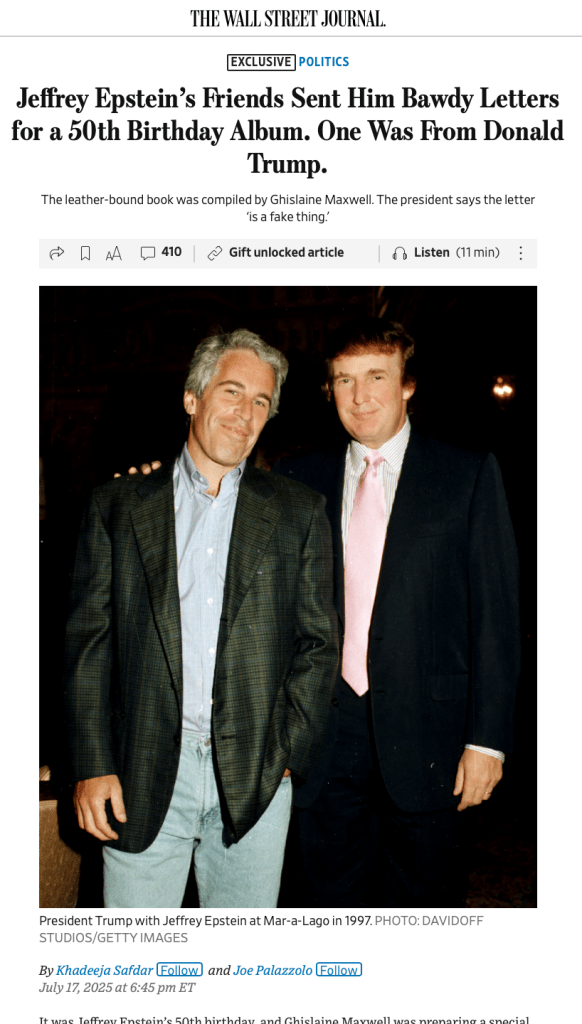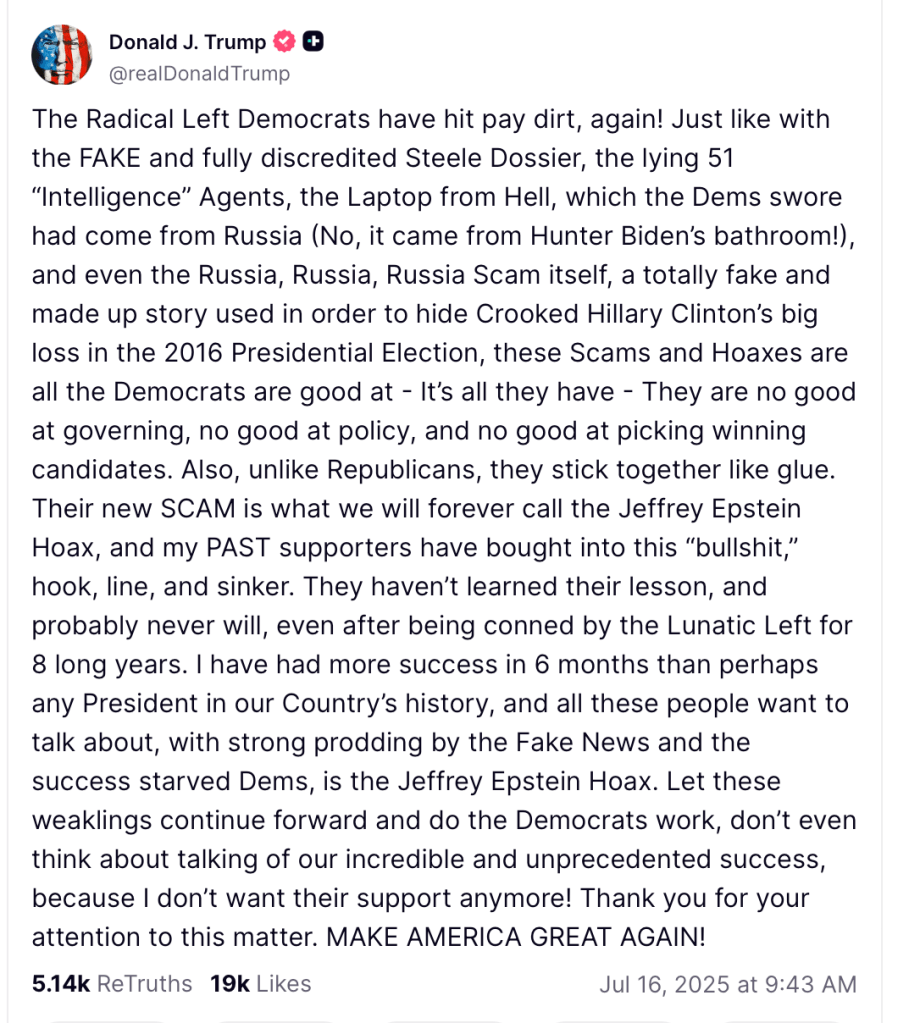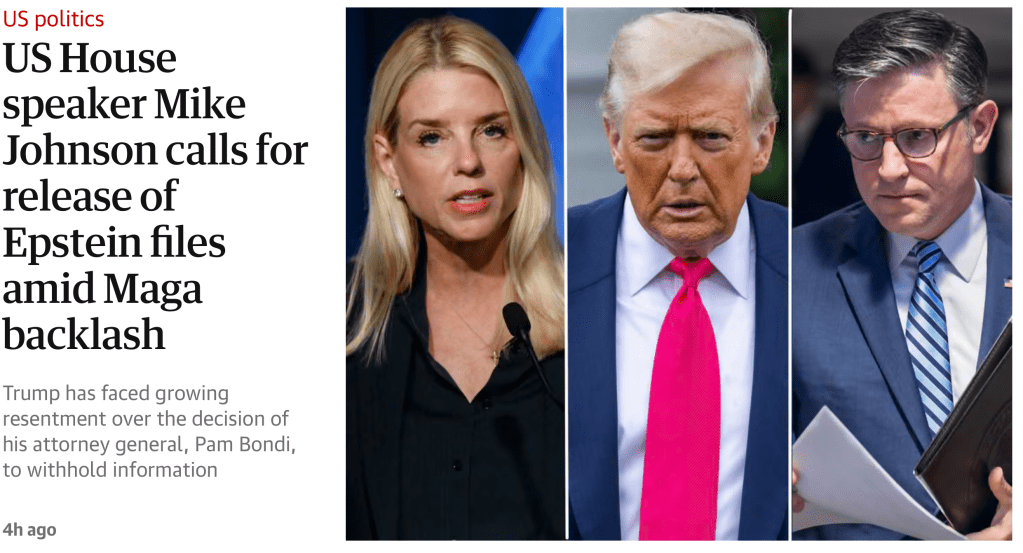
How’s That Epstein Coverup Workin’ Out for Ya, Mango Mussolini? Tonight’s Headlines Would be a Clue
From the Guardian:

Merle Hazzard Explains the Fed’s Dual Mandate
And, by the way, one of the Fed’s two mandates is NOT financing the federal debt at ridiculously low rates of interest and thus driving inflation through the roof.
As Predictable as Day Follows Night, As Friday is the Day After Thursday

I had already written this post in my mind before I read the Politico story, published about an hour ago.
Trump Has Scored a Famous Victory Over the MAGA Influencers. Or Has He?
Today, the talking heads are talking nonstop about how Trump seams to have beat the Epstein conspiracist MAGA influencers into submission—and how they’re singing a different tune from the one they sung on Friday, Saturday, Sunday, and part of Monday.
And whether or not Trump’s effort to tell his base to forget about Epstein will work or not.
The answer is that it all depends. It depends on whether the lunatic part of our American brethren and sistern will choose to believe Trump or whether they will choose to believe what they have believed about the pedophile ring coverup for the past decade. And a basement full of trafficked children in a Washington pizza restaurant that doesn’t have a basement.
That’s because the term “influencer” is inaccurate and misleading. The MAGA influencers don’t really influence. What they are good at spouting back to their listeners and viewers what their listeners and viewers want to hear.
As I would have said back when I was practicing antitrust law and relying on forensic microeconomists, the influencer competition for market share is fierce, the market is dynamic, and entry is easy. Just video yourself on your smartphone, post the video on YouTube, and start making money.
Given the market structure, given the incentives, and given the Zeitgeist, it is inevitable that some would-be influencers are going to come along spouting the theory that the pedophile ring has got to Trump and that he has gone over to the dark side.
I didn’t predict—though I should have predicted—that Nikki Haley would be among the first to stride across the stage in her high heels and begin the competition to sell alternative conspiracy theories.
Others will follow. Many others.
Game on. Now it’s up to the base to see which competing conspiracy appeals to their deformed, paranoid minds.
It’s Monday, and No One Believes the Ministry of Truth Anymore. Even the Nutjobs. Especially the Nutjobs.

I don’t know whether people still read Orwell’s 1984. But I expect most of my readers know it. Remember what Winston Smith’s job was, at the Ministry of Truth?
This feels as if Trump is ordering the Ministry of Truth to rewrite history, and it’s not going so well.
I think the Morning Joe team did a good job of capturing the current situation. As did Philip Bump in today’s Washington Post. See Trump finds himself on the wrong side of a conspiracy theory: He has leveraged conspiracy theories for a decade—and now one lumps him in with The Elites:
One of the common misunderstandings about President Donald Trump is that he created the culture of conspiracy and surreality in which the American right is now immersed. He didn’t. He simply leveraged it.
This isn’t to say Trump hasn’t generated or amplified any conspiracy theories. He obviously has. It is simply meant to note that he emerged as a political figure a decade ago from an existing culture in which such claims were common currency. The central advantage Trump possessed in the 2016 Republican presidential primary was that he was willing to agree with false theories in a way that the established politicians against whom he was running were not. His most identifiable issue, immigration, was and is rooted in false claims about foreign powers shipping criminals to the U.S. where they are subverting traditional America. It’s conspiracies all the way down.
The conspiracies that take hold of the right centrally rely on the idea that Elites Are Up To No Good. In any objective context, Trump himself would be considered an elite, given his billions of dollars and his power, even before being elected president. But Trump sided with The People, meaning those beside him in the conspiratorial swamps. Because he stood against The Elites, a loosely bounded group that ostensibly controls America — meaning The People — Trump was granted a seemingly irrevocable dispensation from elitism.
Now, that dispensation is suddenly looking rather wobbly.
The reason? Jeffrey Epstein, the man who encapsulated so many of the characteristics that the conspiratorial right attributes to The Elites: inconceivable wealth, access to powerful politicians and celebrities, a privileged lifestyle (including a private island!) and accusations of criminal sexual deviancy involving minors. All of that was attributable to Epstein even before his 2019 death in a Manhattan jail cell — a suicide that was quickly presented by conspiracy theorists as something far more suspicious.
By the time Trump announced his presidential candidacy in mid-2015, Epstein was already a felon. The muckraking website Gawker had already published the contents of Epstein’s address book, including more than a dozen phone numbers for Trump and Mar-a-Lago, where Epstein had once been a regular. The site also published logs from Epstein’s private jet; Trump (and former president Bill Clinton) had been passengers multiple times.
But Epstein wasn’t really an issue in the 2016 election.
The salience of Epstein increased once Trump was president, and not only because it was during this period that the disgraced businessman was arrested and died. Trump’s first term in office saw the emergence of a sweeping conspiracy theory about an undercover government employee who was helping Trump conduct a secret, global campaign to uproot a cabal of pedophiles whose membership included various celebrities and (Democratic) politicians.
This was QAnon, which helped explain (as one adherent explained to me at the time) why Trump’s tumultuous, disorganized administration was actually a secret success. The pattern that Trump had leveraged since 2015 appeared again: What appeared to be, wasn’t; what was, was hidden from view.
QAnon caught on. In May 2021, PRRI found that nearly a quarter of Republicans believed in even its most extreme presentation, that “the government, media, and financial worlds in the U.S. are controlled by a group of Satan-worshipping pedophiles who run a global child sex trafficking operation.” QAnon’s adherents were a central element of the effort to overturn the 2020 election during the riot at the Capitol on Jan. 6, 2021. When Trump left power two weeks later, QAnon dissipated somewhat — though that was in part because its precepts and themes were absorbed and adopted by various right-wing actors, including Trump.
Epstein became a cudgel for the right to use against Trump’s replacement, Joe Biden. It’s much easier to espouse and amplify conspiracy theories when you don’t have the power to rebut them. Allies of Trump’s, like his son Donald Trump Jr. and then-Sen. JD Vance (R-Ohio) suggested that there was some nefarious reason that the government wasn’t sharing more information about Epstein, including a theorized set of clients or files in which various other Elites would be implicated.
The idea became so ingrained among Trump’s supporters that the existence of this material was treated as established fact and its release an inevitable element of a second Trump term. He and his allies would be asked about the material and (with a few notable exceptions) would pledge that it would be made public.
And then Trump became president.
There were other places where Trump’s return to the White House put him in a somewhat unsteady position. His advocacy for coronavirus vaccines in his first term had soured in the right-wing media universe since leaving office, for example, but that was easily remedied by tapping one of the country’s foremost anti-vaccination advocates to run the government’s health agencies. Epstein, though? Much harder to circumnavigate.
It probably didn’t help that Trump’s allies, like Attorney General Pam Bondi, weren’t interested in undercutting the right-wing narrative. Early on, she insisted that she was in possession of a client list that was being vetted. Then she — or someone at the Justice Department — attempted to put the whole thing to rest by inviting right-wing social media influencers to the White House and giving them mostly the stuff that had been published by Gawker a decade prior. The pro-Trump right wasn’t satisfied.
Last week, the Justice Department took another approach, releasing a memo flatly rejecting the idea that there was any client list to share. When a reporter attempted to ask Bondi about the memo at a Cabinet meeting, Trump interjected.
“Are you still talking about Jeffrey Epstein?” he asked. “This guy’s been talked about for years.”
Rumors swirled that senior FBI officials disagreed with the approach — officials who’d often touted conspiracy theories in their prior careers as Trump-aligned right-wing commentators. On Saturday, Trump published a lengthy message on Truth Social defending Bondi and offering a novel explanation for what had happened with the Epstein material: The “client list” conspiracy theory was itself a function of a left-wing conspiracy.
“Obama, Crooked Hillary, Comey, Brennan, and the Losers and Criminals of the Biden Administration, who conned the World with the Russia, Russia, Russia Hoax, 51 ‘Intelligence’ Agents, ‘THE LAPTOP FROM HELL,’ and more … created the Epstein Files, just like they created the FAKE Hillary Clinton/Christopher Steele Dossier,” Trump wrote, invoking various other conspiracy theories he had helped establish as canon on the right.
There are three fundamental challenges for Trump here.
The first is that he doesn’t have the control over conspiratorial thinking that he thinks he has. Again, he piggybacked existing anti-elite theorizing to reach the White House. As the vaccine debate shows, he’s never fully controlled it.
The second is that he is now president. As an expert on conspiracy theories explained to me back in 2017, the powerful have a difficult time leveraging conspiracy theories because those theories are generally tools used to rebut power (like that of The Elites). Presidents could prove a conspiracy theory true, if it were, but cannot prove one false since they are part of a system enmeshed in the theory.
The third, and most important, is that there are unanswerable questions about Trump’s relationship with Epstein. Trump was friends with Epstein. Trump and his family appear multiple times in Epstein’s address book, the only “list” that’s known to exist. Not only can the Justice Department never adequately dismiss a conspiracy theory that centers on government power; Trump is perhaps uniquely powerless to fully dismiss a conspiracy theory with which he is intertwined.
We can assume that the Epstein issue will soon fade from relevance in the national conversation, granting Trump a reprieve from the consternation of much of his base. (The replies to his post on the social media platform he owns have been broadly and unusually disparaging.) However, we can still recognize this moment for the exception that it is: Probably for the first time since he announced his candidacy in 2015, Trump has found himself on The Elites side of the divide against The People. Instead of leveraging the power of conspiratorial thinking, for at least a moment, he is seeing it being used against him.
Given how dependent his political power is on the grip with which he holds his base, even the loosening of one finger may be a weakness he can’t afford.
A Final Ray of Sunshine
Imagine how much worse things would be if Pam Bondi had any sense.
He’s Releasing the Files! To Catch All the Pedophiles!
I fear this post will ruin my chances of being hired by the FBI.
Rick Wilson Explains How Trump is Losing His Superpower This Weekend
Epsteingate

I was only able to download an audio file of the second podcast—by Sara Longwell and Will Sommer of the Bulwark. I recommend you give it a listen.The video may be behind a paywall, or you may be able to watch it here.
Why Did Trump Order the Coverup?
This weekend, lots of talking heads are postulating that MAGA minds are in deep distress, trying to figure out whether (1) Trump told Pam Bondi and the FBI to put the kibosh on Epsteingate because there is actually nothing to see, and Trump didn’t want to unwashed masses to realize they had been lied to, or (2) Trump told Pam Bondi and the FBI to put the kibosh on Epsteingate because Trump is as guilty as homemade sin, and he wanted to cover up his misdeeds.
Logically, there’s a third possibility too: Trump told Pam Bondi and the FBI to put the kibosh on Epsteingate because Trump realized there’s a load of blackmail material in the file, against a lot of people, and he wanted to preserve his ability to gain from those blackmail opportunities.
But, given all the facts and circumstances, I think the overwhelming probability is that Door Number Two is the right one: Trump put the kibosh on Epsteingate because Trump is guilty as sin.
A Big Fissure Within MAGA?
Apparently, despite all the talk of splits, fissures, and cognitive dissonance within MAGA resulting from Epsteingate, most of the MAGA folks have also lept to the conclusion that there is a Trump coverup. So, not much cognitive dissonance on the assumption that this is a coverup.
Good for them.
So, what comes next? Who knows?
The N.Y. Times Finally Catches Up on Trump v. CASA, “Nationwide” Injunctions, and Class Actions

Adam Liptak (N.Y. Times), Trump’s Birthright Citizenship Ban Faces New Peril: Class Actions: In last month’s decision limiting one judicial tool, universal injunctions, the court seemed to invite lower courts to use class actions as an alternative.
And, While You’re Over at the Gray Lady, Check Out:
N.Y. Times Editorial Board, ‘I Am Not an Idiot’: Dozens of Federal Judges Have Had It With Trump
The U.S. Justice Department normally employs about ten thousand lawyers. When you fire all the competent ones and replace them with hacks who were lucky to survive the first week of law school, this is what you get.
Your Trump Team of Legal Geniuses at Work

What the Bleeding Hell Did They Think the Case was About?
Like Two Scorpions in a Bottle: Heather Cox Richardson and Rick Wilson Share Their views on Musk and Trump
And, from four months ago, the Marsh Family gives a musical take on Elon.