
Bad Bad Donald Trump, Baddest Man in the Whole Damn Dump
Wednesday
“They’re all bending and saying, ‘Sir, thank you very much,’” Mr. Trump said, adding that they were asking, “‘Where do I sign? Where do I sign?’”
Friday (Today)
Jenner & Block, WilmerHale both file complaints, and both are granted temporary restraining orders by the close of business the same day.
Goody, Goody!
Donald Trump’s commerce secretary told Americans to buy stock in Elon Musk’s electric car company, only for shares in Tesla to keep falling.
“I think, if you want to learn something on this show tonight, buy Tesla,” Howard Lutnick told Fox News on Wednesday. “It’s unbelievable that this guy’s stock is this cheap. It’ll never be this cheap again.”
He added: “I mean, who wouldn’t invest in Elon Musk? You gotta be kidding me.”
Regarding Tesla at least, the answer appears to be: lots of people. In the last month, shares have lost a third of their value. After Lutnick spoke, Tesla was down again in pre-market trading on Thursday.
Musk donated hundreds of millions of dollars to Trump’s re-election campaign and is now slashing government staffing and budgets under the so-called “department of government efficiency” (Doge) – work proving increasingly unpopular and damaging to his businesses. Amid protests that have included vandalism of Teslas and dealerships, Musk has claimed to have done nothing wrong.
On Tuesday, he told Fox: “It turns out when you take away the money people get fraudulently, they get very upset. They basically want to kill me because I’m stopping their fraud, and they want to hurt Tesla because we are stopping this terrible waste and corruption in the government. I guess they are bad people. Bad people do bad things.”
Republicans have attacked Democrats for speaking out against Tesla. Observers have pointed out how the same Republicans have attacked companies for promoting values they do not share, celebrating financial reverses.
Tesla’s problems continue to grow. Last week, JP Morgan said: “We struggle to think of anything analogous in the history of the automotive industry, in which a brand has lost so much value so quickly.”
This week, Dan Ives, managing director at Wedbush and a major Tesla backer, said brand damage caused by Musk’s work for Trump “has spread globally over the last few weeks into what we would characterize as a brand tornado crisis moment”.
Lutnick spoke to Jesse Watters, a Fox primetime host and Trump cheerleader.
“It’s just so outrageous,” the former Cantor Fitzgerald CEO said. “You have probably the best entrepreneur, the best technologist, the best leader of any set of companies in America working for America, and you have this sort of weird side of the Democratic party attacking him.”
Lutnick repeated the claim that Musk “rescued” astronauts from the International Space Station via his SpaceX company on Wednesday – yet in fact, Nasa chose to wait for SpaceX to be ready for the mission.
Lutnick urged viewers to “buy Tesla” and expressed disbelief about the shares’ performance.
He continued: “When people understand the things he’s building, the robots he’s building, the technology he’s building, people are going to be dreaming of today and Jesse Watters, thinking, ‘Gosh, I should have bought Elon Musk’s stock’ … Whether today’s the bottom or not, I tell you what, Elon Musk is probably the best person to bet on I’ve ever met. And I think we all know that.”
Lutnick and Watters then engaged in cheerful promotion of $30,000 robots for domestic chores that the commerce secretary said Musk would soon bring to market.
Concern is growing about conflicts of interest involving Musk and whether he is profiting from his government work. This week, as Musk’s Starlink internet service was installed at the White House, senior Democrats called for investigations.
Lutnick told Fox: “Elon Musk is the best entrepreneur and technologist in America, and I bet on him. I wish I was allowed [to buy Tesla stock]. I’m not allowed to buy any stock.”
A Message from the People of Canada
The Wall Street Journal Would Like You to Know That I Nailed it: Trump’s Screwing the Poor, He’s Screwing the Middle, and, For Good Measure, He’s Screwing the Rich, Too

Robin Hood, he ain’t.
Wall Street Journal, Consumer Angst Is Striking All Income Levels: Signs of weakness are showing up in spending on everything from basics to luxuries
The Journal identifies the “key points” as follows, after which it expatiates.
Key Points
- Consumer spending is declining across all income levels due to concerns about tariffs, inflation and a potential recession.
- Retailers are reporting weak demand since the start of the year as consumers become more cautious about their spending.
The Editor of the National Review Would Like You to Know that Donald Trump is a Nutcase Who is “Impervious to Facts and Logic”
Ramesh Ponnuru (Washington Post), Where’s the economic sense behind Trump’s tariffs? Not even Treasure Secretary Scott Bessent can convincingly defend the president’s trade policy.
Ramesh Ponnuru is a senior fellow at the American Enterprise Institute and editor of the National Review. He writes,
If you think tariffs are painful, try watching President Donald Trump’s aides and supporters attempt to defend them. Whenever they come up with a rationale for his policies, however dubious, he immediately says or does something to contradict it. They say Trump’s trade strategy is all about containing China — then he slaps tariffs on the allies we would need to do so. They explain that the law lets him impose tariffs on Canada to protect our national security, only for him to let slip that he’s mad about Canadian dairy policies.
The truth is that Trump just likes tariffs and people who tell him they make sense. His trade adviser, Peter Navarro, thinks imports harm the economy because he doesn’t understandhow gross domestic product data is calculated. The administration has no grand trade strategy.
But the demand for sophistry in defense of Trump’s tariffs is apparently inexhaustible. Scott Bessent, the treasury secretary, tried out another argument at the Economic Club of New York last week.
The president, Bessent said with a straight face, “sees the world not as a zero-sum game but as interlinkages that can be reordered” to help Americans. (If this were a college paper, the professor would scrawl “citation needed.”)
Bessent argued that the tariffs are designed “to rebalance the international economic system” and “[level] the playing field.” He’s not just making the standard complaint that other countries place tariffs on U.S.-made products. Although true, that fact does not go very far toward justifying Trump’s policies. In fact, many countries place lower tariffs on our exports than we do on theirs — yet Trump wants to hike tariffs on them anyway.
The treasury secretary has a broader view of the imbalances that need to be fixed. “The United States,” he says, “provides reserve assets, serves as a consumer of first and last resort, and absorbs excess supply in the face of insufficient demand in other countries’ domestic models.” Most economists think the United States runs a trade deficit because investment outstrips savings. Bessent looks at it differently: Other countries force trade deficits on America by undervaluing their currencies and investing their excess savings with us.
Bessent sketched his case briefly in New York, but others have developed it in greater detail. Manufacturing employment has shriveled because of all this currency manipulation, these theorists say, but tariffs can undo these distortions by encouraging increased production at home.
Bessent alluded to this idea in the most quoted remark from the speech: that “access to cheap goods is not the essence of the American Dream.” He believes that the global economic order has pushed us to consume too much and produce too little. Perhaps a man with assets above $500 million should have found a better way to phrase this opinion.
But set aside the bad PR. The argument itself is a chain with several links — and not one is solid.
Trade balances don’t indicate which economies are succeeding and which are failing. The United States ran a trade deficit for most of the 19th century while rising as an industrial power. Nor is it true that trade surpluses can keep a country from losing manufacturing jobs. Every developed country — including Germany, which has a trade surplus — has seen the same downward trend.
Tariffs are not a reliable means of increasing domestic production, either. That’s partly because they tend to cause the currency to appreciate. Bessent himself has told us so: During his confirmation hearings, he tried to allay fears that tariffs would raise prices by saying that a rising dollar would soften the blow. But a stronger dollar also reduces demand for U.S. exports — which is the very reason Bessent complains about currency manipulation.
Tariffs also tend to raise the price of goods that U.S. manufacturers use, which makes it harder for them to make and sell their own products. Study after study has found that the tariffs Trump imposed during his first term caused manufacturing employment and output to shrink. Moreover, those tariffs didn’t even reduce the trade deficit.
What Bessent’s case for tariffs has in common with all the other rationalizations is that the president has given no indication he believes it. If Trump believed it, he would want a weaker dollar and an end to its status as a global reserve currency. He doesn’t; he has talked about punishing countries that try to displace the dollar.
The purpose of these theories is not to cohere. It’s to sound just plausible enough to distract from the unsettling truth: The president has an obsession with tariffs, and it is impervious to facts and logic.
Jeff Bezos Tells the Washington Post to Tell All You Idiots Out There That DOGE is Doing Some Great Stuff

Jeff Bezos’s Washington Post, Turmoil within DOGE spills into public view as Musk’s group confronts a PR crisis
The Post’s headline writer has ill served Bezos, and I assume that said headline writer will soon be canned. A much more accurate heading would be the article’s subheading, to wit, “Elon Musk’s DOGE is hunting for “wins” as it races to finish slashing the federal bureaucracy and move on to the more constructive work of building digital tools for the government.”
The gravamen of this is that Elon’s team is about to do great things by replacing outdated government software and replacing human beings with AI chatbots.
Oh frabjous day!
Meanwhile, the Indispensable Ed Luce of the Financial Times of London speaks of “Elon Musk’s Self-Destruction”
Luce writes,
When Elon Musk said he loved Donald Trump “as much as a straight man can love another”, the emetic effect was widespread. Trump is one of the few people left in Washington DC who likes having Musk around. Yet having given Musk more power than any private figure in US history, the president is watching his benefactor turn into an albatross. The question is how Trump will get rid of Musk, not whether.
The price of having him as co-helmsman is already steep. The New York Times chronicled how Trump clipped Musk’s wings in a heated cabinet meeting last week. Cabinet heads, rather than Musk’s so-called Department of Government Efficiency, would take care of their own hiring and firing, Trump said. His White House had until then been notably leak free — in contrast to his first term. But it appears senior staff are keen to see the back of the chainsaw-wielding oligarch. The showdown had been set up with the aim of hastening that day.
A measure of Musk’s worry about his waning star is that his visit to Mar-a-Lago last weekend was not originally scheduled, say insiders. Moreover, Musk has tried to funnel millions more into Trump’s political action committees and been turned down. Trump is not known to refuse money. But it would look like Musk was buying his prolonged stay. His standing is dropping as fast as Tesla’s stock price. Trump’s approval rating has remained steady. With signs of a coming “Trump recession”, Musk may still be a useful lightning rod.
But that is the extent of his upside. His sway is mostly negative. There is not a Republican legislator or Trump principal who is not terrified of Musk’s power. A $50mn cheque to fund a primary challenge could end a senator’s career — $10mn for a legislator. Musk’s X, which is Maga’s informal state broadcast arm, could also destroy a cabinet member’s career. Officials now routinely issue press releases first on X. The secretary of state, Marco Rubio, first announced plans to pare back USAID on X.
There appears to be nothing Musk will not say to defame those in his way. This has been apparent since he accused a beleaguered caver of being a paedophile a few years ago. Musk is only acting more like himself. But his willingness to character assassinate is interfering with Rubio’s job. Musk recently threatened to trigger a collapse in Ukraine’s frontline by pulling his Starlink satellite service. After Poland’s foreign minister, Radosław Sikorski, objected, Musk posted: “Be quiet, small man . . . There is no substitute for Starlink.” Poland is one of the few European countries Trump has said he would aid in the event of an attack. An impotent Rubio felt obliged to back up Musk.
But the cost of keeping him by Trump’s side is growing. In ignorance of how the federal government works, Musk is only causing damage. This also undercuts Russell Vought, head of the White House Office of Management and Budget, who has spent years drawing up plans to deconstruct the administrative state. He was co-author of Project 2025, the Heritage Foundation’s radical blueprint for a second Trump term. The traumatising of America’s civil service will outlast Musk. But Vought is likely to do it less incompetently. Nor does he share Musk’s seeming reluctance to go after the Pentagon, which is a major source of Musk’s federal contracts.
It is tempting to think Musk has a political death wish. The recent drop in the wannabe trillionaire’s net worth has also almost wiped out his post-election gains. But that would be naive. Doge’s access to taxpayer accounts, social security records and federal employee data would offer a gold mine for any AI titan. Musk’s temptation to hoover it up for his own ends will be great. But that means retaining Trump’s trust. If Musk has any self-knowledge, he will wear suits from now on and keep his offspring out of the Oval Office. After he took his four-year-old son, X, to the White House last month, insiders say Trump asked for the HMS Resolute desk to be disinfected. The boy felt just as at home as his father.
There is also Musk’s impact on Trump’s China policy. As clients in the US, Europe and elsewhere spurn Tesla and search for alternatives to SpaceX, Musk’s commercial reliance on China is growing. Musk’s dovish influence on China policy is plain. Trump now sounds almost as uninterested in Taiwan’s fate as he is in Ukraine’s. Most of the rest of his team are China hawks. If and when Trump turns against China, that will be another sign of Musk’s descent.
“In the first Trump term, it took a disease to destroy the economy. This time, he’s the disease.”
As of around 11:00 AM World Time this morning:

The Business Roundtable has about 200 members—all chief executive officers of the largest corporations in America. Trump will be meeting with them later today.
Some politicians want to distribute income upward—in other words, screwing the poor to make the rich richer.
Some politicians want to be Robin Hood—robbing the rich to help the poor.
Trump wants to screw the poor, screw the middle, and screw the rich, all at the same time.
The Wall Street Journal Would Like You to Know That, as of This Afternoon, Things are not Supercalifragilisticexpialidocious
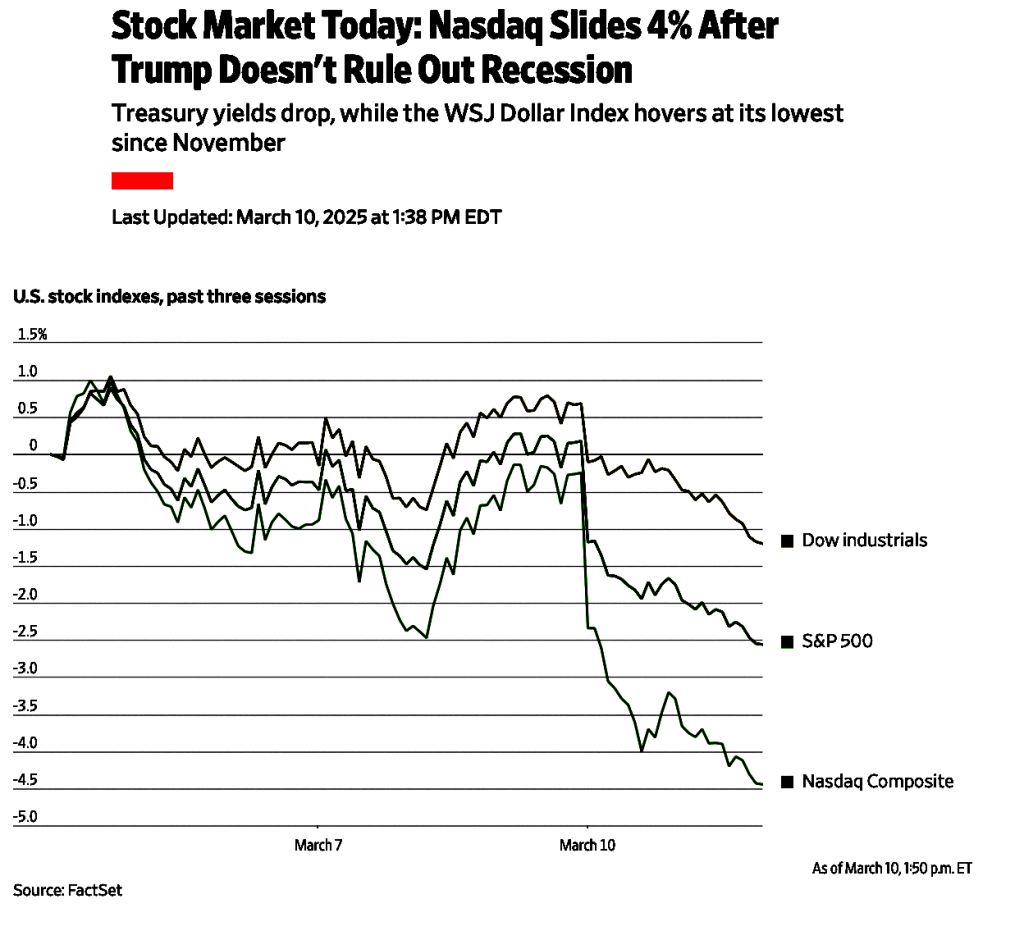
MAGA is About to Have an Epiphany: That Jesus Wants J.D. Vance to be President—and That Right Soon

Today, Trump said that his tariffs could lead to inflation—and maybe a recession.
He’s screwing his rich supporters, with trade wars, demolished supply chains, worthless investments due to demolished supply chains, dysfunctional government services, tanked stock portfolios, and really rotten consumer sentiment.
He’s screwing his poor idiot supporters with high inflation. Mamma’s gonna have problems getting her Social Security money. Grandma’s gonna lose her Medicaid, that pays for her nursing home. And veterans can kiss their health care goodbye.
Jesus is definitely not happy about all of this.
It’s just about time for God to anoint J.D. Vance as our next President.
Probably to ascend to the kingship sometime around mid-April.
 Facing MAGA