
They Sowed the Wind, They Have Inherited the Whirlwind
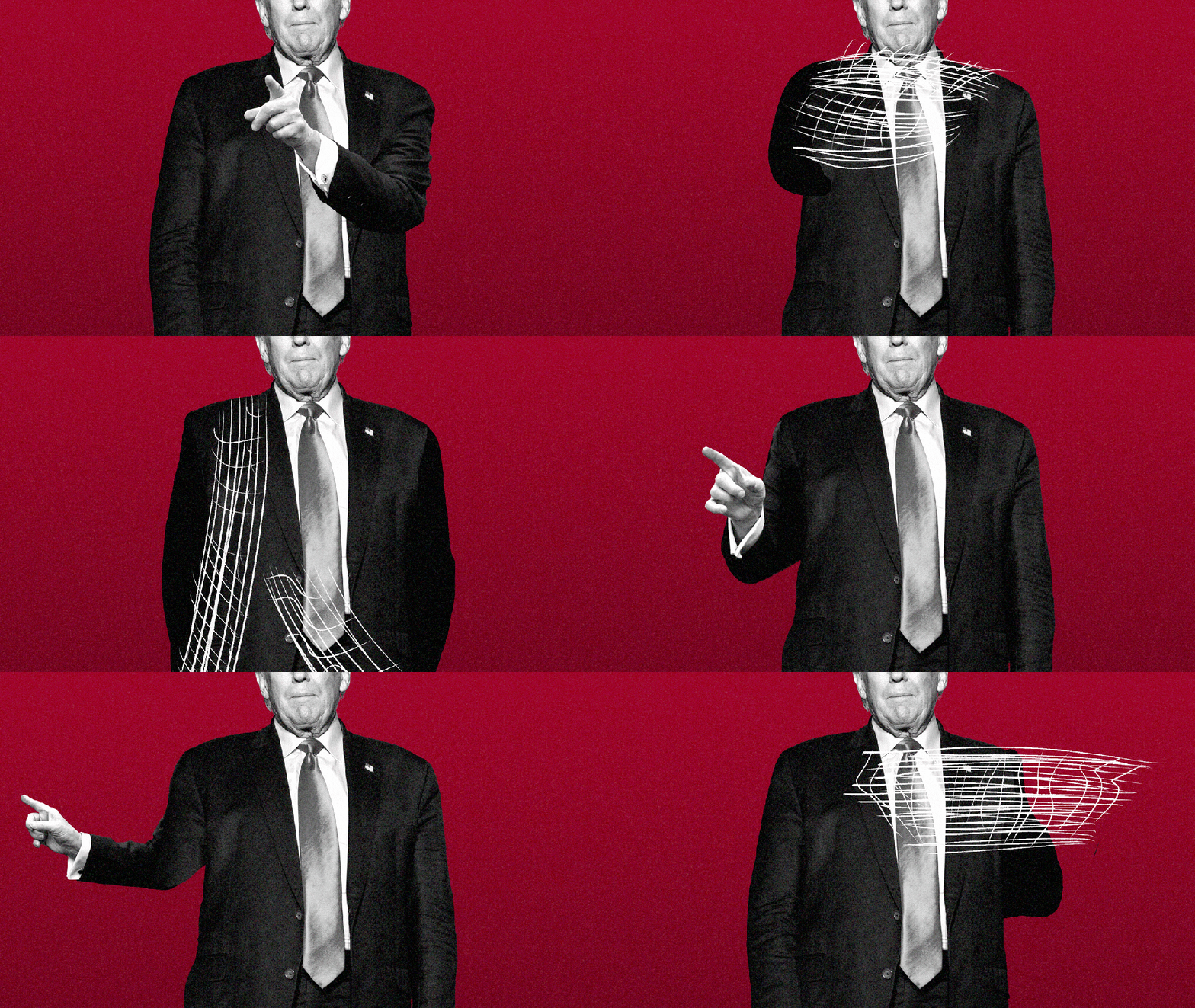
This is the Week When They’re Admitting that if You Elect an Actual Crazy Person, You Will Get Literally Crazy Government—and That the Crazy Person’s Supporters Will Get Exactly What They Deserve
Michelle Goldberg (N.Y. Times), The Right’s Trump Derangement Syndrome
Axios, Trump’s rug-pull presidency
Mike Allen of Axios writes this morning,
Donald Trump is building a reputation for himself as the flip-flopper in chief — the president who, after announcing a bold new policy today, is more than likely to reverse it tomorrow.
Why it matters: In a chaotic and unpredictable world, the federal government normally acts as a stabilizing force. Under Trump, it has become the primary driver of the chaos.
The big picture: Across-the-board tariffs on Mexico and Canada — two of America’s three largest trading partners — have been on and then off and then on and then off. Colombia knowsthe feeling.
- The government put 80 million square feet of its real estate up for sale, only to then take the “for sale” sign down.
- Trump has fired federal employees at the CDC, the FDA, the National Nuclear Security Administration, and the Department of Agriculture, only to then re-hire them.
- He touted the use of military aircraft to carry out high-profile deportations, only to suspend the flights after finding them costly and inefficient.
For the record: “This is the art of the deal,” a White House spokesman tells Axios about the tariff reversals, adding that the General Services Administration and individual agencies, rather than Trump himself, are responsible for other executive-branch actions.
- Elon Musk is also distancing himself from the firings of federal workers.
Flashback: In a matter of days, Trump denounced Ukrainian President Volodymyr Zelensky, then made up and invited him to Washington, then chastised him in the Oval Office, then expressed openness to rebuilding ties, then cut off arms and intelligence sharing.
Zoom in: Republicans in Congress have repeatedly found themselves boxed in by Trump’s flip-flops.
- He spent weeks equivocating on whether Congress should pass his agenda in one bill or two — then blindsided the Senate by backing House Republicans’ one-bill approach.
- He promised not to cut Medicaid, then backed a House GOP budget plan that could force exactly that in order to meet its proposed spending cuts.
- He has vowed to achieve the unthinkable by balancing the budget — while endorsing trillions of dollars in tax cuts, plus new campaign promises like no tax on tips or overtime.
Follow the money: The stock market, for one, is tiring of such shenanigans. On Wednesday, stocks fell on news that tariffs were being imposed — and then on Thursday, when those tariffs were suspended, stocks fell again.
- Foreign investors like French energy company Engie are on the record as saying that they need clarity and predictability in order to invest in the U.S. — something that’s clearly missing at the moment.
- “I’m not even looking at the market,” Trump told reporters in the Oval Office Thursday, disavowing his longtime favorite metric for economic success.
Zoom out: In crypto, a rug-pull is any project that’s announced and then abandoned — often at great expense to anybody who believed the initial announcement.
Between the lines: Elon Musk — who may or may not be the head of DOGE, depending on who you ask — is at least partially responsible for the administration’s “move fast and break things” ethos.
- “We will make mistakes. We won’t be perfect. But when we make a mistake, we’ll fix it very quickly,” Musk said in a Cabinet meeting last week, pointing to the reversed cancellation of Ebola funding.
- DOGE has made plenty of mistakes, but has not always been transparent about fixing them — quietly pulling down billions of dollars from its online “wall of receipts” on multiple occasions.
The bottom line: This is just exhausting.
The Coming Implosion – and the Attack Vector
Federal District Judge Reyes Asks, What Would Jesus Do? The Attorney General is Deeply, Deeply Offended
ABA Journal, DOJ files complaint against federal judge for alleged hostility against government lawyer
Her Excellency, Attorney General Bondi, would like the Court of Appeals for the DC Circuit to please, pretty please say some bad things about Judge Reyes. And what, you may ask, was the burr in the Attorney General’s saddle?
A few days ago, Judge Reyes held a hearing in the case of Talbott v. Trump, challenging an executive order requiring the expulsion of transgender troops from the military, and specifically defaming all transgender people as dishonorable, untruthful, and undisciplined.
As an aside, I have to hand it to Orange Mussolini; if anyone knows how to recognize someone who’s dishonorable, untruthful, and undisciplined, that would be him.
Anyway, during the hearing, the judge was really tough on the unnamed Justice Department attorney who had the misfortune of trying to defend Trump’s words and actions. The ABA Journal writes,
The Associated Press and Law 360 report that during the hearings, Reyes:
• Raised her voice and demanded an answer from a government attorney about whether President Donald Trump’s executive order showed animus by calling “an entire category of people dishonest, dishonorable, undisciplined.”
• Engaged in a rhetorical exercise regarding discrimination. Reyes declared that graduates of the University of Virginia School of Law would be barred from her courtroom because they are “liars and lack integrity.” She then told the government lawyer who was a University of Virginia School of Law grad “to sit down.” According to the ethics complaint, the directive “served no legitimate judicial purpose and transformed an attorney appearing before the court into an unwilling participant in the judge’s unnecessary demonstration.”
• Asked the government lawyer what “Jesus would say to telling a group of people that they are so worthless, so worthless that we’re not going to allow them into homeless shelters? Do you think Jesus would be, ‘Sounds right to me’?” she asked. The complaint says the question “placed DOJ counsel in an untenable position of either appearing unresponsive or speculating about how an incoherent hypothetical aligns with Judge Reyes’ personal religious beliefs.”
Richie Rich and Joe Six Pack Contemplate Their 2024 Vote
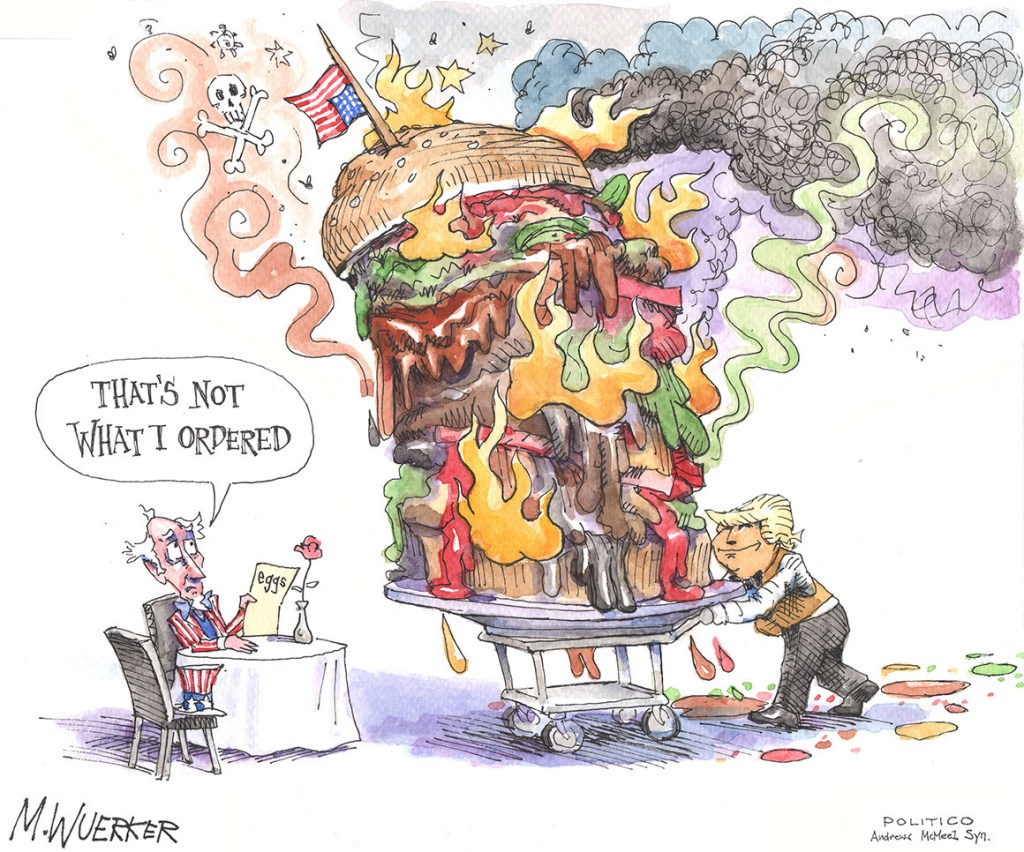
This is What Happens When Rich Folks Want Their Tax Cuts So Much That They Hand Over Power to an Actual Crazy Person
Trump’s Hissy Fit About the WSJ Editorial Board
Folks, grab a six pack and pop a big old bowl of popcorn.

The Guardian writes,
A Wall Street Journal editorial slamming Donald Trump’s tariff plans as terrible for the US economy and auto industry prompted a broadside from the president on Wednesday followed by threats to sue the media.
In an opinion piece titled Trump’s Tariffs Will Punish Michigan, the Journal argued Trump’s tariff plans would harm “US auto workers and Republican prospects in Michigan”.
Trump has threatened to impose 25% tariffs on goods from Mexico and Canada, a move the editorial argues would increase US vehicle prices, hurt auto workers and advantage Asian and European manufacturers.
“If the goal is to harm US auto workers and Republican prospects in Michigan, then by all means go ahead, Mr President,” wrote the Journal.
On his social media site, Truth Social, Trump wrote the Journal is “soooo wrong”. “The tariffs will drive massive amounts of auto manufacturing to MICHIGAN, a State which I just easily one [sic] in the Presidential Election,” he wrote.
Trump followed the rebuttal with a threat to those publishing “Fake books and stories with the so-called ‘anonymous’, or ‘off the record’, quotes” criticizing the opening month of his second presidency.
“At some point I am going to sue some of these dishonest authors and book publishers, or even media in general, to find out whether or not these ‘anonymous sources’ even exist, which they largely do not. They are made up, defamatory fiction, and a big price should be paid for this blatant dishonesty. I’ll do it as a service to our Country. Who knows, maybe we will create some NICE NEW LAW!!!,” he wrote.
The Journal’s conservative editorial board has been a persistent critic of Trump’s tariff plans, calling them “the dumbest trade war in history” earlier this month.
The Budget Resolution That Passed Last Night
Some websites aim to capture anti-Trumpers’ clicks with screaming headlines—“Trump Slides Downhill!” “Trump Humiliates Himself!” etc. etc. But I find The Bulwark’s presentations more objective, and much more useful in understanding what is actually happening, as compared with the rosy scenario sites. Besides, this video is entertaining too.
Friends, let’s never lose our sense of humor. Because the loss of our sense of humor would make it a lot harder to survive this shitshow.
Last night’s nonbinding budget resolution directs the House Energy and Commerce Committee to find $880 billion in budget cuts, over the coming decade, from the programs which that committee oversees. According to Newsweek today,
Trump has said multiple times that Medicaid would not be affected, telling Fox News last week that it would not be “touched.”
But the House Energy and Commerce Committee would have to find this money, out of Medicaid, Medicare and the Children’s Health Insurance Program.
If the committee takes its cuts from everything that is not health care, reducing this spending to $0, it would still be more than $600 billion short, according to analysis by The New York Times.
I tried, without success, to get a definitive answer as to what percentage of Medicaid funding would be lost if $880 billion were cut over a ten-year period. That’s a hard number to find for various reasons, including the fact that there will be lots of political back-and-forth about spending levels over the next decade.
Even so, there’s no doubt that $880 billion is a nice chunk of change.
On the one hand, clearly, axing $880 billion will let a whole lot of Medicaid spending continue. On the other hand, and equally as clear, decreasing funding by $880 billion would most assuredly “touch” Medicaid, contrary to Trump’s promise.
And who would be hurt as and when Medicaid is in fact “touched”?
According to a reliable source, for the year 2023, there were 24,046,700 white people under the age of 65 enrolled in Medicaid. In other words, the 24 million poor white Medicaid recipients don’t count all the white grandmas who have run through their savings and are relying on Medicaid to stay in their nursing homes.
Poor people supported Trump disproportionately in 2024. White people supported Trump disproportionately in 2024. And if you look at the combined category—poor AND white—they were mostly Trump supporters.
But it was still a close election. And the number of poor white folks who will feel pain from significant Medicaid cuts vastly exceeds Trump’s tiny margin of victory.
Speaker Johnson Prays for Cuts in Medicaid That Will Throw Grandma Out of her Nursing Home, Into the Street

Happy Valentine’s Day, My Fellow Americans
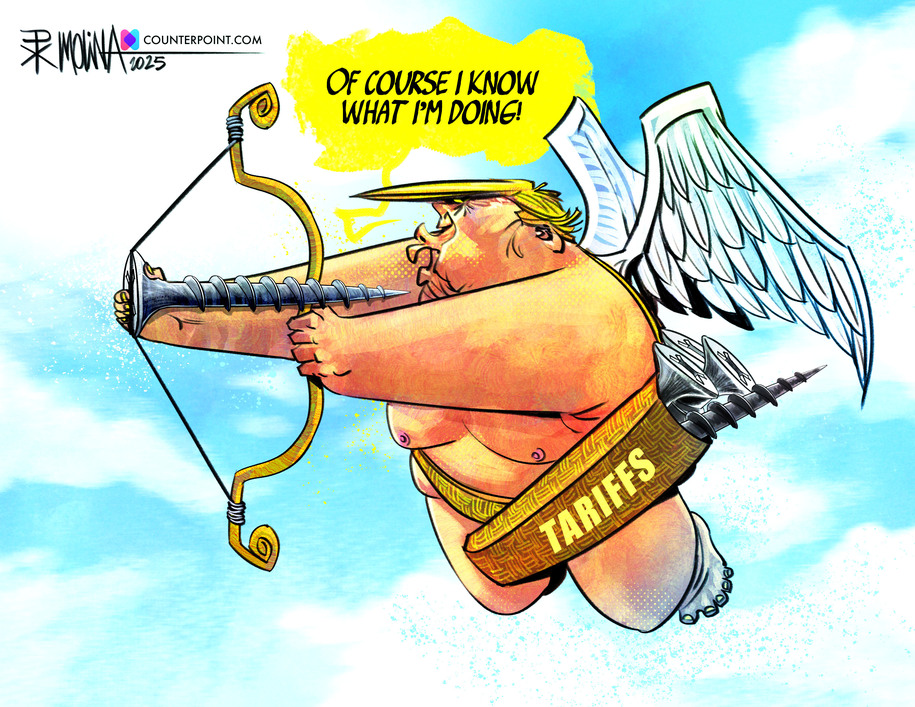
Actually, It’s Not Just Misunderstand and It’s Not Just Poor Strategery—It’s Magical Thinking

The two posts immediately below deal with Trump’s fundamental misunderstanding of how money and interest rates work. One quotes in full a Wall Street Journal Editorial Board piece published late yesterday. The other gives some context: it explains why the fact that these truths are now coming from the WSJ Editorial Board, not some other publication, is a man bites dog story, not a mere dog bites man piece of news.
This is correct as far as it goes, but it does not go far enough. There are all manner of things that I do not understand. But that does not mean that I engage in magical thinking. I do not fancy myself the God of Genesis 1—who just says things, and then they are so.
King Canute knew that he could not make the tide turn back just by telling the tide to turn back.
Trump thinks that King Canute was wrong.
We have elected someone with severe mental illness.
Those who voted for him are getting the president they richly deserve.
 Facing MAGA