The Colbert-Talarico Interview That CBS Would not Broadcast
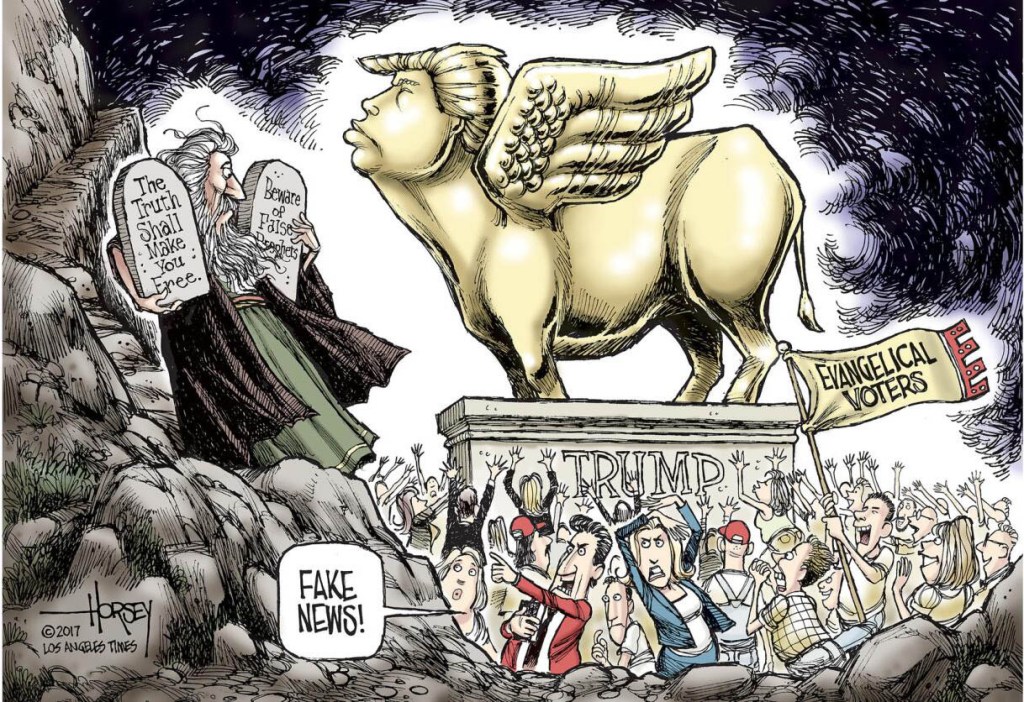

With clear eyes, hard facts, critical thinking, new political strategy, empathy, and a soupçon of Schadenfreude
I watched this lengthy, but very insightful, dialogue between two focus group experts. The time was well spent. Consider taking the trouble to watch yourself, if you want to understand the current state of opinion among the masses of our fellow Americans.
First of all, if you want to employ advocacy in the real world—not just in environments where you feel comfortable, but also in situations where advocacy might actually achieve something—then you need to identify your target and to be clear about what you want he, she, or them to do.
Now, it would be nice if everyone on Team Red would recognize the error of their ways, and come join Team Blue. But that is not going to happen. A more realistic objective would be to help them realize that things are going badly for Team Red—and there’s no real point in their voting in the next election or two. If lots of Team Red stay home, then we win—which, by the way, is exactly what has been happening in recent special elections.
Second, while honesty is essential, candor is likely to be counterproductive. To illustrate: the next time you’re dining with a MAGA acquaintance, you probably don’t want to say something candid such as, “I know that I am your moral and intellectual superior, but I’ll deign to talk with you if you will listen politely.”
A better course would be to argue along the lines, “Well, if you believe X, let’s talk about the implications of that belief.”
Third, if your objective is to get your MAGA acquaintance just to stay home on election day, then a good way of accomplishing that objective may to join he, she, or them in reasoning rationally and honestly from the false premises that he, she, or they entertain. To wit: your MAGA dinner companion may have voted for Trump three times because he or she believes that, while Trump is an asshole, he is an asshole who is working for the MAGA community and against the people whom the MAGA community hates.
Your objective is not to convince your MAGA acquaintance that he or she ought not to hate people—or that she or he ought not to hate the particular kinds of people that he or she hates.
No, your objective is to convince him or her that Trump is an asshole all right, but he is the kind of asshole who actually despises the people who voted for him three times—and that Orange Mussolini has absolutely no intention of prioritizing the core economic interests of his core supporters, namely, white people without a college education.
In other words, MAGA folks, yes, he’s an asshole, but he is most emphatically NOT YOUR asshole.
The biggest and most important thing I learned as a professional advocate for several decades is that it is so much easier—so much easier—to sell an argument if that argument is based on actual facts, as distinguished from delusional bullshit.
Notice how Jon Ossoff uses actual facts to construct his argument, and then to tie it all together with a pink ribbon using the concept of “the Epstein class.”
A deeply considered dive into the nature of our elites.

Back in the day, the state of New York used to show prospective jurors a film about Crown v. Zenger, a 1735 trial in which a New York jury refused to convict John Peter Zenger for “seditious libel” because he published criticism of the Royal governor.
I hope they are still showing it.

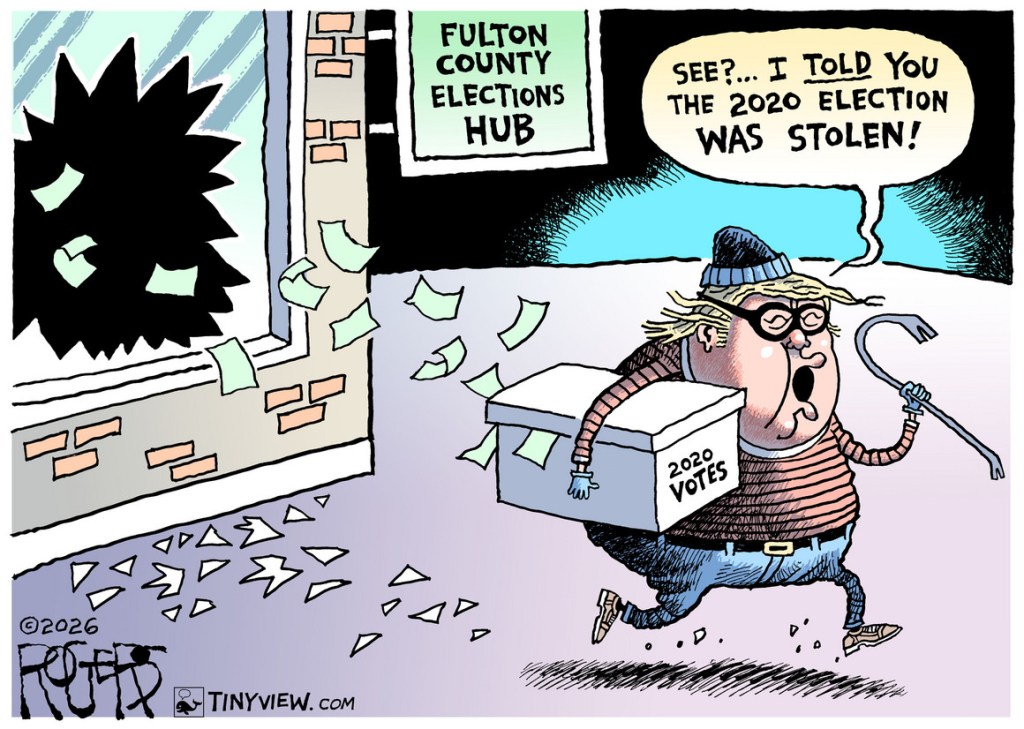
Two days ago, a federal judge in Fulton County ordered that Team Trump “shall file, no later than the close of business on Tuesday, February 10, 2026, the search warrant affidavit [about the alleged voter fraud in 2020] subject to the redaction of the names of non-governmental witnesses.”
United States District Judge J.P. Boulee signed the order. A former partner at Jones Day, where he worked in that firm’s Corporate Criminal Investigations practice group, Judge Boulee was elevated to the federal bench by Donald Trump.
Louisiana state House of Representatives District 60 is a rural area south of Baton Rouge. In 2024, 56 percent of its voters cast their franchise for Trump, while 43 percent voted for the Democratic ticket.
In yesterday’s special election, the Democratic candidate won 62 percent to 38 percent.
In other words, there was a 37 percent shift in favor of the Democrats between November, 2024, and February, 2026.

Maureen Dowd (N.Y. Times), Trump’s Obama Derangement Syndrome (really good stuff in bold face):
It seems etymologically, metaphysically, geologically and ethically impossible that President Trump could reach a new low. But he has.
Every Friday, when I’m planning my column, I find fresh evidence that the president is unfit for his office. He taunts his foes in crude, creepy ways and tries to tattoo his name on everything.
Late Thursday night, a vile clip appeared on Truth Social, depicting Barack and Michelle Obama as apes in a jungle cartoon, to the Tokens’ “The Lion Sleeps Tonight.” It was at the end of a video filled with baseless conspiracy theories about the 2020 election. The man who pushed the despicable “birther” conspiracy is still at it, using a racist meme from a far-right Pepe-the-frog-loving acolyte.
Like many of Trump’s actions, it was both shocking and predictable.
As The Times reported, Trump has a “history of making degrading remarks about people of color, women and immigrants,” and the Obamas in particular, with “the White House, Labor Department and Homeland Security Department all having promoted posts that echo white supremacist messaging” in his current term.
Karoline Leavitt, the White House press secretary, offered a pathetic defense for our pathological president: “This is from an internet meme video depicting President Trump as the king of the jungle and Democrats as characters from ‘The Lion King.’ Please stop the fake outrage and report on something today that actually matters to the American public.”
Well, Karoline, I think Americans do care that your boss is a racist and off his rocker.
“His presidency is enclosed in a bubble wrap of darkness and hatred and resentment,” Rahm Emanuel, who served as Obama’s chief of staff, told me.
Once the White House realized the outrage was real, the post was deleted. Officials blamed a staffer, though you know Trump was in on it. On Wednesday, he said he does “retruth”conspiracy theories himself.
He went so far that even a few Republicans in Congress, looking down the barrel of the midterms, objected.
On X, Tim Scott of South Carolina, the only Black Republican in the Senate, called it “the most racist thing I’ve seen out of this White House.”
Senator Katie Britt, an Alabama Republican who has been increasingly put off by some of Trump’s offensive actions, said on X, “This content was rightfully removed, should have never been posted to begin with, and is not who we are as a nation.”
Trump had a Dostoyevsky-esque moment on Thursday at the National Prayer Breakfast in Washington, when he confessed that his ego would not let him lose the 2020 race.
“You know, they rigged the second election,” he said. “I had to win it, had to win it. I needed it for my own ego. I would have had a bad ego for the rest of my life. Now I really have a big ego, though.”
He was admitting that our ginned-up election integrity crisis was simply an exercise in bending the truth to his bottomless vanity. “His ego could not handle the fact that he lost, so he had to pretend there was a voting crisis,” David Axelrod told me. “The world is still paying for that.”
(Trump also confessed to the religious gathering that he gets annoyed when Speaker Mike Johnson asks to pray before meals. Trump dryly noted: “I say, ‘Excuse me? We’re having lunch in the Oval.’”)
After obscenely slapping his name on everything from the Kennedy Center to a gold card for rich aspiring immigrants to warships, and planning a gargantuan triumphal arch and an outsize White House ballroom as reflections of his bloated ego, Trump is now trying to strong-arm Congress into naming more things after him by holding congressionally approved funds hostage.
The administration tried extortion tactics on Chuck Schumer, threatening not to unfreeze billions for a new railroad tunnel under the Hudson River unless he helped rename Penn Station in New York and Washington Dulles International Airport after Trump.
Trump’s dragging his own name and America’s name in the muck. The word “Trump” is an epithet in many circles. But in a bizarre manifestation of insecurity, the president still wants to stamp his moniker everywhere, just as he did when he was a New York businessman prone to bankruptcy.
Trump had another quintessential Trump moment on Tuesday when he lambasted CNN’s Kaitlan Collins for not smiling as she asked him, in light of the latest release of Jeffrey Epstein filth, what he would say to the pedophile’s survivors “who feel like they haven’t gotten justice.”
He told her that it was time to move on — the latest deflection from the fact that he has never come clean about his association with the odious Epstein.
Like a shuddersome image of worms slithering from underneath a rock, a bunch of powerful and formerly respected people in America and beyond have been exposed by the Epstein files.
Many of the ultra-elite who insisted they did not know the truth about Epstein’s depravity have been unmasked as liars. Instead, as The Wall Street Journal wrote, prominent people from Noam Chomsky to Stanley Pottinger to Peter Mandelson to Michael Wolff “actively consoled him, cast him as a victim and in some cases offered advice on how to rehabilitate his image.”
And the shoes keep dropping. CNN reported on Friday that Navy Secretary John Phelan was listed as a passenger on Epstein’s private plane in 2006.
As The Times’s David Fahrenthold told CNN, the louche role of some tech billionaires in the Epstein scandal is particularly chilling because our lives in the coming years will be defined by these billionaires.
Once we saw the lords of the cloud as heroic — young geniuses who would improve our lives. Now, as Fahrenthold said, the personal failings, insecurities and midlife crises of these men are dictating the way they run their companies. We were, he said, “a little bit misplaced in sort of putting our hopes in these folks.”
They are not keeping hope alive.
 Facing MAGA