Russell Razzaque, M.D., a psychiatrist, earned his medical degree at the University of London. More on him here.
I find his psychiatric analysis of voter insecurities to be persuasive and enlightening. Take a look, and judge for yourself.

With clear eyes, hard facts, critical thinking, new political strategy, empathy, and a soupçon of Schadenfreude
Russell Razzaque, M.D., a psychiatrist, earned his medical degree at the University of London. More on him here.
I find his psychiatric analysis of voter insecurities to be persuasive and enlightening. Take a look, and judge for yourself.

AL.com, Archibald: Alabama wants to pray or pay
The Alabama Legislature is worried about your soul.
So it is considering a bill that would hold education for ransom, slashing funding for school districts that don’t start their classroom days with a prayer.
Good bread, good meat, time’s wastin’ let’s eat.
HB231, sponsored by Pike Road GOP Rep. Reed Ingram and a host of disciples, is clear. Your students, no matter their faith, creed or lack thereof, must hear a prayer “consistent with Judeo-Christian values.”
Or risk losing 25% or their state funding. More than $63 million in Jeffco, for instance. Almost $100 million in Mobile. That’s $37 million in Madison County, and $34 million in Huntsville.
Can I get an amen?
So let’s just take a quiz. What prayers might meet that standard?
It is, of course, not as simple as all that. The bill, a constitutional amendment that would require a vote of the people, would withhold the money from school districts that show a pattern of refusing to comply. But the point is very real.
Freedom of religion in Alabama means “our way,” or to hell with you. Literally.
If this bill, this public piety for political purpose is passed, teachers should print that final prayer out and read it every single day in class.
Bow your heads and say it with me.
Oh Lord, help those men and women in the Alabama Legislature. They have taken food from the mouths of children, medicine from the sick and hope from the hopeless. They cast your people into prisons without mercy, rail against the poor and the immigrant. They have seen the sick and the hungry in their own land, and passed by on the other side of the street. They have done it in your name. Have mercy on their souls.
Amen.
Oh. P.S. Help us pass that damn test.
___________
Thanks to old friend and fellow Tuscaloosa High grad WA for sending along the article.

N.Y. Times, Chuck Schumer: Trump and Musk Would Love a Shutdown. We Must Not Give Them One
Senator Schumer writes,
Over the past two months, the United States has confronted a bitter truth: The federal government has been taken over by a nihilist.
President Trump has taken a blowtorch to our country and wielded chaos like a weapon. Most Republicans in Congress, meanwhile, have caved to his every whim. The Grand Old Party has devolved into a crowd of Trump sycophants and MAGA radicals who seem to want to burn everything to the ground.
Now, Republicans’ nihilism has brought us to a new brink of disaster: Unless Congress acts, the federal government will shut down Friday at midnight.
As I have said many times, there are no winners in a government shutdown. But there are certainly victims: the most vulnerable Americans, those who rely on federal programs to feed their families, get medical care and stay financially afloat. Communities that depend on government services to function will suffer.
This week Democrats offered a way out: Fund the government for another month to give appropriators more time to do their jobs. Republicans rejected this proposal.
Why? Because Mr. Trump doesn’t want the appropriators to do their job. He wants full control over government spending.
Sign up for the Opinion Today newsletter Get expert analysis of the news and a guide to the big ideas shaping the world every weekday morning.
He isn’t the first president to want this, but he may be the first president since Andrew Jackson to successfully cow his party into submission. That leads Democrats to a difficult decision: Either proceed with the bill before us or risk Mr. Trump throwing America into the chaos of a shutdown.
This, in my view, is no choice at all.
For sure, the Republican bill is a terrible option. It is deeply partisan. It doesn’t address this country’s needs. But even if the White House says differently, Mr. Trump and Elon Musk want a shutdown. We should not give them one. The risk of allowing the president to take even more power via a government shutdown is a much worse path.
To be clear: No one on my side of the aisle wants a government shutdown. Members who support this continuing resolution do not want that. Members who oppose it do not want that.
Members who oppose this resolution want the Republicans to take their responsibilities more seriously and to negotiate spending bills that will address the many needs of the American people.
I respect my fellow Democrats for that. Unfortunately, this Republican Party is the party of Trump.
As bad as passing the continuing resolution would be, I believe a government shutdown is far worse.
First, a shutdown would give Mr. Trump and Mr. Musk permission to destroy vital government services at a significantly faster rate than they can right now.Under a shutdown, the Trump administration would have wide-ranging authority to deem whole agencies, programs and personnel nonessential, furloughing staff members with no promise they would ever be rehired.
The decisions about what is essential would, in practice, be largely up to the executive branch, with few left at agencies to check it.
Mr. Musk has reportedly said that he wants a shutdown and may already be planning how to use one to his advantage.
Second, if we enter a shutdown, congressional Republicans could weaponize their majorities to cherry-pick which parts of government to reopen.
In a protracted shutdown, House and Senate Republicans could bring bills to the floor to reopen only their favored departments and agencies while leaving other vital services that they don’t like to languish.
Third, shutdowns mean real pain for American families.
For example, a shutdown could cause regional Veterans Affairs offices to reduce even more of their staffs, further delay benefits processing and curtail mental health services — abandoning veterans who earned, and depend on, those resources.
A shutdown could continue to slash the administrative staffs at Social Security offices — delaying applications and benefit adjustments and forcing seniors to wait even longer for their benefits.
A shutdown could further stall federal court cases and furlough critical staff members — denying victims and defendants alike their day in court, dragging out appeals and clogging the justice system for months or years.
Finally, a shutdown would be the best distraction Donald Trump could ask for from his awful agenda.
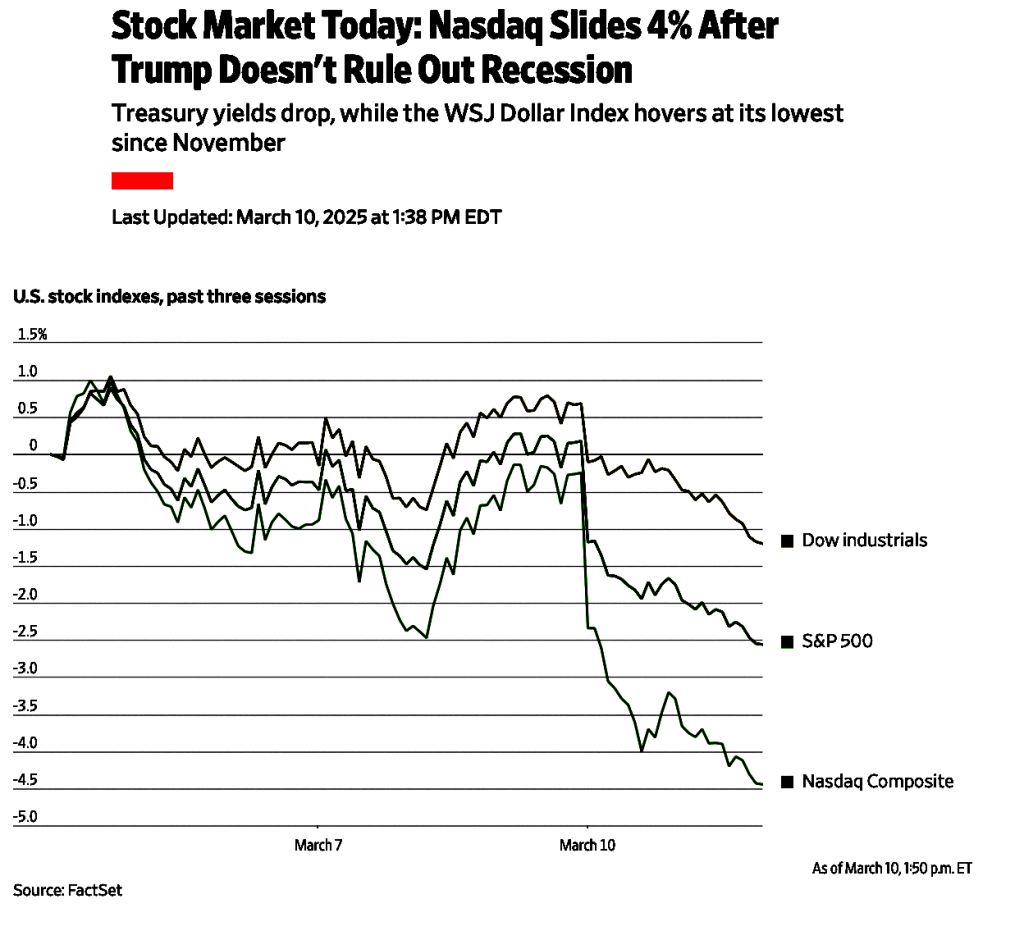
Right now, Mr. Trump owns the chaos in the government. He owns the chaos in the stock market. He owns the damage happening to our economy. The stock market is falling, and consumer confidence is plummeting.
In a shutdown, we would be busy fighting with Republicans over which agencies to reopen and which to keep closed instead of debating the damage Mr. Trump’s agenda is causing.
I believe it is my job to make the best choice for the country, to minimize the harms to the American people. Therefore, I will vote to keep the government open.

Robin Hood, he ain’t.
Wall Street Journal, Consumer Angst Is Striking All Income Levels: Signs of weakness are showing up in spending on everything from basics to luxuries
The Journal identifies the “key points” as follows, after which it expatiates.
Ramesh Ponnuru (Washington Post), Where’s the economic sense behind Trump’s tariffs? Not even Treasure Secretary Scott Bessent can convincingly defend the president’s trade policy.
Ramesh Ponnuru is a senior fellow at the American Enterprise Institute and editor of the National Review. He writes,
If you think tariffs are painful, try watching President Donald Trump’s aides and supporters attempt to defend them. Whenever they come up with a rationale for his policies, however dubious, he immediately says or does something to contradict it. They say Trump’s trade strategy is all about containing China — then he slaps tariffs on the allies we would need to do so. They explain that the law lets him impose tariffs on Canada to protect our national security, only for him to let slip that he’s mad about Canadian dairy policies.
The truth is that Trump just likes tariffs and people who tell him they make sense. His trade adviser, Peter Navarro, thinks imports harm the economy because he doesn’t understandhow gross domestic product data is calculated. The administration has no grand trade strategy.
But the demand for sophistry in defense of Trump’s tariffs is apparently inexhaustible. Scott Bessent, the treasury secretary, tried out another argument at the Economic Club of New York last week.
The president, Bessent said with a straight face, “sees the world not as a zero-sum game but as interlinkages that can be reordered” to help Americans. (If this were a college paper, the professor would scrawl “citation needed.”)
Bessent argued that the tariffs are designed “to rebalance the international economic system” and “[level] the playing field.” He’s not just making the standard complaint that other countries place tariffs on U.S.-made products. Although true, that fact does not go very far toward justifying Trump’s policies. In fact, many countries place lower tariffs on our exports than we do on theirs — yet Trump wants to hike tariffs on them anyway.
The treasury secretary has a broader view of the imbalances that need to be fixed. “The United States,” he says, “provides reserve assets, serves as a consumer of first and last resort, and absorbs excess supply in the face of insufficient demand in other countries’ domestic models.” Most economists think the United States runs a trade deficit because investment outstrips savings. Bessent looks at it differently: Other countries force trade deficits on America by undervaluing their currencies and investing their excess savings with us.
Bessent sketched his case briefly in New York, but others have developed it in greater detail. Manufacturing employment has shriveled because of all this currency manipulation, these theorists say, but tariffs can undo these distortions by encouraging increased production at home.
Bessent alluded to this idea in the most quoted remark from the speech: that “access to cheap goods is not the essence of the American Dream.” He believes that the global economic order has pushed us to consume too much and produce too little. Perhaps a man with assets above $500 million should have found a better way to phrase this opinion.
But set aside the bad PR. The argument itself is a chain with several links — and not one is solid.
Trade balances don’t indicate which economies are succeeding and which are failing. The United States ran a trade deficit for most of the 19th century while rising as an industrial power. Nor is it true that trade surpluses can keep a country from losing manufacturing jobs. Every developed country — including Germany, which has a trade surplus — has seen the same downward trend.
Tariffs are not a reliable means of increasing domestic production, either. That’s partly because they tend to cause the currency to appreciate. Bessent himself has told us so: During his confirmation hearings, he tried to allay fears that tariffs would raise prices by saying that a rising dollar would soften the blow. But a stronger dollar also reduces demand for U.S. exports — which is the very reason Bessent complains about currency manipulation.
Tariffs also tend to raise the price of goods that U.S. manufacturers use, which makes it harder for them to make and sell their own products. Study after study has found that the tariffs Trump imposed during his first term caused manufacturing employment and output to shrink. Moreover, those tariffs didn’t even reduce the trade deficit.
What Bessent’s case for tariffs has in common with all the other rationalizations is that the president has given no indication he believes it. If Trump believed it, he would want a weaker dollar and an end to its status as a global reserve currency. He doesn’t; he has talked about punishing countries that try to displace the dollar.
The purpose of these theories is not to cohere. It’s to sound just plausible enough to distract from the unsettling truth: The president has an obsession with tariffs, and it is impervious to facts and logic.

Jeff Bezos’s Washington Post, Turmoil within DOGE spills into public view as Musk’s group confronts a PR crisis
The Post’s headline writer has ill served Bezos, and I assume that said headline writer will soon be canned. A much more accurate heading would be the article’s subheading, to wit, “Elon Musk’s DOGE is hunting for “wins” as it races to finish slashing the federal bureaucracy and move on to the more constructive work of building digital tools for the government.”
The gravamen of this is that Elon’s team is about to do great things by replacing outdated government software and replacing human beings with AI chatbots.
Oh frabjous day!
Luce writes,
When Elon Musk said he loved Donald Trump “as much as a straight man can love another”, the emetic effect was widespread. Trump is one of the few people left in Washington DC who likes having Musk around. Yet having given Musk more power than any private figure in US history, the president is watching his benefactor turn into an albatross. The question is how Trump will get rid of Musk, not whether.
The price of having him as co-helmsman is already steep. The New York Times chronicled how Trump clipped Musk’s wings in a heated cabinet meeting last week. Cabinet heads, rather than Musk’s so-called Department of Government Efficiency, would take care of their own hiring and firing, Trump said. His White House had until then been notably leak free — in contrast to his first term. But it appears senior staff are keen to see the back of the chainsaw-wielding oligarch. The showdown had been set up with the aim of hastening that day.
A measure of Musk’s worry about his waning star is that his visit to Mar-a-Lago last weekend was not originally scheduled, say insiders. Moreover, Musk has tried to funnel millions more into Trump’s political action committees and been turned down. Trump is not known to refuse money. But it would look like Musk was buying his prolonged stay. His standing is dropping as fast as Tesla’s stock price. Trump’s approval rating has remained steady. With signs of a coming “Trump recession”, Musk may still be a useful lightning rod.
But that is the extent of his upside. His sway is mostly negative. There is not a Republican legislator or Trump principal who is not terrified of Musk’s power. A $50mn cheque to fund a primary challenge could end a senator’s career — $10mn for a legislator. Musk’s X, which is Maga’s informal state broadcast arm, could also destroy a cabinet member’s career. Officials now routinely issue press releases first on X. The secretary of state, Marco Rubio, first announced plans to pare back USAID on X.
There appears to be nothing Musk will not say to defame those in his way. This has been apparent since he accused a beleaguered caver of being a paedophile a few years ago. Musk is only acting more like himself. But his willingness to character assassinate is interfering with Rubio’s job. Musk recently threatened to trigger a collapse in Ukraine’s frontline by pulling his Starlink satellite service. After Poland’s foreign minister, Radosław Sikorski, objected, Musk posted: “Be quiet, small man . . . There is no substitute for Starlink.” Poland is one of the few European countries Trump has said he would aid in the event of an attack. An impotent Rubio felt obliged to back up Musk.
But the cost of keeping him by Trump’s side is growing. In ignorance of how the federal government works, Musk is only causing damage. This also undercuts Russell Vought, head of the White House Office of Management and Budget, who has spent years drawing up plans to deconstruct the administrative state. He was co-author of Project 2025, the Heritage Foundation’s radical blueprint for a second Trump term. The traumatising of America’s civil service will outlast Musk. But Vought is likely to do it less incompetently. Nor does he share Musk’s seeming reluctance to go after the Pentagon, which is a major source of Musk’s federal contracts.
It is tempting to think Musk has a political death wish. The recent drop in the wannabe trillionaire’s net worth has also almost wiped out his post-election gains. But that would be naive. Doge’s access to taxpayer accounts, social security records and federal employee data would offer a gold mine for any AI titan. Musk’s temptation to hoover it up for his own ends will be great. But that means retaining Trump’s trust. If Musk has any self-knowledge, he will wear suits from now on and keep his offspring out of the Oval Office. After he took his four-year-old son, X, to the White House last month, insiders say Trump asked for the HMS Resolute desk to be disinfected. The boy felt just as at home as his father.
There is also Musk’s impact on Trump’s China policy. As clients in the US, Europe and elsewhere spurn Tesla and search for alternatives to SpaceX, Musk’s commercial reliance on China is growing. Musk’s dovish influence on China policy is plain. Trump now sounds almost as uninterested in Taiwan’s fate as he is in Ukraine’s. Most of the rest of his team are China hawks. If and when Trump turns against China, that will be another sign of Musk’s descent.
As of around 11:00 AM World Time this morning:

The Business Roundtable has about 200 members—all chief executive officers of the largest corporations in America. Trump will be meeting with them later today.
Some politicians want to distribute income upward—in other words, screwing the poor to make the rich richer.
Some politicians want to be Robin Hood—robbing the rich to help the poor.
Trump wants to screw the poor, screw the middle, and screw the rich, all at the same time.
 Facing MAGA