Distracted and heart sick as we are by the shit show that is the second Trump presidency, we must remember that we lost the election because of immigration and the border, and, more importantly because of the misery of the working class. Misery to which affluent center-left people like me were blind. Misery that was ruthlessly exploited by the MAGA noise machine.
What we uncovered shocked us. The bottom line is that, for 20 years or more, including the months prior to the election, voter perception was more reflective of reality than the incumbent statistics. Our research revealed that the data collected by the various agencies is largely accurate. Moreover, the people staffing those agencies are talented and well-intentioned. But the filters used to compute the headline statistics are flawed. As a result, they paint a much rosier picture of reality than bears out on the ground.
Take, as a particularly egregious example, what is perhaps the most widely reported economic indicator: unemployment. Known to experts as the U-3, the number misleads in several ways. First, it counts as employed the millions of people who are unwillingly under-employed — that is, people who, for example, work only a few hours each week while searching for a full-time job. Second, it does not take into account many Americans who have been so discouraged that they are no longer trying to get a job. Finally, the prevailing statistic does not account for the meagerness of any individual’s income. Thus you could be homeless on the streets, making an intermittent income and functionally incapable of keeping your family fed, and the government would still count you as “employed.”
I don’t believe those who went into this past election taking pride in the unemployment numbers understood that the near-record low unemployment figures — the figure was a mere 4.2 percent in November — counted homeless people doing occasional work as “employed.” But the implications are powerful. If you filter the statistic to include as unemployed people who can’t find anything but part-time work or who make a poverty wage (roughly $25,000), the percentage is actually 23.7 percent. In other words, nearly one of every four workers is functionally unemployed in America today — hardly something to celebrate.
Ludwig goes on to analyze the flaws in other indicia, including earnings averages, inflation measures. “The resources required simply to maintain the same working class lifestyle over the last two decades,” he writes, “have risen much more dramatically than we’ve been led to believe.” Moreover,
the aggregate measure of GDP has hidden the reality that a more modest societal split has grown into an economic chasm. Since 2013, Americans with bachelor’s or more advanced degrees have, in the aggregate, seen their material well-being improve — by the Federal Reserve’s estimate, an additional tenth of adults have risen to comfort. Those without high school degrees, by contrast, have seen no real improvement. And geographic disparities have widened along similar lines, with places ranging from San Francisco to Boston seeing big jumps in income and prosperity, but places ranging from Youngstown, Ohio, to Port Arthur, Texas, falling further behind. The crucial point, even before digging into the nuances, is clear: America’s GDP has grown, and yet we remain largely blind to these disparities.
Take all of these statistical discrepancies together. What we have here is a collection of economic indicators that all point in the same misleading direction. They all shroud the reality faced by middle- and lower-income households. The problem isn’t that some Americans didn’t come out ahead after four years of Bidenomics. Some did. It’s that, for the most part, those living in more modest circumstances have endured at least 20 years of setbacks, and the last four years did not turn things around enough for the lower 60 percent of American income earners. …
In an age where faith in institutions of all sorts is in free fall, Americans are perpetually told, per a classic quote from former Sen. Daniel Patrick Moynihan, that while we may be entitled to our own opinions, we aren’t entitled to our own facts. That should be right, at least in the realm of economics. But the reality is that, if the prevailing indicators remain misleading, the facts don’t apply. We have it in our grasp to cut through the mirage that led Democrats astray in 2024. The question now is whether we will correct course.
A Statement by the President of the ABA: Every Lawyer’s Duty
It has been three weeks since Inauguration Day. Most Americans recognize that newly elected leaders bring change. That is expected. But most Americans also expect that changes will take place in accordance with the rule of law and in an orderly manner that respects the lives of affected individuals and the work they have been asked to perform.
Instead, we see wide-scale affronts to the rule of law itself, such as attacks on constitutionally protected birthright citizenship, the dismantling of USAID and the attempts to criminalize those who support lawful programs to eliminate bias and enhance diversity.
We have seen attempts at wholesale dismantling of departments and entities created by Congress without seeking the required congressional approval to change the law. There are efforts to dismiss employees with little regard for the law and protections they merit, and social media announcements that disparage and appear to be motivated by a desire to inflame without any stated factual basis. This is chaotic. It may appeal to a few. But it is wrong. And most Americans recognize it is wrong. It is also contrary to the rule of law.
The American Bar Association supports the rule of law. That means holding governments, including our own, accountable under law. We stand for a legal process that is orderly and fair. We have consistently urged the administrations of both parties to adhere to the rule of law. We stand in that familiar place again today. And we do not stand alone. Our courts stand for the rule of law as well.
Just last week, in rejecting citizenship challenges, the U.S. District Judge John Coughenour said that the rule of law is, according to this administration, something to navigate around or simply ignore. “Nevertheless,” he said, “in this courtroom and under my watch, the rule of law is a bright beacon which I intend to follow.” He is correct. The rule of law is a bright beacon for our country.
In the last 21 days, more than a dozen lawsuits have been filed alleging that the administration’s actions violate the rule of law and are contrary to the Constitution or laws of the United States. The list grows longer every day.
These actions have forced affected parties to seek relief in the courts, which stand as a bulwark against these violations. We support our courts who are treating these cases with the urgency they require. Americans know there is a right way and a wrong way to proceed. What is being done is not the right way to pursue the change that is sought in our system of government.
These actions do not make America stronger. They make us weaker. Many Americans are rightly concerned about how leaders who are elected, confirmed or appointed are proceeding to make changes. The goals of eliminating departments and entire functions do not justify the means when the means are not in accordance with the law. Americans expect better. Even among those who want change, no one wants their neighbor or their family to be treated this way. Yet that is exactly what is happening.
These actions have real-world consequences. Recently hired employees fear they will lose their jobs because of some matter they were assigned to in the Justice Department or some training they attended in their agency. USAID employees assigned to build programs that benefit foreign countries are being doxed, harassed with name-calling and receiving conflicting information about their employment status. These stories should concern all Americans because they are our family members, neighbors and friends. No American can be proud of a government that carries out change in this way. Neither can these actions be rationalized by discussion of past grievances or appeals to efficiency. Everything can be more efficient, but adherence to the rule of law is paramount. We must be cognizant of the harm being done by these methods. No American can be proud of a government that carries out change in this way. Neither can these actions be rationalized by discussion of past grievances or appeals to efficiency. Everything can be more efficient, but adherence to the rule of law is paramount. We must be cognizant of the harm being done by these methods.
These stories should concern all Americans because they are our family members, neighbors and friends. No American can be proud of a government that carries out change in this way.
Moreover, refusing to spend money appropriated by Congress under the euphemism of a pause is a violation of the rule of law and suggests that the executive branch can overrule the other two co-equal branches of government. This is contrary to the constitutional framework and not the way our democracy works. The money appropriated by Congress must be spent in accordance with what Congress has said. It cannot be changed or paused because a newly elected administration desires it. Our elected representatives know this. The lawyers of this country know this. It must stop.
There is much that Americans disagree on, but all of us expect our government to follow the rule of law, protect due process and treat individuals in a way that we would treat others in our homes and workplaces. The ABA does not oppose any administration. Instead, we remain steadfast in our support for the rule of law.
We call upon our elected representatives to stand with us and to insist upon adherence to the rule of law and the legal processes and procedures that ensure orderly change. The administration cannot choose which law it will follow or ignore. These are not partisan or political issues. These are rule of law and process issues. We cannot afford to remain silent. We must stand up for the values we hold dear. The ABA will do its part and act to protect the rule of law.
We urge every attorney to join us and insist that our government, a government of the people, follow the law. It is part of the oath we took when we became lawyers. Whatever your political party or your views, change must be made in the right way. Americans expect no less.
Right now, the federal district courts are doing a good job standing up to Trump’s myriad of unconstitutional and otherwise illegal acts. And the lawyers who have the misfortune to try to defend Trump in court can’t quite decide whether to obey the injunctions, to pretend to obey the injunctions and lie to the court, or just to say, “Your Honor, fuck you and the horse you rode in on.”
Soon, the circuit courts of appeal will weigh in, and then the Supreme Court.
The New York Times spoke to a bunch of experts on constitutional law, and produced the following article summarizing the situation as of today, Monday, Feb. 10. (And please remember that among the jobs of an expert on constitutional law is to follow closely the thinking of individual justices.)
The Times reporter writes,
There is no universally accepted definition of a constitutional crisis, but legal scholars agree about some of its characteristics. It is generally the product of presidential defiance of laws and judicial rulings. It is not binary: It is a slope, not a switch. It can be cumulative, and once one starts, it can get much worse.
It can also be obvious, said Erwin Chemerinsky, dean of the law school at the University of California, Berkeley.
“We are in the midst of a constitutional crisis right now,” he said on Friday. “There have been so many unconstitutional and illegal actions in the first 18 days of the Trump presidency. We never have seen anything like this.”
His ticked off examples of what he called President Trump’s lawless conduct: revoking birthright citizenship, freezing federal spending, shutting down an agency, removing leaders of other agencies, firing government employees subject to civil service protections and threatening to deport people based on their political views.
That is a partial list, Professor Chemerinsky said, and it grows by the day. “Systematic unconstitutional and illegal acts create a constitutional crisis,” he said.
The distinctive feature of the current situation, several legal scholars said, is its chaotic flood of activity that collectively amounts to a radically new conception of presidential power. But the volume and speed of those actions may overwhelm and thus thwart sober and measured judicial consideration.
It will take some time, though perhaps only weeks, for a challenge to one of Mr. Trump’s actions to reach the Supreme Court. So far he has not openly flouted lower court rulings temporarily halting some of his initiatives, and it remains to be seen whether he would defy a ruling against him by the justices.
“It’s an open question whether the administration will be as contemptuous of courts as it has been of Congress and the Constitution,” said Kate Shaw, a law professor at the University of Pennsylvania. “At least so far, it hasn’t been.”
Vice President JD Vance struck a confrontational tone on social media on Sunday when he wrote, “Judges aren’t allowed to control the executive’s legitimate power.”Haiyun Jiang for The New York Times
Professor Shaw said a clash with the courts would only add to a crisis that is already underway. “A number of the new administration’s executive orders and other executive actions are in clear violation of laws enacted by Congress,” she said.
“The administration’s early moves,” she added, “also seem designed to demonstrate maximum contempt for core constitutional values — the separation of powers, the freedom of speech, equal justice under law.”
Pamela Karlan, a law professor at Stanford, added that a crisis need not arise from clashes between the branches of the federal government.
“It’s a constitutional crisis when the president of the United States doesn’t care what the Constitution says regardless whether Congress or the courts resist a particular unconstitutional action,” she said. “Up until now, while presidents might engage in particular acts that were unconstitutional, I never had the sense that there was a president for whom the Constitution was essentially meaningless.”
The courts, in any event, may not be inclined or equipped to push back. So much is happening, and so fast, that even eventual final rulings from the Supreme Court rejecting Mr. Trump’s arguments could come too late. After the U.S. Agency for International Development or the Consumer Financial Protection Bureau are disassembled, say, no court decision can recreate them.
In many cases, of course, the Supreme Court’s six-member conservative majority may be receptive to Mr. Trump’s arguments. Its decision in Julygranting him substantial immunityfrom prosecution embraced an expansive vision of the presidency that can only have emboldened him.
Members of that majority are, for instance, likely to embracethe president’s position that he is free to fire leaders of independent agencies.
The court may nonetheless issue an early, splashy ruling against Mr. Trump to send a signal about its power and independence. Striking down Mr. Trump’s order directing officials to deny citizenship to the children of immigrants would seem to be a good candidate, as it is at odds with the conventional understanding of the Constitution and the court’s precedents.
Such a decision would have an added benefit: It would be hard to disobey. From its earliest days, the Supreme Court has been wary of issuing rulings that might be ignored.
“I’m reminded of Marbury v. Madison, when the government did not even bother to show up before the Supreme Court to defend its position — strongly suggesting it would flout any court order against it,” said Amanda Frost, a law professor at the University of Virginia.
Even as the court ruled that the administration of Thomas Jefferson had acted unlawfully, she said, “the court carefully crafted its opinion in that case to avoid a ruling requiring executive branch compliance.”
Much has changed since that 1803 decision, and the Supreme Court’s stature and authority has grown. “Nonetheless,” Professor Frost said, “the Supreme Court may find it hard to defend the laws Congress enacted against executive usurpation when the Republican-controlled Congress refuses to do the same.”
Professor Karlan said she worried that the justices would rule for Mr. Trump for fear that he would ignore decisions rejecting his positions. “The idea that courts should preserve the illusion of power by abdicating their responsibilities would just make the constitutional crisis even worse,” she said.
Mr. Trump has already disregarded one Supreme Court decision, its ruling last monthupholding a federal law, passed by lopsided bipartisan majorities, requiring TikTok to be sold or banned. Mr. Trump instead ordered the Justice Departmentnot to enforce the law for 75 days, citing as authority for the move his “unique constitutional responsibility for the national security of the United States.”
President Dwight D. Eisenhower sent the 101st Airborne Division to Little Rock, Ark., in 1957 to enforce Brown v. Board of Education, a Supreme Court decision in 1954 that banned segregation in public schools.Associated Press
Defiance of Supreme Court decisions is not unheard-of. Southern states, for instance, for years refused to follow Brown v. Board of Education, the 1954 decision that banned segregation in public schools, engaging in what came to be known as “massive resistance.”
The Brown decision is now almost universally viewed as a towering achievement. But its enforcement required President Dwight D. Eisenhower to decide to send members of the 101st Airborne Division to Little Rock, Ark., to escort Black students through an angry white mob.
Not all presidents gave the court’s rulings the same respect. In 1832, President Andrew Jackson refused to enforce a Supreme Court decisionarising from a clash between Georgia and the Cherokee Nation. A probably apocryphal but nonetheless potent comment is often attributed to Jackson about Chief Justice John Marshall: “John Marshall has made his decision; now let him enforce it.”
Even before this weekend, Mr. Vance has saidthat Mr. Trump should ignore the Supreme Court. In a 2021 interview, he said Mr. Trump should “fire every single midlevel bureaucrat, every civil servant in the administrative state” and “replace them with our people.”
He added: “When the courts stop you, stand before the country like Andrew Jackson did and say, ‘The chief justice has made his ruling. Now let him enforce it.’”
Chief Justice John G. Roberts Jr. took note of such threats in his year-end reportin December.
“Every administration suffers defeats in the court system — sometimes in cases with major ramifications for executive or legislative power or other consequential topics,” he wrote. “Nevertheless, for the past several decades, the decisions of the courts, popular or not, have been followed, and the nation has avoided the standoffs that plagued the 1950s and 1960s.”
“Within the past few years, however,” the chief justice went on, “elected officials from across the political spectrum have raised the specter of open disregard for federal court rulings. These dangerous suggestions, however sporadic, must be soundly rejected.”
That view has many supporters, though some use caveats. “It would be an extremely grave matter for a president to defy an actual (unstayed, in-effect) order of a federal court in a case that is indisputably in the court’s jurisdiction,” Ed Whelan, a conservative legal commentator, wrote on social media.
But considering discrete clashes may be relying on an outdated paradigm.
“One way to look at the administration’s assault on legal barriers is that it is seeking to establish ‘test cases’ to litigate and win favorable Supreme Court decisions,” Bob Bauer and Jack Goldsmith wrote in their Executive Functionsnewsletter. “But the typical test case is a carefully developed, discrete challenge to statutory or judge-made law with some good faith basis.”
Mr. Goldsmith is a law professor at Harvard and a former Justice Department official in the George W. Bush administration. Mr. Bauer was White House counsel for President Barack Obama. They are students of Article II of the Constitution, which sets out the powers of the president.
Mr. Trump’s executive orders have some features suggesting that they mean to test legal theories in the Supreme Court, they wrote. “But in the aggregate,” they added, “they seem more like pieces of a program, in the form of law defiance, for a mini-constitutional convention to ‘amend’ Article II across a broad front.”
Step One. Will the federal district courts and the federal courts of appeal keep on telling Trump that he must obey the Constitution and the laws?
Step Two. When the first cases reach the Supreme Court, will the Court follow the example set by the lower courts and order the Administration to obey the Constitution and the laws, and will the Supreme Court reaffirm that Marbury v. Madison remains the law of the land? (See the post immediately below for some thoughts on that question.)
Step Three. Thus far, Mango Mussolini and some of the people aboard his clown car have been cutsy-wootsy about whether they will obey the courts. But J.D. Vance—who has some asshole buddies that hate democracy—bleated out this weekend that the Supreme Court has no authority over Trump. Soo … when the courts find some of Trump’s henchmen in contempt of court and order the U.S. Marshalls Service to go arrest them, will Trump countermand the order, or will he back down, or will he pretend to back down and play cutsy-wootsy?
Step Four. If Orange Jesus follows Vance’s advice and defies the courts, what happens then?
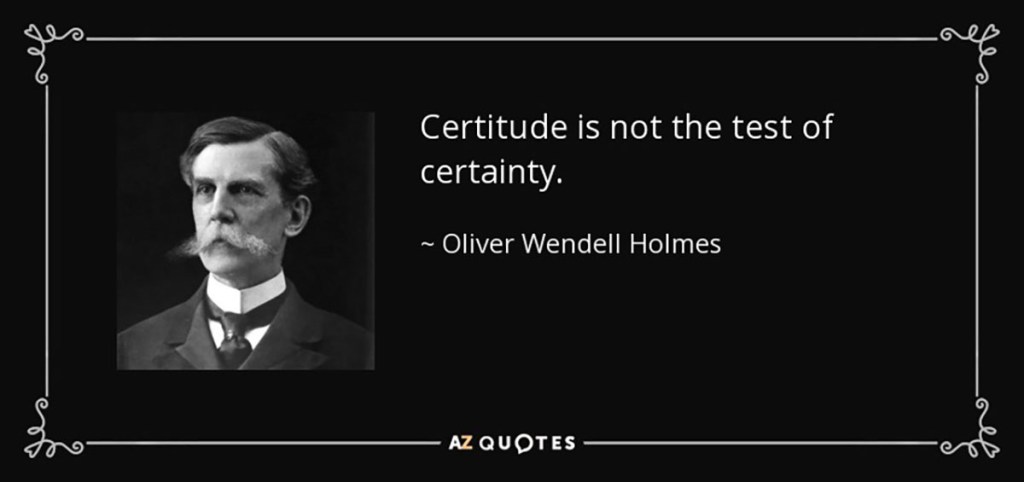
Donald Trump is certain that he knows more than any general about how to fight a war and more than any scientist about climate science. By like token, some of my friends are certain beyond rational argument that the Supreme Court will just bow down to Trump. The professional constitutional lawyers are not so certain, see my post on The Constitutional Crisis, but what do they know?
I have had some challenging conversations in the last few days.
Well, que sera sera. The Supreme Court is going to do whatever the Supreme Court is going to do. Can I predict with certainty what they will be? No, I can’t. And neither, by the way, can the dean at UC Berkeley make a certain prediction.
Certainly, the Supreme Court majority has made some awful decisions, and that’s a strong point in favor of the catastrophists imbued with certain certitude about the impending apocalypse.
On the other hand, if the Supreme Court tells Trump he need not worry about obeying the Constitution, they are telling him it’s OK to ignore the Bill of Rights, imprison anyone he wants to lock up, and declare himself President for Life and Lord of Lords.
Even if you are a very bad person, you might rationally hesitate to give someone that much power. Because—guess what?—you might be next on the list.
There are some other considerations, too. For one, the Federalist Society and its cohorts have been on a 40-year quest to take over the courts and impose their regressive views on society, all in the name of “rule of law.” During the first Trump term, their efforts were crowned with success when they got three additional seats on the Supreme Court. But if, henceforth, a judge’s order isn’t worth the paper it’s written on, then the whole Federalist Society effort—to use its version of “law” to force a right-wing agenda down our throats—goes glug glug down the drain.
And then there’s this. If law no longer matters, then a whole lot of the 1,322,649 lawyers in the United States no longer have a useful skill, and they are going to have to do something else for a living.
And, finally, there is this minor consideration. A whole lot of the crazy stuff that Trump and Elon are doing is not only unconstitutional or otherwise illegal but also economically hurtful—sometimes in disastrous ways—for Trump’s own supporters.
No, ladies and germs, there are a lot of reasons why the Supreme Court may not muster five votes to destroy the constitutional republic.
When the situation ripens to a direct conflict between Court and President, there will be conflicting voices other than Vance’s whispering into Trump’s shell-like ears. Vice President Vance will urge him to head headlong into catastrophe. Possibly, however,Orange Jesus might decide to back off. But more probably, in my view, he’ll tell John Roberts to take a long walk off a short cliff.
What then?
I saw George Conway this morning saying that Trump would order the U.S. Marshals Service not to obey the Court’s order, the Service would comply with Trump’s directive, and that would be that. Our constitutional republic would be over and done with.
I think he’s right about the Marshals Service, but predicting in predicting the imminent end of the republic, Conway might be out over his skis.
Half the country—the folks who voted for Kamala—would take to the streets.
And, remember, this would be in a context where lots of Trump voters would have started to suffer from Trump’s disastrous policies, including his unconstitutional and otherwise illegal actions. Tariffs. Trade wars. Slashing the military. Slashing funds for hospitals in rural communities. And on and on and on.
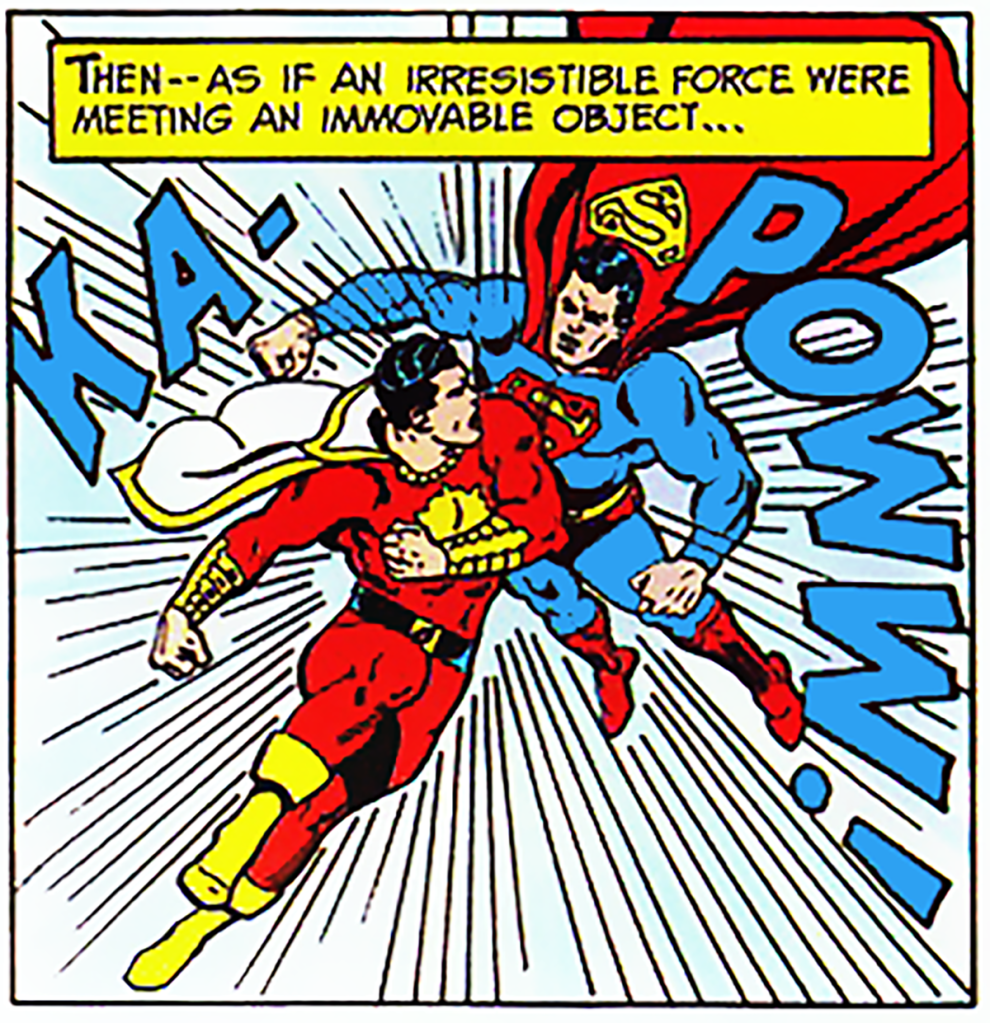
Irresistible force, meet immovable object.
It would appear that Vance and his cohorts are trying to maneuver the situation to a point where Trump has no choice but to (a) back down, bigly, or (b) declare himself Dictator for Life.
Choice (b) would be unpopular with, maybe 65% of the country.
And how will it all turn out? My crystal ball grows cloudy. But I do see blood in the streets.
What Mango Mussolini Thinks He’s Doing—A Clever Way to Transfer Wealth from the Poor to the Rich
The WSJ doesn’t say it, so I will. As far as I can tell, Orange Jesus knows full well that tariffs are going to increase inflation, cost jobs, and hurt his supporters. But he thinks they are a complicated, and therefore clever, way to generate a shit load of revenue and thus finance tax cuts for the billionaires.
As for the foreigners, Trump hates them all, but he particularly hates American allies. As the WSJ points out, Mexico and Canada will be hurt even more than his American supporters will be hurt. For Mango Mussolini, that’s a feature, not a bug.
Some Thoughts from the Wall Street Journal Editorial Board
Now back to the Wall Street Journal Editorial Board, which writes,
“WILL THERE BE SOME PAIN? YES, MAYBE (AND MAYBE NOT!). BUT WE WILL MAKE AMERICA GREAT AGAIN, AND IT WILL ALL BE WORTH THE PRICE THAT MUST BE PAID,” Mr. Trump posted on Truth Social on Sunday morning. He also included a blast at these columns for leading the “Tariff Lobby” after our Saturday editorial called his 25% across-the-board tariffs on our friends and neighbors “the dumbest trade war in history.”
We appreciate Mr. Trump’s attention, though we’re anti-tariff and not lobbyists. But bad policy has damaging consequences, whether or not Mr. Trump chooses to admit it. Mr. Trump can’t repeal the laws of economics any more than Joe Biden could on inflation.
***
Tariffs are taxes, and when you tax something you get less of it. Who pays the tariff depends on the elasticity of supply and demand for the specific goods. But Mr. Trump wants American workers and employers to take one for the team. Hope you don’t lose your job or business before the golden age arrives.
The economic fallout began Saturday evening as Canada said it will retaliate with a 25% tariff on $30 billion (Canadian dollars) of U.S. goods, with another C$125 billion to follow in three weeks. Mexican President Claudia Sheinbaum also promised to retaliate.
Canada’s new border taxes will hit orange juice, whiskey and peanut butter—all from states with GOP Senators. Prime Minister Justin Trudeau said Ottawa’s tariff list would also include beer, wine, vegetables, perfume, clothing, shoes, household appliances, furniture and much more. He said Canada could also withhold critical minerals.
Note that Canada’s Conservative opposition leader, Pierre Poilievre, also called for retaliation. Mr. Poilievre is the favorite to be the next Prime Minister and he rightly said the trade war will damage both countries. But he said Canada had to stand up for its “sovereignty” and protect its economic interests.
Mr. Trump’s tariffs are already roiling North America’s energy markets, which are highly integrated. The President implicitly recognized the risk by hitting Canada’s energy exports to the U.S. with a lower 10% tariff. But that will still hurt Midwestern refiners that rely on Canadian oil. Canada and Mexico could send more of their oil elsewhere for refining, perhaps even China.
Canada’s expanded Trans Mountain pipeline runs from Alberta to the West Coast and has spare capacity. It could be used to increase tariff-free oil shipments to Asia that would hurt California refineries that now import oil from Trans Mountain. California could have to import more oil from the Middle East.
Mr. Trump says the tariffs will revive U.S. manufacturing. But Jay Timmons, CEO of the National Association of Manufacturers, said in a statement that “a 25% tariff on Canada and Mexico threatens to upend the very supply chains that have made U.S. manufacturing more competitive globally.”
He added that, while his members understand the need to reduce fentanyl flows to the U.S., “the ripple effects will be severe, particularly for small and medium-sized manufacturers that lack the flexibility and capital to rapidly find alternative suppliers or absorb skyrocketing energy costs.”
Many more trade groups have criticized the tariffs, including even U.S. aluminum makers who benefited from tariffs in the first term. Canada accounts for more than half of U.S. aluminum imports (owing to its cheap hydropower) that secondary and downstream manufacturers use.
***
None of this means the Trump tariffs will tip the U.S. economy into recession. U.S. growth may be strong enough to absorb the blow from tariffs, as it was after Mr. Trump’s more modest levies in the first term. But the same can’t be said about Mexico and Canada, where growth is weak and which depend on U.S. markets for much of their GDP.
The tariffs may also not cause a surge in the general U.S. price level. Overall inflation depends far more on the Federal Reserve’s monetary policy. But prices will increase for most tariffed goods, which will be painful enough.
The tariff broadside also adds new policy risk and uncertainty that could dampen business animal spirits. Markets have been pricing in an assumption that Mr. Trump would step back from his most florid tariff threats, or limit tariffs to China.
The hammer blow to Mexico and Canada shows that no country or industry is safe. Mr. Trump believes tariffs aren’t merely useful as a diplomatic tool but are economically virtuous by themselves. This will cause friends and foes to recalibrate their dependence on America’s market, with consequences that are hard to predict. How this helps the U.S. isn’t apparent, so, yes, “dumbest trade war” sounds right, if it isn’t an understatement.
Good evening. Today, the United States informed us they will be imposing a 25 per cent tariff on Canadian exports to the United States and 10 per cent on Canadian energy, a decision that, should they elect to proceed with, should take effect on Tuesday, Feb. 4.
Tonight, first I want to speak directly to Americans. Our closest friends and neighbors. This is a choice that, yes, will harm Canadians. But beyond that, it will have real consequences for you, the American people.
As I have consistently said, tariffs against Canada will put your jobs at risk, potentially shutting down American auto assembly plants and other manufacturing facilities.
They will raise costs for you, including food at the grocery stores and gas at the pump.
They will impede your access to an affordable supply of vital goods crucial for U.S. security, such as nickel, potash, uranium, steel and aluminum.
They will violate the free trade agreement that the president and I, along with our Mexican partner, negotiated and signed a few years ago. But it doesn’t have to be this way.
As President John F. Kennedy said many years ago, geography has made us neighbors. History has made us friends, economics has made us partners and necessity has made us allies.
That rang true for many decades prior to President Kennedy’s time in office, and in the decades since, from the beaches of Normandy to the mountains of the Korean Peninsula, from the fields of Flanders to the streets of Kandahar, we have fought and died alongside you during your darkest hours during the Iranian hostage crisis. Those 444 days, we worked around the clock from our embassyto get your innocent compatriots home.
During the summer of 2005, when Hurricane Katrina ravaged your great city of New Orleans, or mere weeks ago when we sent water bombers to tackle the wildfires in California. During the day, the world stood still, Sept. 11, 2001, when we provided refuge to stranded passengers and planes. We were always there, standing with you, grieving with you. The American people.
Together, we’ve built the most successful economic, military and security partnership the world has ever seen. A relationship that has been the envy of the world.
Yes, we’ve had our differences in the past, but we’ve always found a way to get past them. As I’ve said before, if President Trump wants to usher in a new golden age for the United States, the better path is to partner with Canada, not to punish us.
Canada has critical minerals, reliable and affordable energy, stable democratic institutions, shared values and the natural resources you need. Canada has the ingredients necessary to build a booming and secure partnership for the North American economy, and we stand at the ready to work together.
Let’s take a moment to talk about our shared border. Our border is already safe and secure, but there’s always, always more work to do. Less than one per cent of fentanyl, less than one per cent of illegal crossings into the United States come from Canada.
But hearing concerns from both Canadians and Americans, including the American president himself, we’re taking action. We launched a $1.3 billion border plan that is already showing results, because we, too, are devastated by the scourge that is fentanyl, a drug that has torn apart communities and caused so much pain and torment for countless families across Canada, just like in the United States.
A drug that we too want to see wiped from the face of this earth. A drug whose traffickers must be punished as neighbors, we must work collaboratively to fix this.
Unfortunately, the actions taken today by the White House split us apart instead of bringing us together.
Tonight, I am announcing Canada will be responding to the U.S. trade action with 25 per cent tariffs against a $155 billion worth of American goods. This will include immediate tariffs on $30 billion worth of goods as of Tuesday, followed by further tariffs on $125 billion worth of American products in 21 days time to allow Canadian companies and supply chains to seek to find alternatives.
ike the American tariffs, our response will also be far reaching and include everyday items such as American beer, wine and bourbon, fruits and fruit juices, including orange juice, along with vegetables, perfume, clothing and shoes.
It’ll include major consumer products like household appliances, furniture and sports equipment, and materials like lumber and plastics, along with much, much more.
And as part of our response, we are considering with the provinces and territories, several non-tariff measures, including some relating to critical minerals, energy procurement and other partnerships.
We will stand strong for Canada. We will stand strong to ensure our countries continue to be the best neighbors in the world.
With all that said, I also want to speak directly to Canadians in this moment.
I’m sure many of you are anxious, but I want you to know we are all in this together. The Canadian government, Canadian businesses, Canadian organized labor, Canadian civil society, Canada’s premiers, and tens of millions of Canadians from coast to coast to coast are aligned and united.
This is Team Canada at its best.
Geopolitically, Prime Minister, the 12th on the unique is 30 day is a rush only to see a linear storm.
And now is also the time to choose Canada.
It might mean doing all of these things or finding your own way to stand up for Canada. In this moment, we must pull together because we love this country. We pride ourselves on braving the cold during the long winter months. We don’t like to beat our chests, but we’re always out there waving the maple leaf loudly and proudly to celebrate an Olympic gold medal.
Canada is home to bountiful resources, breathtaking beauty, and a proud people who’ve come from every corner of the globe to forge a nation with a unique identity worth embracing and celebrating. We don’t pretend to be perfect, but Canada is the best country on earth.
There’s nowhere else that I, in our 41 million strong family, would rather be.
And we will get through this challenge just as we’ve done countless times before together.




 Facing MAGA