Trump is His Own Worst Enemy. And Thank God for That.

This morning, New York Times columnist Jamelle Bouie has four important points to make. I’ll summarize them and then let Mr. Bouie speak for himself.

1. In an alternative universe, in his second term, a politically skilled and disciplined Trump could probably have engineered a dictatorship in the United States.

2. But in this universe, Trump is “so solipsistic, so plainly consumed with narcissism, so deeply indifferent to the details of governance and so eager to satisfy his basest impulses that there was little chance he’d ever complete the authoritarian consolidation of his dreams.”

3. The second Trump term, we have “a presidency in terminal decline, if not outright collapse.”

4. If you don’t understand that “presidential commands are never self-executing,” then you don’t understand what the hell is going on.

Jamelle Bouie (N.Y. Times), Trump Is the Anti-Trump:

There is an alternate universe in which Donald Trump is the popular, successful president of his imagination.

In this world, Trump has a clear view of the political landscape. He knows he won a narrow victory, not a landslide. He knows that his key voters — the ones who put him over the top, as opposed to his core voters — elected him to lower the cost of living and turn the page back to where it was before the pandemic. And while he has the advantage of an unpopular predecessor — an easy repository for blame should things go wrong — he also starts the clock with a small and finite amount of political capital. The modern American public is wary, fickle and quick to anger. The right move is to invest that capital carefully, not gamble with the people’s trust.

This hypothetical President Trump would take the path of least political resistance. He would work with the Republican majority in Congress to send a new round of stimulus checks, rehashing the most important political success of his first term and fulfilling his promise to lower costs for most Americans. He would work with Congress to pass modest tariffs on critical goods and he would take a less draconian path on deportations, focusing, as he promised, on people in jails and prisons — “the worst of the worst.” And he would put hard political limits on his most fanatical aides and deputies, like Russell Vought and Stephen Miller. This Trump wouldn’t give Elon Musk his run of the executive branch and he would sideline his own desire for retribution against his political opponents, or at least channel his rage into something more productive. He would also decline to hand management of the federal government to an ignominious cadre of hacks, apparatchiks and television personalities.

In short, this Trump would rerun the approach of his first term. He would still be corrupt. He would still stretch the limits of common decency. He would still be bombastic, transgressive and contemptuous of political norms. But he would be restrained, somewhat, by the practical realities of governance. And this restraint would give our hypothetical Trump the leeway to pursue his more authoritarian goals; to curtail civil society and consolidate power over the entire federal government, courts and Congress included.

From the perspective of liberal society and constitutional government, this alternative world, in which a more cautious and methodical Trump successfully builds public and political support for the transformation of the United States into a full-throated authoritarian regime, would have been the worst-case scenario for a second Trump term.

We are lucky, then, that this alternate reality is unimaginable. There is no apparent evidence that Trump is capable of even the slightest bit of deferred gratification. If life is a series of marshmallow tests, then he has failed one after the other, kept afloat only by his immense wealth and privilege. The actual Trump is so solipsistic, so plainly consumed with narcissism, so deeply indifferent to the details of governance and so eager to satisfy his basest impulses that there was little chance he’d ever complete the authoritarian consolidation of his dreams.

All of this is simply to contrast what might have been with what plainly is: a presidency in terminal decline, if not outright collapse. Consider the big picture. Trump is nearly as unpopular now as he has ever been. His average approval ranges from a net negative of about 13 points to a net negative rating of nearly 20 points. He is underwater on every issue of consequence. The Supreme Court nullified his signature economic program and his immigration enforcement actions are so toxic with voters that they’ve forced him to fire his head of Homeland Security, Kristi Noem. He has wrecked the coalition that brought him into office with major reversals among Latinos, young men and Black Americans, and he is treading water with his core supporters, white voters without college degrees.

Trump insists, of course, that he is as popular as ever, but even Republican lawmakers see the writing on the wall. There has been a historic number of retirements from Congress, led mostly by Republicans.

Last, but far from least, is the president’s foolhardy, reckless and immoral war in Iran, which was launched with neither public buy-in nor Congressional authorization. It didn’t take long after the bombing began before it destroyed an elementary school, killing more than 175 people, most of them children. Just two weeks in, the conflict has already grown beyond its initially limited scope, involving other belligerents and threatening the global economy. It is no surprise, then, that this is also the most unpopular war in modern American history, with few supporters beyond the president’s fellow partisans.

It is tempting to think that the president’s political collapse doesn’t really matter — that, as the Teflon Don, he suffers no particular consequences for his bad behavior. And it is true that the shamelessness, celebrity and cult of personality that defines Trump (and Trumpism) also works to buoy him in the face of political catastrophe. He might sink below water, but he’ll never go under. To end the story there, however, is to miss the larger relationship between presidential standing and presidential power.“Presidential commands are never self-executing,” the political scientist Jeffrey Tulis observes in his book “The Rhetorical Presidency,” paraphrasing another political scientist, Richard Neustadt. “Their efficacy depends upon artful wielding of informal power through bargaining — by showing other politicians that they will be helped, or at least not hurt, by doing what the president wants.”

The second Trump administration is defined by its total embrace of the “imperial presidency” and the “unitary executive.” But a key weakness of both concepts is that they treat presidential power as rigid, well-defined and highly formal — the “core duties” of Chief Justice John Roberts’s opinion in Trump v. United States.

The reality is more complicated. It may seem as if presidents have the power to command, to issue orders and see immediate results. But as Tulis reminds us, successful presidents do not order as much as they coax, cajole and persuade, for the straightforward reason that the formal authority of the presidency is limited compared with other actors in government. A skeptical lawmaker or recalcitrant bureaucrat can derail a presidential agenda and leave the chief executive at the mercy of an angry public. It’s for this reason that the most able men to hold the office of chief executive have rarely seen fit to act as tyrants, raining demands down onto the rest of the executive branch. They act instead as conveners, working to align different interests in pursuit of a single goal.

Presidential standing, in this paradigm, is the currency that makes presidential power work. A popular and well-liked president has more resources to deploy in pursuit of his agenda. He has the informal power he needs to bolster his more circumscribed formal authority. A distrusted, divisive and unpopular president, on the other hand, quickly finds that he is unable to work his will on political actors who are more worried about their own fates than the president’s interests and appetites.

And that is what we’ve seen with this president, a year after he gambled his political capital away in a disastrous attempt to reshape the nature of the American political system. His fast-eroding position has curtailed Trump’s ability to pressure lawmakers into backing his agenda: See the president’s empty demands for Congress to pass the SAVE America Act or the ongoing shutdown of the Department of Homeland Security. This rapid decline has also lowered the cost of institutional resistance to the administration’s attempts to curtail civil society and done the same for judicial opposition to the president’s most aggressive power grabs. I do not think it is an accident that the two most consequential rulings against Trump issued by this Supreme Court were decided as the president’s standing entered a tailspin.

You will notice that after months of teasing the possibility, Trump has mostly stopped talking about serving an unconstitutional third term. Perhaps he still intends to. Or perhaps he has enough self-awareness to know that he is not the triumphant leader of his imagination. That he is, instead, a lame duck whose White House is in disarray and whose actions have plunged the world into chaos. He thought he might remake the country in his own image. Instead, he’s likely to leave it like one of his casinos: broke, broken and in desperate need of new management.

If impeachment weren’t a dead letter, then we could remove him and end his misrule. As it is, we have nearly three more years to live through. It’s an open question whether we survive it intact.
Authoritarianism, Patriarchy, and Misogyny in the White Evangelical Church

Those who enjoy reveling in their own moral superiority and the intellectual inferiority of the yokels will find much to enjoy in these two videos. If you must, brew up a nice cup of hot chocolate, or grab a frosty beer, or, better yet, pour a big glass on Jack Daniels, settle in by the fireplace, and have a fine old wallow.

That, however, was not why I wrote this post. I wrote this post to advance our understanding of what’s going on in these people’s heads. That understanding is an essential foundation if we want talk with our evangelical brethren and sistern—and if we want, in general, to begin to address the current regrettable state of our nation. Because it’s really hard to fix something that you don’t understand. 

I will have some takes of my own on these matters. They will appear in a later post. 

Authoritarianism and the White Evangelical Church

Pat Kahnke—not previously within my radar screen—retired as pastor of an evangelical church in St. Paul, Minnesota, in 2016. He has spent the remaining years explaining in books and podcases why people who love Jesus should not love Donald Trump.

Patriarchy, Misogyny, a Dab of Racism, and the White Evangelical Church

Russell Moore was the president of the Ethics & Religious Liberty Commission of the Southern Baptist Convention. Concerned over his ethics and his support for religious liberty, Moore’s  compatriots in the SBC forced him to resign from the Commission and to exit the church in June, 2021. 

As you probably know, David French is a lawyer, a New York Times columnist, and an actual Christian. 

On Fascism: Some Comments on MacWilliams and Goldberg

This follows up on the immediately preceding post. Some comments below.

1. What one key thing explains the rise of Trump? It’s a great question. I’ve been asking it for a decade, and so, very probably, have you. 

In my opinion, this onion has a whole lot of layers, but if you’re looking to identify the essence of the matter, I think MacWilliams—he’s a political scientist at the University of Massachusetts—has as good an insight as any: (a) Always and everywhere, there are a goodly number of people with authoritarian tendencies. (b) Trump found a way to trigger these folks’ natural inclination toward authoritarianism. (c) The triggering process was greatly facilitated by the rise of the internet and of social media. 

2. Some more layers to the onion, you said? Yes, I did say that. Here are some of them:

Point: with the rise of social media, a whole lot of our fellow citizens have detected a permission structure to joyfully embrace their inner asshole. One of these ways, but only one, is saying hello to the Nazi side of their personality.

Point: although I don’t believe either Goldberg or MacWilliams mentions racism by name, I think a large part of Trump’s attractiveness is the fact that he is both a stone cold racist and a wealthy celebrity. It gratifies his unwashed followers that a person of such wealth and celebrity will openly share their racism.

Point: I strongly suspect that, when a definitive history of our era is available, we’ll find it wasn’t just underlying racism, it wasn’t just the malign ability of one man to appear charismatic, and it wasn’t just the rise of social media as such. I think we’re going to find there was a whole lot of conscious, clever, compensated manipulation of social media by intelligent people in the pay of some of our economic overlords. 

3. Always look on the bright side of life. Trump is not Machiavelli. His fundamental problem is that he believes a lot of his own bullshit—not all of it, but a whole lot of it, and a lot of it that is relevant to pursuing his fascist agenda. In consequence, he is forever misunderstanding key facts about the politico-economic environment. He lacks, moreover, the ability to gather, evaluate, and apply important information. He regularly fails to predict how key actors will respond to his lies, his bluster, his threats, and his bullshit. And when people do not respond as he might wish, his severely limited skill set handicaps him in reacting to an unfavorable situation. He cannot, for example, construct a rational argument or distinguish between a plausible lie and an implausible lie. 

4. A lot of people think that things have changed in the past month. Are they right? Yes, I certainly think so. Michelle Goldberg identifies some key factors, and I agree with her. 

Trump dimly perceives (a) that L’Affaire Epstein is a serious challenge to his continued popularity among the one third of the country who are his core supporters, and (b) that his standing with his own people is further threatened by the economic chaos caused by his policies on tariffs and immigration. 

In response, Trump is trying both to appease and to distract the worst of his own supporters with military aggression, domestic and foreign. Because if the worst of the worst desert him, who will he have left?

5. What is the best advice for decent progressives? When your adversary is screwing himself, hold his beer, and let him get on with it. 

We must oppose fascist aggression. And we must be mindful that Trump’s gross incompetence is helping him to dig his own political grave.

On Fascism

Michelle Goldberg (N.Y. Times), The Resistance Libs Were Right:

For the last decade there’s been a debate, among people who don’t like Donald Trump, about whether he’s a fascist.

The argument that he isn’t often hinges on two things. First, when Trump first came to power, he lacked a street-fighting force like Benito Mussolini’s Blackshirts, even if he was able to muster a violent rabble on Jan. 6. “Trump didn’t proceed to unleash an army of paramilitary supporters in an American Kristallnacht or take dramatic action to remake the American state in his image,” wrote the leftists Daniel Bessner and Ben Burgis in “Did It Happen Here?,” a 2024 anthology examining the fascism question.

Second, Trump didn’t pursue campaigns of imperial expansion, which some scholars view as intrinsic to fascism. “For all of Trump’s hostility towards countries he perceives as enemies of the U.S., notably Iran, there is no indication that he sought a war with any foreign power, still less that he has been consumed by a desire for foreign conquest and the creation of an American empire,” wrote Richard J. Evans in his 2021 essay “Why Trump Isn’t a Fascist.”

It’s striking how much the arguments that Trump is not a fascist have suffered in just the first few days of this year, in which we’ve plunged to new depths of national madness.

Now that America has plucked the dictator Nicolás Maduro from power in Venezuela and announced that it would help itself to the country’s oil, other nations are adjusting to a reality in which we’re more predator than ally. European countries are contemplating stepping up their military presence in Greenland to protect it from the United States. An Economist headline proclaims, “Canada’s Armed Forces Are Planning for Threats From America.”

In the Midwest, Trump’s paramilitary forces killed a citizen in Minneapolis and now appear to be using her death to threaten other activists, barking at one observer, “You did not learn from what just happened?” Videos from the city show gun-toting men in masks and camouflage descending on people to demand proof of citizenship, pelting crowded streets with tear gas and sometimes attacking those who film them. Meanwhile, a new ICE recruiting ad declares, “We’ll Have Our Home Again,” which just happens to be part of the refrain of a white nationalist anthem.

Both ICE’s occupation of Minneapolis and Trump’s threatened seizure of Greenland are part of the same story: An increasingly unpopular regime is rapidly radicalizing and testing how far it can go down the road toward autocracy. If anyone had predicted back in 2024 precisely what Trump’s return to the White House was going to look like, I suspect they’d have been accused of suffering from Trump Derangement Syndrome. But the shrillest of Resistance libs have always understood Trump better than those who make a show of their dispassion. As the heterodox writer Leighton Woodhouse put it on X, “The hysterical pussy hats were right.”

Of course they were. From the moment he descended his golden escalator, Trump’s message, the emotional core of his movement, has been textbook fascism. In his 2004 book “The Anatomy of Fascism,” the eminent historian Robert O. Paxton described the “mobilizing passions” that form fascism’s foundation. Among them are a “sense of overwhelming crisis” that renders traditional solutions obsolete; a belief that one’s own group has been victimized, justifying almost any action in redress; “dread of the group’s decline under the corrosive effects of individualistic liberalism, class conflict and alien influences”; and the need for a strong male leader with instincts more powerful than mere “abstract and universal reason.”

The premonitions of our current regime in Paxton’s work don’t stop there. Fascism, in his telling, is marked by its contradictory attitude toward modernity: a hatred of atomized urban life combined with a fetish for technology. Fascist movements “exploited the protests of the victims of rapid industrialization and globalization,” he wrote, though in power, they doubled down on industrial concentration. And, of course, fascists “need a demonized enemy against which to mobilize followers.”

If Trump didn’t always act on his most fascistic predilections in his first term, it was because he was restrained by the establishment types around him. Mark Esper, Trump’s former defense secretary, said that Trump repeatedly broached the idea of bombing Mexico. In 2019, Trump canceled a meeting with Prime Minister Mette Frederiksen of Denmark after she refused to entertain the idea of selling him Greenland. His taste for violence against his political enemies has never been secret, and was made clearest on Jan. 6, the event that led a once-doubtful Paxton to conclude that the word “fascist” applied to Trump.

None of this means that America is destined to become a fully fascist country. For now, we are trapped in the space between the liberal democracy most Americans grew up in and the dark, belligerent authoritarian state that our government seeks to impose. The important thing isn’t really the name we give to this political development, but our ability to see what’s happening clearly and make sense of its likely trajectory.

On the last page of “The Anatomy of Fascism,” Paxton offers a warning. “We know from tracing its path that fascism does not require a spectacular ‘march’ on some capital to take root,” he writes. “Seemingly anodyne decisions to tolerate lawless treatment of national ‘enemies’ is enough.”

Are We Drifting into Authoritarianism—Or Maybe Drifting into Chaos?

When I was three years old, I had to learn by experience what are the consequences of sticking the table knife into the electric socket. Apparently, large numbers of our fellow citizens need to learn from experience that it is unwise to pick as your airline pilot someone suffering from severe mental illness, who lacks common sense, and who is quickly becoming senile and demented. Such a pilot is likely to fly the plane into the ground. It’s a shame the passenegers didn’t know that before the picked him. 

The Markers of Authoritarianism

I think the New York Times did a good job laying out twelve markers of authoritarianism. (See the immediately preceding post.) That said, I also think some context is badly needed.

What Trump Doesn’t Know

Trump doesn’t know how to do second-order thinking. He cannot accurately grasp the consequences of his actions, or the consequences of the actions of others.

Trump doesn’t know how to think long term. Witness, for example, his thoughts on the filibuster.

Trump doesn’t know how to use any tools to achieve his goals, apart from bribery and threats, including threats of violence. 

It is a constant surprise to Trump that, while some people will succumb to bribery and some will succumb to threats, others will not. In fact, for many, the threats will, from Trump’s perspective, be entirely counterproductive. 

As a sociopath lacking all empathy, Trump is unable to appeal to others’ empathy, because he does not know that most people are empathetic, at least to some degree. 

Trump doesn’t know how to construct a plausible argument. Thus, on the rare occasions when his positions have some merit, he cannot make a logical argument. 

In fact, Trump is unaware that some arguments are backed by facts and logic, and some are just bullshit. To him, legal disputes are just a matter of which side screams the loudest. Because he is unaware that some legal positions are well founded and others are not, and because he cannot accurately predict the consequences of his actions, and because he is incapable of second order thinking, he has ordered the prosecution of Letitia James and James Comey even though the prosecutions will fail, and he and his legal team will be revealed as the idiots they are. 

By contrast, a rational proto-fascist would have known that ordinary prosecutions of his enemies would fail, and he would do better to encourage violent action against them, outside the formal legal structure. 

But Trump is the President

So, he can do a lot of mischief and cause a lot of chaos. 

Trump’s Popularity is Headed South

From The Economist this morning:

Inflation and Criminal Immigrants

Trump’s slender margin of victory in 2024 was based on inflation and fears of criminal immigrants. 

A rational proto-fascist would have kept his promise to try to lower inflation. A rational wannabe dictator would have realized that policies that tend to promote inflation will in fact increase inflation. Someone capable of second order thinking would have realized that higher inflation would decrease his popularity and make it harder for him to achieve his authoritarian dreams. Someone not blinded by grandiosity would recognize his loss of popularity when he sees it.

A rational nascent Nazi would recognize that if he has made inroads into the Latino community by promising to round up criminal immigrants, then he should round up criminal immigrants, not terrorize the whole Latino population. 

And What About the Supreme Court?

The Supreme Court is slow walking Trump’s emergency application to invade Illinois. On Wednesday of this week, they’ll hear oral argument on Trump’s tariff power grab. Other issues will follow in due course. 

They game of Trump v. Justice is under way, but there are more innings to play. In the last game of the World Series, the Blue Jays were ahead at the end of eighth inning, but the Dodgers won the contest. Let’s let this game play out.  

Yeah, But What if Trump Just Defies the Courts?

Well, as someone once said, aye, there’s the rub.

Let’s say Trump doesn’t want to obey a Supreme Court order and directs [insert name of police unit, National Guard, Army battalion, etc. etc.] to act in contravention of the Court’s decision, will the people making up that official body obey Trump or will they obey the Supreme Court or will law and order just break down?

I put it to you that it’s hardly a foregone conclusion that the … police, National Guard, Army, etc. … will just jerk their knees and do exactly what Trump tells them to do. 

But Because I Can Do Second Order Thinking, I Post the Next Question

If the official organs of state power refuse to obey illegal orders, will Trump just call out the Proud Boys and the other hooligans?

Answer: I don’t know, but he has done it before. 

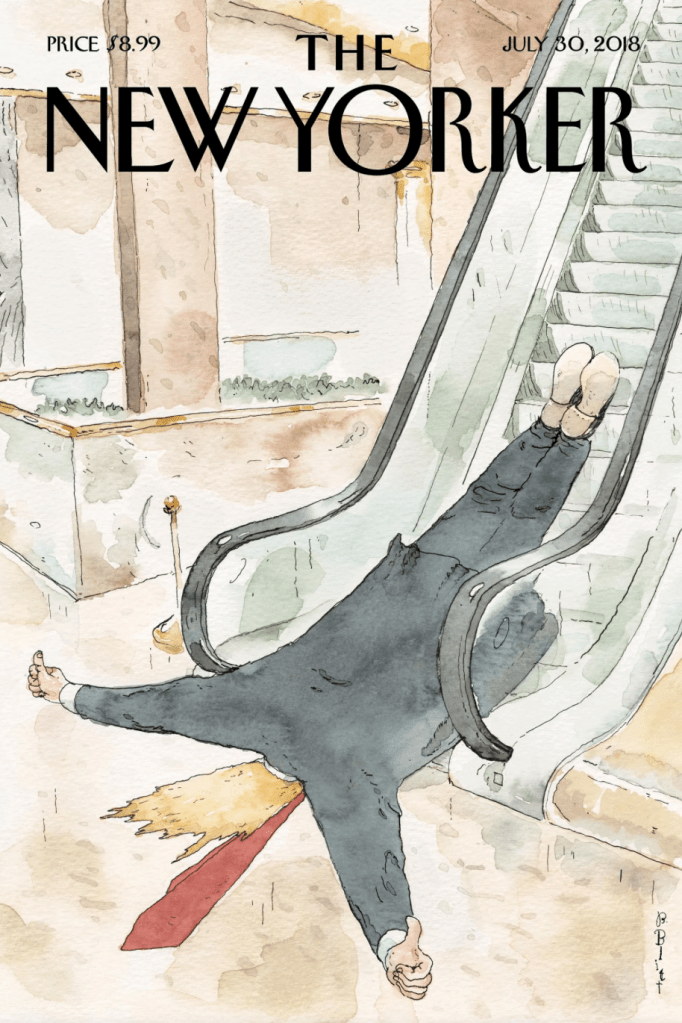
Like a Man Trying to Race Upward on a Downward-Moving Escalator

Before I quote from Frum’s piece, I begin with some key points. 

First, Frum is a mighty shrewd fellow. 

Second, Frum grasps a vital truth: to understand what’s going on around us, you have absolutely got to focus on what motivates people. That’s people in general. That’s individual people, with all their eccentricities and foibles. And that’s categories of people. And, in our day and age, the category of criminals and opportunists who surround Trump. 

If the Trump hangers on think that Trump is prevailing, well, that’s one calculation. But if they begin to fear he’s losing, well, that’s another calculation entirely. 

So, with those thoughts in mind, take it away, David!

David Frum (The Atlantic),Trump Might Be Losing His Race Against Time: The president is gambling that he can consolidate authority before the public turns too sharply against him:

President Donald Trump is worried that Attorney General Pam Bondi is moving too slowly to prosecute his political adversaries on fake charges. Trump has good reason to be concerned. He is carrying out his project to consolidate authoritarian power against the trend of declining public support for his administration and himself. He is like a man trying to race upward on a downward-moving escalator. If he loses the race, he will be pulled ever deeper below—and the escalator keeps moving faster against him.

Autocracies are headed by one man but require the cooperation of many others. Some collaborators may sincerely share the autocrat’s goals, but opportunists provide a crucial margin of support. In the United States, such people now have to make a difficult calculation: Do the present benefits of submitting to Trump’s will outweigh the future hazards?

As Bondi makes her daily decisions about whether to abuse her powers to please Trump, she has to begin with one big political assessment: Will Trump ultimately retain the power to reward and punish her? It’s not just about keeping her present job. On the one hand, people in Trump’s favor can make a lot of money from their proximity to power. On the other, Richard Nixon’s attorney general, John Mitchell, served 19 months in prison for his crimes during Watergate. If Trump’s hold on power loosens, Bondi could share Mitchell’s fate.

Trump’s hold on power is indeed loosening. His standing with the voting public is quickly deteriorating. Grocery prices jumped in August 2025 at the fastest speed since the peak of the post-pandemic inflation in 2022. Job growth has stalled to practically zero.

Almost two-thirds of Americans disapprove of higher tariffs, Trump’s signature economic move. His administration’s attack on vaccines for young children is even more unpopular. This year has brought the highest number of measles cases since the Clinton administration introduced free universal vaccination for young children in 1993. Parents may be rightly shocked and angry.

Shortly after MSNBC reported that Tom Homan, Trump’s border czar, had accepted $50,000 in cash from FBI agents posing as businessmen last year, allegedly in exchange for a promise to help secure government contracts, the pro-Trump podcaster Megyn Kelly posted, “We DO NOT CARE.” This kind of acquiescence to corruption has been one of Trump’s most important resources. But the American people become a lot less tolerant of corruption in their leaders when they feel themselves under economic pressure. As of early August, nearly two-thirds of Americans regarded Trump as corrupt, 45 percent as “very corrupt.” More than 60 percent think the Trump administration is covering up the Jeffrey Epstein case. Almost 60 percent regard Bondi personally responsible for the cover-up.

The MAGA project in many ways resembles one of former businessman Donald Trump’s dangerously leveraged real-estate deals. A comparatively small number of fanatics are heart-and-soul committed. Through them, Trump controls the Republican apparatus and the right-wing media world, which allows him to do things like gerrymander states where he is in trouble (50 percent of Texans now disapprove of Trump, while only 43 percent approve) or wield the enforcement powers of the Federal Communications Commission to silence on-air critics. But overleveraged structures are susceptible to external shocks and internal mistakes.

Trump in his first term mostly avoided screwing up the economy. His trade wars with China triggered a nearly 20 percent stock-market slump in the fall and early winter of 2018. Trump retreated, and no recession followed the slump until the COVID shock of 2020. But in his second term, Trump has jettisoned his former economic caution. The stock market is doing fine in 2025 on hopes of interest-rate cuts. The real economy is worsening. The percentage of Americans who think the country is on the “wrong track” rose sharply over the summer. Even self-identified Republicans are now more negative than positive.

The souring is especially bitter among younger people. More than 60 percent of Republicans younger than 45 say things are on the wrong track, a 30-point deterioration over the three summer months.

Trump has a shrewd instinct for survival. He must sense that if he does not act now to prevent free and fair elections in 2026, he will lose much of his power—and all of his impunity. That’s why he is squeezing Bondi. But for her, the thought process must be very different. Trump is hoping to offload culpability for his misconduct onto her. She’s the one most directly at risk if she gives orders later shown to be unethical or illegal.

The survival of American rights and liberties may now turn less on the question of whether Pam Bondi is a person of integrity—which we already know the dismal answer to—than whether she is willing to risk her career and maybe even her personal freedom for a president on his way to repudiation unless he can fully pervert the U.S. legal system and the 2026 elections.

And Apart from That, How Did You Like the Play, Mrs. Lincoln?

In this video, Jason Stanley, professor of philosophy at Yale and author of Erasing History: How Fascists Rewrite the Past to Control the Future, makes it sound as if the authoritarians are bound to win.

Stanley’s pessimism contrasts with David Brooks, who contends that Trump isn’t organized enough to be a Mussolini. That, according to Brooks, is the good news. The bad news is that he’s an anarchist.

But I digress. I take Professor Stanley’s point about the fascist oligarchs. But our side has its own billionaires. Contrary to what your instinct might be, IMHO, our side needs to work with them—and to discourage any of them planning to leave the country.