

Legal Developments: A Fistful of Hot Takes

Walking Out the Door at Paul, Weiss

Four top litigation partners at Paul, Weiss have walked out the, together with their associates, their paralegals, their secretaries, and their book of business. In my experience, this sort of thing happens all the time at the big firms, even without cowardly deals capitulating to a would-be tinpot dictator. I wish I were persuaded that the walkout was over the Trump deal—and that it presages severe harm to the Cowardly Nine firm—but if wishes were horses, we’d all take a ride.

And if you don’t like my hot take on the matter, then ask perplexity.ai “Does the departure of four litigation partners at Paul Weiss mean anything?” Their AI chatbot’s opinion is quite different from mine.

How Many Federal Officials Can Trump Fire?

According to statutory law, a president cannot fire, without cause, a member of the National Labor Relations Board or of the Merit Systems Protection Board. Trump did it anyway. The lower courts told him to reinstate the two individuals, pending a final decision on the merits. Over the dissent of the three liberals, the rest of the court ordered that, until the case is decided on the merits, the two fired officials can stay fired. 

The legal issues are a teense complex, and if you’re interested, check out this article from SCOTUSblog.

My hot take: A majority of the Supreme Court seems to be getting ready to shitcan a century of precedent, and to destroy the independent status of heretofore independent agencies like the Federal Trade Commission. 

What Else Happened to Team Trump in the Courts Last Week?

Nothing good for Trump. Harvard filed a new lawsuit against Team Trump, challenging the Administration’s refusal to allow any foreign students next year. The judge granted Harvard a preliminary injunction so fast that he barely had time to read the papers.

Another judge granted Jenner & Block’s request for a preliminary injunction against Trump. And a third judge ruled that Trump had acted illegally against the United States Institute of Peace. 

A Reminder About a Fundamental Rule of Constitutional Law

Finally, Prof. Mitchell Berman of the University of Pennsylvania reminds us that No, Trump can’t force his agenda on U.S. entities. They have rights: The government cannot withhold benefits because it doesn’t like how people exercise their rights.
Why We Respond to the Authoritarian Project the Way We Do: The Fundamental Explanation

Erwin Chemerinsky (Washington Post), Trump is targeting law firms and academia. Why don’t they speak up?

Lawrence H. Summers (N.Y. Times), If Powerful Places Like Harvard Don’t Stand Up to Trump, Who Can?

Dean Chemerinsky is a distinguished constitutional scholar and dean of the law school at U.C. Berkeley. Prof. Summers is many things, including former Secretary of the Treasury and former president of Harvard University. Each of them bemoans the failure of many rich law firms, and many prestigious universities, to stand up to Trump.

And good for them. Let us all bemoan the cowardice. 

And let the record reflect that I, Ronald W. Davis, who attended Princeton, Harvard, and Columbia, hereby bemoan Harvard’s and Columbia’s failure to stand firm. And I hereby celebrate the position of Princeton’s president. I hope and expect he and the university will continue to stand firm, and, if they do, when Annual Giving rolls around, I will do the right thing. As, I believe, will my fellow alumni. 

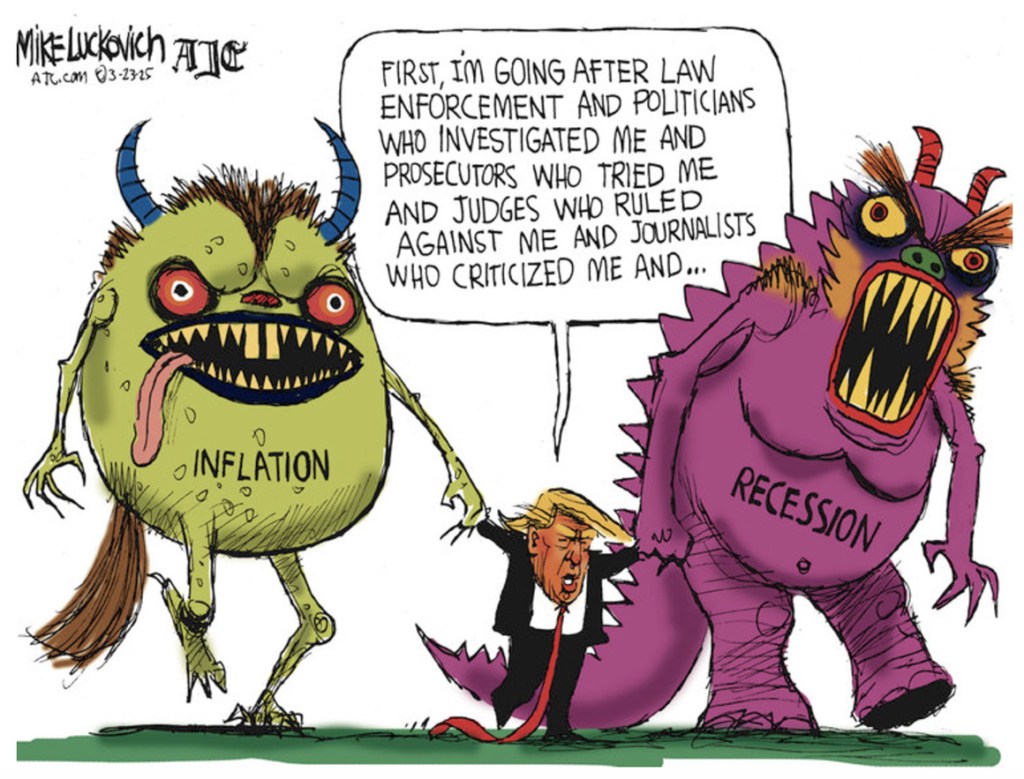
At the same time, I suggest that we all spend about 2% of our time bemoaning this or that and the remaining 98% of our time in hard-headed analysis and strategizing. And, here in the real world—not the one we wish we lived in—I suggest that for most people, most of the time, the most salient questions are

Is the authoritarian project going to take root, in which case I and my organization had best accommodate to it? 

Or is the authoritarian project going down the shitter, in which case I and my organization can just keep our heads down and wait it out?

To help answer those questions, you might want to look to the town halls, the election results on Tuesday, and the condition of the financial markets this afternoon.

A Little Context for the Preceding Post—the One About the New York City Bar Association

It’s the Incentives, Stupid

In a couple of hours, my wife will be having a pointed discussion with the local tax assessors over the value of her apartment. The condos in our building vary a whole lot in size, layout, and many other features. But guess what? It turns out that the thing that best predicts the sale price is the number of square feet in the condo. If you know that number, then you have a very good idea of the condo’s fair market value.

Why in the world make that point? Because, let me humbly submit, while people vary in all sorts of ways, the one thing that best predicts their behavior is their incentives.

I was in Big Law for a long time. Some of the people I knew were fine human beings. Some, I’m sorry to say, had the morality of a sea slug. But, like the rest of the human race, most of them were somewhere in the middle, morality-wise. 

I am confident that, for some of those who wrote and promoted the New York City Bar Association’s statement on the Adams case, promoting justice and good government was a driving concern. I am equally confident that the objective incentives of the Bar Association’s members was a driving force, as well.

Let me put it bluntly.

If the legal system breaks down, ain’t nobody gonna pay you no $2.5 million for your skilful manipulation of the legal system.