Trump, the Supreme Court, and the Shadow Docket: What’s Going On?

A Trigger Warning—and Some Disclaimers

The Trigger Warning: Some readers will be triggered by prose that, read superficially, might sound sympathetic to Chief Justice Roberts and to his sidekicks, Justices Coney Barret and Kavanaugh. Such readers may want to skip this post. In any event, they are requested not to throw food in my direction. Or, if they must, please pick the corn muffins we’re getting tonight, and take a pass on the bean soup and the pistachio pudding. 

The Multiple Disclaimers: In this post, I’m not in the moralizing business, I’m not in the mind reading business, and I’m not in the prediction business. Not that moralizing, mind reading, and prediction are unimportant. They’re just not what I’m trying to do here. Here, I’m in the hypothesizing business. I’m in the trying-to-understand business. 

The Three Court Factions

You can generally count on the three liberal justices to do the right thing. If you bet that Justices Thomas, Alito, and Gorsuch will do the wrong thing—and that Justice Gorsuch will camouflage the wrong thing with extensive verbiage made to superficially resemble legal scholarship—then you’re likely to win your bet. In the middle, that leaves the Chief Justice, along with Justices Coney Barrett and Kavanaugh. These three generally decide who’s going to win the case.

And, by the way, when I say “middle faction,” the word “middle” is not intended to be either favorable or pejorative. It just means they’re literally in the middle of the other two factions. 

The Supreme Court and Trump’s Multiple Power Grabs

It appears that the rubber will soon meet the road, and that the Supreme Court is going to make some definitive rulings on, among other things,

  • the proper construction of the emergency economic powers act that Trump has employed to justify his massive restructuring of American trade and world trade, 
  • Trump’s endeavor to rewrite the Constitution by fiat to eliminate birthright citizenship,
  • Trump’s many violations of statutory law and constitutional due process in connection with immigration roundups,
  • the Administration’s usurpation of the power of the purse, which, under the Constitution, belongs to Congress,
  • Trump’s attempt to destroy the United States Civil Service,
  • Trump’s attempts to use the National Guard and the military to take over big cities, and
  • Trump’s effort to do away with the independence of independent agencies like the Federal Trade Commission.

The Vexed Question of the Shadow Docket

In introduced this topic in the immediately preceding post, which you may wish to read now, before proceeding further. 

There are many reasons why it’s a vexed question. In the first place, the Court’s behavior contradicts what we learned in civics class—back when they taught civics in high school. We have checks and balances. When the president violates the law, the courts are supposed to check him. And indeed, lots of district courts and courts of appeal HAVE been checking Trump—but without a lot of support from the Supreme Court on its shadow docket.

Relatedly, the shadow docket is a vexed question from a technical legal standpoint. The Court is ruling on the validity of lower court decision on whether to grant a preliminary injunction pending trial and appeal, and that p.i. issue, in turn, is supposed to depend, in large measure, on “likelihood of success on the merits.” If the district court grants a p.i. against some Trump outrage, and if the court of appeals affirms, and if the Supreme Court majority then reverses the ruling, so that Trump can go on engaging in whatever horseshit he wants, pending trial, does that mean that the Supreme Court thinks Trump is right on the law and all the lower court judges are wrong?

Does it mean that the Supreme Court majority doesn’t give a tinker’s damn about checks and balances?

Does it mean that the majority wants to live in a country governed like Russia and Hungary?

Well, maybe it does mean some or all of those things. 

Or—Possibly—Something Else is Going On

I continue to focus here on the middle faction of the Supreme Court—Justices Roberts, Coney Barrett, and Kavanaugh—not on the three wingnuts, and not on the three liberals. An alternative hypothesis to explain the middle faction’s strange behavior would go something like this.

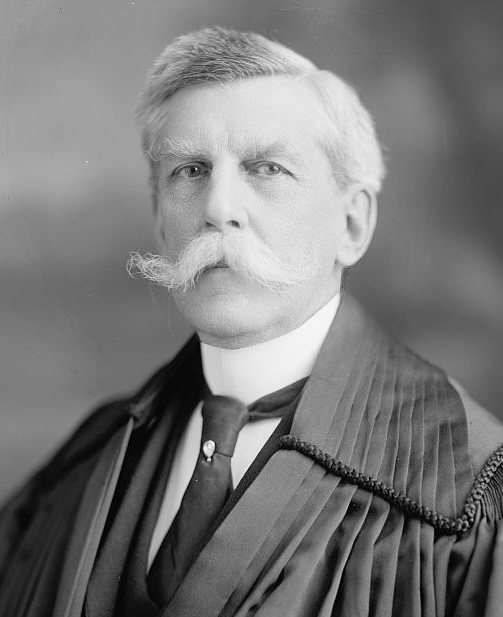
The middle faction would prefer to live in a constitutional republic governed under law, not in Hungary or Russia, but they are mindful that, to achieve that end, they have to preserve a certain level of public deference to court decisions. And, as Justice Oliver Wendell Holmes, Jr. (pictured above) said a century ago, the Court reads the newspapers. 

Having read the newspapers, the middle faction knew that a reelected, pumped up Trump was going to try to grab power in all sorts of ways. They knew that if the Supreme Court intervened immediately and forcefully, there would likely follow an immediate and grave constitutional crisis. 

The hypothesis continues: The middle faction reasoned that, instead of an immediate constitutional crisis, it would be better to wait a season; let the whole country, including the MAGA base, get a full taste of Trump’s policies; and let Trump’s political support dissipate. 

2026, not 2025, would be right year for strong action to preserve the rule of law. Or so they thought, in the hypothesis presented here.

Remember, Y’all, It’s a Hypothesis

Remember, y’all, it’s a hypothesis. There’s no mind reading, there’s no moralizing, and there’s no prediction about how the Court will actually decide all those issues I mentioned above. 

As far as predictions go, to quote the sage observation of President Eisenhower, “The future lies ahead.”
Trump, the Supreme Court, and the Shadow Docket: Setting the Table

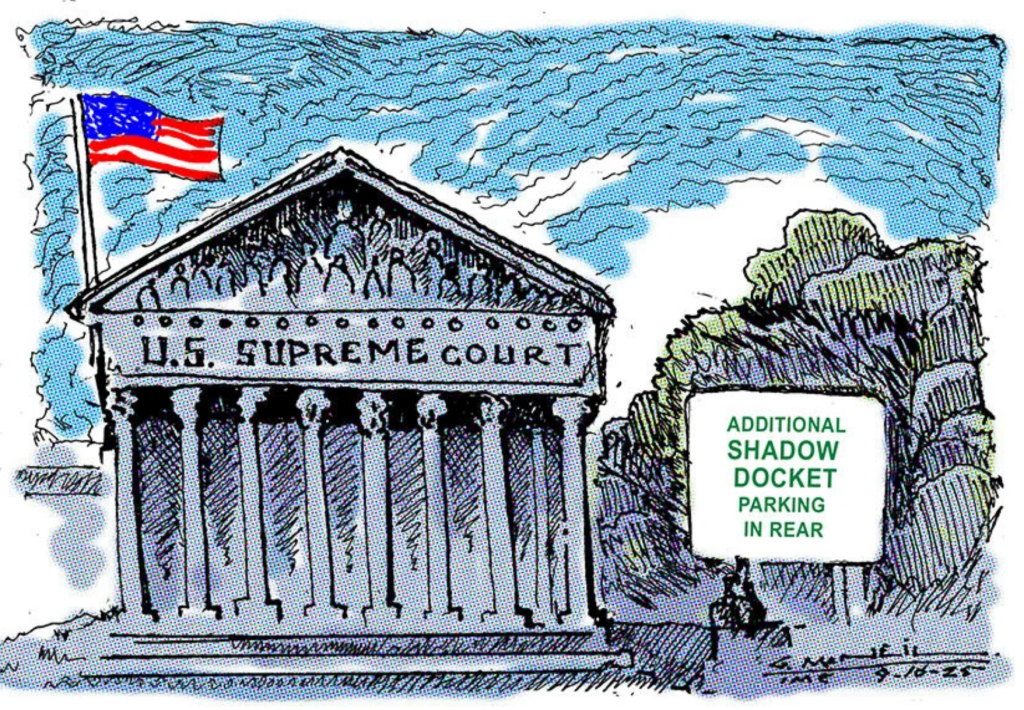
Something weird is going on at the Supreme Court. In my next post, I’m going to lay out a hypothesis about what that might be. Here, I need to lay the predicate for that discussion.

What is the Shadow Docket (Also Known as the Emergency Docket)?

The shadow docket consists of cases where the Supreme Court reviews lower court decisions that have either granted or denied temporary relief, pending a trial, a decision on the merits, and appeal of the decision in the ordinary course. 

In most of these cases, the lower courts have either granted a preliminary injunction or they have denied a preliminary injunction. 

What is a Preliminary Injunction?

Trials take a long time, appeals take even longer, and in the meantime you may suffer a lot of harm due to behavior that you say is illegal. Your uncle may be departed to El Salvador. Trump may have fired you from the Federal Trade Commission because you are a Democrat. Your business may be going bankrupt because of high tariffs that Trump has illegally imposed. 

A preliminary injunction is intended to preserve the status quo, preventing that injury, pending a final resolution of the dispute. 

When Should a Preliminary Injunction be Granted? When Should it be Denied?

When a party to a case wants a preliminary injunction, the court is supposed to ask four questions.

1. Considering the facts and the law, which party is more likely to win the case, down the road?

2. If the preliminary injunction is denied, how much harm will be caused, and is that harm irreparable? 

3. And what about the potential harm to the other side, if the preliminary injunction is granted?

4. Finally, in this private dispute between two parties, where does the public interest lie?

That’s the legal theory. In practice, the first factor—often called “likelihood of success on the merits”—tends to predominate. 

In other words, if a district judge grants a preliminary injunction, that often means that she thinks the defendant is behaving illegally. If she denies the request, that usually implies that, in her view, the plaintiff doesn’t have a good legal case. 

When She Rules on a P.I. Request, Is a District Judge Required to Explain Her Reasoning?

Yes. The Federal Rules of Civil Procedure provide that a federal district court is legally obligated to explain its reasoning in granting or denying a requested preliminary injunction. The main rationale for that rule is that, without a reasoned explanation, a court of appeals can’t make an informed decision about whether the district judge was right or wrong.

When the Supreme Court Rules on a P.I., Is it Legally Required to Explain its Reasoning?

No, it is not. However, before Trump, the Court normally did explain, at least briefly, how it thought likelihood of success on the merits and the other three factors applied to the case at hand. 

What’s Going on Now?

In a recent article, Erwin Chemerinsky, constitutional law expert and dean of the law school at U.C. Berkeley, explained, 

The Supreme Court always has had an emergency docket to hear requests such as those for last-minute stays of execution in death penalty cases. But it has grown greatly in recent years, and last year saw an exponential increase in orders from the shadow docket. In the October 2023 term, the court resolved 82 matters on its emergency docket. But in the October 2024 term, by June 27, 2025—the last day opinions were handed down—it had resolved 107 matters on its emergency docket. By the time the term officially ended when the new term began on Oct. 6, 2025, the court had decided 140 matters on its emergency docket.

Some of this increase is because of the many cases involving challenges to President Donald Trump’s administration’s initial actions that made it to the Supreme Court. But that does not explain all of the dramatic increase. I think that there is a simple explanation for why the shadow docket has grown: the court’s willingness to rule on matters on its emergency docket. The more the court is willing to give relief on an emergency basis, the more parties will go to the justices for stays of lower court decisions, such as of preliminary injunctions.

There is much to be concerned about in the growth of the shadow docket. Matters are decided without full briefing and without any oral argument. Yet in 2025, the Supreme Court indicated that lower courts were obligated to follow its shadow docket rulings. In several important cases, the court handed down orders without any written opinion, giving no guidance to the lower courts and making the decisions seem an arbitrary exercise of power since no reasons were given for the conclusions. In some cases, the court appeared to disregard detailed factual findings by lower courts and abandon the usual standard for emergency relief: the need for a showing of irreparable injury. …

There have been dozens of rulings by the court on its emergency docket concerning lower-court preliminary injunctions against Trump administration actions. In almost every case, the Supreme Court—virtually always in a 6-3 ruling—has stayed the preliminary injunction and ruled in favor of President Trump. These decisions have included the Supreme Court staying lower court orders stopping the firing of agency officials, ordering the reinstatement of terminated federal grants, forbidding deportations to South Sudan of individuals with no contact with that country, preventing U.S. Immigration and Customs Enforcement agents from stopping people without reasonable suspicion, and keeping the State Department from requiring that passports list a person’s birth sex rather than gender identity. …

In a ruling on the emergency docket, in United States v. Shilling, the court, once more 6-3, stayed a district court’s preliminary injunction and allowed President Trump to bar transgender individuals from serving in the military. Neither the majority nor the dissenting justices wrote an opinion.