
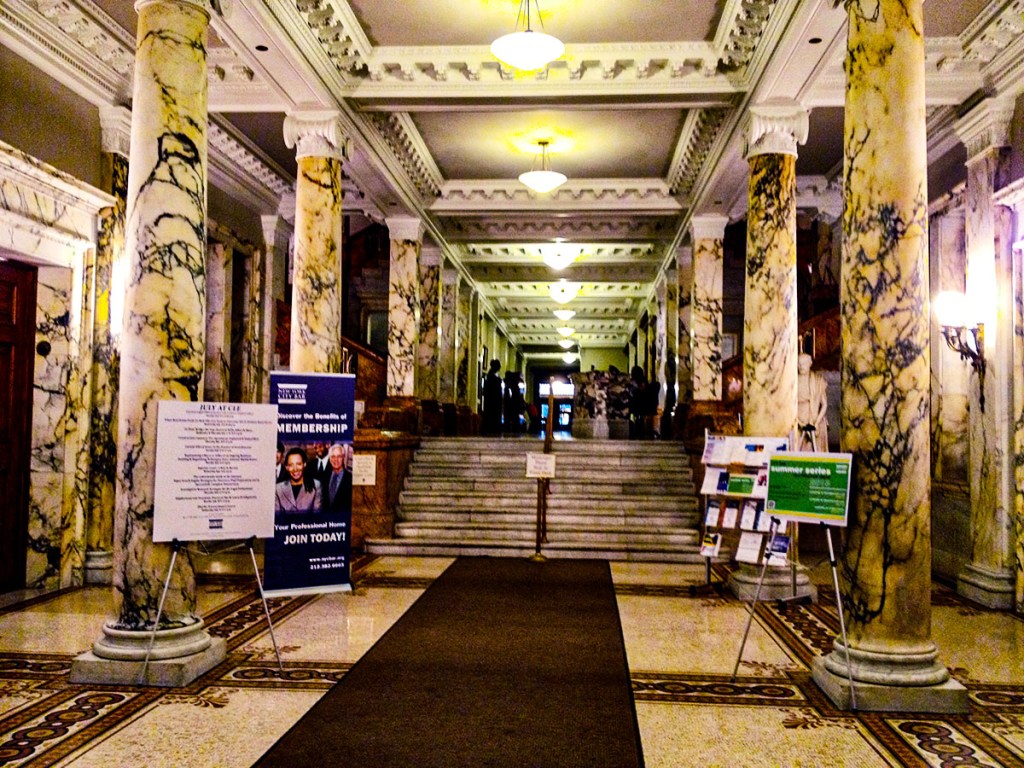
Back in my day, it was officially The Association of the Bar of the City of New York, its original name from back in 1870, when it was formed to fight the judicial corruption promoted by the Tammany Hall machine. Now, it’s the New York City Bar Association. Its president is a partner in a global law firm with profits per partner of $2.5 million. Its leadership includes a number of the president’s peers in other global law firms (together with others too, like professors and legal aid attorneys).
Yesterday, the association issued this press release.
On United States v. Eric Adams
Since its founding in 1870, the New York City Bar Association has supported the rule of law as one of its core missions – regardless of politics or ideological persuasion. “The true administration of justice is the firmest pillar of good government” is not merely an aphorism engraved in stone on courthouses but, together with the rule of law, the essence of American democracy. This mission and these values necessitate voicing our concern about the events of recent days in the ongoing federal case of United States v. Eric Adams, 24-CRIM-556 (S.D.N.Y.).
Prosecutors have a duty to act in the public interest, to perform their duties with objectivity, and to analyze all the evidence when deciding whether to pursue criminal charges. This is especially true in the prosecution of crimes allegedly committed by public officials involving abuses of power or corruption.
While the City Bar takes no position on the substantive merits of the Adams case, the numerous resignations by prosecutors from the office of the United States Attorney for the Southern District of New York and the Public Integrity Section of the United States Department of Justice, and the flurry of letters from those who have resigned and from the Acting Deputy Attorney General, command the City Bar’s attention and expression of concern.
The events of recent days are reminiscent of the Saturday Night Massacre resignations of Attorney General Elliot Richardson and Deputy Attorney General William Ruckelshaus, which precipitated the crisis of public confidence when they were ordered by President Nixon to dismiss Special Prosecutor Archibald Cox to halt the Watergate investigation.
The direction of Acting Deputy Attorney General Emil Bove III to the Southern District prosecutors to prepare and file a motion to dismiss the case against the Mayor of New York City cuts to the heart of the rule of law. The unusual form of Mr. Bove’s direction via a public memorandum buttresses arguments that the direction is based on pretextual grounds.
The letter from Acting United States Attorney Danielle Sassoon and Mr. Bove’s response give every indication that the dismissal of Mayor Adams’ case, without prejudice, is predicated on his agreeing to increase New York City’s assistance in the Trump administration’s immigration enforcement efforts. When the proposed dismissal is made “without prejudice” to the charges possibly being reinstated at some future date, the entire proposal raises serious questions involving both the potential quid pro quo and prosecutorial weaponization of our justice system.
Indeed, the justification offered by Mr. Bove for his decision expressly avoids any consideration of the merits of the prosecution, instead resting on a rationale which is expressly political. In particular, Mr. Bove suggests that dismissal is predicated upon Mr. Adams’s continuing agreement to use the power of his office as mayor to facilitate the administration’s immigration enforcement policies. The policy choices of the government of New York City cannot be dependent on or appear to be dependent on the decision of the Justice Department to prosecute or withhold prosecution of corruption charges against the mayor.
Against such a backdrop, the City Bar commends Ms. Sassoon for her courageous decision to offer her resignation from a post she assumed a few short weeks ago. Whatever the merits of the underlying case against Mayor Adams, her letter reflects the proper course of conduct for a prosecutor seeking to adhere to her oath to pursue justice without fear or favor. Her letter reflects integrity and a principled commitment to the rule of law and democracy. The City Bar likewise applauds Assistant United States Attorney Hagan Scotten, Acting Chief of the Criminal Division Kevin Driscoll, Acting Chief of the Public Integrity Section John Keller, and the other attorneys at the Department of Justice who chose to resign rather than acquiesce to a decision raising profound questions of legality, morality, and legal ethics.
The interests of the public are best served by the continuation of the prosecution of Mr. Adams. In any event, the Department of Justice’s motion to dismiss the charges must be resolved on the basis of a complete record, which should include a searching inquiry into the nature of the bargain struck and a determination of its benefit to the public. If, as Mr. Bove contends, the prosecution of Mayor Adams was brought for improper political purposes, such an allegation can and should be adjudicated in the District Court. There is precedent for the District Court’s appointment of amicus curiae to obtain input from an independent counsel. See United States v. Flynn, No. 20-5143 (D.D.C.) (brief by former federal judge John Gleeson). In our view, the District Court should not dismiss the indictment against Mayor Adams without hearing from an independent lawyer, as neither the Mayor’s counsel nor the lawyers from the Department of Justice can fulfill that role.
Now it is for the United States District Court for the Southern District of New York to examine whether dismissal of the charges in United States v. Eric Adams is “in the public interest” and is “not tainted by impropriety” or “bad faith.” All members of the public concerned about whether law enforcement agencies will protect the public rather than manipulate the criminal justice system for political means await the outcome. Whatever the outcome, this episode is a stark reminder of the dangers of political interference in our justice system and the potential such interference has to undermine the public’s trust and confidence in the rule of law.
About the Association
The mission of the New York City Bar Association, which was founded in 1870 and has 23,000 members, is to equip and mobilize a diverse legal profession to practice with excellence, promote reform of the law, and uphold the rule of law and access to justice in support of a fair society and the public interest in our community, our nation, and throughout the world. www.nycbar.org
 Facing MAGA