
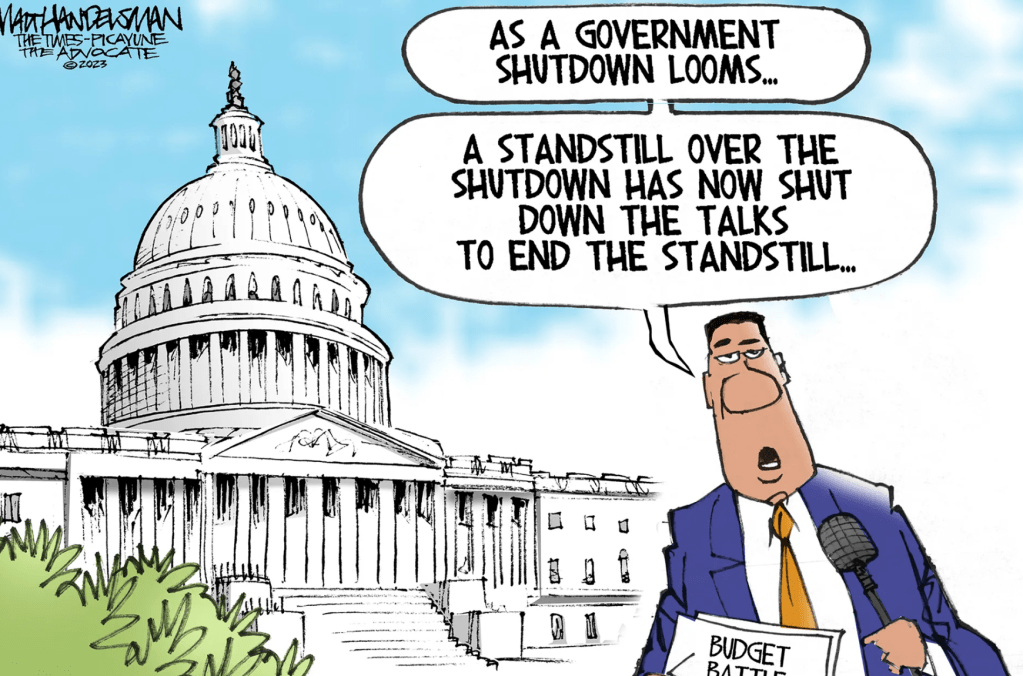
The Shutdown Deal

Ezra Klein (N.Y. Times), What Were Democrats Thinking?

As far as I can tell, the headline is intended to be read in a straightforward way—“WHAT were Democrats thinking?”—not in a sarcastic tone of voice—“What were Democrats THINKING?” 

In any event, as per usual, Ezra Klein has a dozen or so really interesting things to say—some of which might not have occurred to you and me—and it’s best to let him speak for himself. 

But as a preamble, two brief comments from me. First, some of the eight senators who joined the Republicans are political heavyweights, and people not known for an inclination to wimp out. So, before your knee jerks and you hurl criticism at them for wimping out, please think twice.

Second, among the really interesting things one might say about this putrid mess, the most interesting, IMHO, is that Republicans are now set up to cast spectacularly unpopular votes to screw a large portion of the public on the health insurance costs. 

Ezra Klein writes, 

Back in September, when I was reporting an article on whether Democrats should shut down the government, I kept hearing the same warning from veterans of past shutdown fights: The president controls the bully pulpit. He controls, to some degree, which parts of the government stay open and which parts close. It is very, very hard for the opposition party to win a shutdown.

Which makes it all the more remarkable that Democrats were winning this one. Polls showed that most voters blamed Republicans, not Democrats, for the current shutdown — perhaps because President Trump was bulldozing the East Wing of the White House rather than negotiating to reopen the government. Trump’s approval rating has been falling — in CNN’s tracking poll, it dipped into the 30s for the first time since he took office again. And last week, Democrats wrecked Republicans in the elections and Trump blamed his party’s losses in part on the shutdown. Democrats were riding higher than they have been in months.

Then, over the weekend, a group of Senate Democrats broke ranks and negotiated a deal to end the shutdown in return for — if we’re being honest — very little.

The guts of the deal are this: Food assistance — both SNAP and WIC, I was told — will get a bit more funding, and there are a few other modest concessions on spending levels elsewhere in the government. Laid-off federal workers will be rehired and furloughed federal workers given back pay. Most of the government is funded only until the end of January. (So get ready: We could be doing this again in a few months.) Most gallingly, the deal does nothing to extend the expiring Affordable Care Act tax credits over which Democrats ostensibly shut down the government in the first place. All it offers is a promise from Republicans to hold a vote on the tax credits in the future. Of the dozen or so House and Senate Democrats I spoke to over the past 24 hours, every one expected that vote to fail.

To understand why the shutdown ended with such a whimper, you need to understand the strange role the A.C.A. subsidies played in it. Democrats said the shutdown was about the subsidies, but for most of them, it wasn’t. It was about Trump’s authoritarianism. It was about showing their base — and themselves — that they could fight back. It was about treating an abnormal political moment abnormally.

T he A.C.A. subsidies emerged as the shutdown demand because they could keep the caucus sufficiently united. They put Democrats on the right side of public opinion — even self-identified MAGA voters wanted the subsidies extended — and held the quivering Senate coalition together. You shut the government down with the Democratic caucus you have, not with the Democratic caucus you want.

The shutdown was built on a cracked foundation. There were Senate Democrats who didn’t want a shutdown at all. There were Senate Democrats who did want a shutdown but thought it strange to make their demand so narrow: Was winning on health care premiums really winning the right fight? Should Democrats really vote to fund a government turning toward authoritarianism so long as health insurance subsidies were preserved?

And what if winning on the health care fight was actually a political gift to Donald Trump? Absent a fix, the average health insurance premium for 20 million Americans will more than double. The premium shock will hit red states particularly hard. Tony Fabrizio, Trump’s longtime pollster, had released a survey of competitive House districts showing that letting the tax credits expire might be lethal to Republican efforts to hold the House. Why were Democrats fighting so hard to neutralize their best issue in 2026?

The political logic of the shutdown fight was inverted: If Democrats got the tax credits extended — if they “won” — they would be solving a huge electoral problem for Republicans. If Republicans successfully allowed the tax credits to expire — if they “won” — they would be handing Democrats a cudgel with which to beat them in the elections.

This is why Senator Chuck Schumer’s compromise, which offered to reopen the government if Republicans extended the tax credits for a year, struck many Democrats as misguided. Morally, it might be worth sacrificing an electoral edge to lower health insurance premiums. But a one-year extension solved the Republicans’ electoral problem without solving the policy problem. Why on earth would they do that?

In any case, Republicans were not interested in Schumer’s offer. Trump himself has shown no interest in a deal. Rather than negotiating over health care spending, Trump has been ratcheting up the pain the shutdown is causing. Hundreds of thousands of federal workers have been furloughed or fired. The administration has been withholding food assistance from Americans who desperately need it. Airports are tipping into chaos as air traffic controllers go without pay.

More than anything else, this is what led some Senate Democrats to cut a deal: Trump’s willingness to hurt people exceeds their willingness to see people get hurt. I want to give them their due on this: They are hearing from their constituents and seeing the mounting problems and they are trying to do what they see as the responsible, moral thing. They do not believe that holding out will lead to Trump restoring the subsidies. They fear that their Republican colleagues would, under mounting pressure, do as Trump had demanded and abolish the filibuster. (Whether that would be a good or a bad thing is a subject for another column.) This, in the end, is the calculation the defecting Senate Democrats are making: They don’t think a longer shutdown will cause Trump to cave. They just think it will cause more damage.

If I were in the Senate, I wouldn’t vote for this compromise. Shutdowns are an opportunity to make an argument, and the country was just starting to pay attention. If Trump wanted to cancel flights over Thanksgiving rather than keep health care costs down, I don’t see why Democrats should save him from making his priorities so exquisitely clear. And I worry that Democrats have just taught Trump that they will fold under pressure. That’s the kind of lesson he remembers.

But it’s worth keeping this is perspective: The shutdown was a skirmish, not the real battle. Both sides were fighting for position, and Democrats, if you look at the polls, are ending up in a better one than they were when they started. They elevated their best issue — health care — and set the stage for voters to connect higher premiums with Republican rule. It’s not a win, but given how badly shutdowns often go for the opposition party, it’s better than a loss.

“Just Because Trump is a Product of American Rage Does not Mean he is a Solution to It”

Derek Thompson (The Atlantic), The Political Right of the Century: For the first time in decades, America has a chance to define its next political order. Trump offers fear, retribution, and scarcity. Liberals can stand for abundance.

Derek Thompson is the co-author, along with Ezra Klein, of the new book Abundance. I strongly recommend the whole article. If you don’t subscribe to The Atlantic, then you really should. 

Here are some highlights:

Donald Trump has promised a “golden age of America.” But for all his bluster about being the champion of an American century, Trump’s actual policies point to something different: not an expansive vision of the future, but a shrunken vision of the present.

Throughout the opening months of his administration, the Trump White House has consistently pointed to existing shortages to demand new sacrifices. The administration says America cannot afford its debt, and therefore we cannot afford health care for the poor. The administration says America doesn’t have a healthy economy, and therefore we have to accept economic “hardship.” The administration says America doesn’t have enough manufacturing, and so we must suffer the consequences of less trade. The administration says America doesn’t have enough housing, and so we need fewer immigrants. The administration says American scientists aren’t focused on the right research, and so we have to gut our federal science programs. Again and again, Americans are being fed the line that everything that we don’t have requires the elimination of something that we need.

The MAGA movement might try to justify its wrecking-ball style by arguing that its extreme approach is commensurate with the level of anger that voters feel about the status quo. But just because Trump is a product of American rage does not mean he is a solution to it.

In housing, for example, Americans have every right to be furious. Home construction has lagged behind our national needs for decades. Today, the median age of first-time homebuyers has surged to a record high of 38. Large declines in young homeownershiphave likely prevented many young people from dating, marrying, and starting a family. Although Trump was swept into office on a wave of economic frustration, his initial foray into economic policy has done little to help the situation. As the National Association of Home Builders pointed out in an alarmed March 7 memo, his persistent threat of tariffs on Mexico and Canada could drive up the cost of crucial materials, such as softwood lumber and drywall gypsum, which are “largely sourced from Canada and Mexico, respectively.” Meanwhile, Trump’s anti-immigrant policies foretell new labor shortages in the construction industry, where roughly 25 percent or more workers are foreign-born.

This is where Democrats should be able to stand up and show that they have a winning response to the less-is-less politics from the right. But in many places run by Democrats, the solution on offer is another variety of scarcity. Blue cities are laden with rules and litigation procedures that block new housing and transit construction. As my colleague Yoni Appelbaum has noted, in California cities where the share of progressives votes goes up by 10 points, the number of housing permits issued declines by 30 percent. Where the supply of homes is constricted, housing prices soar, and homelessness rises. As of 2023, the five states with the highest rates of homelessness were New York, Hawaii, California, Oregon, and Washington—all run by Democrats.

As the cost of living rises in blue states, tens of thousands of families are leaving them. But the left isn’t just losing people. It’s losing an argument. It has become a coalition of Kindness Is Everything signs in front yards zoned for single-family homes. Liberals say they want to save the planet from climate change, but in practice, many liberal areas have shut down zero-carbon nuclear plants and protested solar-power projects, leaving it to red states such as Texas to lead the nation in renewable-energy generation. Democrats cannot afford to become the party of language over outcomes, of ever more lawn signs and ever fewer working-class families.

If Trump’s opponents are going to win at the polls, they will need to construct a new political movement, one that aims for abundance instead of scarcity. Such a movement would combine the progressive virtue of care for the working class and a traditionally conservative celebration of national greatness, while taking a page from the libertarian obsession with eliminating harmful regulations to make the most important markets work better. It would braid a negative critique of Trump’s attack on the government with a positive vision of actual good governance in America—while providing a rigorous focus on removing the bottlenecks that stand in the way.

Abundance begins with specific goals for America’s future. Imagine much more housing where it’s most in demand. An economy powered by plentiful clean energy. A revitalized national science policy prioritizing high-risk discoveries that extend lives and improve health. And a national invention agenda that seeks to pull forward technologies in transportation, medicine, energy, and beyond that would improve people’s lives. …

I can imagine somebody opposed to the MAGA movement reading all of this and thinking: Why, at a time when Trump presents such a clear threat to the American project, is it appropriate to focus such criticism on the Democratic side?

First, to make the argument for a liberal alternative to Trumpism, Democrats have to show Americans that voting for liberals actually works. … 

Second, Americans are furious about the status quo—the youngest voters are “more jaded than ever about the state of American leadership,” according to the Harvard Political Review—and liberals need a new style of politics for the age of anti-establishment anger. The right’s answer to rage is chaos in search of an agenda. MAGA acts like a drunk toddler with a chain saw, carelessly slashing through state programs with a high risk of self-harm. But Democrats should not allow the forces of negative polarization to turn them into the party that reflexively defends the status quo at every turn, even when it means refusing to reform institutions that have lost the public’s trust. Quite the opposite: Abundance should be a movement of proud, active, and even obsessive institutional renewal.

Consider U.S. science policy, an area that is under attack from the right at this moment. As the centerpiece of U.S. biomedical funding, the National Institutes of Health has accomplished extraordinary things; you will have a hard time finding many scientific breakthroughs in the past 50 years—in heart disease, genetics, epidemiology—that were not irrigated by its funding.

But many of the same factors that have infamously plagued our housing and energy markets—paperwork, bureaucratic drift, entrenched incumbent interests—have become fixtures in American science. It is practically a cliché among researchers that the NIH privileges incremental science over the sort of high-risk, high-reward investigations that would likely uncover the most important new truths. Surveys indicate that the typical U.S. researcher spends up to 40 percent of their time preparing grant proposals and filling out paperwork rather than actually conducting science. As John Doench, the director of research and development in functional genomics at the Broad Institute, told me: “Folks need to understand how broken the system is.” …

Today, we seem to be in a rare period in American history, when the decline of one political order makes space for another. This crackup was decades in the making. It started with the Great Recession, which shattered a broad belief in free and unregulated markets. It continued throughout the 2010s, as slow economic recovery fueled public resentment of inequality, and an affordability crisis gathered steam. In 2020, the pandemic obliterated many Americans’ trust in government, or what was left of it. And from 2021 to 2024, inflation brought national attention to the interlocking crises of scarcity, supply, and unaffordability. For years, the boundaries of American politics had felt fixed, even settled. But now they are falling.

“For a political order to triumph, it must have a narrative, a story it tells about the good life,” Gerstle told me. Today’s politics are suffused with pessimism about government because “a way of living sold to us as good and achievable is no longer good, or no longer achievable.” In 2016, the rise of Bernie Sanders on the left and Donald Trump on the right revealed how many Americans had stopped believing that the life they had been promised was achievable. What both the socialist left and the populist-authoritarian right understood was that the story that had been told by the establishments of both parties, the story that had kept their movements consigned to the margins, had come to its end.

Political movements succeed when they build a vision of the future that is imbued with the virtues of the past. Franklin D. Roosevelt pitched his expansive view of government as a sentinel for American freedoms: of speech, of worship, from want, from fear. Decades later, Ronald Reagan recast government as freedom’s nemesis rather than its protector. Abundance, too, is about redefining freedom for our own time. It is about the freedom to build in an age of blocking; the freedom to move and live where you want in an age of a stuck working class; the freedom from curable diseases that come from scientific breakthroughs. Trump has defined his second term by demolition and deprivation. America can instead choose abundance.