
Immigration and the Democrats
Josh Barro (N.Y. Times), Democrats Blew It on Immigration:
Since the spring, the shine has come off President Trump’s handling of immigration. And yet there has been no apparent surge in voters’ desire to put immigration policy back in the hands of Democrats.
Frankly, Democrats have not earned voters’ trust on immigration — and I say this as a Democrat.
The most recent Democratic administration presided over an enormous surge in migration, with the unauthorized immigrant population exploding to 14 million in 2023 from 10.5 million in 2021 and likely millions more by the time Joe Biden left office, according to the Pew Research Center.
For too long, Mr. Biden and his team asserted they couldn’t stop the surge without new legislation. That proved false: In 2024, having failed to get an immigration bill through Congress, Mr. Biden finally took executive actions to curb abuse of the asylum system and slow the flow of migrants across the southern border. When Mr. Trump took office, illegal border crossings slowed to a trickle. In other words, the problem had been fixable all along; Mr. Biden simply did not fix it until much too late.
As a result, the unauthorized immigrant population in the United States today is considerably different from what it was before Mr. Biden’s presidency. In 2021, over 80 percent of unauthorized immigrants had been living here for at least five years. Now there are millions more recent arrivals without similarly deep links to American communities. Admitting all these new migrants was never an agreed-upon public policy — no voters endorsed this, no law passed by Congress contemplated it and to the extent the migrants are seeking asylum, their legal claims are too often bogus.
But it happened, and Democrats need to explain to voters why they should not expect it to happen again if they regain power. They also need a story about what happens with the millions of people who came here recently, even though they weren’t supposed to.
The longstanding preferred Democratic framework has been comprehensive immigration reform. The idea is that you secure the border, set an intentional and thoughtful immigration policy about who to admit going forward, and give some sort of amnesty to most of the unauthorized immigrants who are already here. Twenty years of legislative efforts to enact this framework failed, even when there was substantial Republican support for it, which is no longer the case. And that was before the composition of the unauthorized immigrant population changed so drastically.
Center-left commentators like Matthew Yglesias and Jerusalem Demsas have been proposing policy ideas that aim to make Democrats’ plans for immigration more appealing to the public. These include refocusing immigration toward higher-skilled migrants, allowing more guest workers on nonimmigrant visas to address inflation-producing labor shortages in industries like hospitality, adding requirements related to assimilation and English-language learning, and even taxing immigrants at higher rates than native-born Americans.
The Center for American Progress has a smart set of proposals to prevent a recurrence of the abuses of the asylum system that prevailed during the Biden administration. The institution’s Neera Tanden and Debu Gandhi propose to prohibit almost all asylum claims from migrants who crossed the southern border illegally, while those who make claims at the border would be held in custody instead of being allowed into the country on a parole basis. Their claims would be adjudicated within 30 days, with rapid removal for those whose claims are rejected. The proposal would also raise the standard of proof for asylum claims and maintain a list of democratic countries whose citizens are presumptively ineligible for asylum.
These sorts of reforms to prevent abuse are necessary to maintain the long-term political viability of the right to claim asylum — though Democrats should also be mindful that the total number of migrants matters, and further restriction could be necessary if too many migrants try to seek asylum under the new system.
The idea is to emphasize that immigration policy must be designed principally for the benefit of American citizens, who stand to gain from the economic and cultural contributions of immigrants so long as immigration is managed appropriately.
This is a good project — but it won’t work without a robust and credible commitment to enforcement, including interior enforcement. That’s because you can make whatever rules you want about who is supposed to immigrate and how, but if you continue to allow millions of people to come live in the United States in contravention of those rules, the immigration situation on the ground will not match what is written in policy.
The mental block that Democrats have here relates to an instinct about deportations: a feeling that it’s presumptively improper to remove an unauthorized immigrant who has settled in our country if that migrant hasn’t committed a crime unrelated to immigration. These people have been here a long time, the idea goes. They’re not causing trouble.
But if we build a system where people very often get to stay here simply because they made it in — the system that prevailed during most of Mr. Biden’s term — then we don’t really have an immigration policy, and voters won’t have any reason to believe us when we say our new policy will produce different results about who comes here.
Liberals also note, accurately, that there are negative economic consequences to a stepped-up program of interior enforcement that doesn’t focus narrowly on criminals. Unauthorized immigrants play an important role in our work force, especially in agriculture and construction. More deportations will make it more expensive to grow fruits and vegetables and reduce the number of housing units we can add. (On the other hand, it will also reduce demand for housing.) But these near-term economic costs need to be weighed against the way that stepped-up interior enforcement makes any future immigration policy more credible and more effective by sending migrants the message that they need a valid visa to stay in the United States.
The need to make a credible enforcement threat does not require Democrats to endorse specific enforcement practices of the Trump administration, like having ICE officers cover their faces during raids or pursue a goal of 3,000 detentions per day. Democrats are right to highlight and criticize the way that indiscriminate raids can sweep up U.S. citizens and to call for a more effectively targeted approach. But that more targeted approach still needs to contemplate that being in the country without authorization is reason enough to deport someone.
There is a political risk for Democrats in Mr. Trump’s softer poll numbers on immigration. Earlier in the year, when his immigration stances were clearly a political asset, Democrats looked for ways to moderate their image on immigration and show a willingness to get tough on enforcement; for example, many moderate Democrats in Congress voted for the Laken Riley Act (which directs the authorities to detain and deport immigrants who are charged or admit to — but are not yet convicted of — specific crimes, if they are in the country illegally).
But now that more Americans disapprove than approve of his approach to immigration, Democrats have often reverted toward centering the concerns of noncitizens — which is to say, nonvoters. The fact that voters increasingly see Mr. Trump’s approach to immigration as too harsh is not enough to turn the issue into an asset for Democrats. A late-July poll for The Wall Street Journalshows the problem for Democrats. It found respondents narrowly disapproving of the president’s handling of the issue — and yet it also showed that voters would not rather see immigration policy in the hands of Democrats. Only 28 percent said that they trust Democrats in Congress to handle immigration policy more than they trust Republicans, while 45 percent say they trust Republicans more than Democrats (the split was slightly wider on the question of illegal immigration).
If we force voters to choose between Mr. Trump’s overly harsh approach and our overly permissive one, we will continue to lose on the issue.
Most voters say immigration provides net benefits to the country, but they also want rules to be enforced. We need to echo both of those sentiments.
From David Ignatius’ Lips to God’s Ears

David Ignatius (Washington Post), Democrats ignored border politics. Now the consequences are here: To fight Trump’s excesses on immigration, Democrats need to show they are credible on the issue:
Democrats have gotten the border issue so wrong, for so long, that it amounts to political malpractice. The latest chapter — in which violent protesters could be helping President Donald Trump create a military confrontation he’s almost begging for as a distraction from his other problems — may prove the most dangerous yet.
When I see activists carrying Mexican flags as they challenge ICE raids in Los Angeles this week, I think of two possibilities: These “protesters” are deliberately working to create visuals that will help Trump, or they are well-meaning but unwise dissenters who are inadvertently accomplishing the same goal.
Democrats’ mistake, over more than a decade, has been to behave as though border enforcement doesn’t matter. Pressured by immigrant rights activists, party leaders too often acted as if maintaining a well-controlled border was somehow morally wrong. Again and again, the short-term political interests of Democratic leaders in responding to a strong faction within the party won out over having a policy that could appeal to the country as a whole.
When red-state voters and elected officials complained that their states were being overwhelmed by uncontrolled immigration over the past decade, Democrats found those protests easy to ignore. They were happening somewhere else. But when red states’ governors pushed migrants toward blue-state cities over the past several years, protests from mayors and governors finally began to register. But still not enough to create coherent Democratic policies, alas.
It’s open season on former president Joe Biden these days, and he doesn’t deserve all the retrospective criticism he’s getting. But on immigration, he was anything but a profile in courage. Security advisers including Homeland Security Secretary Alejandro Mayorkaswanted tougher border policies starting in 2021. But political advisers such as Chief of Staff Ron Klain, who sought amity with immigration rights progressives in Congress and the party’s base, resisted strong measures. Though Biden was elected as a centrist, he leaned left — and waited until the last months of his presidency to take the strong enforcement measures recommended earlier.
Throughout the 2024 campaign, Trump played shamelessly on public anxieties about the border. Some of his arguments, such as claims that hungry migrants were eating pets, were grotesque. They were simply provocations. But Biden and Kamala Harris didn’t have good answers, other than indignation. They had straddled the issue through Biden’s term, talking about border security but failing to enact it, and the public knew it.
Democrats finally came up with a bipartisan border bill in 2024 that would have given the president more authority to expel migrants and deny asylum claims, and more money to secure the border. Republicans, led by Trump, were shameless opportunists in opposing the bill. They didn’t want Biden to have a win. In the end, Democrats didn’t have the votes — or, frankly, the credibility on the issue. Biden took executive action in June 2024, limiting entry into the United States. But it was too late. He could have taken that action in 2021.
Since Trump took office in January, he has been building toward this week’s confrontation in the streets. ICE raids have steadily increased in cities with large migrant populations, as have nationwide quotas for arrests and deportations. Trump declared a national emergency on Inauguration Day that gave him authority to send troops to the border to “assist” in controlling immigration. Homeland Security Secretary Kristi L. Noem seized every photo opportunity to convey a militarized approach to the coming clash. Over these months, the immigration issue has been a car crash skidding toward us in slow motion.
Since his first term, Trump has clearly wanted a military confrontation with the left over immigration or racial issues. Gen. Mark A. Milley, then chairman of the Joint Chiefs of Staff, helped talk Trump out of invoking the Insurrection Act in 2020 to contain the unrest that followed the death of George Floyd. But this time, Trump faces no opposition. He is surrounded by yes-men and -women.
The saddest part is that Democrats still have no clear policy. Some blue-state mayors and governors have pledged to provide “sanctuary” for migrants, but they don’t have good arguments to rebut Trump’s claim that they’re interfering with the enforcement of federal law. In some cases, sanctuary has meant refusing to hand over undocumented migrants convicted of violent crimes, former DHS officials tell me. That’s wrong. The courts have limited Trump’s most arbitrary policies and his defiance of due process, but not his authority to enforce immigration laws.
California Gov. Gavin Newsom (D) this week chose sensible ground to fight, filing a lawsuitchallenging Trump’s authority to override gubernatorial power by federalizing National Guard troops when there isn’t a “rebellion” or “invasion.” There is no evidence of such extreme danger — or that local law enforcement in Los Angeles can’t handle the problems.
But Newsom’s smart pushback doesn’t get Democrats out of addressing an issue they’ve been ducking for more than a decade: Do they have the courage to enforce the border themselves?
Over the long run, taking border issues seriously means more immigration courts and more border-control people and facilities — and a fair, legal way of deciding who stays and who goes. But right now, it means Democratic mayors and governors using state and local police to contain protests, so that troops aren’t necessary — and preventing extremists among the activists from fomenting the cataclysm in the streets that some of them seem to want as much as Trump.
Yes, of course, we need new bipartisan legislation to resolve the gut issue of how to protect the “dreamers” and other longtime residents who show every day that they want only to be good citizens. But on the way to that day of sweet reason, Democrats need to oppose violence, by anyone — and to help enforce immigration policies that begin with a recognition that it isn’t immoral to have a border.
Mango Mussolini’s Moronic Manufactured Mayhem
Today, many talking heads are talking about the events in Los Angeles as a step on the road to authoritarianism—and an attempt to distract from Team Trump’s many failures.
All true.
And yet there remains an elephant in the room for Team Blue.
As a movement, we do not yet have a coherent and politically viable answer about
- How to deal with the undocumented people currently present here,
or about
- What the rules and procedures for political asylum ought to be,
or about
- Apart from people with legitimate asylum claims, how many—and who—should be permitted to enter the United States.
Not to have coherent and politically viable answers to these questions is political malpractice.
Seven Justices of the Supreme Court Meant What They Said About Due Process
As of this Morning, the Constitutional Republic Still Stands
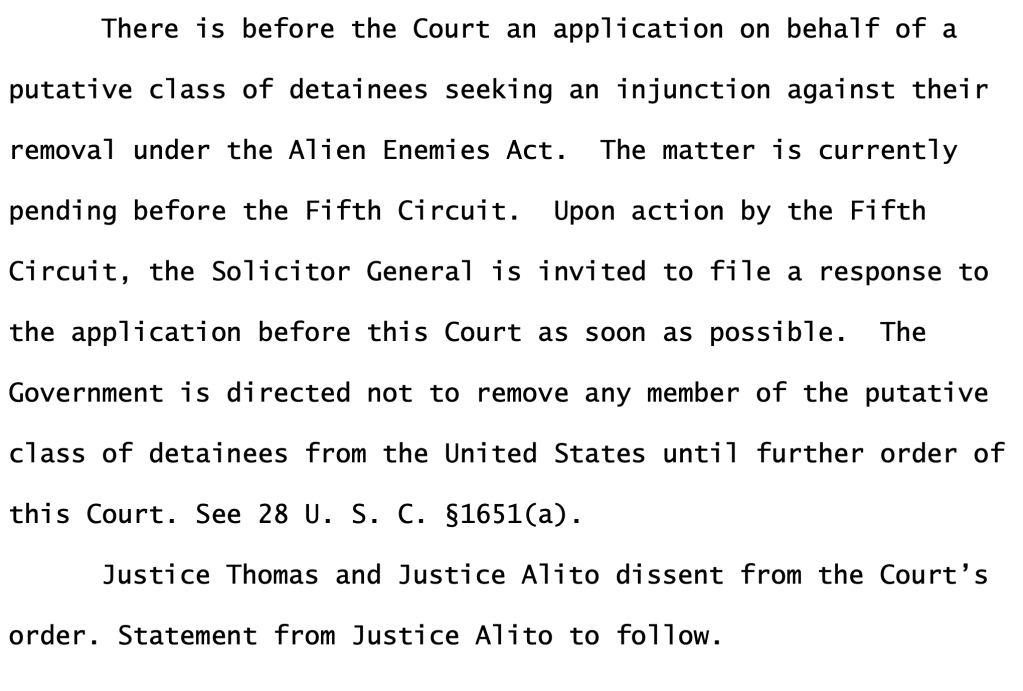
About 1 AM this morning, the Supreme Court, in response to an emergency petition by the American Civil Liberties Union, issued this order:
Musk Versus MAGA Redux
From Goldman Sachs to God’s Ears
This from the Dec. 28 message from Axios (“Presented from Goldman Sachs”):
| The one big thing: New DEI fight |
 |
| Via X |
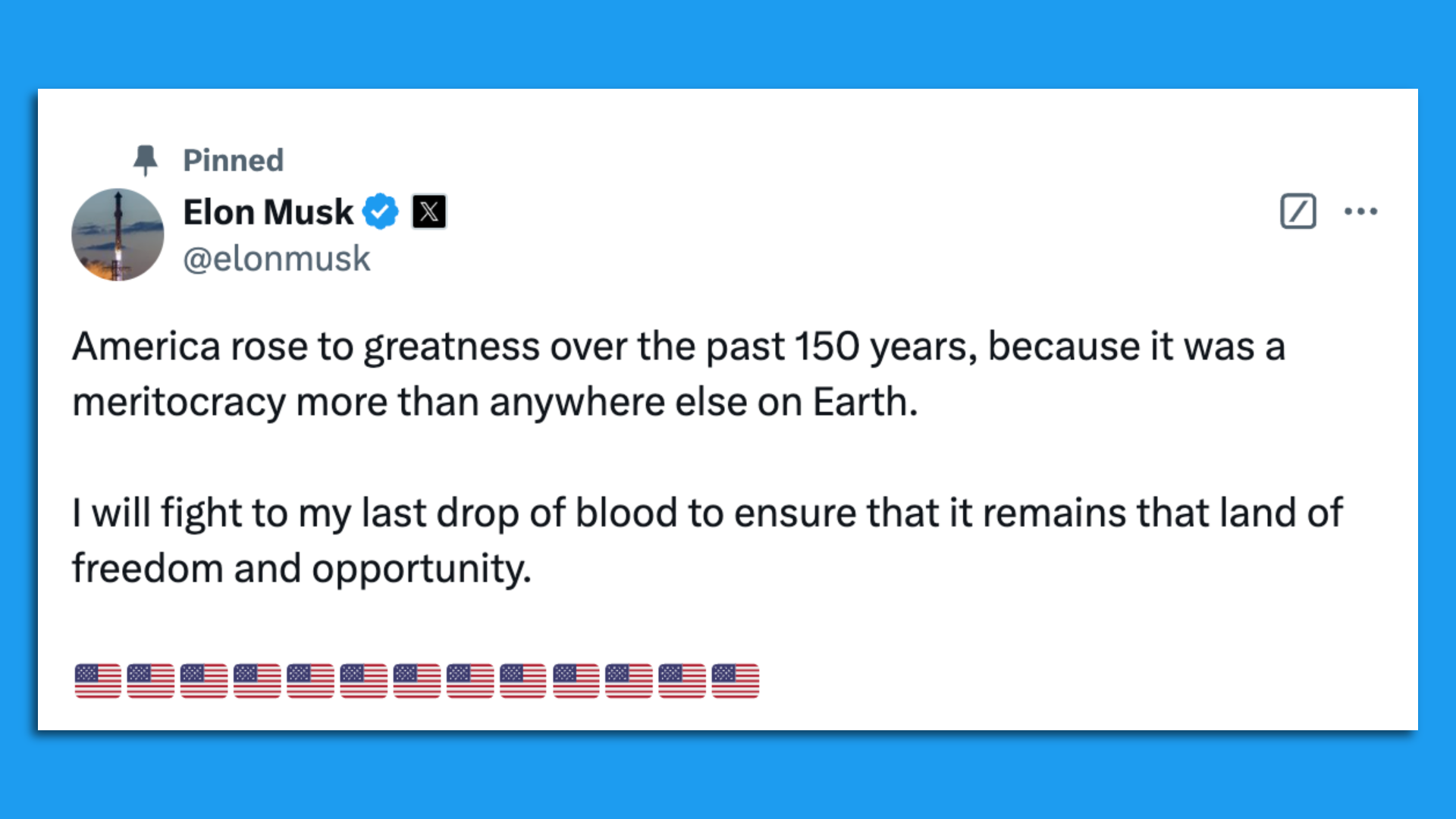
Nothing revs up MAGA like the chance to dunk on DEI — diversity, equity and inclusion. DEI-bashing is the core of the “anti-woke” theology. MAGA warriors want a true color/gender-blind meritocracy, they say. Why it matters: MAGA’s DEI unity has hit a big snag. Elon Musk — a MAGA fanboy and fav until this past week — and others on X are arguing forcefully that in a true meritocracy, you’d pick harder-working foreigners for high-skilled gigs over less-qualified Americans. Steve Bannon and many MAGA originals consider this apostasy —basically another high-end, rich-guy way to screw the working-class voters behind the Donald Trump movement. Welcome to the new frontier of the DEI. Musk tweeted last evening: “The point was not to replace DEI, which is one form of racism/sexism, with a different form of racism/sexism, but rather to be a meritocratic society!”🖼️ The big picture: N.Y. Times columnist David Brooks points out this isn’t a “discrete one-off dispute.”“This is the kind of core tension you get in your party when you do as Trump has done: taken a dynamic, free-market capitalist party and infused it with protective, backward-looking, reactionary philosophy,” Brooks writes.“We’re going to see this kind of dispute also when it comes to economic regulation, trade, technology policy, labor policy, housing policy and so on.” Lead story of today’s N.Y. Times, front-page story of today’s Washington Post💣 The latest: Musk vowed last night to “go to war” to defend the H-1B visa program for foreign tech workers, branding some Republican opponents as “hateful, unrepentant racists,” Axios’ Ben Berkowitz writes.Why it matters: The MAGA-DOGE civil war that erupted over the last 48 hours has hit a tipping point, with President-elect Trump’s new techno-libertarian coalition of billionaires taking full aim at his base.Trump faces a deepening conflict between rich, powerful advisers — and the people who swept him to office.Steve Bannon, one of the longest-tenured voices in Trump’s orbit, had multiple guests on his show this week to talk about his hardline anti-H-1B views. Bannon tells Axios he helped kick off the debate with a now-viral Gettr post calling out a lack of support for the Black and Hispanic communities in Big Tech. Lead story of today’s N.Y. Times, front-page story of today’s Washington Post💣 The latest: Musk vowed last night to “go to war” to defend the H-1B visa program for foreign tech workers, branding some Republican opponents as “hateful, unrepentant racists,” Axios’ Ben Berkowitz writes.Why it matters: The MAGA-DOGE civil war that erupted over the last 48 hours has hit a tipping point, with President-elect Trump’s new techno-libertarian coalition of billionaires taking full aim at his base.Trump faces a deepening conflict between rich, powerful advisers — and the people who swept him to office.Steve Bannon, one of the longest-tenured voices in Trump’s orbit, had multiple guests on his show this week to talk about his hardline anti-H-1B views. Bannon tells Axios he helped kick off the debate with a now-viral Gettr post calling out a lack of support for the Black and Hispanic communities in Big Tech. |
A Plurality Made Up of the Inconsistently Aggrieved
Trump won by assembling a portfolio of the ill informed, the gullible, and people who had a big grievance—or thought they had a grievance.
Example (only one among many): Latinos who were butt hurt because new undocumented asylum seekers were getting work permits and drivers licenses while earlier undocumented immigrants were not. See PBS Wisconsin, Resentment among immigrants over newer arrivals helped boost Trump for Latino voters: Across the United States, Latino immigrants who have been in the country a long time felt that asylum-seekers got preferential treatment
A lot of the voters motivated by that particular grievance were family members or friends of the earlier undocumented community—the very people that Steven Miller and his ilk long to deport.
Surprisingly, it turns out that putting together a plurality of the inconsistently aggrieved was a winning strategy. Unsurprisingly, trying to govern based on a coalition of people with diametrically opposed views is going to be a big, big problem.
The video linked above—based on events of the last few days—illustrates the point very well.
A Note on the Midas Touch Network
During the election season, I watched them from time to time. As far as I can tell, they were earning viewers by continually making the case that the good guys were beating the bad guys—right up until the point when the bad guys won the election. Now, they may be trying to earn viewers by exaggerating the problems that Trump will have governing.
Be that as it may, I can tell you what I am, and am not, trying to do in these posts. I am not intentionally selecting facts just to make our side feel good. I am trying to be objective.
So go ahead and reach for that shaker of salt. Take a little. And then enjoy watching the video.
“People Aren’t Anti-Immigrant, They’re Anti-Chaos”
Hard Truths About How the Immigration Mess Happened, Hard Truths About the Current Political Environment
Frank Sharry elaborates on the Dec. 16, 2024, piece in the Atlantic that he wrote with Cecelia Munoz, How Democrats Lost Their Way on Immigration: The party once championed an approach popular with voters and politicians alike. Why give up on it?
Why indeed? Well, as Sharry explains, there were lots of reasons: Republican bad faith, especially back in 2013, plus lots of misjudgments and political malpractice on the liberal side.
But it’s got to get fixed.
Frank Sharry is an immigration activist and advocate. If you’re interested, check out his Wikipedia article. As a point of personal privilege, I was happy to learn that he’s a Princeton man. As we used to say back in the day: “Princeton in the Nation’s Service.”
Preaching From Matthew 25 While Jesús Cleans the Church—For Very Little Money

Here are the key points.
First, there was a big, big bump in immigration under Biden.
Second, that big, big bump noticeable downward pressure on wages for all types of unskilled workers in the United States. See my previous post.
Third, Trump thinks the resulting anger among Latino and other voters was what put him over the top in the 2024 election—and, for once, Trump is almost surely right.
Fourth, lots of people like me were reluctant to crack down on undocumented immigrants. After all, didn’t Rabbi Jesus teach us to welcome the stranger? And didn’t Exodus and Leviticus in the Hebrew Scriptures teach us the very same thing?
Conclusion?
It’s a win-win situation!
Opening the floodgates to undocumented immigrants is the right and moral thing to do!
And we economically comfortable folks get to benefit from cheap labor.
Like I said, a win-win.
And if unskilled working class people here in the United States see their wages depressed, well then, they had just better reread what Jesus said in Matthew 25, learn to share, and not be so picky about what wages they receive. If they have to choose between paying the rent and buying groceries, that’s just the burden they have to bear in order to do the right thing and welcome the stranger.
Oh Wait! That Sounds Like Hypocrisy!
It sounds like prosperous progressives are using purported morality as a cover for economic oppression of the working class.
Maybe we should all cover ourselves in sackcloth and ashes, rend our garments, and spend the next six months in profound contemplation of our own wickedness.
No! No! No! No! No!
Listen up, folks. Here’s the takeaway message.
We are in a political crisis. Trump and his enablers have leveraged concern over immigration to get the electorate to vote for a proto-fascist regime.
If your house is on fire, you put out the damn fire before you start to think deeply about what caused the fire.
Contemplating our own alleged hypocrisy at length is a luxury we can no longer afford.
Establishing a fine moral balance between the worth of a poor person in Guatemala versus a not quite so poor person here in the United States is, likewise, something that we cannot afford to do.
What we MUST do—well in advance of the 2026 election—is to work with the Latino community to develop a politically acceptable solution.
More posts on this issue to follow soon.
Posted by Ron Davis, Dec. 16, 2024
Facing MAGA on Immigration

Rogé Karma, Why Democrats Got the Politics of Immigration So Wrong for So Long: They spent more than a decade tracking left on the issue to win Latino votes. It may have cost them the White House—twice.
I want to make two distinct points about facing MAGA on immigration. I believe that each of my two points is terribly important. (You might not share that opinion, and if you don’t share it, then bless your heart. It’s a free country—at least for the moment.)
Point One: Really Bad Situational Awareness and Strategy
That aptly named Mr. Karma, who is a staff writer for The Atlantic, offers up a lengthy, thorough, and brutal exposition of the Democratic political malpractice that led to the loss of Latino support in 2024 and to the catastrophic Trump victory.
Although I am no expert on the topic, I find Karma’s analysis persuasive. If you are interested in Democratic victories going forward, then I urge you to read it.
Point Two: A Vital Missing Piece of the Analysis—What’s the Right Thing to do About Immigration?
The immigration question is really two issues: 1) What legal standards ought to govern who can, and who cannot, immigrate to the United States, and how are these legal standards best enforced? 2) What should be done about the 11 million plus undocumented people who already live here? Should all of them be deported? Some of them? If only some of them, how to decide who gets to stay and who has to leave?
These are hard questions. Very hard questions. In large measure, because many considerations need to be taken into account in answering them. And because those considerations point in all sorts of different directions.
One of these considerations, among many others, is what is politically feasible. What proposed answers can someone of good will, acting in good faith, present to the American people and obtain their consent?
Because no matter how fair and wise your preferred approach might be, trying to push that approach without public buy-in will only make matters worse.
And conversely: shouldn’t you at least try to identify a sound, moral policy and then see whether you can sell that policy? Shouldn’t you try that approach first, before leaping into a discussion about which bumper sticker slogan is most likely to sell?
And, by the way, I don’t fault Mr. Karma for writing an article on political inside baseball rather than an article on what is good and sound public policy. He and his editors get to choose the topic on which they want to write.
I’m just saying: realize that any analysis of political inside baseball, no matter how fine the analysis, needs to be married to good, defensible public policy.
Posted by Ron Davis, Dec. 10, 2024
 Facing MAGA