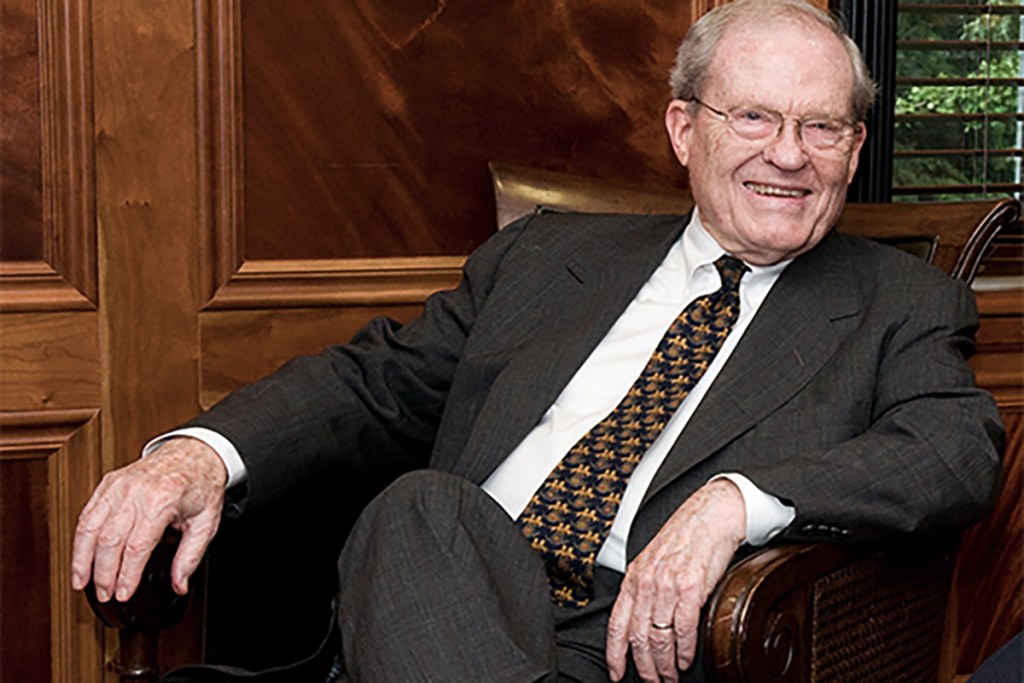
Jim Laney, 98, is a former president of Emory University, a former ambassador to South Korea, and a person I am honored to call my friend. Reproduced below is an article discussing Dr. Laney’s views on the current relationship between South Korea and the United States. The piece is by S. Nathan Park, an international business litigator, expert on international relations, and a contributor to Foreign Affairs, The Atlantic, and many other publications.
U.S.-South Korea Relations Are at Breaking Point
The Iran war has confirmed how little Washington cares for its ally’s welfare.
By S. Nathan Park, a Washington-based attorney and nonresident fellow of the Quincy Institute for Responsible Statecraft.
Few U.S. experts are as respected in South Korea as James Laney, former U.S. ambassador to the country. Laney first went to Korea in 1947 as an army intelligence officer and returned in 1959 as a Methodist missionary. Two of his three daughters were born in the country, which was recovering from the devastating Korean War. After serving as president of Emory University for 16years, Laney served as the U.S. ambassador in Seoul from 1993 to 1997, playing an important role in diffusing the North Koreannuclear crisis in 1994.
Yonsei University, one of South Korea’s most prestigious universities, has a James Laney chair professorship as well as a James Laney lecture series, which features the most prominent minds in U.S.- Korea relations.
So it was no small news when the 98-year-old former ambassador offered a blunt assessment of the current state of the SouthKorea-U.S. alliance on March 5, as he received the 2026 Building Bridges Award from the Pacific Century Institute (where I am a board member). In an event usually filled with fluffy grace notes, Laney’s prerecorded remarks offered a cold-eyed analysis that left the audience—which included former South Korean President Moon Jae-in—stunned:
“The [United States] has unilaterally turned the bridge [of the U.S.-Korea alliance] into a drawbridge, with controls only on theUnited States side. Even when the bridge is down, the gates, that is, tariffs, are controlled by Washington, and the entire edifice operates at the whim of a United States president.
“It grieves me to say it. Boy, I never thought I would have to say it. But I think Korea must begin to project its future on its ownterms. Of course, it will do so wisely and prudently, but its interests are no longer congruent with those of the White House.
“What this means for troop command, independent nuclear capability and relations with China will require political skill anddeftness of extraordinary range. … [U.S. President Donald] Trump has made it abundantly clear that the [United States] is solely concerned with its own interest. Anything else is for the gullible.”
Laney verbalized what many Korea analysts have been thinking but were too afraid to say: the U.S.-South Korea alliance is close to rupturing, and Washington is at fault. Thanks to the Trump administration’s actions, Seoul must reconsider the fundamentalbuilding blocks of the alliance, including U.S. troop presence in South Korea, a nuclear umbrella instead of its own nucleararmament, and participation in U.S. deterrence of China.
One may disagree with Laney’s prescription, but his diagnosis is unassailable: Trump has shown no regard toward the value of thealliance. Trump’s 25 percent tariff against South Korea’s exports is a flagrant violation of the 2007 U.S.-Korea Free TradeAgreement, as well as the 2025 negotiation between the two countries to set tariffs at 15 percent. The latter agreement was coupled with South Korea’s pledge to invest up to $350 billion in U.S. industries, but the Trump administration could not even gracefully accept the financial boon.
In September 2025, U.S. immigration authorities conducted a thuggish raid on a Hyundai factory that was under construction in Georgia. The South Korean public watched in shock as hundreds of South Korean engineers, most of whom had valid employment visas, were shackled in chains on live television. Even Chosun Ilbo, South Korea’s leading conservative daily paper with a staunch pro-U.S. stance, wrote in an editorial that the raid was “unacceptable between allies” and “raised fundamental questions as to what the United States means by ‘alliance.’”
Trump’s reckless war may be the straw that breaks the camel’s back, pushing the U.S.-South Korea alliance to the point of no return. Laney prepared his remarks before Trump began the attack on Iran, but his warning proved unusually prescient.
The Iran war has imposed significant costs on South Korea. More than 70 percent of South Korea’s crude oil imports pass through the Strait of Hormuz, which is now blockaded. So dire is the petroleum shortage in South Korea that the government has limitedthe operation of government-owned vehicles and is weighing restriction on driving—a drastic measure unseen since the 1997 Asian financial crisis.
Petroleum by-products are also affected. With no crude oil to process, South Korea’s refineries have been shutting down one by one, leading to a critical shortage of naphtha—the raw ingredient for all plastic products, including paint and plastic bags. The same is happening with helium, a by-product of liquefied natural gas and an essential material for semiconductor manufacturing.South Korea’s stock market had been flying high thanks to its world-leading semiconductor companies, but the possibility of losing up to 90 percent of its helium imports from Qatar has sent its market tumbling.
But the intangible costs of the war may be even harder. For the first time in its existence as an independent nation, South Korea is genuinely doubting whether the United States can in fact make good on its security guarantee. The Iran war was the moment whenthe U.S. military was supposed to show its might on a real-life battlefield. But since the rubber met the road, the United States has been reduced to watching helplessly as Iran blockades the Strait of Hormuz and Iranian missiles hit the glittering skyscrapers of Dubai and oil refineries in Saudi Arabia.
To be sure, South Korea has a much stronger self-defense capability than the United Arab Emirates or Saudi Arabia. (The UAE, infact, uses South Korea’s M-SAM Cheongung-II missile defense system.) But it only takes a short mental jump for South Koreans to imagine a potential conflict between China and Taiwan, and Chinese missiles raining down on the high-rises in Seoul because of the U.S. military presence in South Korea.
One move in particular made the Trump administration seem pathetic to South Koreans. Because of his inability to prevail over Iran, Trump had to resort to redeploying the United States’s Terminal High Altitude Area Defense (THAAD) missile defense system from South Korea to the Middle East, while begging South Korea to send its navy to the Persian Gulf. The redeployment of THAAD is particularly galling for South Koreans; in 2017, after allowing the United States to deploy THAAD on South Korean territorydespite China’s objections, Seoul suffered boycotts and trade restrictions imposed by Beijing. These wreaked havoc on large SouthKorean companies that were operating in China, such as Lotte, while the United States (then under the first Trump administration) stood pat and did nothing.
What good is the U.S. security guarantee against China when the United States cannot even handle a middle power such as Iran? What was the point of suffering through China’s economic retaliation to deploy THAAD in the name of upholding the U.S.-South Korea alliance when the United States makes a mockery of that suffering by unilaterally pulling THAAD to a different corner of theworld? What good is a guarantor that asks you to spend your resources to cover the liability it created?
For many South Koreans, the logical move seems to be what Laney counsels: take full control of the South Korean military (over which the United States currently has joint wartime operational control,) develop nuclear weapons, and seek better relations withChina while downgrading the U.S. alliance to a transactional relationship.
From a U.S. perspective, there is no good time for weakened alliance, but this moment could not be worse. In a world where Chinais the top geopolitical rival of the United States, South Korea may well be the U.S.’s most indispensable ally. Camp Humphreys in Pyeongtaek, South Korea, is the largest overseas U.S. military base, and the closest one to mainland China.
In nearly all future-oriented technology industries where China is poised to overtake the United States—including semiconductors, electric vehicle batteries, nuclear power, and advanced shipbuilding—South Korea holds technology and capacity that the United States simply does not have. For too long, Washington has arrogantly assumed that Seoul could not afford to walk away from thealliance. It should have been asking if the United States could afford not to have South Korea as an ally.
Rupture in the U.S.-South Korea alliance is not a foregone conclusion. But to forestall this unwanted future, Washington must begin a full reverse from its current path of economic sanctions over allies and military adventurism that disrupts the global supply chain. The full reverse must come from all component parts of the U.S. government. Congress must exercise its oversight, and the judiciary must continue declaring Trump’s unilateral tariffs and undemocratic power grabs illegal.
The same is true for U.S. foreign-policy experts. It is a failure of the Korea expert community in Washington that a 98-year-oldformer ambassador is virtually the only one with the courage to speak up about the damage Trump is causing to the alliance, while the leading think tanks are cowed into silence. If nothing is done to stop Trump, Laney’s dire predictions will become grim reality.
 Facing MAGA