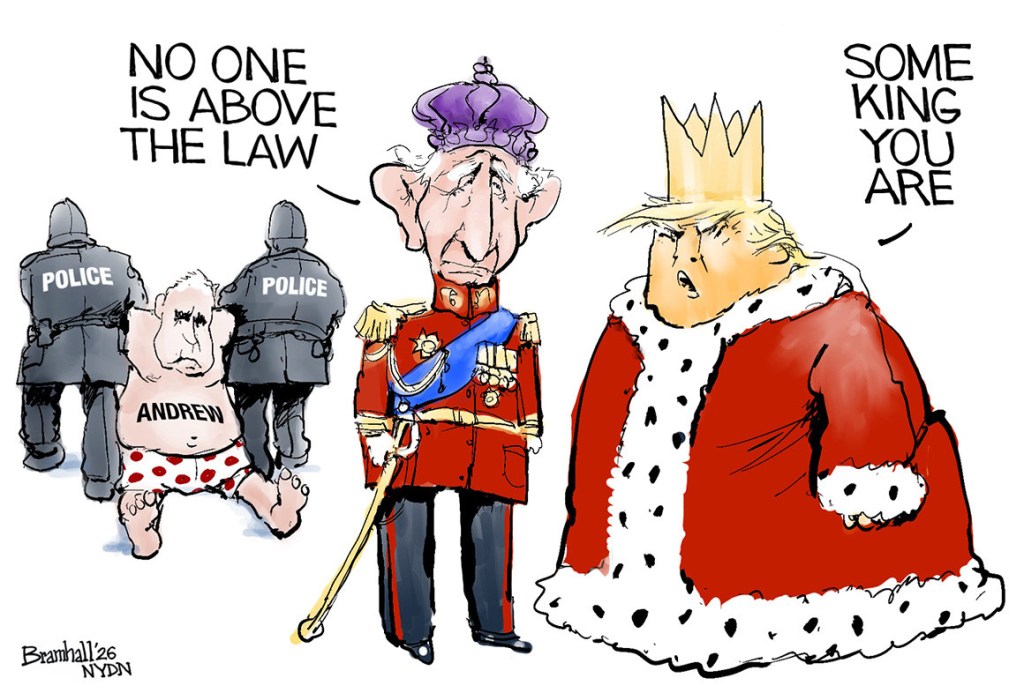
Some King You Are!

With clear eyes, hard facts, critical thinking, new political strategy, empathy, and a soupçon of Schadenfreude
The Trigger Warning: Some readers will be triggered by prose that, read superficially, might sound sympathetic to Chief Justice Roberts and to his sidekicks, Justices Coney Barret and Kavanaugh. Such readers may want to skip this post. In any event, they are requested not to throw food in my direction. Or, if they must, please pick the corn muffins we’re getting tonight, and take a pass on the bean soup and the pistachio pudding.
The Multiple Disclaimers: In this post, I’m not in the moralizing business, I’m not in the mind reading business, and I’m not in the prediction business. Not that moralizing, mind reading, and prediction are unimportant. They’re just not what I’m trying to do here. Here, I’m in the hypothesizing business. I’m in the trying-to-understand business.
You can generally count on the three liberal justices to do the right thing. If you bet that Justices Thomas, Alito, and Gorsuch will do the wrong thing—and that Justice Gorsuch will camouflage the wrong thing with extensive verbiage made to superficially resemble legal scholarship—then you’re likely to win your bet. In the middle, that leaves the Chief Justice, along with Justices Coney Barrett and Kavanaugh. These three generally decide who’s going to win the case.
And, by the way, when I say “middle faction,” the word “middle” is not intended to be either favorable or pejorative. It just means they’re literally in the middle of the other two factions.
It appears that the rubber will soon meet the road, and that the Supreme Court is going to make some definitive rulings on, among other things,
In introduced this topic in the immediately preceding post, which you may wish to read now, before proceeding further.
There are many reasons why it’s a vexed question. In the first place, the Court’s behavior contradicts what we learned in civics class—back when they taught civics in high school. We have checks and balances. When the president violates the law, the courts are supposed to check him. And indeed, lots of district courts and courts of appeal HAVE been checking Trump—but without a lot of support from the Supreme Court on its shadow docket.
Relatedly, the shadow docket is a vexed question from a technical legal standpoint. The Court is ruling on the validity of lower court decision on whether to grant a preliminary injunction pending trial and appeal, and that p.i. issue, in turn, is supposed to depend, in large measure, on “likelihood of success on the merits.” If the district court grants a p.i. against some Trump outrage, and if the court of appeals affirms, and if the Supreme Court majority then reverses the ruling, so that Trump can go on engaging in whatever horseshit he wants, pending trial, does that mean that the Supreme Court thinks Trump is right on the law and all the lower court judges are wrong?
Does it mean that the Supreme Court majority doesn’t give a tinker’s damn about checks and balances?
Does it mean that the majority wants to live in a country governed like Russia and Hungary?
Well, maybe it does mean some or all of those things.
I continue to focus here on the middle faction of the Supreme Court—Justices Roberts, Coney Barrett, and Kavanaugh—not on the three wingnuts, and not on the three liberals. An alternative hypothesis to explain the middle faction’s strange behavior would go something like this.
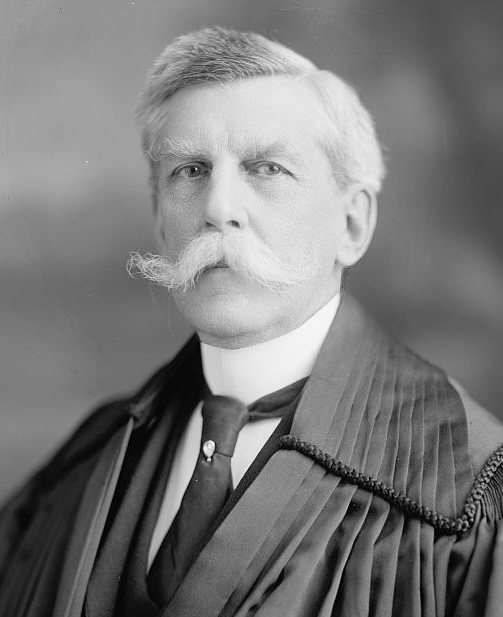
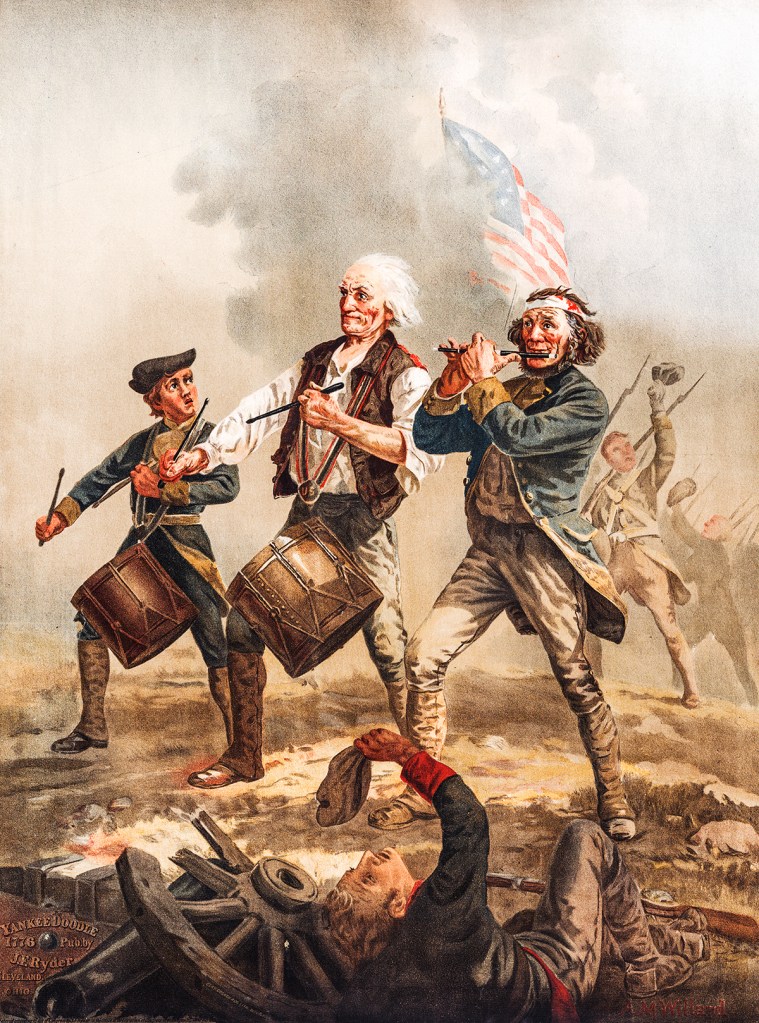
The middle faction would prefer to live in a constitutional republic governed under law, not in Hungary or Russia, but they are mindful that, to achieve that end, they have to preserve a certain level of public deference to court decisions. And, as Justice Oliver Wendell Holmes, Jr. (pictured above) said a century ago, the Court reads the newspapers.
Having read the newspapers, the middle faction knew that a reelected, pumped up Trump was going to try to grab power in all sorts of ways. They knew that if the Supreme Court intervened immediately and forcefully, there would likely follow an immediate and grave constitutional crisis.
The hypothesis continues: The middle faction reasoned that, instead of an immediate constitutional crisis, it would be better to wait a season; let the whole country, including the MAGA base, get a full taste of Trump’s policies; and let Trump’s political support dissipate.
2026, not 2025, would be right year for strong action to preserve the rule of law. Or so they thought, in the hypothesis presented here.
Remember, y’all, it’s a hypothesis. There’s no mind reading, there’s no moralizing, and there’s no prediction about how the Court will actually decide all those issues I mentioned above.
As far as predictions go, to quote the sage observation of President Eisenhower, “The future lies ahead.”
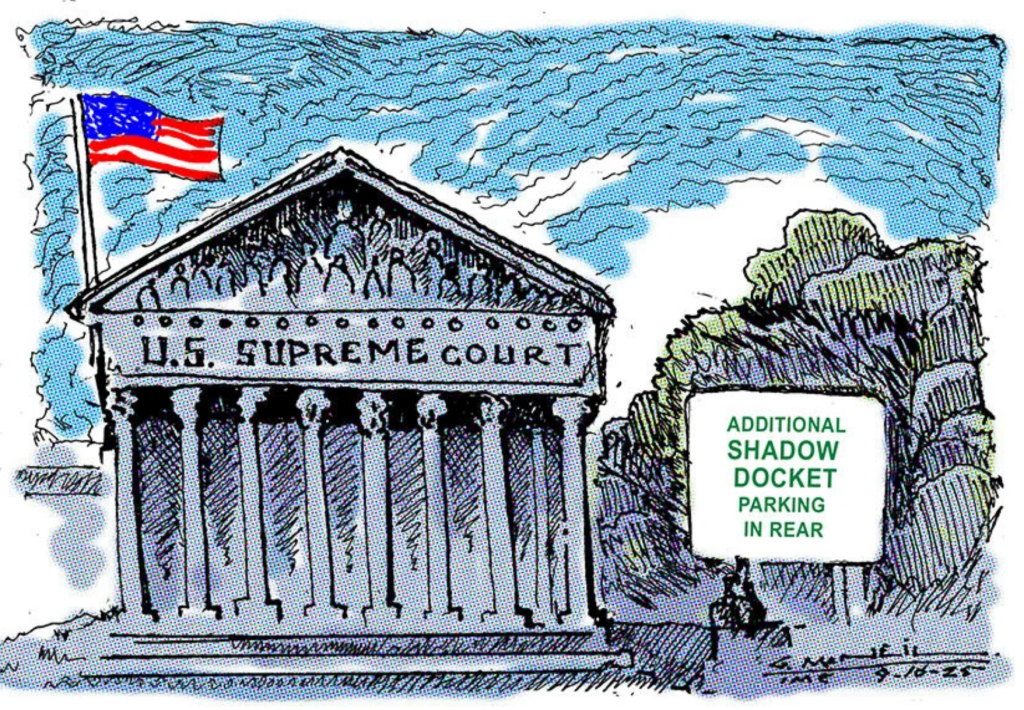
Something weird is going on at the Supreme Court. In my next post, I’m going to lay out a hypothesis about what that might be. Here, I need to lay the predicate for that discussion.
The shadow docket consists of cases where the Supreme Court reviews lower court decisions that have either granted or denied temporary relief, pending a trial, a decision on the merits, and appeal of the decision in the ordinary course.
In most of these cases, the lower courts have either granted a preliminary injunction or they have denied a preliminary injunction.
Trials take a long time, appeals take even longer, and in the meantime you may suffer a lot of harm due to behavior that you say is illegal. Your uncle may be departed to El Salvador. Trump may have fired you from the Federal Trade Commission because you are a Democrat. Your business may be going bankrupt because of high tariffs that Trump has illegally imposed.
A preliminary injunction is intended to preserve the status quo, preventing that injury, pending a final resolution of the dispute.
When a party to a case wants a preliminary injunction, the court is supposed to ask four questions.
1. Considering the facts and the law, which party is more likely to win the case, down the road?
2. If the preliminary injunction is denied, how much harm will be caused, and is that harm irreparable?
3. And what about the potential harm to the other side, if the preliminary injunction is granted?
4. Finally, in this private dispute between two parties, where does the public interest lie?
That’s the legal theory. In practice, the first factor—often called “likelihood of success on the merits”—tends to predominate.
In other words, if a district judge grants a preliminary injunction, that often means that she thinks the defendant is behaving illegally. If she denies the request, that usually implies that, in her view, the plaintiff doesn’t have a good legal case.
Yes. The Federal Rules of Civil Procedure provide that a federal district court is legally obligated to explain its reasoning in granting or denying a requested preliminary injunction. The main rationale for that rule is that, without a reasoned explanation, a court of appeals can’t make an informed decision about whether the district judge was right or wrong.
No, it is not. However, before Trump, the Court normally did explain, at least briefly, how it thought likelihood of success on the merits and the other three factors applied to the case at hand.
In a recent article, Erwin Chemerinsky, constitutional law expert and dean of the law school at U.C. Berkeley, explained,
The Supreme Court always has had an emergency docket to hear requests such as those for last-minute stays of execution in death penalty cases. But it has grown greatly in recent years, and last year saw an exponential increase in orders from the shadow docket. In the October 2023 term, the court resolved 82 matters on its emergency docket. But in the October 2024 term, by June 27, 2025—the last day opinions were handed down—it had resolved 107 matters on its emergency docket. By the time the term officially ended when the new term began on Oct. 6, 2025, the court had decided 140 matters on its emergency docket.
Some of this increase is because of the many cases involving challenges to President Donald Trump’s administration’s initial actions that made it to the Supreme Court. But that does not explain all of the dramatic increase. I think that there is a simple explanation for why the shadow docket has grown: the court’s willingness to rule on matters on its emergency docket. The more the court is willing to give relief on an emergency basis, the more parties will go to the justices for stays of lower court decisions, such as of preliminary injunctions.
There is much to be concerned about in the growth of the shadow docket. Matters are decided without full briefing and without any oral argument. Yet in 2025, the Supreme Court indicated that lower courts were obligated to follow its shadow docket rulings. In several important cases, the court handed down orders without any written opinion, giving no guidance to the lower courts and making the decisions seem an arbitrary exercise of power since no reasons were given for the conclusions. In some cases, the court appeared to disregard detailed factual findings by lower courts and abandon the usual standard for emergency relief: the need for a showing of irreparable injury. …
There have been dozens of rulings by the court on its emergency docket concerning lower-court preliminary injunctions against Trump administration actions. In almost every case, the Supreme Court—virtually always in a 6-3 ruling—has stayed the preliminary injunction and ruled in favor of President Trump. These decisions have included the Supreme Court staying lower court orders stopping the firing of agency officials, ordering the reinstatement of terminated federal grants, forbidding deportations to South Sudan of individuals with no contact with that country, preventing U.S. Immigration and Customs Enforcement agents from stopping people without reasonable suspicion, and keeping the State Department from requiring that passports list a person’s birth sex rather than gender identity. …
In a ruling on the emergency docket, in United States v. Shilling, the court, once more 6-3, stayed a district court’s preliminary injunction and allowed President Trump to bar transgender individuals from serving in the military. Neither the majority nor the dissenting justices wrote an opinion.

Yesterday, May 16, the Supreme Court issued another ruling in the case of the Venezuelan people than Trump wants to deport to a gulag in El Salvador; read the opinion here. I posted about this case on April 19,April 20, and April 22.
The May 16 decision consists of (1) an eight-page unsigned (“per curiam”) opinion on behalf of the Chief Justice, the three Trump-appointed justices, and the three liberal justices, (2) a two-page concurring opinion by Justice Kavanaugh, and (3) a 14-page dissenting opinion by Justice Alito, joined by Justice Thomas.
Although the majority, per curiam opinion did not use words such as “bad faith,” “fibbing,” or “too cute for words” in describing the Justice Department’s position, it clearly implied that the government attorneys were prevaricating with the Supreme Court about the government’s plans to whisk the plaintiffs away—and then claim the Court had no jurisdiction as to individuals located in a foreign country.
The Court ordered, once again, that the Venezuelans should stay in this country pending further legal proceedings, and it remanded the case to the Fifth Circuit Court of Appeals for further consideration of how due process should work under the Alien Enemies Act, along with a variety of other considerations.
Justice Kavanaugh agreed with the majority’s analysis but would have kept the case in the Supreme Court and have the Court eschew further shilly-shallying, and just decide the damn case.
In his dissent, Justice Alito enlarged ad nauseam on the multiple ways in which the majority’s truncated, expedited procedure is in tension with the way things are normally done. As indeed they are. No shit, Sherlock. The government was lying to the courts, frog-marching the poor Venezuelans out of the country, and employing every bad faith trick in the books to use the normal, deliberative rules of the law of civil procedure in order to forestall real due process for immigrants.
Let’s look at the situation from 30,000 feet. What do we see?
First, Team Trump’s legal strategy—along will all the legal tactics that flow from that strategy—is to replace rule of law with a Ptemkin village that looks, from the outside, something like rule of law, but is not in fact rule of law.
Second, that legal strategy is doomed to failure unless a critical mass of the judiciary—and particularly a critical mass of the justices of the Supreme Court—are prepared to go along with it. (Sure, Trump could just order the police to arrest or kill all the members of the Supreme Court, and if the police obey the order, then Trump would win. But in that situation, the outcome would not be a legal Potemkin village, but rather a legal wasteland.)
Third, Team Trump seems to have thought that Justices Alito and Thomas, plus the three Trump-appointed justices would embrace the Potemkin village approach. Well, if that’s what Team Trump thought, then it appears they were right about Alito and Thomas but wrong about Kavanaugh, Gorsuch, and Barrett.
The real news here—the Man Bites Dog element—is that the three Trump-appointed justices did not bark in the night at Trump’s command.
Logical conclusion: the days are hastening on to the place where Team Trump is either going to have to back down on multiple legal fronts or it is going to have to declare, in words that are clear to the least intelligent folks among us, that the rule of law is over.
If it choose the latter option, it will be subject to vehement objections by all the Trump justices appointed in the first term–as well as a great many of the Trump Judes appointed to the courts of appeal and to the district court.
The unvarnished assault on the rule of law will come at a time when Walmart is running out of cheap goods, then Americans are being injured in multiple ways by cuts in government services, when small businesses are going out of business, and when Walmart is running out of cheap imported goods.
Please read these remarks in light of my comments, right below, on the character of judges.
By now, we have all read a lot about the authoritarian playbook. If, by and large, judges can’t be intimidated, can’t be bought, and can’t be fooled, then, presumably, the next step in the authoritarian playbook would be to start arresting them.
We are now conditioned to look for that sort of thing to start happening. We hear that, a couple of days ago, the FBI arrested a state judge out in Milwaukee for something having to do with immigration. Our confirmation bias kicks in, and the chorus all proclaim in unison, “Well, the fascism is now beginning in earnest!”
To add to the circus atmosphere, Attorney General Blondi goes out in public to do her cosplay fascist act—encouraging us to fear that federal judges who follow the constitution and demand due process might risk arrest, too. See Aaron Blake (Washington Post), Pam Bondi’s striking comments on arresting judges.
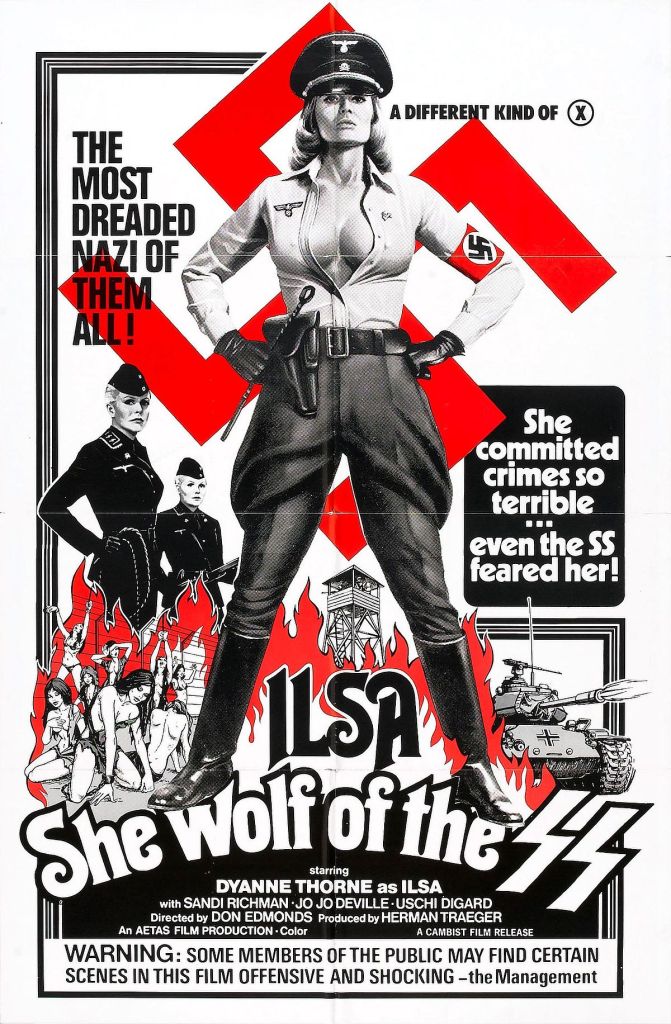
As a side observation: most humans, myself included, try to make ourselves look morally better than we really are. But that seems to be going out of fashion. Now the Attorney General of the United States wants everyone to think she is Ilsa, the She Wolf of the SS.
A sign of the times, I suppose.
We now return to our regularly scheduled program.
Back in Milwaukee, Judge Dugan, learning that ICE was about to snatch one Eduardo Flores-Ruiz—a misdemeanor criminal defendant in a case before her— allegedly showed Señor Flores-Ruiz how to get out the side door, thereby delaying his capture by ICE by a few minutes.
I don’t know how many people witnessed this incident. I don’t know whether they all remember it the same way. I don’t know what Judge Dugan’s account is; I don’t know what she says she did or didn’t do, and I don’t know what she says about her her intent. Accordingly, I have no rational basis to reach a conclusion as to what actually went down.
I don’t know—because I haven’t researched the matter, and I don’t intend to do so—what are the words of the statutes that Judge Dugan is supposed to have violated. Nor do I know how these words have been interpreted in judicial decisions (“case law,” as we call it). I don’t know whether Judge Dugan’s conduct clearly violated the law, clearly did not violate the law, or fell into an ambiguous gray area. I don’t know whether she will claim to have consciously run a legal risk to herself in order to advance a higher moral principle. If she does make such a claim, I don’t how whether the evidence will back up her claim.
But here is something I do know. I do know that it would be unwise for our side to be tricked into arguing that “lawless behavior by our guys is OK, while lawless behavior by your guys is not OK.”
Instead, we should just reserve judgment on the facts and the law in this case, agree that everybody who breaks the law should be punished—and that, sometimes, people who decide to break the law to promote righteousness should suffer legal punishment. And then we should erect a statue in their honor.

I think sounds of silence signal that the legal part of Team Trump is having a terrible, horrible, no good, very bad weekend.
Meanwhile, an insightful op-ed in the N.Y. Times speaks of a recently invented right wing legal principle—the major questions doctrine, newly discovered as a conservative cure for perceived liberal excesses—that requires “clear congressional authorization” when the bureaucrats make decisions of great “economic and political significance.” Otherwise, bye-bye liberal policy adventuresomeness.
Now, Orange Mussolini is the poster child for one who makes decisions of great economic and political significance without a ghost of a shadow of congressional authorization.
Will the courts apply their new major questions doctrine in an intellectually consistent way? Stay tuned. We’ll find out in due course. See Aaron Tang, Will This Conservative Legal Doctrine Undo Trump’s First Months in Office?
Enquiring minds want to know.
David French (N.Y. Times), The Supreme Court Can’t Save America, but Here’s What It Can Do
Mr. French writes,
Millions of Americans are desperate for a quick and effective response to Trump’s attacks on the Constitution. But the election foreclosed that possibility. The courts — even if they have the courage — lack the power to save America.
In this moment, think of the courts as a rear guard, capable of delaying constitutional collapse until the American people finally understand that the life and health of the Constitution is up to them. If they keep electing men like Trump or sycophants like those in his Congress of cowards, then we’ll lose our Republic.
But if a critical mass of Americans do wake up, then the court’s stand will be indispensable to justice and — critically — accountability. Every public official associated with Trump’s defiance of the courts (including his vice president, JD Vance) should be impeached, convicted and barred forever from holding public office.
I know that’s a fantastical vision in the present moment. In a closely divided country, impeachment and removal aren’t viable options, but supermajorities among Americans have existed before. The civil rights movement, empowered in part by the Supreme Court, attained a supermajority that changed America, and a movement to preserve the Constitution can be a supermajority again.
We can’t ask the Supreme Court to do more than it’s able to do, but it must do all that it can. The choices it will face may well be as stark as the choice between segregation and equality, or between internment and freedom.
The court’s past failures have destroyed lives and put our Republic in mortal danger. Its past courage has inspired revolutionary change. Unless Trump backs down, it will face the same choice the court faced in 1954 — yield in the face of enormous resistance or stand even when the politicians fail.
Quinn Emanuel Urquhart & Sullivan is a top ranked business litigation law firm. King & Spalding is a top corporate and litigation firm; one good source ranks them as #24. Here is the letter that two of their partners signed on behalf of Harvard and sent to Team Trump:
April 14, 2025
VIA ELECTRONIC MAIL
Josh Gruenbaum
Commissioner of the Federal Acquisition Service General ServicesAdministration
Sean R. Keveney Acting General Counsel
U.S. Department of Health & Human Services
Thomas E. Wheeler Acting GeneralCounsel
U.S. Department of Education
Dear Messrs. Gruenbaum, Keveney, and Wheeler:
We represent Harvard University. We are writing in response to your letter dated April 11, 2025, addressed toDr. Alan Garber, Harvard’s President, and Penny Pritzker, Senior Fellow of the Harvard Corporation.
Harvard is committed to fighting antisemitism and other forms of bigotry in its community. Antisemitism and discrimination of any kind not only are abhorrent and antithetical to Harvard’s values but also threaten its academicmission.
To that end, Harvard has made, and will continue to make, lasting and robust structural, policy, and programmatic changes to ensure that the university is a welcoming and supportive learning environment for allstudents and continues to abide in all respects with federal law across its academic programs and operations, whilefostering open inquiry in a pluralistic community free from intimidation and open to challenging orthodoxies,whatever their source.
Over the past 15 months, Harvard has undertaken substantial policy and programmatic measures. It hasmade changes to its campus use policies; adopted new accountability procedures; imposed meaningful discipline for those who violate university policies; enhanced programs designed to address bias and promote ideological diversity and civil discourse; hired staff to support these programs and support students; changed partnerships; dedicatedresources to combat hate and bias; and enhanced safety and security measures. As a result, Harvard is in a verydifferent place today from where it was a year ago. These efforts, and additional measures the university will be taking against antisemitism, not only are the right thing to do but also are critical to strengthening Harvard’scommunity as a place in which everyone can thrive.
It is unfortunate, then, that your letter disregards Harvard’s efforts and instead presents demands that, incontravention of the First Amendment, invade university freedoms long recognized by the Supreme Court. The government’s terms also circumvent Harvard’s statutory rights by requiring unsupported and disruptive remedies foralleged harms that the government has not proven through mandatory processes established by Congress and required by law. No less objectionable is the condition, first made explicit in the letter of March 31, 2025, that Harvard accede to these terms or risk the loss of billions of dollars in federal funding critical to vital research and innovation that has saved and improved lives and allowed Harvard to play a central role in making our country’sscientific, medical, and other research communities the standard-bearers for the world. These demands extend notonly to Harvard but to separately incorporated and independently operated medical and research hospitals engaging in life-saving work on behalf of their patients. The university will not surrender its independence or relinquish its constitutional rights. Neither Harvard nor any other private university can allow itself to be taken over by the federal government. Accordingly, Harvard will not accept the government’s terms as an agreement in principle.
Harvard remains open to dialogue about what the university has done, and is planning to do, to improve the experience of every member of its community. But Harvard is not prepared to agree to demands that go beyond thelawful authority of this or any administration.
William A. Burck Robert K. Hur
Quinn Emanuel Urquhart & Sullivan, LLP King & Spalding LLP
1300 I Street NW 1700 Pennsylvania Avenue NW
Suite 900 Suite 900
Washington, DC 20005 Washington, DC 20006
April 2025
Dear President McInnis, Provost Strobel, and Members of the Yale Board of Trustees:
We stand together at a crossroads. American universities are facing extraordinary attacks that threaten the bedrock principles of a democratic society, including rights of free expression, association, and academic freedom. We write as one faculty, to ask you to stand with us now.
We urge you to:
We stand united, asking for your courageous leadership. We look forward to standing alongside you in this work.
Signed,
[Yale faculty of all ranks can sign this letter here.]
Susman Godfrey is possibly the best litigation law firm in the country. And they are being punished for successfully holding Fox News to account for its election lies.
If anybody can make Trump eat shit, these are the folks to do the job.
We shall see what we shall see. In the meantime, the firm had this to say:
In response to the executive order filed by the administration on April 9th, 2025, Susman Godfrey has issued the following statement:
“Anyone who knows Susman Godfrey knows we believe in the rule of law, and we take seriously our duty to uphold it. This principle guides us now. There is no question that we will fight this unconstitutional order.”
A point of personal privilege: I was among the late Steve Susman’s ten thousand closest friends. (Actually, it could have been more than ten thousand; I don’t rightly know.) And I am damn proud of it, too.
From wherever he is in the bardo, Steve is urging his living partners to hang in—and whispering litigation tricks into their shelflike ears.
 Facing MAGA