President Trump took a broad swing at the [legal] industry Friday night after three earlier orders punishing Paul Weiss and two other firms. In a presidential memorandum, he broadly accused law firms of abusing the legal system to challenge his policies, stymie immigration enforcement and pursue partisan causes. He instructed Attorney General Pam Bondi to seek sanctions in court against lawyers and firms who engage in “frivolous, unreasonable and vexatious litigation.”
Trump also directed Bondi to launch a broad review of conduct by lawyers in litigation against the government over the last eight years to determine whether additional firms should face the same type of punishments he has issued already, most notably the termination of government contracts held by firm clients.
Administration officials already have built a list of more than a dozen law firms they might target with executive orders, and Trump has expressed eagerness in signing more of them, according to people familiar with the planning.
Trump’s latest pronouncement landed particularly hard in an industry that was still processing Paul Weiss’s decision to cut a deal with the White House rather than challenge the administration in court. Trump on Thursday rescinded his order against the firm after it agreed to provide $40 million in pro bono legal services to support the administration’s initiatives, such as assisting veterans and fighting antisemitism.
Several law-firm chairs and senior partners said they were working to calm clients and employees, with younger associates increasingly calling for lawyers to take a stand against Trump. Some firm leaders said their clients—and their fellow partners—were split on whether they would rather their firms take a deal if targeted or fight it out in court. A number of firms were trying to draw distinctions to clients between their work and the activities of the firms that Trump has punished already. Corporate lawyers with a connection to the Trump administration have been tapped to open communication lines with the White House, and several firms were seeking to engage lobbyists, people familiar with the discussions said.
Paul Weiss chairman Brad Karp spoke with other firms’ leaders in recent days and told them he found the deal with the White House distasteful but said he had little choice but to take it, according to people familiar with those conversations.
“Clients had told us that they were not going to be able to stay with us, even though they wanted to,” Karp told firm lawyers and employees in an internal email Sunday viewed by the Journal. “It was very likely that our firm would not be able to survive a protracted dispute with the Administration.”
One firm, Perkins Coie, which was hit with a Trump executive order on March 6, continued to lead the fight against the administration over the weekend.
“Now more than ever law firms and lawyers across the political spectrum have to stand up for our timeless values,” David Perez, a Perkins Coie partner said on LinkedIn. The Paul Weiss agreement, he said, emboldened Trump “to ratchet up his attack on one of the strongest checks on his power: lawyers and the rule of law.”
Perkins Coie sued the administration on March 11 and won a restraining order against the administration, with a judge saying the executive order was likely unconstitutional. But while the firm is winning in court, it is struggling to manage the fallout behind the scenes.
Perkins is losing clients who fear Trump’s wrath, and a number of top companies that work with the firm have called other firms about representation, people familiar with the matter said. One of the people said some competing lawyers have made sympathetic calls to Perkins to say they aren’t trying to steal the firm’s clients and would step aside if those clients wanted to return to Perkins after the situation calmed down.
An effort across a number of firms to file a court brief in support of Perkins continues to flounder because not enough firms are willing to sign it, for fear of antagonizing the administration, people familiar with those negotiations said.
San Francisco-based Keker, Van Nest & Peters urged law firm leaders “to resist the administration’s erosion of the rule of law.”
“Our liberties depend on lawyers’ willingness to represent unpopular people and causes, including in matters adverse to the federal government,” the firm said. “An attack on lawyers who perform this work is inexcusable and despicable.”
Trump’s campaign in part has been focused on paying back opponents. Perkins, for example, worked with Hillary Clinton’s presidential campaign and an opposition-research firm that compiled a discredited dossier against Trump. Covington & Burling, another firm hit with an executive order, provided legal counsel to former special counsel Jack Smith. And Trump cited Paul Weiss’s previous ties to Mark Pomerantz, who also worked on the Manhattan district attorney’s investigation into Trump and his business.
But the president’s Friday memorandum also signaled Trump’s broader frustrations with lawyers challenging his initiatives in court—and winning. His administration is currently locked in a showdown with a Washington federal judge over Trump’s invocation of wartime powers to deport alleged Venezuelan gang members. A number of the president’s other initiatives have been put on hold by the courts, including the termination of thousands of government employees and limits on birthright citizenship and transgender rights.
Public-interest legal organizations and smaller firms have been leading many of those cases.
Sid Davidoff, a New York lawyer who was famously on President Richard Nixon’s “enemies list,” said industry leaders were caving to pressure.
“You have some top notch firms, significant legal minds, and they’re just being whipped,” Davidoff said. “I guess they are trying to protect their bottom line, but it’s really upsetting.”
A deeply researched article on the goings on at Paul Weiss, based on lots of things, including the thoughts of the firm’s managing partner, who tries to tell his side of the story.
Here are some questions. (As I said, I’ll give my personal answers in later posts; others may have different answers than mine.)
Is the “agreement” between Trump and Paul Weiss legally enforceable—and does it even purport to be legally enforceable?
What did Paul Weiss actually “agree” to do?
What lies did Trump tell about the “agreement”?
In addition to the points in the agreement, what points are missing? In other words, what hound dogs are not barking in the night?
When the managing partner of Paul Weiss walked out of his meeting with Mango Mussolini, did the said managing partner think, “Man o man, did I just snooker Trump”?
What did Trump actually want from the “agreement,” and did he actually get the thing that he actually wanted?
Did Mr. Karp, Paul Weiss’s managing partner, overlook the forest for the trees?
Big law firms like Paul Weiss compete in three important dimensions. (1) They compete for the business of rich clients with legal issues. (2) They compete for associates (salaried junior lawyers); central to their business model is hiring able associates, paying them a lot of money—i.e., buying their time at wholesale—and then marking up their time to sell at retail, at exorbitant hourly rates. (3) They compete to steal partners with good “books of business” from other firms, and they strive to keep the partners they have from walking out the door. How will the Trump “agreement” impact Paul Weiss’s ability to engage effectively in these three modes of competition?
Paul Weiss probably expects to hire several dozen new associates from the graduating law class of 2025. How will the Trump “agreement” affect the thinking of those potential new hires? How will it affect their incentives to join—or not to join—Paul Weiss? How many of the 2025 law grads who have Paul Weiss offers are actually going to show up at the firm this summer? How many will decide to look for work elsewhere?
Would it be in the collective self-interest of the big firms to take the “Trump factor” out of their competition for corporate business, their competition for able associates, and their competition for partners?
In the next two weeks or so, is Paul Weiss likely to turn around and modify its position?
If a lot of the big firms decide, on reflection, that they would collectively be better off to stand together against Trump, what steps might they take to implement that decision?
In the next two weeks or so, is it likely that many of the big law firms will come to the epiphany that they need—in their own stone cold self-interest—to take collective action to support the rule of law?
Is Perkins Coie likely to win or lose in its lawsuit against Trump—and would one or more amicus briefs likely affect the outcome substantially?
President Lizard Brain seems to think he can head off the lawsuits against him—there are now well over a hundred, and he’s losing most of them—by punishing the lawyers who represent plaintiffs with legal positions adverse to him. But is there in fact there a constitutional right to sue? And does a litigant have a legal right to counsel of their choice? And is it lawful for the government to punish someone for exercising a constitutional right?
Is collective action against Trump by the major law firms a matter of life and death for democracy and the rule of law, or is it more like Kabuki theater?
If rule of law is ultimately to be preserved, what three factors will achieve the preservation?
And apart from that, how did you enjoy the play, Mrs. Lincoln?
Well, yeah. But I think there are actually two sides to this coin.
Two Sides to the Coin: Who Will or Won’t Obey Which Orders?
Well may we ask, how do the courts enforce their orders when Trump tells his minions to violate the law?
But, by like token, when Trump tells his team to violate the law, how many of them will actually do it?
Let’s wargame this out.
Some on the Trump team are lawyers—actual members of the bar. Lawyers who engage in contempt of court—not to mention other violations like subornation of perjury or obstruction of justice—face fines, imprisonment, and disciplinary actions up to and including disbarment.
If you are a lawyer, there will probably come a time when a client will pressure you to violate the law or demand that you violate the law. You had bloody well not do it. It’s the wrong thing to do. But even if you don’t give a tinker’s damn about right or wrong, it’s still a really bad idea to violate the law on a client’s behalf.
Now, to push our little thought experiment to the next step: Maybe you are a member of the bar who has drunk deeply of the MAGA Kool-Aid. Maybe you think that a Trump dictatorship would be just fine and dandy. But are you SURE that the leap toward dictatorship is actually going to work?
Because, friend, if Trump doesn’t pull off his dictatorship, then you are going to be left up that famous tributary without a means of locomotion.
If you are a lawyer, you will be subject to disbarment, and will need to find another line of work—animal husbandry, maybe?
If you are not a lawyer, you can’t be disbarred—you were never “barred” in the first place—but there are plenty of other adverse consequences that could ensue.
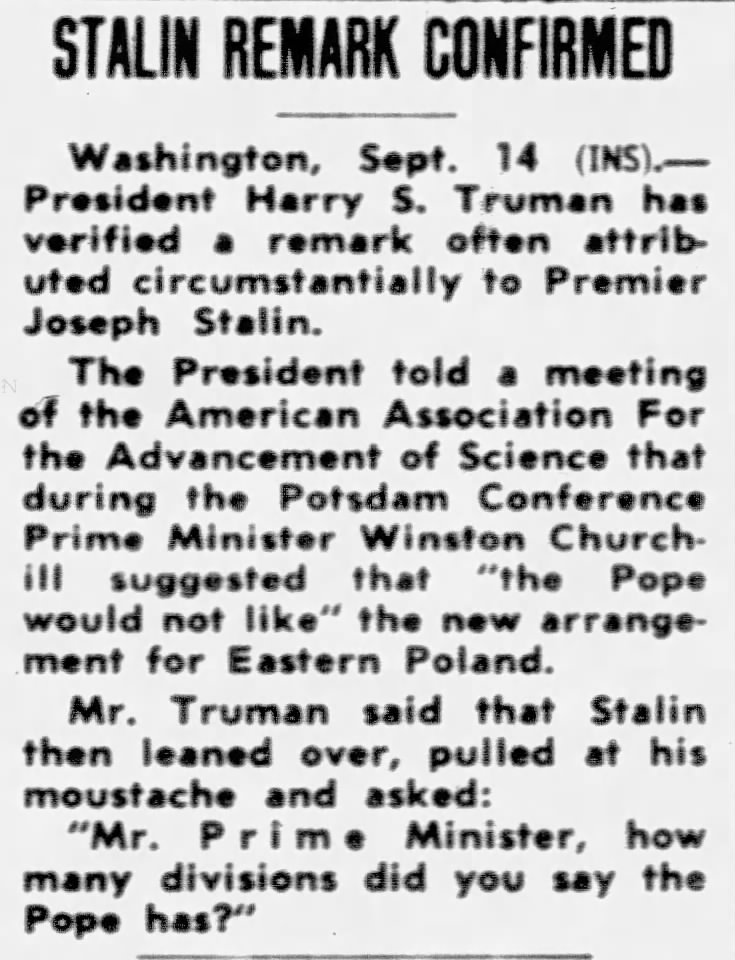
In short, Conway is surely right as far as he goes: Just because the Supreme Court says “Jump,” that doesn’t mean that everyone in the land will ask “How high, sirs?”
But the same thing goes if and when Trump says “Jump—into defiance of the rule of law!” Lots of people will jump. But how many will not jump?
And Then There are the Knock-on Effects …
As Conway says, when push comes to shove, there will be a lot of folks out in the streets. But it won’t only be folks in the streets. Read the damn WSJ Editorial Board, for example: If the rule of law disappears and it becomes a jungle out there, how the hell can big business enforce its contracts—or have enough certainty to invest and thrive?
What will Trump do when every Fortune 500 CEO comes for him?
… At a Time When There is Massive Pain Throughout Society
If you’re Mango Mussolini and you want to go full authoritarian, maybe you don’t want to pick a time when government breakdowns are hurting your peeps and when trade wars are causing big pain.
Not a Rosy Scenario—But a Damn Uncertain Scenario
No, my name is not Rosy Scenario, and of course I don’t know how all of this is going to turn out. But I do know, to a high level of confidence, that there are a whole lot of moving parts—and a lot of those moving parts may not move in Trump’s direction.
The key to understanding this morning’s Supreme Court ruling unfreezing American foreign aid is that two different rulings are at issue here, and teasing apart those technicalities reveals a loss that is perhaps more significant for the Trump administration than is first apparent.
The two orders both come from U.S. District Court Judge Amir Ali. There’s his underlying temporary restraining order (TRO), which remains in effect (and which the government has neither tried to appeal nor sought emergency relief from), and then there’s his more specific order, which purported to enforce the TRO by obliging the government to pay somewhere from $1.5 billion to $2 billion of committed foreign-aid funds by February 26. It was that order that the government tried to appeal, and from which it sought emergency relief first in the D.C. Circuit Court and then in the Supreme Court. By issuing an “administrative stay” last Wednesday night, Chief Justice John Roberts temporarily absolved the government of its obligation to comply with that order—but not with the underlying TRO, which generally requires the government to spend money that Congress has appropriated for foreign-aid funding.
Against that backdrop, the Court’s ruling today is more than a little confusing. Let’s start with what’s clear: A 5–4 majority (with Chief Justice Roberts and Justice Amy Coney Barrett joining the three Democratic appointees) denied the government’s application to vacate Judge Ali’s enforcement order. The Court’s ruling contains only one meaningful sentence, and it is maddeningly opaque:
“Given that the deadline in the challenged order has now passed, and in light of the ongoing preliminary injunction proceedings, the District Court should clarify what obligations the Government must fulfill to ensure compliance with the temporary restraining order, with due regard for the feasibility of any compliance timelines.”
This sentence (or, perhaps, an earlier draft of it) provoked a fiery and more than a little hypocritical eight-page dissent from Justice Samuel Alito, joined in full by Justices Clarence Thomas, Neil Gorsuch, and Brett Kavanaugh. But before getting to the dissent, let me try to read a couple of tea leaves out of this cryptic but important passage.
First, I think it’s meaningful that the majority denied the government’s application rather than dismissing it as moot. In English, that is the majority signaling that the government likely still must comply with the “pay now” order—the second of the two—albeit not on the original timeline. If the majority thought that the “pay now” order was no longer live because the deadline had come and gone, then the proper disposition would have been to dismiss the application as moot, not to deny it. (Indeed, although there are good reasons to not rely upon dissents to figure out what the majority held, Alito’s dissent seems to reinforce this reading.) This may seem like a very thin reed, but it’s a distinction I can’t imagine was lost upon the justices. The majority (and, apparently, the dissent) seems to agree that the government remains under not just the general obligation of the original TRO but the specific obligation of the “pay now” order.
Second, the clause about the district court clarifying the obligations that the government must fulfill to comply with the TRO strikes me as an invitation to Judge Ali to do exactly that—to issue a more specific order that (1) identifies the particular spending commitments that he believes the government must honor to comply with the TRO and (2) gives the government at least a little more than 48 hours to do so. The upshot is that, even if the Trump administration doesn’t have to pay the money immediately, it will have to do so very soon. That’s small solace to the organizations and people who have already had their lives upended by the spending freeze, but it’s a bigger loss for the Trump administration than the text may suggest.
Third, the timing of the ruling is striking. The Court handed down the order right at 9 a.m. this morning—less than 12 hours after the end of President Donald Trump’s address to Congress last night. It is just about impossible to imagine that the ruling was still being finalized overnight (or that the chief justice was somehow influenced by his awkward moment with Trump). If not, then there appears to have been at least some choice on the Court’s part to hand down the ruling after the president’s speech and not before it at the close of business yesterday—perhaps to avoid the possibility of Trump attacking the justices while several of them were in the audience. I’ve written before about the problem of the Court timing its rulings—and how it underscores the extent to which the justices are, and ought to admit that they are, playing at least some politics even with what should be a straightforward procedure for releasing rulings when they’re ready. This at least seems like it might be another example.
And fourth, here’s that 5–4 lineup again. Back in January, I wrote about how this particular 5–4 alignment (the chief justice, Justice Barrett, and the three Democratic appointees) is starting to show up in cases “in which the Chief Justice’s elusive but not illusory institutional commitments, and Justice Barrett’s emerging independence, are separating them from the other Republican appointees. For a host of reasons that I suspect are obvious, we may see more such cases sooner rather than later.”
On one hand, it’s a bit alarming that Kavanaugh joined the dissent. On the other hand, for those hoping that the Court is going to be a bulwark against the (mounting) abuses of the Trump administration, it’s a cautiously optimistic sign that there may well be at least five votes to support lower-court rulings attempting to rein in those abuses.
In many ways, the dissent is far more illuminating than the majority’s order. As is unfortunately often the case with respect to Alito’s dissents from emergency applications, this one combines a remarkable amount of hypocrisy with statements that are either materially incorrect or, at the very least, misleading.
On page three of the ruling (page two of the dissent), for example, Alito writes that “the Government must apparently pay the $2 billion posthaste—not because the law requires it, but simply because a District Judge so ordered.” Of course, this completely misstates both the theory of the plaintiffs’ lawsuits and the gravamen of Judge Ali’s order. The whole point is that the law does require it—that Congress has mandated the spending and that the contractual obligations have been fulfilled. Indeed, Judge Ali’s “pay now” order is about work already completed for which the money was already due. If there is authority for the proposition that the government is not legally obliged to pay its bills, Alito doesn’t cite it. Yes, there may be separate questions about the courts’ power to compel the government, but that’s not the same thing as whether the “law requires” the government to pay its bills. Do the dissenters genuinely believe that the answer is no?
Alito also makes much out of the argument that sovereign immunity bars the claims against the government. But the Supreme Court has already held that relief under the Administrative Procedure Act can run to whether the government is obliged to pay expenditures to which the recipients are legally entitled. Alito asserts that actually ordering the government to pay those expenditures is something else entirely; suffice to say, I think that’s slicing the bologna pretty thin. His argument would have more force if Judge Ali’s “pay now” order was about funds for which the administrative processes haven’t fully run. But here, they have. And so it’s just a question of whether federal courts have the power to force the government to … enforce the law.
In that respect, contrast Alito’s analysis here with his dissenting 2023 opinion in United States v. Texas—in which he would have upheld an injunction by a single (judge-shopped) district judge that effectively dictated to the executive branch what its immigration-enforcement priorities must be. In explaining why the Biden administration should lose, he wrote:
“Nothing in our precedents even remotely supports this grossly inflated conception of “executive Power,” which seriously infringes the “legislative Powers” that the Constitution grants to Congress. At issue here is Congress’s authority to control immigration, and “[t]his Court has repeatedly emphasized that ‘over no conceivable subject is the legislative power of Congress more complete than it is over’ the admission of aliens.” In the exercise of that power, Congress passed and President Clinton signed a law that commands the detention and removal of aliens who have been convicted of certain particularly dangerous crimes. The Secretary of Homeland Security, however, has instructed his agents to disobey this legislative command and instead follow a different policy that is more to his liking.”
In 2023, Alito dismissed the view that courts could not push back against the president in such cases as a “radical theory.” In 2025, apparently, it’s correct. I wonder what’s changed?
Finally, Alito offers what I would euphemistically call a remarkable discussion of why the harm that the plaintiffs are suffering is insufficient to overcome the government’s case for a stay:
“Any harm resulting from the failure to pay amounts that the law requires would have been diminished, if not eliminated, if the Court of Appeals had promptly decided the merits of the Government’s appeal, which it should not have dismissed. If we sent this case back to the Court of Appeals, it could still render a prompt decision.”
In other words, the plaintiffs are being harmed not by the government’s refusal to pay them but by the D.C. Circuit’s refusal to exercise appellate jurisdiction over Judge Ali’s “pay now” order. I don’t even know what to say about this argument other than that, if that’s how irreparable harm worked, well, emergency relief (and the role of intermediate appellate courts) would look a heck of a lot different.
Alito closes by accusing the majority of imposing “a $2 billion penalty on American taxpayers.” This comes back to the central analytical flaw in the dissent: The “penalty” to which Alito is referring is the government’s underlying legal obligation to pay its debts. Debts aren’t a penalty; they are the literal cost of doing business. And if this is the approach that these four justices are going to take in all of the spending cases to come, that’s more than a little disheartening.
As for what comes next, well, I’m not entirely sure. We know that Judge Ali is scheduled to hold a preliminary injunction hearing tomorrow. It is very possible that before then (or shortly thereafter) he will reimpose some kind of “pay now” mandate that, with the hints from the Supreme Court majority, is a bit more specific and has a slightly longer timeline. Of course, the government could seek emergency relief from that order, too, but I take today’s ruling as a sign that, so long as Judge Ali follows the Court’s clues, at least five justices will be inclined to deny such relief. That doesn’t do anything immediately for the plaintiffs and other foreign-aid recipients who are continuing to suffer debilitating consequences. But it does suggest that, sometime soon, the government really is going to have to pay out at least some of the money at issue in these cases (and, as important, perhaps other funding cases too).
The broader takeaway, though, is that this is now the second ruling (the first was Dellinger) in which the Court has, in the same ruling, moved gingerly but at the same time denied the relief that the Trump administration was seeking. Two cases are, obviously, a small data set. But for those hoping that even this Supreme Court will stand up, at least in some respects, to the Trump administration, I think there’s a reason to see today’s ruling as a modestly positive sign in that direction.
Yes, the Court could do even more to push back in these cases. But the fact that Trump is already 0–2 on emergency applications is, I think, not an accident, and a result that may send a message to lower courts, whether deliberately or not, to keep doing what they’re doing.
In a couple of hours, my wife will be having a pointed discussion with the local tax assessors over the value of her apartment. The condos in our building vary a whole lot in size, layout, and many other features. But guess what? It turns out that the thing that best predicts the sale price is the number of square feet in the condo. If you know that number, then you have a very good idea of the condo’s fair market value.
Why in the world make that point? Because, let me humbly submit, while people vary in all sorts of ways, the one thing that best predicts their behavior is their incentives.
I was in Big Law for a long time. Some of the people I knew were fine human beings. Some, I’m sorry to say, had the morality of a sea slug. But, like the rest of the human race, most of them were somewhere in the middle, morality-wise.
I am confident that, for some of those who wrote and promoted the New York City Bar Association’s statement on the Adams case, promoting justice and good government was a driving concern. I am equally confident that the objective incentives of the Bar Association’s members was a driving force, as well.
Let me put it bluntly.
If the legal system breaks down, ain’t nobody gonna pay you no $2.5 million for your skilful manipulation of the legal system.
Danielle Sassoon, Esq., a graduate of Harvard College and of Yale Law School, a former clerk for Justice Antonin Scalia, a continuing member in good standing of the Federalist Society, and—for a few weeks, following Trump’s inauguration—temporary chief federal prosecutor in Manhattan, has resigned. She took this action because she could not, in good conscience, obey her masters’ orders to go into court and ask for dismissal of the criminal case against Eric Adams, in circumstances where there was no proper legal basis for making such a request.
Her resignation letter of February 12, addressed to Attorney General Bondi, spends 7½ pages explaining the baselessness of the position she had been ordered to advocate to the courts. The letter concludes thusly,
I Cannot in Good Faith Request the Contemplated Dismissal
Because the law does not support a dismissal, and because I am confident that Adams has committed the crimes with which he is charged, I cannot agree to seek a dismissal driven by improper considerations. As Justice Robert Jackson explained, “the prosecutor at his best is one of the most beneficent forces in our society, when heacts from malice or other base motives, he is one of the worst.” The Federal Prosecutor, 24 J. Am. Jud. Soc’y 18 (“This authority has been granted by people who really wanted the right thing done—wanted crime eliminated—but also wanted the best in our American traditions preserved.”). I understand my duty as a prosecutor to mean enforcing the law impartially, and that includes prosecuting a validly returned indictment regardless whether its dismissal would be politically advantageous, to the defendant or to those who appointed me. A federal prosecutor “is the representative not of an ordinary party to a controversy, but of a sovereignty whose obligation to govern impartially is as compelling as its obligation to govern at all.” Berger v. United States, 295 U.S. 78, 88 (1935).
For the reasons explained above, I do not believe there are reasonable arguments in support of a Rule 48(a) motion to dismiss a case that is well supported by the evidence and the law. I understand that Mr. Bove disagrees,and I am mindful of your recent order reiterating prosecutors’ duty to make good-faith arguments in support of the Executive Branch’s positions. See Feb. 5, 2025 Mem. “General Policy Regarding Zealous Advocacy on Behalf of the United States.” But because I do not see any good-faith basis for the proposed position, I cannot make sucharguments consistent with my duty of candor. N.Y.R.P.C. 3.3; id. cmt. 2 (“A lawyer acting as an advocate in an adjudicative proceeding has an obligation to present the client’s case with persuasive force. Performance of thatduty while maintaining confidences of the client, however, is qualified by the advocate’s duty of candor to the tribunal.”).
In particular, the rationale given by Mr. Bove—an exchange between a criminal defendant and the Department of Justice akin to the Bout exchange with Russia—is, as explained above, a bargain that a prosecutor should not make. Moreover, dismissing without prejudice and with the express option of again indicting Adams in the future creates obvious ethical problems, by implicitly threatening future prosecution if Adams’s cooperation with enforcing the immigration laws proves unsatisfactory to the Department. See In re Christoff, 690 N.E.2d 1135 (Ind. 1997) (disciplining prosecutor for threatening to renew a dormant criminal investigation against a potentialcandidate for public office in order to dissuade the candidate from running); Bruce A.Green & Rebecca Roiphe, Who Should Police Politicization of the DOJ?, 35 Notre Dame J.L. Ethics & Pub. Pol’y671, 681 (2021) (noting that the Arizona Supreme Court disbarred the elected chief prosecutor of Maricopa County,Arizona, and his deputy, in part, for misusing their power to advance the chief prosecutor’s partisan political interests). Finally, given the highly generalized accusations of weaponization, weighed against the strength of theevidence against Adams, a court will likely question whether that basis is pretextual. See, e.g., United States v. Greater Blouse, Skirt & Neckwear Contractors, 228 F. Supp. 483, 487 (S.D.N.Y. 1964) (courts “should be satisfiedthat the reasons advanced for the proposed dismissal are substantial and the real grounds upon which the application is based”).
I remain baffled by the rushed and superficial process by which this decision was reached, in seemingcollaboration with Adams’s counsel and without my direct input on the ultimate stated rationales for dismissal. Mr. Bove admonished me to be mindful of my obligation to zealously defend the interests of the United States and to advance good-faith arguments on behalf of the Administration. I hope you share my view that soliciting andconsidering the concerns of the U.S. Attorney overseeing the case serves rather than hinders that goal, and that we can find time to meet.
In the event you are unwilling to meet or to reconsider the directive in light of the problems raised by Mr. Bove’s memo, I am prepared to offer my resignation. It has been, and continues to be, my honor to serve as a prosecutor in the Southern District of New York.
Very truly yours,
DANIELLE R. SASSOON
United States Attorney Southern District of NewYork
A Statement by the President of the ABA: Every Lawyer’s Duty
It has been three weeks since Inauguration Day. Most Americans recognize that newly elected leaders bring change. That is expected. But most Americans also expect that changes will take place in accordance with the rule of law and in an orderly manner that respects the lives of affected individuals and the work they have been asked to perform.
Instead, we see wide-scale affronts to the rule of law itself, such as attacks on constitutionally protected birthright citizenship, the dismantling of USAID and the attempts to criminalize those who support lawful programs to eliminate bias and enhance diversity.
We have seen attempts at wholesale dismantling of departments and entities created by Congress without seeking the required congressional approval to change the law. There are efforts to dismiss employees with little regard for the law and protections they merit, and social media announcements that disparage and appear to be motivated by a desire to inflame without any stated factual basis. This is chaotic. It may appeal to a few. But it is wrong. And most Americans recognize it is wrong. It is also contrary to the rule of law.
The American Bar Association supports the rule of law. That means holding governments, including our own, accountable under law. We stand for a legal process that is orderly and fair. We have consistently urged the administrations of both parties to adhere to the rule of law. We stand in that familiar place again today. And we do not stand alone. Our courts stand for the rule of law as well.
Just last week, in rejecting citizenship challenges, the U.S. District Judge John Coughenour said that the rule of law is, according to this administration, something to navigate around or simply ignore. “Nevertheless,” he said, “in this courtroom and under my watch, the rule of law is a bright beacon which I intend to follow.” He is correct. The rule of law is a bright beacon for our country.
In the last 21 days, more than a dozen lawsuits have been filed alleging that the administration’s actions violate the rule of law and are contrary to the Constitution or laws of the United States. The list grows longer every day.
These actions have forced affected parties to seek relief in the courts, which stand as a bulwark against these violations. We support our courts who are treating these cases with the urgency they require. Americans know there is a right way and a wrong way to proceed. What is being done is not the right way to pursue the change that is sought in our system of government.
These actions do not make America stronger. They make us weaker. Many Americans are rightly concerned about how leaders who are elected, confirmed or appointed are proceeding to make changes. The goals of eliminating departments and entire functions do not justify the means when the means are not in accordance with the law. Americans expect better. Even among those who want change, no one wants their neighbor or their family to be treated this way. Yet that is exactly what is happening.
These actions have real-world consequences. Recently hired employees fear they will lose their jobs because of some matter they were assigned to in the Justice Department or some training they attended in their agency. USAID employees assigned to build programs that benefit foreign countries are being doxed, harassed with name-calling and receiving conflicting information about their employment status. These stories should concern all Americans because they are our family members, neighbors and friends. No American can be proud of a government that carries out change in this way. Neither can these actions be rationalized by discussion of past grievances or appeals to efficiency. Everything can be more efficient, but adherence to the rule of law is paramount. We must be cognizant of the harm being done by these methods. No American can be proud of a government that carries out change in this way. Neither can these actions be rationalized by discussion of past grievances or appeals to efficiency. Everything can be more efficient, but adherence to the rule of law is paramount. We must be cognizant of the harm being done by these methods.
These stories should concern all Americans because they are our family members, neighbors and friends. No American can be proud of a government that carries out change in this way.
Moreover, refusing to spend money appropriated by Congress under the euphemism of a pause is a violation of the rule of law and suggests that the executive branch can overrule the other two co-equal branches of government. This is contrary to the constitutional framework and not the way our democracy works. The money appropriated by Congress must be spent in accordance with what Congress has said. It cannot be changed or paused because a newly elected administration desires it. Our elected representatives know this. The lawyers of this country know this. It must stop.
There is much that Americans disagree on, but all of us expect our government to follow the rule of law, protect due process and treat individuals in a way that we would treat others in our homes and workplaces. The ABA does not oppose any administration. Instead, we remain steadfast in our support for the rule of law.
We call upon our elected representatives to stand with us and to insist upon adherence to the rule of law and the legal processes and procedures that ensure orderly change. The administration cannot choose which law it will follow or ignore. These are not partisan or political issues. These are rule of law and process issues. We cannot afford to remain silent. We must stand up for the values we hold dear. The ABA will do its part and act to protect the rule of law.
We urge every attorney to join us and insist that our government, a government of the people, follow the law. It is part of the oath we took when we became lawyers. Whatever your political party or your views, change must be made in the right way. Americans expect no less.
The International Association of Chiefs of Police (IACP) and the Fraternal Order of Police (FOP) have had long standing and positive relationships with both President Trump and President Biden and have greatly appreciated their support of the policing profession. However, the IACP and FOP are deeply discouraged by the recent pardons and commutations granted by both the Biden and Trump Administrations to individuals convicted of killing or assaulting law enforcement officers. The IACP and FOP firmly believe that those convicted of such crimes should serve their full sentences.
Crimes against law enforcement are not just attacks on individuals or public safety — they are attacks on society and undermine the rule of law. Allowing those convicted of these crimes to be released early diminishes accountability and devalues the sacrifices made by courageous law enforcement officers and their families.
When perpetrators of crimes, especially serious crimes, are not held fully accountable, it sends a dangerous message that the consequences for attacking law enforcement are not severe, potentially emboldening others to commit similar acts of violence.
The IACP and FOP call on policymakers, judicial authorities, and community leaders to ensure that justice is upheld by enforcing full sentences, especially in cases involving violence against law enforcement. This approach reaffirms our commitment to the rule of law, public safety, and the protection of those who risk their lives for our communities.



 Facing MAGA