I discussed the executive order on birthright citizenship in the preceding post.
What is a “Nationwide Injunction”?
The term “nationwide injunction” is inapt and misleading, but lots of people want to use it anyway. So let’s define it for present purposes. For present purposes, a “nationwide injunction” is an injunction issued in a case brought by one or more persons (either two-legged persons or juridical persons such as corporations) that protects not only the individual plaintiff(s) but also everyone else in a similar legal position, even though there is no certified “class action” in accordance with Rule 23 of the Federal Rules of Civil Procedure.
As so defined, a nationwide injunction is an end run around the normal requirements for class certification under Rule 23.[1]
To illustrate and explain the point: Plaintiffs in the CASA case include four new mothers and their babies, one pregnant woman and her unborn child, and three undocumented immigrant women who might become pregnant. If the plaintiffs wanted to secure a ruling protecting not only their children but also all children whom Trump threatened to deprive of citizenship, then the normal/traditional route would be to ask the district court to “certify” such a “class” of similarly situated mothers. That class certification process involves a number of inquiries about whether it would be advisable for the litigation to go forward on a class basis, not an individual basis. But Liza, Andrea, and the other expectant mothers asked for nationwide/universal relief, without going through the certification exercise.
Before Trump v. CASA, Was There a Legitimate Legal Controversy about Whether Courts Could Issue “Nationwide Injunctions”?
Yes. Long story. But yes.
In fact, the Biden administration asked the Supreme Court to impose severe limitations on “nationwide injunctions.”
Some Say it was Odd—and Inadvisable—for the Court to Rule on the “Nationwide Injunction” Question but Kick the Can Down the Road on the Substantive Issue of Birthright Citizenship. Do You Agree?
Yes, I do agree. And if anyone reading this post wants to delve deeper, many of the sources cited above will be useful.
But I think the much more interesting question is whether plaintiff can represent a class of similarly situated mothers, babies, and unborn children.
And whether, by so complying with Rule 23, they can find effective legal relief against Trump’s illegal position on birthright citizenship.
What’s Going to Happen Next in the Birthright Citizenship Cases?
I’ll write about that in my next post, which will appear immediately above this one, because the posts on my blog appear in reverse chronological order.
[1] Related, but distinct, issues are raised by lawsuits with plaintiffs claiming to represent a category of other people—for example, a suit brought by a state government on behalf of all its citizen or a suit brought by a trade association on behalf of all its members. Team Trump challenged the “standing” of states and associations to bring such cases, but the Court decided to kick this can down the road.
Some people react to Trump-related Supreme Court decisions the way they react to baseball games. This season Team Trump was down 4 to 2 to Team Resistance, but yesterday Team Trump won, so now he’s only down 4 to 3.
If this is the way you think, then I have two pieces of advice: First, stop thinking this way, and try to figure out what’s actually going on in these court cases.
Second, if you reject my first piece of advice, then don’t count this as a Team Trump loss, because this particular game is far from over.
Hint: Only Justice Jackson disagreed with yesterday’s order. The other two liberals went along with it.
This is a clue.
Here is what the controversy appears to be about. Current law affords any President discretion—and listen up, I said “discretion”—to grant temporary protected status to immigrants who cannot safely return to their country. Recently, Team Trump exercised that discretion to pull protected status from several hundred thousand Venezuelans. Team Trump cited no evidence that conditions in Venezuela had changed for the better. Instead, their discretionary decision was based on factually unsupported bullshit about Tren de Aragua, etc., etc., etc., etc.
Now, what is a court supposed to do with this shambolic mess? Should it rule that a president lacks legal power to exercise lawful discretion if his reasoning is bullshit and arrant nonsense? Or is that approach a bridge too far in terms of constitutional separation of powers?
Yesterday, the Supreme Court decided to kick the can down the road for a mile or two. In July, the Ninth Circuit Court of Appeals is going to hear the case “on the merits” (as we shysters say). And in the meanwhile, individual Venezuelans about to be deported are entitled to a judicial hearing. So observed the Supreme Court in passing.
I’m not a mind reader, but I assume that’s why Justices Kagan and Sotomayor went along with the majority.
So this particular game isn’t over—at least not yet. But I think that the interference-with-presidential-discretion argument may, in the end, carry the day. It’s always problematic to create a legal rule that says, “You are hereby forbidden to act like an asshole and a jerk.” The courts may deem in prudent to retreat to a rule that says “You are hereby forbidden to exercise legal authority that you clearly don’t have.”
And that would mean disaster for more than a million Venezuelans, Haitians, Nicaraguans, and Cubans now residing in the United States–people whose lives may be shattered on the alter of judicial restraint.
It is common ground that, on Friday night, the ACLU sounded the alarm, got the justices out of bed, told them that the Trump Administration had put a bunch of immigrants on buses, that the buses were headed to the airport, where a plane was headed for El Salvador, and that seven of the nine justices believed the ACLU and issued the Midnight Order.
The main issue, for purposes of the weekend, was whether the ACLU was just throwing sand in the Court’s eye, or whether the Administration really was trying to pull a fast one, tying the courts up in the niceties of their own procedures while a bunch of immigrants were headed to the gulag.
Now, as I said, the Solicitor General filed a 15-page weekend brief. And what, pray tell, did the Solicitor General say about the main issue?
He said nothing whatsoever about the main issue. And that is because there was nothing he could say, without either lying through his teeth or expressing open contempt for the Supreme Court.
Ladies and gentlemen, when you are compelled to file a brief that says nothing at all about the key issue then you are indeed having a horrible, terrible, no good, very bad day.
Part of the Solicitor General’s problem was that the Fake News Media had video of the immigrants on the buses – which passed by the exit to the Abilene, Texas, airport, turned around, and delivered the prisoners back to their Texas prison!
Unlike some in the Administration, the Solicitor General has enough sense to know that “who’re you gonna believe, me or your lying eyes?” is not an argument you should make to the Supreme Court.
On April the 18th of 75—that would be 1775—Paul Revere took a midnight ride. Around midnight on April the 18th of 2025, seven justices of the Supreme Court issued an order. The order was addressed to His Most High Excellency, and it declared, in words or substance, “Yo! Numbnuts! Don’t deport no more undocumented aliens without due process! And, by the way, we’re telling you this at midnight on Good Friday, after unusual and truncated legal procedure, because we don’t trust your fat ass any further than we can throw your fat ass. And that ain’t very far. Have a nice day. Love and kisses, The Supreme Court.”
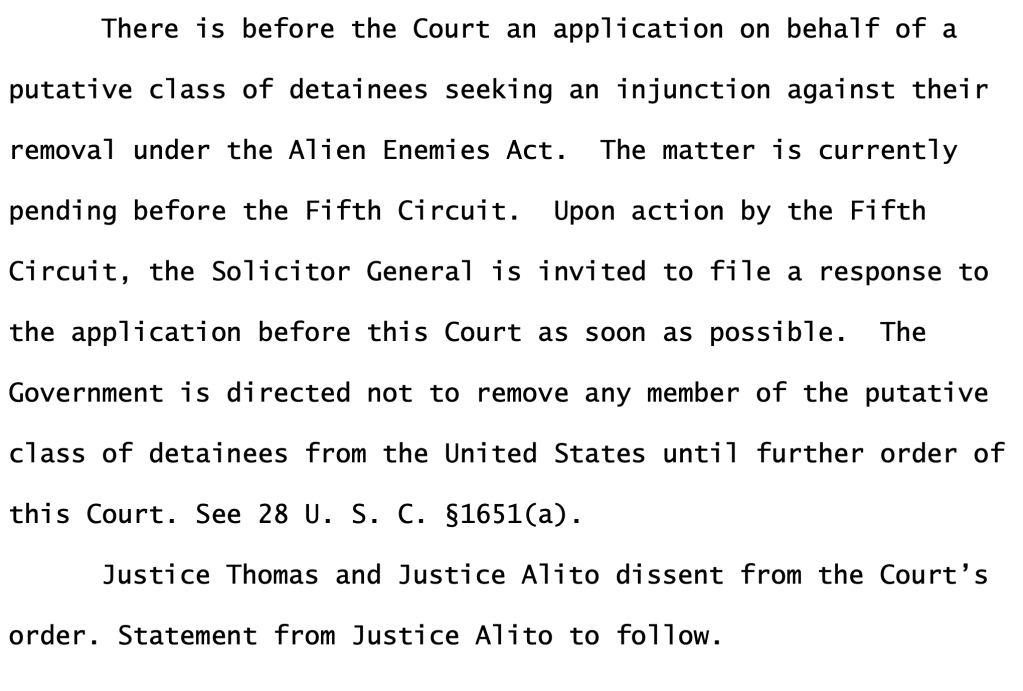
Justices Alito and Thomas dissented, and promised a written opinion. Two days later the written opinion has appeared over the transom.
The First Question About the Dissent
Back on April 7, in Trump v. J.G.G., Justice Kavanagh wrote,
I agree with the Courts per curiam opinion. Importantly, as the Court stresses, the Court’s disagreement with the dissenters is not over whether the detainees receive judicial review of their transfers—all nine Members of the Court agree that judicial review of their transfers—all nine Members of the Court agree that judicial review is available. The only question is where that judicial review should occur. That venue question turns on … [yadda, yadda, yadda, yadda].
But was Justice Kavanagh telling the truth about the actual views of “all nine Members of the Court”? After all, Justices Alito and Thomas are—how to put this?—often idiosyncratic in their views. And their stated dissent to the Midnight Ruling left open the possibility that they might have dissented because they agreed with the Trump Administration on its dictatorial interpretation of the Alien Enemies Act.
The Answer to the First Question
Well, who knows what Alito and Thomas might do or say at some future time. But, as of this afternoon, we do know what they did not say. Their dissent offers no scintilla of support for Trump’s basic claim, or for any hint that Justice Kavanagh might have misdescribed their views of due process and judicial review.
None. Zero. Not a smidgen. Not a soupçon. Bupkis. Rien. Nada.
The Second Question About the Dissent
The second question is: What are we to glean from the fact that the Alito/Thomas dissent goes on, and on, and on, about how the Supreme Court’s Midnight Ruling is inconsistent with a whole variety of arcane rules of civil procedure?
The Answer to the Second Question
The answer is that seven justices do not Trump’s fat ass any further than they can throw Trump’s fat ass.
And they bloody well want him to know that they don’t trust his fat ass.
And they want him to know that if he goes ahead and puts the next fifty Venzuelans on a plane for El Salvador, without notice and a hearing, then the long anticipated full blown constitutional crisis will be upon us.
The Third Question About the Dissent
Well, then, why did Alito dissent?
The Answer to the Third Question
Alito writes, “ I refused to join the Court’s order because we had no good reason to think that, under the circumstances, issuing an order at midnight was necessary or appropriate.”
Translation? Not entirely clear, but one supposes that it wasn’t “appropriate” because it was in such tension with established procedural laws and precents—and it wasn’t “necessary” because, surely, Trump wasn’t going to play games and put those 50 guys on a plane before the Supreme Court could act.
Let me say that, if Justice Alito actually believes that Team Trump wasn’t trying to make a mockery of the Supreme Court, then I have a very nice bridge in Brooklyn that I am prepared to sell, at a very reasonable price.
The Dissent’s Addendum
The dissent ends thusly:
Both the Executive and the Judiciary have an obligation to follow the law. The Executive must proceed under the terms of our order in Trump v. J.G.G., 604 U.S. ___ (2025) (per curiam), and the Court should follow established procedures.
And what, ladies and germs, is “our order in Trump v. J.G.G.”—the order that Justices Alito and Thomas so warmly embrace?
Why, it is, to quote the exact language of the Supreme Court decision, that detainees under the Alien Enemies Act “must receive notice … that they are subject to removal under the Act. The notice must be afforded within a reasonable time and in such a manner as will allow them to actually seek habeas relief in the proper venue before such removal occurs.”
Millions of Americans are desperate for a quick and effective response to Trump’s attacks on the Constitution. But the election foreclosed that possibility. The courts — even if they have the courage — lack the power to save America.
In this moment, think of the courts as a rear guard, capable of delaying constitutional collapse until the American people finally understand that the life and health of the Constitution is up to them. If they keep electing men like Trump or sycophants like those in his Congress of cowards, then we’ll lose our Republic.
But if a critical mass of Americans do wake up, then the court’s stand will be indispensable to justice and — critically — accountability. Every public official associated with Trump’s defiance of the courts (including his vice president, JD Vance) should be impeached, convicted and barred forever from holding public office.
I know that’s a fantastical vision in the present moment. In a closely divided country, impeachment and removal aren’t viable options, but supermajorities among Americans have existed before. The civil rights movement, empowered in part by the Supreme Court, attained a supermajority that changed America, and a movement to preserve the Constitution can be a supermajority again.
We can’t ask the Supreme Court to do more than it’s able to do, but it must do all that it can. The choices it will face may well be as stark as the choice between segregation and equality, or between internment and freedom.
The court’s past failures have destroyed lives and put our Republic in mortal danger. Its past courage has inspired revolutionary change. Unless Trump backs down, it will face the same choice the court faced in 1954 — yield in the face of enormous resistance or stand even when the politicians fail.
Comments: Despite the headline, the article mostly addresses this question: “Does the Trump administration plan to ignore or defy future court orders that it disagrees with—perhaps even an order from the Supreme Court?”
The author marshals arguments for the view that, at the end of the day, Trump will obey the courts, because he will understand and abide by his own self-interest.
The author might be right. I strongly suggest you read the piece.
I agree that, if Trump tells the Supreme Court just to pound sand, that will end the decades-long project to remake the courts into a powerful force for economic and social conservatism, all in the name of “federalism,” the Constitution, “originalism,” and “textualism.”
All hail James Madison!
But what the author does not say is that ending that decades-long Federalist Society project makes no nevermind if you plan a permanent rightwing dictatorship based on the exercise of ruthless force.
If you see our future as continuing a contest between two parties, then the Federalist Society project is important. If you see our future as fascist dictatorship, then the Federalist Society project is worth no more than a bucket of warm spit.
And let me add this: Trump is a doofus, and he has willfully surrounded himself with a coterie of doofi.
To me, the evidence strongly indicates that some of the doofuses are trying maneuver Orange Mussolini into a position where he will think he has not choice but to defy the Supreme Court.
The key to understanding this morning’s Supreme Court ruling unfreezing American foreign aid is that two different rulings are at issue here, and teasing apart those technicalities reveals a loss that is perhaps more significant for the Trump administration than is first apparent.
The two orders both come from U.S. District Court Judge Amir Ali. There’s his underlying temporary restraining order (TRO), which remains in effect (and which the government has neither tried to appeal nor sought emergency relief from), and then there’s his more specific order, which purported to enforce the TRO by obliging the government to pay somewhere from $1.5 billion to $2 billion of committed foreign-aid funds by February 26. It was that order that the government tried to appeal, and from which it sought emergency relief first in the D.C. Circuit Court and then in the Supreme Court. By issuing an “administrative stay” last Wednesday night, Chief Justice John Roberts temporarily absolved the government of its obligation to comply with that order—but not with the underlying TRO, which generally requires the government to spend money that Congress has appropriated for foreign-aid funding.
Against that backdrop, the Court’s ruling today is more than a little confusing. Let’s start with what’s clear: A 5–4 majority (with Chief Justice Roberts and Justice Amy Coney Barrett joining the three Democratic appointees) denied the government’s application to vacate Judge Ali’s enforcement order. The Court’s ruling contains only one meaningful sentence, and it is maddeningly opaque:
“Given that the deadline in the challenged order has now passed, and in light of the ongoing preliminary injunction proceedings, the District Court should clarify what obligations the Government must fulfill to ensure compliance with the temporary restraining order, with due regard for the feasibility of any compliance timelines.”
This sentence (or, perhaps, an earlier draft of it) provoked a fiery and more than a little hypocritical eight-page dissent from Justice Samuel Alito, joined in full by Justices Clarence Thomas, Neil Gorsuch, and Brett Kavanaugh. But before getting to the dissent, let me try to read a couple of tea leaves out of this cryptic but important passage.
First, I think it’s meaningful that the majority denied the government’s application rather than dismissing it as moot. In English, that is the majority signaling that the government likely still must comply with the “pay now” order—the second of the two—albeit not on the original timeline. If the majority thought that the “pay now” order was no longer live because the deadline had come and gone, then the proper disposition would have been to dismiss the application as moot, not to deny it. (Indeed, although there are good reasons to not rely upon dissents to figure out what the majority held, Alito’s dissent seems to reinforce this reading.) This may seem like a very thin reed, but it’s a distinction I can’t imagine was lost upon the justices. The majority (and, apparently, the dissent) seems to agree that the government remains under not just the general obligation of the original TRO but the specific obligation of the “pay now” order.
Second, the clause about the district court clarifying the obligations that the government must fulfill to comply with the TRO strikes me as an invitation to Judge Ali to do exactly that—to issue a more specific order that (1) identifies the particular spending commitments that he believes the government must honor to comply with the TRO and (2) gives the government at least a little more than 48 hours to do so. The upshot is that, even if the Trump administration doesn’t have to pay the money immediately, it will have to do so very soon. That’s small solace to the organizations and people who have already had their lives upended by the spending freeze, but it’s a bigger loss for the Trump administration than the text may suggest.
Third, the timing of the ruling is striking. The Court handed down the order right at 9 a.m. this morning—less than 12 hours after the end of President Donald Trump’s address to Congress last night. It is just about impossible to imagine that the ruling was still being finalized overnight (or that the chief justice was somehow influenced by his awkward moment with Trump). If not, then there appears to have been at least some choice on the Court’s part to hand down the ruling after the president’s speech and not before it at the close of business yesterday—perhaps to avoid the possibility of Trump attacking the justices while several of them were in the audience. I’ve written before about the problem of the Court timing its rulings—and how it underscores the extent to which the justices are, and ought to admit that they are, playing at least some politics even with what should be a straightforward procedure for releasing rulings when they’re ready. This at least seems like it might be another example.
And fourth, here’s that 5–4 lineup again. Back in January, I wrote about how this particular 5–4 alignment (the chief justice, Justice Barrett, and the three Democratic appointees) is starting to show up in cases “in which the Chief Justice’s elusive but not illusory institutional commitments, and Justice Barrett’s emerging independence, are separating them from the other Republican appointees. For a host of reasons that I suspect are obvious, we may see more such cases sooner rather than later.”
On one hand, it’s a bit alarming that Kavanaugh joined the dissent. On the other hand, for those hoping that the Court is going to be a bulwark against the (mounting) abuses of the Trump administration, it’s a cautiously optimistic sign that there may well be at least five votes to support lower-court rulings attempting to rein in those abuses.
In many ways, the dissent is far more illuminating than the majority’s order. As is unfortunately often the case with respect to Alito’s dissents from emergency applications, this one combines a remarkable amount of hypocrisy with statements that are either materially incorrect or, at the very least, misleading.
On page three of the ruling (page two of the dissent), for example, Alito writes that “the Government must apparently pay the $2 billion posthaste—not because the law requires it, but simply because a District Judge so ordered.” Of course, this completely misstates both the theory of the plaintiffs’ lawsuits and the gravamen of Judge Ali’s order. The whole point is that the law does require it—that Congress has mandated the spending and that the contractual obligations have been fulfilled. Indeed, Judge Ali’s “pay now” order is about work already completed for which the money was already due. If there is authority for the proposition that the government is not legally obliged to pay its bills, Alito doesn’t cite it. Yes, there may be separate questions about the courts’ power to compel the government, but that’s not the same thing as whether the “law requires” the government to pay its bills. Do the dissenters genuinely believe that the answer is no?
Alito also makes much out of the argument that sovereign immunity bars the claims against the government. But the Supreme Court has already held that relief under the Administrative Procedure Act can run to whether the government is obliged to pay expenditures to which the recipients are legally entitled. Alito asserts that actually ordering the government to pay those expenditures is something else entirely; suffice to say, I think that’s slicing the bologna pretty thin. His argument would have more force if Judge Ali’s “pay now” order was about funds for which the administrative processes haven’t fully run. But here, they have. And so it’s just a question of whether federal courts have the power to force the government to … enforce the law.
In that respect, contrast Alito’s analysis here with his dissenting 2023 opinion in United States v. Texas—in which he would have upheld an injunction by a single (judge-shopped) district judge that effectively dictated to the executive branch what its immigration-enforcement priorities must be. In explaining why the Biden administration should lose, he wrote:
“Nothing in our precedents even remotely supports this grossly inflated conception of “executive Power,” which seriously infringes the “legislative Powers” that the Constitution grants to Congress. At issue here is Congress’s authority to control immigration, and “[t]his Court has repeatedly emphasized that ‘over no conceivable subject is the legislative power of Congress more complete than it is over’ the admission of aliens.” In the exercise of that power, Congress passed and President Clinton signed a law that commands the detention and removal of aliens who have been convicted of certain particularly dangerous crimes. The Secretary of Homeland Security, however, has instructed his agents to disobey this legislative command and instead follow a different policy that is more to his liking.”
In 2023, Alito dismissed the view that courts could not push back against the president in such cases as a “radical theory.” In 2025, apparently, it’s correct. I wonder what’s changed?
Finally, Alito offers what I would euphemistically call a remarkable discussion of why the harm that the plaintiffs are suffering is insufficient to overcome the government’s case for a stay:
“Any harm resulting from the failure to pay amounts that the law requires would have been diminished, if not eliminated, if the Court of Appeals had promptly decided the merits of the Government’s appeal, which it should not have dismissed. If we sent this case back to the Court of Appeals, it could still render a prompt decision.”
In other words, the plaintiffs are being harmed not by the government’s refusal to pay them but by the D.C. Circuit’s refusal to exercise appellate jurisdiction over Judge Ali’s “pay now” order. I don’t even know what to say about this argument other than that, if that’s how irreparable harm worked, well, emergency relief (and the role of intermediate appellate courts) would look a heck of a lot different.
Alito closes by accusing the majority of imposing “a $2 billion penalty on American taxpayers.” This comes back to the central analytical flaw in the dissent: The “penalty” to which Alito is referring is the government’s underlying legal obligation to pay its debts. Debts aren’t a penalty; they are the literal cost of doing business. And if this is the approach that these four justices are going to take in all of the spending cases to come, that’s more than a little disheartening.
As for what comes next, well, I’m not entirely sure. We know that Judge Ali is scheduled to hold a preliminary injunction hearing tomorrow. It is very possible that before then (or shortly thereafter) he will reimpose some kind of “pay now” mandate that, with the hints from the Supreme Court majority, is a bit more specific and has a slightly longer timeline. Of course, the government could seek emergency relief from that order, too, but I take today’s ruling as a sign that, so long as Judge Ali follows the Court’s clues, at least five justices will be inclined to deny such relief. That doesn’t do anything immediately for the plaintiffs and other foreign-aid recipients who are continuing to suffer debilitating consequences. But it does suggest that, sometime soon, the government really is going to have to pay out at least some of the money at issue in these cases (and, as important, perhaps other funding cases too).
The broader takeaway, though, is that this is now the second ruling (the first was Dellinger) in which the Court has, in the same ruling, moved gingerly but at the same time denied the relief that the Trump administration was seeking. Two cases are, obviously, a small data set. But for those hoping that even this Supreme Court will stand up, at least in some respects, to the Trump administration, I think there’s a reason to see today’s ruling as a modestly positive sign in that direction.
Yes, the Court could do even more to push back in these cases. But the fact that Trump is already 0–2 on emergency applications is, I think, not an accident, and a result that may send a message to lower courts, whether deliberately or not, to keep doing what they’re doing.



 Facing MAGA