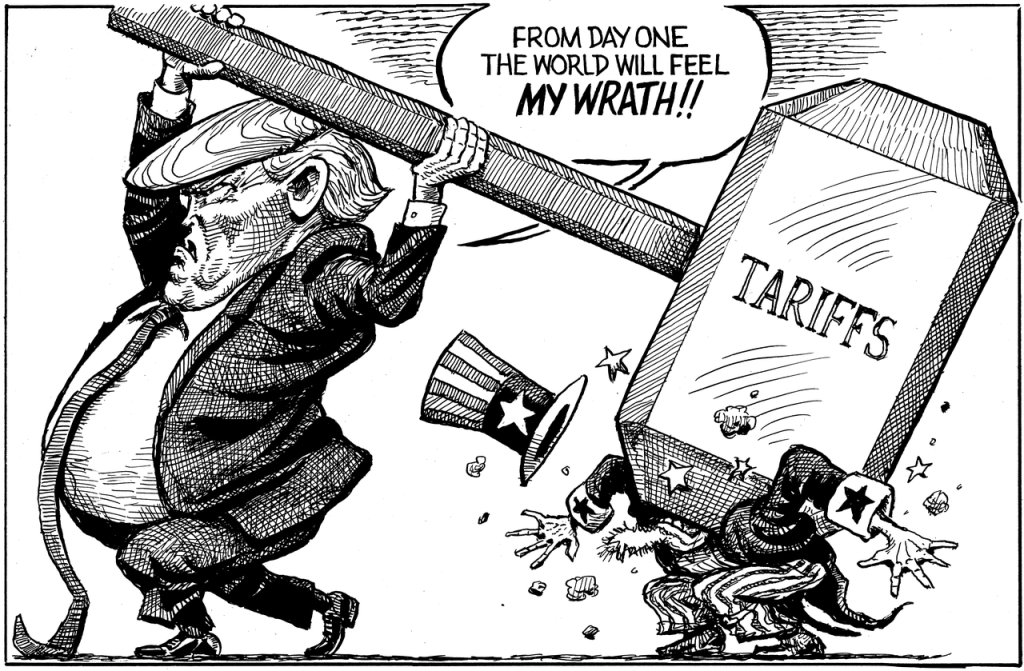

At This Point, He’s Just Flinging Poo at the Walls

But if Walmart doesn’t pass on the tariffs, then China loses no sales because of the tariffs. And U.S. manufacturers who compete with Chinese-made goods gain no advantage from the tariffs.

The only thing that has happened is that Walmart owners suffer an economic loss. There is no economic loss to China or its exporters. And there is no enhanced incentive to “on-shore” American manufacturing. Which was the original stated goal of the tariffs.

Those Were the Days!

Andy Kessler (Wall Street Journal), Trump’s Protectionist Blunder: The U.S. prospers atop a horizontal empire, not as a vertical island.

Mr. Kessler writes,

“Mister, we could use a man like Herbert Hoover again,” goes the “All in the Family” theme song. Donald Trump, who grew up 15 minutes from Archie Bunker, took it seriously. “We’re bringing wealth back to America,” says tariff-happy Mr. Trump. “That’s a big thing.” Those in the Trump administration with Wall Street experience should know better.

Mr. Trump’s America-first policy, as hallucinated by trade adviser Peter Navarro, is this: Make in America. Invest in America. Everything done by Americans. A self-sufficient, stand-alone country. 

It’s more of a political agenda than an economic one—more about protectionism and isolationism. Trade? Globalization? Increased living standards? How quaint. 

Look, I’m all for America on top, but America first isn’t how you get there. America first is a vertical model: Do everything. But vertical always fails. Vertical IBM made chips, wrote software, assembled computers and wrapped plastic around them. Vertical AT&T provided phones, wires and both local and long-distance calls. 

Fortunately, vertical gave way to horizontal: industries organized into layers of expertise, sorted by value added. Intel and Microsoft owned layers in a horizontal stack that made up personal computers, leveling IBM mainframes. The internet became a horizontal stack of routers, servers and applications, upending AT&T’s network. Even the artificial-intelligence revolution is horizontal—Silicon Valley’s OpenAI uses Nvidia chips made by Taiwan’s TSMCusing Dutch ASML’s equipment.

“Didn’t need no welfare state, everybody pulled his weight,” the theme song goes. Globalism and trade also became a horizontal model, with the U.S. sitting on top of what I call a horizontal empire, sorted by value added. Apple designs iPhones in California but assembles them lower down the stack in China—now shifting toward Vietnam and India—where living standards also increased.

Sadly, this horizontal model causes freak-outs over U.S. trade deficits. But who cares? Forget actual trade numbers. Focus on the margin of the products flowing cross-border. Apple has 34% operating margins. Foxconn, which assembles trade-deficit-boosting iPhones, has operating margins of 3%. Which would you prefer?

TVs, cars, clothes, toys and lumber that we import are all low-margin and usually labor-intensive businesses. We export high-margin software, financial services, drugs and AI applications, all intelligence-intensive businesses. I like to say, “we think, they sweat.” Meanwhile, Commerce Secretary Howard Lutnick says, “Human beings screwing in little screws to make iPhones, that kind of thing is going to come to America.” You first, Howard.

Getting horizontal got society wealthy. Economists note that trade deficits have a flip side of capital-account surpluses, money that gets invested in the U.S. to offset those trade deficits. But where are they in our economic statistics? Hard to find. Economists can count foreign money that bought Treasury bonds (so Americans don’t have to). But when capital flows into stocks—foreigners own 18% of our equities—the numbers get fuzzy. A net $1,000 buying Google shares can drive its value up $2,000, or $5,000. Google is worth more than $2 trillion, but $2 trillion in cash didn’t get invested—productivity drove its value up.

Mr. Bessent says, “Data is on our side.” Is it? We’ve run cumulative trade deficits since 1999 of $15.4 trillion. Meanwhile, U.S. equity values rose $45 trillion between 1999 and 2024 (both market peaks). U.S. household net worth at the end of 1999: $41 trillion. End of 2024: $160 trillion. Let’s run bigger trade deficits! As long as we keep the margin. Trade and productivity pay. No wonder the market is a yo-yo.

“Gee, our old LaSalle ran great,” the song concludes. So why would you ever want to go back to a vertical, isolationist model for the U.S., leading to higher-rate mortgages and expensive cars? A margin surplus means we let low-margin jobs move overseas and become a high-margin nation. Living standards rose across the globe. Smartphones and autos everywhere. Why go back?

Note to Trump yes-men: Low-wage jobs aren’t the American dream either. Populist protectionism, worsened by tariffs, has been shown to destroy more jobs than it creates. Even the lower-valued jobs that the Trump administration hopes will return may not exist. Most machine and metalworking shops now use programmable machine tools. Factory jobs will require proficiency in operating robots. Fixing education is critical.

“Boo hoo,” one can almost hear, “collapsing stocks only hurt the rich.” Yeah, but it also severely limits access to capital for U.S. companies to fund growth and create better jobs—let alone build new factories. Do we really want that? America can stay first only by sitting on top of a horizontal empire, not by reconstructing a retro isolated vertical island. Going backward is a meathead move. Stop trying to bring back the “All in the Family” nostalgia: “Those were the days!”

Fundamental Insights, Unwelcome News: For Trump, For the Rest of Us, Too

Steve Pearlstein (Washington Post), Trump’s tariffs were rash. But the reckoning was inevitable: And delaying that reckoning will only make things worse.

Prof. Pearlstein teaches public and international affairs at George Mason. According to him, that with which we must reckon is that “As a country, we live beyond our means, consuming more than we produce and investing more than we save.”

I urge you to read the article. Much of it, you probably won’t like. But that’s the very reason why you need to read it. 

But there is some sweet along with the bitter; you’ll like the multiple reasons why Trump’s tariffs are stupid. After expatiating on the multiple stupidities, Pearlstein ends this way:

That doesn’t mean we couldn’t benefit from raising tariffs on some imports until major trading partners lower tariff and nontariff barriers to American goods or stop subsidizing their exports. The dogmatic free traders were always wrong about that.

But tariffs are unlikely to alter the fundamental reality that, as a country, we collectively buy and invest more than we produce and save, which in broad terms is what the trade deficit represents. A simpler and more effective way to reduce that roughly $1 trillion annual trade deficit is to reduce our government’s $2 trillion annual budget deficit. Unfortunately, Trump is determined to do the opposite. For just as his new tariffs were unveiled, the president and his Republican allies in Congress were pushing through a budget plan to extend and expand tax cuts, increasing future budget deficits by hundreds of billions of dollars each year.

Put another way, by refusing to tax ourselves to pay for all the government services we demand — and borrowing the difference from the rest of the world — we are effectively giving households and businesses the money to buy more of the imports that the president is so determined to reduce.

For the past 50 years, America’s economic fantasy has been that another round of tax cuts or public investments will magically allow us to produce our way out of outsize budget and trade deficits. Instead, the twin deficits rose in tandem. In the real world, the only way to bring things back into balance is to begin living within our means and accept the painful adjustments that it entails. As we learned this week, there are better and worse ways to go about that rebalancing. But delaying that reckoning will only make things worse.