This is What Happens When Rich Folks Want Their Tax Cuts So Much That They Hand Over Power to an Actual Crazy Person
Trump’s Hissy Fit About the WSJ Editorial Board
Folks, grab a six pack and pop a big old bowl of popcorn.

The Guardian writes,
A Wall Street Journal editorial slamming Donald Trump’s tariff plans as terrible for the US economy and auto industry prompted a broadside from the president on Wednesday followed by threats to sue the media.
In an opinion piece titled Trump’s Tariffs Will Punish Michigan, the Journal argued Trump’s tariff plans would harm “US auto workers and Republican prospects in Michigan”.
Trump has threatened to impose 25% tariffs on goods from Mexico and Canada, a move the editorial argues would increase US vehicle prices, hurt auto workers and advantage Asian and European manufacturers.
“If the goal is to harm US auto workers and Republican prospects in Michigan, then by all means go ahead, Mr President,” wrote the Journal.
On his social media site, Truth Social, Trump wrote the Journal is “soooo wrong”. “The tariffs will drive massive amounts of auto manufacturing to MICHIGAN, a State which I just easily one [sic] in the Presidential Election,” he wrote.
Trump followed the rebuttal with a threat to those publishing “Fake books and stories with the so-called ‘anonymous’, or ‘off the record’, quotes” criticizing the opening month of his second presidency.
“At some point I am going to sue some of these dishonest authors and book publishers, or even media in general, to find out whether or not these ‘anonymous sources’ even exist, which they largely do not. They are made up, defamatory fiction, and a big price should be paid for this blatant dishonesty. I’ll do it as a service to our Country. Who knows, maybe we will create some NICE NEW LAW!!!,” he wrote.
The Journal’s conservative editorial board has been a persistent critic of Trump’s tariff plans, calling them “the dumbest trade war in history” earlier this month.
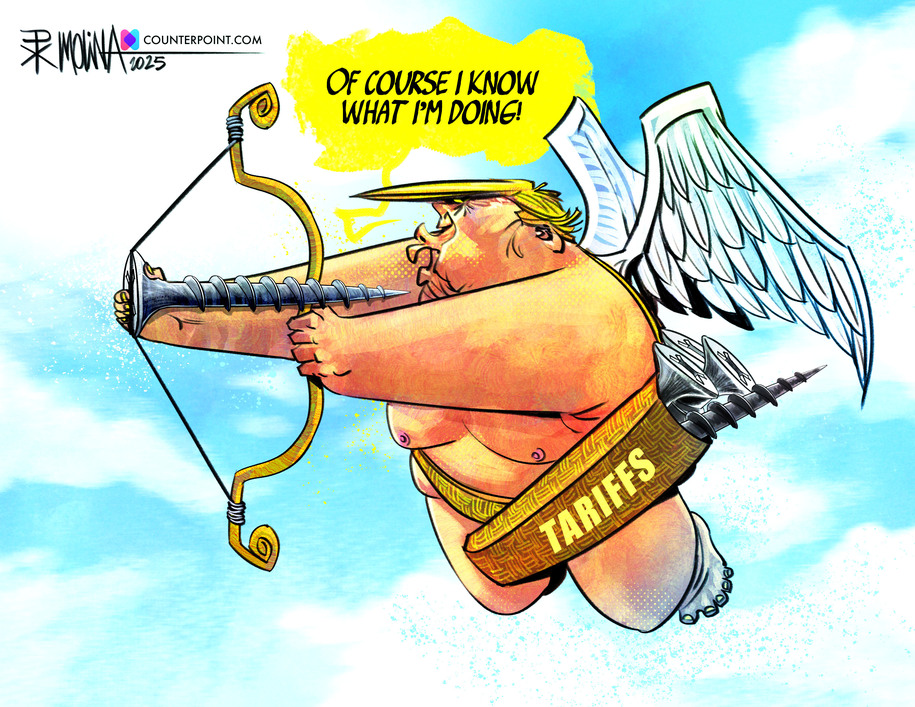
Happy Valentine’s Day, My Fellow Americans
Dumb and Dumber

Wall Street Journal Editorial Board, The Dumbest Trade War Fallout Begins: Canada and Mexico vow retaliation in response to Trump’s tariffs, amid new economic uncertainty
What Mango Mussolini Thinks He’s Doing—A Clever Way to Transfer Wealth from the Poor to the Rich
The WSJ doesn’t say it, so I will. As far as I can tell, Orange Jesus knows full well that tariffs are going to increase inflation, cost jobs, and hurt his supporters. But he thinks they are a complicated, and therefore clever, way to generate a shit load of revenue and thus finance tax cuts for the billionaires.
As for the foreigners, Trump hates them all, but he particularly hates American allies. As the WSJ points out, Mexico and Canada will be hurt even more than his American supporters will be hurt. For Mango Mussolini, that’s a feature, not a bug.
Some Thoughts from the Wall Street Journal Editorial Board
Now back to the Wall Street Journal Editorial Board, which writes,
“WILL THERE BE SOME PAIN? YES, MAYBE (AND MAYBE NOT!). BUT WE WILL MAKE AMERICA GREAT AGAIN, AND IT WILL ALL BE WORTH THE PRICE THAT MUST BE PAID,” Mr. Trump posted on Truth Social on Sunday morning. He also included a blast at these columns for leading the “Tariff Lobby” after our Saturday editorial called his 25% across-the-board tariffs on our friends and neighbors “the dumbest trade war in history.”
We appreciate Mr. Trump’s attention, though we’re anti-tariff and not lobbyists. But bad policy has damaging consequences, whether or not Mr. Trump chooses to admit it. Mr. Trump can’t repeal the laws of economics any more than Joe Biden could on inflation.
***
Tariffs are taxes, and when you tax something you get less of it. Who pays the tariff depends on the elasticity of supply and demand for the specific goods. But Mr. Trump wants American workers and employers to take one for the team. Hope you don’t lose your job or business before the golden age arrives.
The economic fallout began Saturday evening as Canada said it will retaliate with a 25% tariff on $30 billion (Canadian dollars) of U.S. goods, with another C$125 billion to follow in three weeks. Mexican President Claudia Sheinbaum also promised to retaliate.
Canada’s new border taxes will hit orange juice, whiskey and peanut butter—all from states with GOP Senators. Prime Minister Justin Trudeau said Ottawa’s tariff list would also include beer, wine, vegetables, perfume, clothing, shoes, household appliances, furniture and much more. He said Canada could also withhold critical minerals.
Note that Canada’s Conservative opposition leader, Pierre Poilievre, also called for retaliation. Mr. Poilievre is the favorite to be the next Prime Minister and he rightly said the trade war will damage both countries. But he said Canada had to stand up for its “sovereignty” and protect its economic interests.
Mr. Trump’s tariffs are already roiling North America’s energy markets, which are highly integrated. The President implicitly recognized the risk by hitting Canada’s energy exports to the U.S. with a lower 10% tariff. But that will still hurt Midwestern refiners that rely on Canadian oil. Canada and Mexico could send more of their oil elsewhere for refining, perhaps even China.
Canada’s expanded Trans Mountain pipeline runs from Alberta to the West Coast and has spare capacity. It could be used to increase tariff-free oil shipments to Asia that would hurt California refineries that now import oil from Trans Mountain. California could have to import more oil from the Middle East.
Mr. Trump says the tariffs will revive U.S. manufacturing. But Jay Timmons, CEO of the National Association of Manufacturers, said in a statement that “a 25% tariff on Canada and Mexico threatens to upend the very supply chains that have made U.S. manufacturing more competitive globally.”
He added that, while his members understand the need to reduce fentanyl flows to the U.S., “the ripple effects will be severe, particularly for small and medium-sized manufacturers that lack the flexibility and capital to rapidly find alternative suppliers or absorb skyrocketing energy costs.”
Many more trade groups have criticized the tariffs, including even U.S. aluminum makers who benefited from tariffs in the first term. Canada accounts for more than half of U.S. aluminum imports (owing to its cheap hydropower) that secondary and downstream manufacturers use.
***
None of this means the Trump tariffs will tip the U.S. economy into recession. U.S. growth may be strong enough to absorb the blow from tariffs, as it was after Mr. Trump’s more modest levies in the first term. But the same can’t be said about Mexico and Canada, where growth is weak and which depend on U.S. markets for much of their GDP.
The tariffs may also not cause a surge in the general U.S. price level. Overall inflation depends far more on the Federal Reserve’s monetary policy. But prices will increase for most tariffed goods, which will be painful enough.
The tariff broadside also adds new policy risk and uncertainty that could dampen business animal spirits. Markets have been pricing in an assumption that Mr. Trump would step back from his most florid tariff threats, or limit tariffs to China.
The hammer blow to Mexico and Canada shows that no country or industry is safe. Mr. Trump believes tariffs aren’t merely useful as a diplomatic tool but are economically virtuous by themselves. This will cause friends and foes to recalibrate their dependence on America’s market, with consequences that are hard to predict. How this helps the U.S. isn’t apparent, so, yes, “dumbest trade war” sounds right, if it isn’t an understatement.
 Facing MAGA