But if Walmart doesn’t pass on the tariffs, then China loses no sales because of the tariffs. And U.S. manufacturers who compete with Chinese-made goods gain no advantage from the tariffs.
The only thing that has happened is that Walmart owners suffer an economic loss. There is no economic loss to China or its exporters. And there is no enhanced incentive to “on-shore” American manufacturing. Which was the original stated goal of the tariffs.
Yesterday, May 16, the Supreme Court issued another ruling in the case of the Venezuelan people than Trump wants to deport to a gulag in El Salvador; read the opinion here. I posted about this case on April 19,April 20, and April 22.
The May 16 decision consists of (1) an eight-page unsigned (“per curiam”) opinion on behalf of the Chief Justice, the three Trump-appointed justices, and the three liberal justices, (2) a two-page concurring opinion by Justice Kavanaugh, and (3) a 14-page dissenting opinion by Justice Alito, joined by Justice Thomas.
Although the majority, per curiam opinion did not use words such as “bad faith,” “fibbing,” or “too cute for words” in describing the Justice Department’s position, it clearly implied that the government attorneys were prevaricating with the Supreme Court about the government’s plans to whisk the plaintiffs away—and then claim the Court had no jurisdiction as to individuals located in a foreign country.
The Court ordered, once again, that the Venezuelans should stay in this country pending further legal proceedings, and it remanded the case to the Fifth Circuit Court of Appeals for further consideration of how due process should work under the Alien Enemies Act, along with a variety of other considerations.
Justice Kavanaugh agreed with the majority’s analysis but would have kept the case in the Supreme Court and have the Court eschew further shilly-shallying, and just decide the damn case.
In his dissent, Justice Alito enlarged ad nauseam on the multiple ways in which the majority’s truncated, expedited procedure is in tension with the way things are normally done. As indeed they are. No shit, Sherlock. The government was lying to the courts, frog-marching the poor Venezuelans out of the country, and employing every bad faith trick in the books to use the normal, deliberative rules of the law of civil procedure in order to forestall real due process for immigrants.
Let’s look at the situation from 30,000 feet. What do we see?
First, Team Trump’s legal strategy—along will all the legal tactics that flow from that strategy—is to replace rule of law with a Ptemkin village that looks, from the outside, something like rule of law, but is not in fact rule of law.
Second, that legal strategy is doomed to failure unless a critical mass of the judiciary—and particularly a critical mass of the justices of the Supreme Court—are prepared to go along with it. (Sure, Trump could just order the police to arrest or kill all the members of the Supreme Court, and if the police obey the order, then Trump would win. But in that situation, the outcome would not be a legal Potemkin village, but rather a legal wasteland.)
Third, Team Trump seems to have thought that Justices Alito and Thomas, plus the three Trump-appointed justices would embrace the Potemkin village approach. Well, if that’s what Team Trump thought, then it appears they were right about Alito and Thomas but wrong about Kavanaugh, Gorsuch, and Barrett.
The real news here—the Man Bites Dog element—is that the three Trump-appointed justices did not bark in the night at Trump’s command.
Logical conclusion: the days are hastening on to the place where Team Trump is either going to have to back down on multiple legal fronts or it is going to have to declare, in words that are clear to the least intelligent folks among us, that the rule of law is over.
If it choose the latter option, it will be subject to vehement objections by all the Trump justices appointed in the first term–as well as a great many of the Trump Judes appointed to the courts of appeal and to the district court.
The unvarnished assault on the rule of law will come at a time when Walmart is running out of cheap goods, then Americans are being injured in multiple ways by cuts in government services, when small businesses are going out of business, and when Walmart is running out of cheap imported goods.
The immediately preceding post gave links to sources that summarize how major law firms have reacted to Trump’s nonsense. Here, using FAQs, I give an account of the current state of play.
Among the law firms that have been targeted by Trumps, how many have sued, and how are the lawsuits going to date?
On March 6, Trump issued an executive order against Perkins Coie—“Where Innovation Meets Infrastructure”—because he was butt hurt that the firm had previously represented Hillary Clinton. Five days later, on March 11, the law firm sued. On May 2, less than two months later, the district judge issued a 100+ page order permanently enjoining Trump from carrying out his threats.
Presumably, Team Trump will appeal the decision, but that has not happened as of this writing.
Why did the district judge in the Perkins Coie case reach a final decision in record time?
Because Team Trump had no cognizable defense.
Or, as we used to say back in New York, their only argument is the so-you-caught-me defense.
What about the other law firm lawsuits?
WilmerHale filed its case on March 28, and procured a preliminary injunction—not a permanent injunction—on April 24. Team Trump can still appeal the PI ruling, if it so chooses, or it may decide to wait until the decision on a permanent injunction.
Jenner & Block also filed on March 28. Judge Howell, the judge in the Perkins Coie case, rejected Jenner’s attempt to get the case assigned to her as a “related case.” The lawsuit was then bounced to Judge Bates, who granted a temporary restraining order the same day.
Fast footwork, that.
There was a hearing on April 28 on Jenner’s request for a final ruling it its favor, but the judge has not yet issued his decision. Presumably, he is writing his opinion—with due attention to the 100+ page ruling in the Perkins Coie litigation.
Meanwhile, a temporary restraining order against Trump remains in effect.
Susman Godfrey was the last of the four, filing its complaint on April 11. A temporary restraining order was entered and remains in effect. On May 8, Judge AliKhan held a hearing on the question whether Team Trump should be enjoined permanently, but no decision has been released as of this writing. However, back on April 15 when he issued the TRO, the judge described Trump’s action against the Susman firm as a misuse of presidential authority and a “shocking abuse of power.”
This would be a clue about how the good judge is likely to rule.
Apart from the four law firms that have sued Team Trump, which other firms have been targeted by punitive executive orders?
In alphabetical order they are:
Covington & Burling
Elias Law Group
Milbank
Paul, Weiss, Rifkind Wharton & Garrison
Skadden, Arps, Slate, Meagher & Flom
Willkie Farr & Gallagher
Have all of these firms reached “deals” with Trump?
No. Covington and Elias have not. Milbank, Paul, Weiss, Skadden, and Willkie all have capitulated.
Have other big law firms bowed down under the mere threat of a punitive executive order?
Yes, indeed. In alphabetical order they are:
Allan Overy Shearman Sterling
Cadwalader, Wickersham & Taft
Kirkland & Ellis
Latham & Watkins
Simpson Thacher & Bartlett
So, all together, nine big law firms have signed “deals” with Trump?
Correct.
And why are you putting quotation marks around “deals”?
What’s the story with Covington & Burling and the Elias Group, both of which were targeted by executive orders and neither of which has a “deal” with Team Trump?
Covington is a major law firm headquartered in Washington, D.C., has a significant lobbying operation, and recruits politically prominent individuals from both parties. Its best known current partner is Eric Holder, the former Attorney General.
As far as is publicly known—and that’s an important qualification,
Team Trump has not taken any serious enforcement action against Covington, which continues to go about its ordinary business,
Covington has not lost clients or lawyers,
Covington has neither sued Team Trump nor issued any fire-breathing declarations against Trump, and
There are no ongoing negotiations.
And why is nothing happening (as far as is publicly known)? Maybe (1) Covington, being the well-connected firm that it is, has some threat to hold over Trump’s head. Or maybe (2) Covington has done something valuable for Trump, but not told anyone about it. Or, perhaps most likely (3) with both sides knowing that Covington could walk down to the courthouse any day of the week and get an injunction, both sides decided to see how the four pending cases play out, once they reach the Supreme Court, and will then reconsider their position.
The Elias Law Group, a small, progressive firm focusing on voting rights and other public interest issues, has just told Team Trump to go to hell.
In view of all the foregoing, what are we to make of the claim by the head of Paul, Weiss that he had to capitulate because his firm faced an “existential threat”?
It’s reasonable to conclude that the head of Paul, Weiss showed poor situational awareness, exercised bad judgment, and demonstrated an attitude at odds with his duty as a legal professional.
The nine capitulating law firms have, in the aggregate, “agreed” to provide over $900 million (in value) in pro bono legal services to causes mutually agreed with Team Trump. How does that stand?
Each of the nine firms has “agreed” to provide pro bono services in identified general areas, like “promoting justice” or “opposing antisemitism.” And Trump has made some public noises about the kinds of legal services he has in mind. But, as far as is publicly known,
None of the nine firms is currently providing pro bono services to anyone, pursuant to their Trump “deals,” and, indeed,
There are no reports that Team Trump has asked a specific firm to take on a specific pro bono client.
Have the nine capitulating law firms suffered negative effects such as client departures, attorney resignations, and reduced recruitment of the ablest law school graduates?
There have been reports of some resignations by attorneys at other capitulating firms, but, thus far, as far as is publicly known, concrete harms have been limited.
But push will shortly come to shove. To take one example: Kirkland & Ellis expects to welcome more than 500 “summer associates” (rising third-year law students) next month, at its various offices, and probably an equal number of law graduates this fall (after they have taken their bar exams).
Of those anticipated hires, how many will actually show up?
Maybe all of them, or maybe not. I don’t know. But I do know that, for those young men who descend on the K&E home office in Chicago, when the visit the men’s room they will find two kinds of hair spray and two brands of mouthwash. Their breath will smell of roses, but, otherwise, the stink will be pungent and lasting.
Finally, is the real effect of the nine capitulations something that isn’t written down on paper, namely, the cowardly law firms’ decision to stay away from clients and causes that Trump doesn’t like, both paid and pro bono?
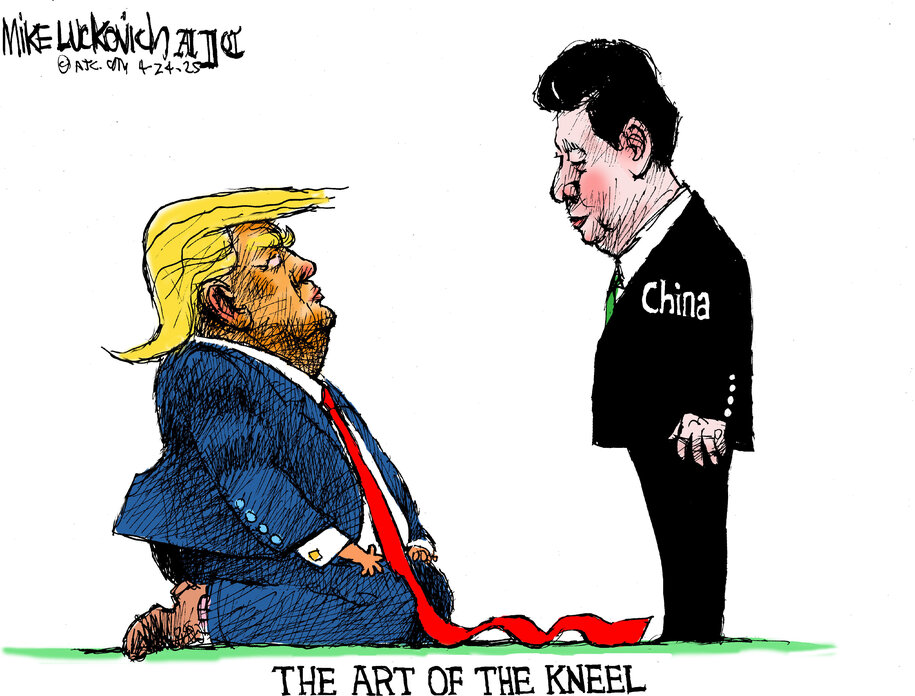
President Donald Trump said Friday that the United States could lower tariffs on China to 80 percent [instead of 145 percent] ahead of a meeting this weekend between his top aides and their counterparts from Beijing. …
The president’s apparent eagerness to get a deal reflects the mounting economic damage from the tariffs he has imposed thus far. China said its exports to the United States dropped 21 percent in April from a year before, and economists have forecast an increased likelihood of a U.S. recession. White House officials have grown alarmed by Chinese curbs on exports of rare earth minerals, used to make military drones, consumer electronics, electric cars and other important products.
The Constitution has this to say about the presidential oath of office:
Before he enter on the Execution of his Office, he shall take the following Oath or Affirmation: – “I do solemnly swear (or affirm) that I will faithfully execute the office of President of the United States, and will to the best of my ability, preserve, protect and defend the Constitution of the United States.”
The Constitution has this to say about the role of the courts:
The Judicial Power of the United States, shall be vested in one supreme Court, and in such inferior Courts as the Congress may from time to time ordain and establish. The Judges, both of the supreme and inferior Courts, shall hold their Offices during good Behavior … The Judicial Power shall extend to all Cases, in Law and Equity, arising under this Constitution [or] the Laws of the United States …




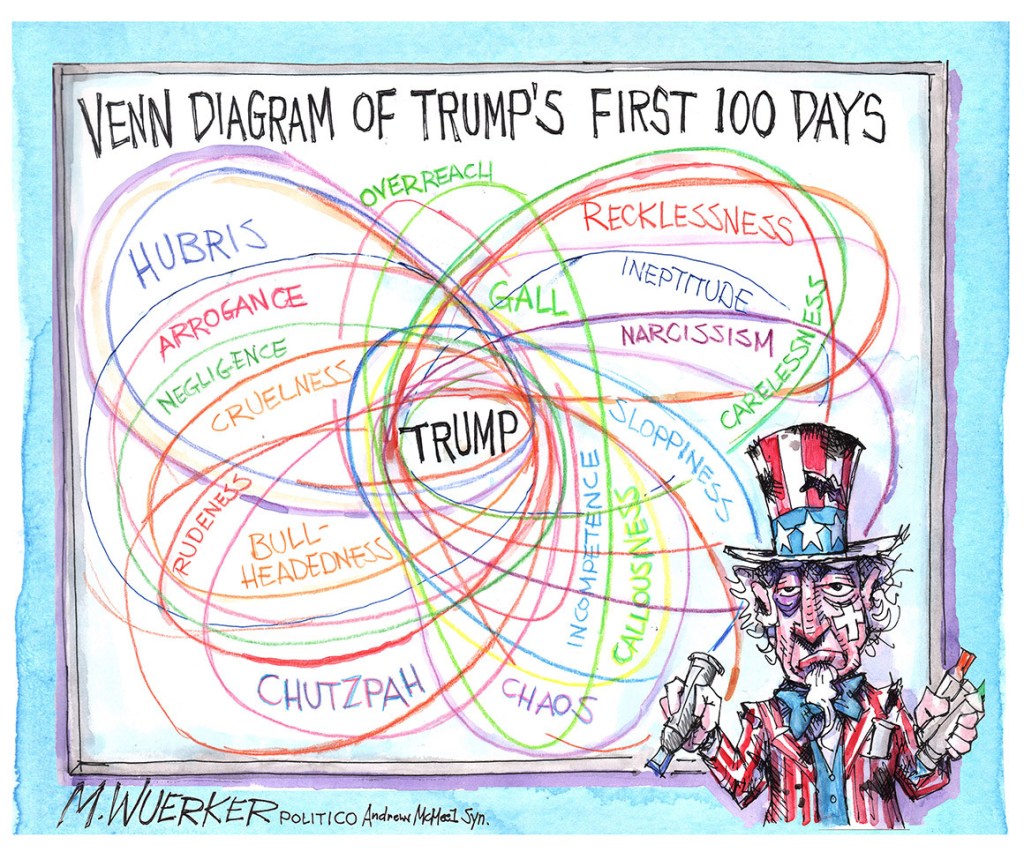
 Facing MAGA