


With clear eyes, hard facts, critical thinking, new political strategy, empathy, and a soupçon of Schadenfreude
This follows up on the immediately preceding post. Some comments below.
1. What one key thing explains the rise of Trump? It’s a great question. I’ve been asking it for a decade, and so, very probably, have you.
In my opinion, this onion has a whole lot of layers, but if you’re looking to identify the essence of the matter, I think MacWilliams—he’s a political scientist at the University of Massachusetts—has as good an insight as any: (a) Always and everywhere, there are a goodly number of people with authoritarian tendencies. (b) Trump found a way to trigger these folks’ natural inclination toward authoritarianism. (c) The triggering process was greatly facilitated by the rise of the internet and of social media.
2. Some more layers to the onion, you said? Yes, I did say that. Here are some of them:
Point: with the rise of social media, a whole lot of our fellow citizens have detected a permission structure to joyfully embrace their inner asshole. One of these ways, but only one, is saying hello to the Nazi side of their personality.
Point: although I don’t believe either Goldberg or MacWilliams mentions racism by name, I think a large part of Trump’s attractiveness is the fact that he is both a stone cold racist and a wealthy celebrity. It gratifies his unwashed followers that a person of such wealth and celebrity will openly share their racism.
Point: I strongly suspect that, when a definitive history of our era is available, we’ll find it wasn’t just underlying racism, it wasn’t just the malign ability of one man to appear charismatic, and it wasn’t just the rise of social media as such. I think we’re going to find there was a whole lot of conscious, clever, compensated manipulation of social media by intelligent people in the pay of some of our economic overlords.
3. Always look on the bright side of life. Trump is not Machiavelli. His fundamental problem is that he believes a lot of his own bullshit—not all of it, but a whole lot of it, and a lot of it that is relevant to pursuing his fascist agenda. In consequence, he is forever misunderstanding key facts about the politico-economic environment. He lacks, moreover, the ability to gather, evaluate, and apply important information. He regularly fails to predict how key actors will respond to his lies, his bluster, his threats, and his bullshit. And when people do not respond as he might wish, his severely limited skill set handicaps him in reacting to an unfavorable situation. He cannot, for example, construct a rational argument or distinguish between a plausible lie and an implausible lie.
4. A lot of people think that things have changed in the past month. Are they right? Yes, I certainly think so. Michelle Goldberg identifies some key factors, and I agree with her.
Trump dimly perceives (a) that L’Affaire Epstein is a serious challenge to his continued popularity among the one third of the country who are his core supporters, and (b) that his standing with his own people is further threatened by the economic chaos caused by his policies on tariffs and immigration.
In response, Trump is trying both to appease and to distract the worst of his own supporters with military aggression, domestic and foreign. Because if the worst of the worst desert him, who will he have left?
5. What is the best advice for decent progressives? When your adversary is screwing himself, hold his beer, and let him get on with it.
We must oppose fascist aggression. And we must be mindful that Trump’s gross incompetence is helping him to dig his own political grave.
Michelle Goldberg (N.Y. Times), The Resistance Libs Were Right:
For the last decade there’s been a debate, among people who don’t like Donald Trump, about whether he’s a fascist.
The argument that he isn’t often hinges on two things. First, when Trump first came to power, he lacked a street-fighting force like Benito Mussolini’s Blackshirts, even if he was able to muster a violent rabble on Jan. 6. “Trump didn’t proceed to unleash an army of paramilitary supporters in an American Kristallnacht or take dramatic action to remake the American state in his image,” wrote the leftists Daniel Bessner and Ben Burgis in “Did It Happen Here?,” a 2024 anthology examining the fascism question.
Second, Trump didn’t pursue campaigns of imperial expansion, which some scholars view as intrinsic to fascism. “For all of Trump’s hostility towards countries he perceives as enemies of the U.S., notably Iran, there is no indication that he sought a war with any foreign power, still less that he has been consumed by a desire for foreign conquest and the creation of an American empire,” wrote Richard J. Evans in his 2021 essay “Why Trump Isn’t a Fascist.”
It’s striking how much the arguments that Trump is not a fascist have suffered in just the first few days of this year, in which we’ve plunged to new depths of national madness.
Now that America has plucked the dictator Nicolás Maduro from power in Venezuela and announced that it would help itself to the country’s oil, other nations are adjusting to a reality in which we’re more predator than ally. European countries are contemplating stepping up their military presence in Greenland to protect it from the United States. An Economist headline proclaims, “Canada’s Armed Forces Are Planning for Threats From America.”
In the Midwest, Trump’s paramilitary forces killed a citizen in Minneapolis and now appear to be using her death to threaten other activists, barking at one observer, “You did not learn from what just happened?” Videos from the city show gun-toting men in masks and camouflage descending on people to demand proof of citizenship, pelting crowded streets with tear gas and sometimes attacking those who film them. Meanwhile, a new ICE recruiting ad declares, “We’ll Have Our Home Again,” which just happens to be part of the refrain of a white nationalist anthem.
Both ICE’s occupation of Minneapolis and Trump’s threatened seizure of Greenland are part of the same story: An increasingly unpopular regime is rapidly radicalizing and testing how far it can go down the road toward autocracy. If anyone had predicted back in 2024 precisely what Trump’s return to the White House was going to look like, I suspect they’d have been accused of suffering from Trump Derangement Syndrome. But the shrillest of Resistance libs have always understood Trump better than those who make a show of their dispassion. As the heterodox writer Leighton Woodhouse put it on X, “The hysterical pussy hats were right.”
Of course they were. From the moment he descended his golden escalator, Trump’s message, the emotional core of his movement, has been textbook fascism. In his 2004 book “The Anatomy of Fascism,” the eminent historian Robert O. Paxton described the “mobilizing passions” that form fascism’s foundation. Among them are a “sense of overwhelming crisis” that renders traditional solutions obsolete; a belief that one’s own group has been victimized, justifying almost any action in redress; “dread of the group’s decline under the corrosive effects of individualistic liberalism, class conflict and alien influences”; and the need for a strong male leader with instincts more powerful than mere “abstract and universal reason.”
The premonitions of our current regime in Paxton’s work don’t stop there. Fascism, in his telling, is marked by its contradictory attitude toward modernity: a hatred of atomized urban life combined with a fetish for technology. Fascist movements “exploited the protests of the victims of rapid industrialization and globalization,” he wrote, though in power, they doubled down on industrial concentration. And, of course, fascists “need a demonized enemy against which to mobilize followers.”
If Trump didn’t always act on his most fascistic predilections in his first term, it was because he was restrained by the establishment types around him. Mark Esper, Trump’s former defense secretary, said that Trump repeatedly broached the idea of bombing Mexico. In 2019, Trump canceled a meeting with Prime Minister Mette Frederiksen of Denmark after she refused to entertain the idea of selling him Greenland. His taste for violence against his political enemies has never been secret, and was made clearest on Jan. 6, the event that led a once-doubtful Paxton to conclude that the word “fascist” applied to Trump.
None of this means that America is destined to become a fully fascist country. For now, we are trapped in the space between the liberal democracy most Americans grew up in and the dark, belligerent authoritarian state that our government seeks to impose. The important thing isn’t really the name we give to this political development, but our ability to see what’s happening clearly and make sense of its likely trajectory.
On the last page of “The Anatomy of Fascism,” Paxton offers a warning. “We know from tracing its path that fascism does not require a spectacular ‘march’ on some capital to take root,” he writes. “Seemingly anodyne decisions to tolerate lawless treatment of national ‘enemies’ is enough.”
Dr. Richardson is a prominent historian and professor at Boston College.
I think the whole video is worth watching, even if you are generally aware of what’s going on in this country. Some of the relevant points:
First Minute: HCR puts some of Trump’s outrageousness in historical context, in light of a Republican intellectual triumphalism—“We’re right and, guess what, you’re wrong!” We saw a lot of that beginning with Reagan’s election. I remember it well.
Third Minute: She doesn’t use the phrase, but others rightly call it “herrenvolk democracy”: any Democratic victory is inherently illegitimate.
Sixth Minute: A concerted effort to destroy rules-based order.
Eighth Minute: He thinks only people like himself should be in power.
Ninth Minute: He’s no compos mentis. It appears they’re giving him psychiatric drugs. It’s a behind-the-scenes effort to control him.
Eleventh Minute: No, J.D. Vance would not be worse.
Twelfth Minute: It’s extremely difficult to tell what’s happening in this Administration.
Fourteenth Minute: What appears to have just happened in Venezuela.
End of Seventeenth Minute: A work of genius by the Venezuelan regime and its allies.
As historians know, invasion of your country greatly helps to unify your people.
Nineteenth Minute: Trump’s oil fantasy.
Twenty-first Minute: Shrinkage from a global power to a regional power. Jettisoning the benefits of the rules-based international order.
Twenty-third Minute: Greenland.
Twenty-fourth Minute: A fundamental misunderstanding of the nature of American power.
Twenty-sixth Minute: Russia gets Ukraine, we get Venezuela. Sort of like the eve of World War I, but this time with nuclear weapons.
Twenty-seventh Minute: Oil is the technology of the past. The future lies in semi-conductors. We’re giving Xi permission to take over Taiwan—which makes 60% of the world’s semi-conductors. And Trump doesn’t understand this.
Twenty-eighth Minute: Destruction of the rules-based international order. A demented president, no longer operating in reality. Magical thinking is a hallmark of this moment.
Twenty-ninth Minute: Don’t follow grandpa down this road. Time to speak up.
Quick, get out of the way
You’d better watch what you say, boys
Better watch what you say
… We’ve rammed in your harbor and tied to your port
And our pistols are hungry and our tempers are short
So bring your daughters around to the port
‘Cause we’re the Cops of the World, boys
… We’re the Cops of the World
We pick and choose as please, boys
Pick and choose as please
You’d best get down on your knees, boys
… Best get down on your knees
We’re hairy and horny and ready to shack
We don’t care if you’re yellow or black
Just take off your clothes and lie down on your back
… ‘Cause we’re the Cops of the World, boys
We’re the Cops of the World
Our boots are needing a shine, boys
Boots are needing a shine
… But our Coca-cola is fine, boys
Coca-cola is fine
We’ve got to protect all our citizens fair
So we’ll send a battalion for everyone there
… And maybe we’ll leave in a couple of years
‘Cause we’re the Cops of the World, boys
We’re the Cops of the World
Dump the reds in a pile, boys
… Dump the reds in a pile
You’d better wipe of that smile, boys
Better wipe off that smile
We’ll spit through the streets of the cities we wreck
… We’ll find you a leader that you can’t elect
Those treaties we sighned were a pain in the neck
‘Cause we’re the Cops of the World, boys
We’re the Cops of the World
… Clean the johns with a rag, boys
Clean the johns with a rag
If you like you can use your flag, boys
If you like you can use your flag
… We’ve got too much money we’re looking for toys
And guns will be guns and boys will be boys
But we’ll gladly pay for all we destroy
‘Cause we’re the Cops of the World, boys
… We’re the Cops of the World
Please stay off of the grass, boys
Please stay off of the grass
Here’s a kick in the ass, boys
… Here’s a kick in the ass
We’ll smash down your doors, we don’t bother to knock
We’ve done it before, so why all the shock?
We’re the biggest and toughest kids on the block
… ‘Cause we’re the Cops of the World, boys
We’re the Cops of the World
When we butchered your son, boys
When we butchered your son
… Have a stick of our gum, boys
Have a stick of our buble-gum
We own half the world, oh say can you see
The name for our profits is democracy
… So, like it or not, you will have to be free
‘Cause we’re the Cops of the World, boys
We’re the Cops of the World
The Trigger Warning: Some readers will be triggered by prose that, read superficially, might sound sympathetic to Chief Justice Roberts and to his sidekicks, Justices Coney Barret and Kavanaugh. Such readers may want to skip this post. In any event, they are requested not to throw food in my direction. Or, if they must, please pick the corn muffins we’re getting tonight, and take a pass on the bean soup and the pistachio pudding.
The Multiple Disclaimers: In this post, I’m not in the moralizing business, I’m not in the mind reading business, and I’m not in the prediction business. Not that moralizing, mind reading, and prediction are unimportant. They’re just not what I’m trying to do here. Here, I’m in the hypothesizing business. I’m in the trying-to-understand business.
You can generally count on the three liberal justices to do the right thing. If you bet that Justices Thomas, Alito, and Gorsuch will do the wrong thing—and that Justice Gorsuch will camouflage the wrong thing with extensive verbiage made to superficially resemble legal scholarship—then you’re likely to win your bet. In the middle, that leaves the Chief Justice, along with Justices Coney Barrett and Kavanaugh. These three generally decide who’s going to win the case.
And, by the way, when I say “middle faction,” the word “middle” is not intended to be either favorable or pejorative. It just means they’re literally in the middle of the other two factions.
It appears that the rubber will soon meet the road, and that the Supreme Court is going to make some definitive rulings on, among other things,
In introduced this topic in the immediately preceding post, which you may wish to read now, before proceeding further.
There are many reasons why it’s a vexed question. In the first place, the Court’s behavior contradicts what we learned in civics class—back when they taught civics in high school. We have checks and balances. When the president violates the law, the courts are supposed to check him. And indeed, lots of district courts and courts of appeal HAVE been checking Trump—but without a lot of support from the Supreme Court on its shadow docket.
Relatedly, the shadow docket is a vexed question from a technical legal standpoint. The Court is ruling on the validity of lower court decision on whether to grant a preliminary injunction pending trial and appeal, and that p.i. issue, in turn, is supposed to depend, in large measure, on “likelihood of success on the merits.” If the district court grants a p.i. against some Trump outrage, and if the court of appeals affirms, and if the Supreme Court majority then reverses the ruling, so that Trump can go on engaging in whatever horseshit he wants, pending trial, does that mean that the Supreme Court thinks Trump is right on the law and all the lower court judges are wrong?
Does it mean that the Supreme Court majority doesn’t give a tinker’s damn about checks and balances?
Does it mean that the majority wants to live in a country governed like Russia and Hungary?
Well, maybe it does mean some or all of those things.
I continue to focus here on the middle faction of the Supreme Court—Justices Roberts, Coney Barrett, and Kavanaugh—not on the three wingnuts, and not on the three liberals. An alternative hypothesis to explain the middle faction’s strange behavior would go something like this.
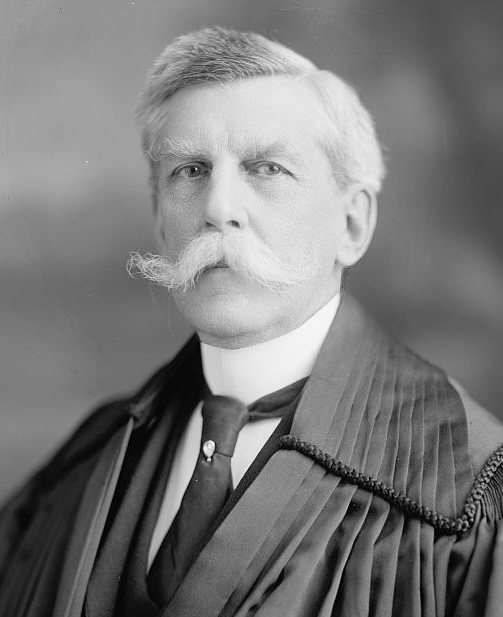
The middle faction would prefer to live in a constitutional republic governed under law, not in Hungary or Russia, but they are mindful that, to achieve that end, they have to preserve a certain level of public deference to court decisions. And, as Justice Oliver Wendell Holmes, Jr. (pictured above) said a century ago, the Court reads the newspapers.
Having read the newspapers, the middle faction knew that a reelected, pumped up Trump was going to try to grab power in all sorts of ways. They knew that if the Supreme Court intervened immediately and forcefully, there would likely follow an immediate and grave constitutional crisis.
The hypothesis continues: The middle faction reasoned that, instead of an immediate constitutional crisis, it would be better to wait a season; let the whole country, including the MAGA base, get a full taste of Trump’s policies; and let Trump’s political support dissipate.
2026, not 2025, would be right year for strong action to preserve the rule of law. Or so they thought, in the hypothesis presented here.
Remember, y’all, it’s a hypothesis. There’s no mind reading, there’s no moralizing, and there’s no prediction about how the Court will actually decide all those issues I mentioned above.
As far as predictions go, to quote the sage observation of President Eisenhower, “The future lies ahead.”
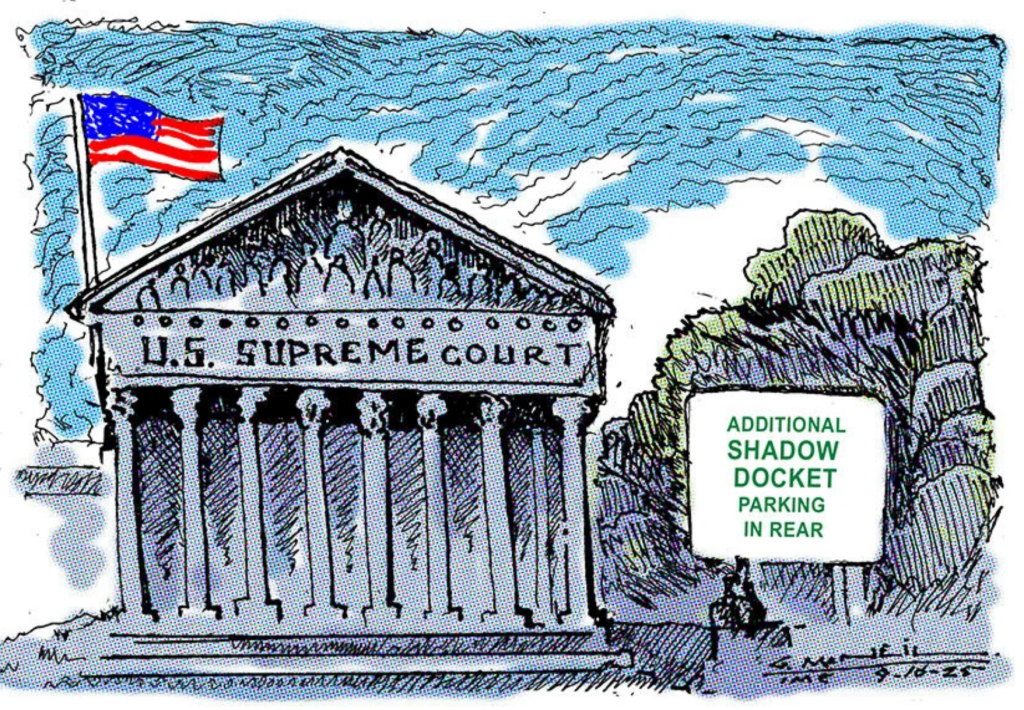
Something weird is going on at the Supreme Court. In my next post, I’m going to lay out a hypothesis about what that might be. Here, I need to lay the predicate for that discussion.
The shadow docket consists of cases where the Supreme Court reviews lower court decisions that have either granted or denied temporary relief, pending a trial, a decision on the merits, and appeal of the decision in the ordinary course.
In most of these cases, the lower courts have either granted a preliminary injunction or they have denied a preliminary injunction.
Trials take a long time, appeals take even longer, and in the meantime you may suffer a lot of harm due to behavior that you say is illegal. Your uncle may be departed to El Salvador. Trump may have fired you from the Federal Trade Commission because you are a Democrat. Your business may be going bankrupt because of high tariffs that Trump has illegally imposed.
A preliminary injunction is intended to preserve the status quo, preventing that injury, pending a final resolution of the dispute.
When a party to a case wants a preliminary injunction, the court is supposed to ask four questions.
1. Considering the facts and the law, which party is more likely to win the case, down the road?
2. If the preliminary injunction is denied, how much harm will be caused, and is that harm irreparable?
3. And what about the potential harm to the other side, if the preliminary injunction is granted?
4. Finally, in this private dispute between two parties, where does the public interest lie?
That’s the legal theory. In practice, the first factor—often called “likelihood of success on the merits”—tends to predominate.
In other words, if a district judge grants a preliminary injunction, that often means that she thinks the defendant is behaving illegally. If she denies the request, that usually implies that, in her view, the plaintiff doesn’t have a good legal case.
Yes. The Federal Rules of Civil Procedure provide that a federal district court is legally obligated to explain its reasoning in granting or denying a requested preliminary injunction. The main rationale for that rule is that, without a reasoned explanation, a court of appeals can’t make an informed decision about whether the district judge was right or wrong.
No, it is not. However, before Trump, the Court normally did explain, at least briefly, how it thought likelihood of success on the merits and the other three factors applied to the case at hand.
In a recent article, Erwin Chemerinsky, constitutional law expert and dean of the law school at U.C. Berkeley, explained,
The Supreme Court always has had an emergency docket to hear requests such as those for last-minute stays of execution in death penalty cases. But it has grown greatly in recent years, and last year saw an exponential increase in orders from the shadow docket. In the October 2023 term, the court resolved 82 matters on its emergency docket. But in the October 2024 term, by June 27, 2025—the last day opinions were handed down—it had resolved 107 matters on its emergency docket. By the time the term officially ended when the new term began on Oct. 6, 2025, the court had decided 140 matters on its emergency docket.
Some of this increase is because of the many cases involving challenges to President Donald Trump’s administration’s initial actions that made it to the Supreme Court. But that does not explain all of the dramatic increase. I think that there is a simple explanation for why the shadow docket has grown: the court’s willingness to rule on matters on its emergency docket. The more the court is willing to give relief on an emergency basis, the more parties will go to the justices for stays of lower court decisions, such as of preliminary injunctions.
There is much to be concerned about in the growth of the shadow docket. Matters are decided without full briefing and without any oral argument. Yet in 2025, the Supreme Court indicated that lower courts were obligated to follow its shadow docket rulings. In several important cases, the court handed down orders without any written opinion, giving no guidance to the lower courts and making the decisions seem an arbitrary exercise of power since no reasons were given for the conclusions. In some cases, the court appeared to disregard detailed factual findings by lower courts and abandon the usual standard for emergency relief: the need for a showing of irreparable injury. …
There have been dozens of rulings by the court on its emergency docket concerning lower-court preliminary injunctions against Trump administration actions. In almost every case, the Supreme Court—virtually always in a 6-3 ruling—has stayed the preliminary injunction and ruled in favor of President Trump. These decisions have included the Supreme Court staying lower court orders stopping the firing of agency officials, ordering the reinstatement of terminated federal grants, forbidding deportations to South Sudan of individuals with no contact with that country, preventing U.S. Immigration and Customs Enforcement agents from stopping people without reasonable suspicion, and keeping the State Department from requiring that passports list a person’s birth sex rather than gender identity. …
In a ruling on the emergency docket, in United States v. Shilling, the court, once more 6-3, stayed a district court’s preliminary injunction and allowed President Trump to bar transgender individuals from serving in the military. Neither the majority nor the dissenting justices wrote an opinion.
 Facing MAGA