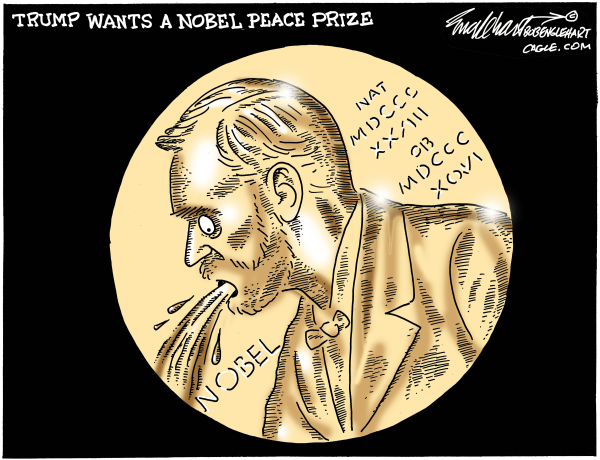
Tonight’s News: Trump Says He “Stopped the Conflict between Cambodia and Armenia. It was Just Starting and it was a Bad One”
With clear eyes, hard facts, critical thinking, new political strategy, empathy, and a soupçon of Schadenfreude
Clearly, he wants the Peace Prize so much that Putin can twist him around his middle finger.
Some thoughts that come to mind:
Maybe the Heritage Foundation, joined with the Southern Baptist Convention, could name him the International Prince of Peace.
Or the Council on Foreign Relations could award him the Annual Prize for Creative Diplomatic Strategy—commenting that Obama never won this prize, which clearly proves Trump is twice the man Obama is.
Or perhaps the best idea of all: Harvard could give him an honorary Ph.D in Foreign PolicyThinkology.
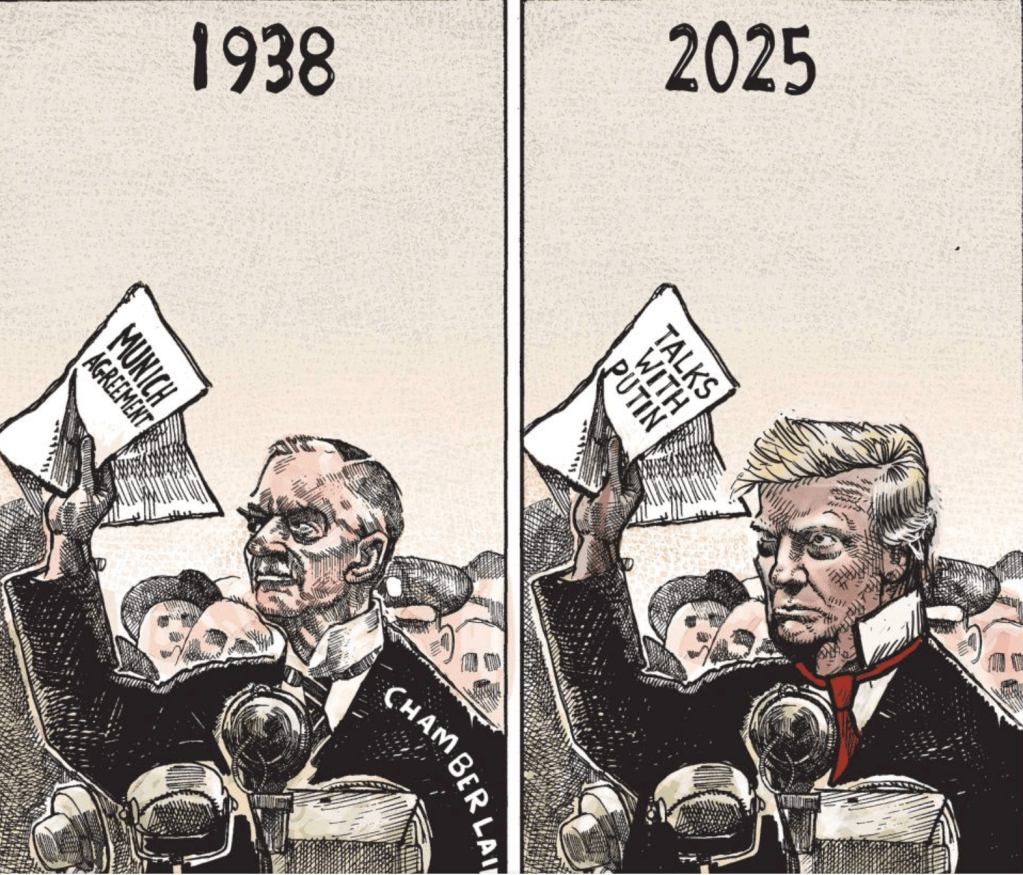
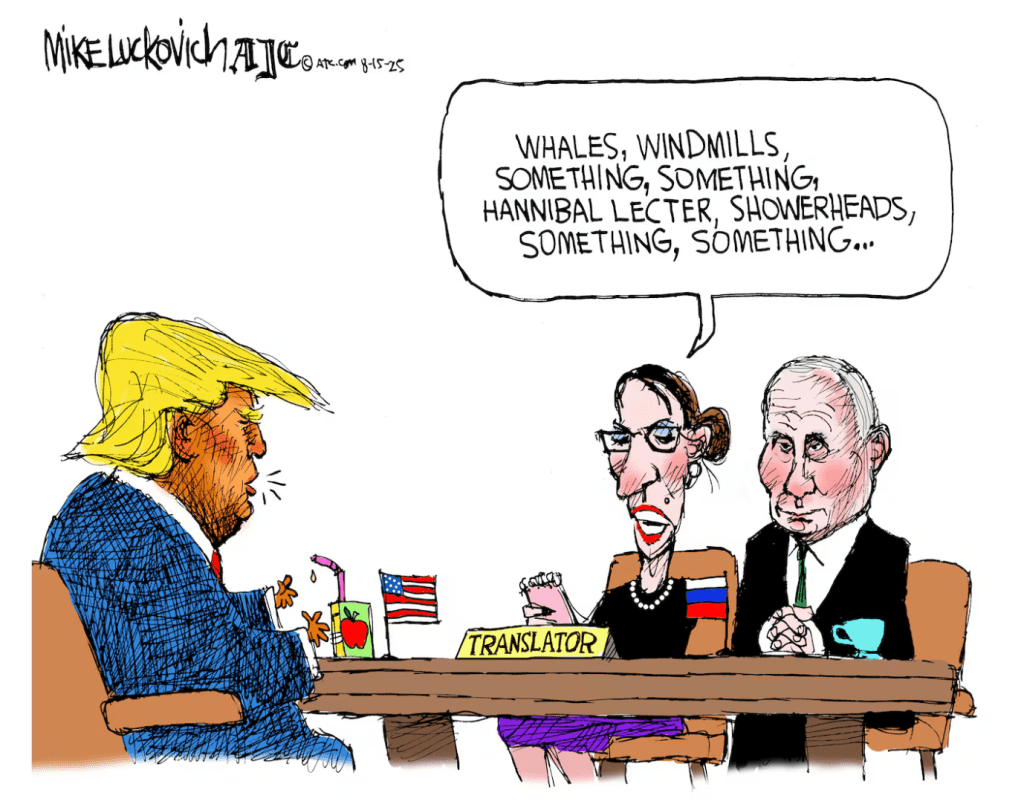
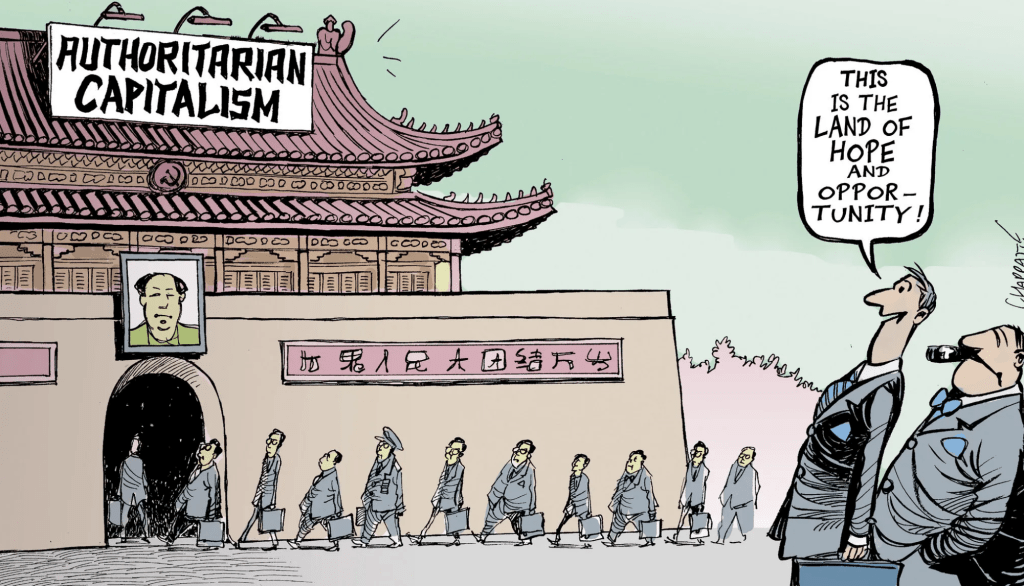
Bill Saporito (N.Y. Times), Trump Thinks He Is the C.E.O. of Everything. Awesome.
Greg Ip (Wall Street Journal), The U.S. Marches Toward State Capitalism With American Characteristics: President Trump is imitating Chinese Communist Party by extending political control ever deeper into economy
Hot take by me at the end of this post. Meanwhile, the indispensable Greg Ip writes,
Recent examples include President Trump’s demand that Intel’s chief executive resign; the 15% of certain chip sales to China that Nvidia and Advanced Micro Devices will share with Washington; the “golden share” Washington will get in U.S. Steel as a condition of Nippon Steel’s takeover; and the $1.5 trillion of promised investment from trading partners Trump plans to personally direct.
This isn’t socialism, in which the state owns the means of production. It is more like state capitalism, a hybrid between socialism and capitalism in which the state guides the decisions of nominally private enterprises.
China calls its hybrid “socialism with Chinese characteristics.” The U.S. hasn’t gone as far as China or even milder practitioners of state capitalism such as Russia, Brazil and, at times, France. So call this variant “state capitalism with American characteristics.” It is still a sea change from the free market ethos the U.S. once embodied.
We wouldn’t be dabbling with state capitalism if not for the public’s and both parties’ belief that free-market capitalism wasn’t working. That system encouraged profit-maximizing CEOs to move production abroad. The result was a shrunken manufacturing workforce, dependence on China for vital products such as critical minerals, and underinvestment in the industries of the future such as clean energy and semiconductors.
The federal government has often waded into the corporate world. It commandeered production during World War II and, under the Defense Production Act, emergencies such as the Covid-19 pandemic. It bailed out banks and car companies during the 2007-09 financial crisis. Those, however, were temporary expedients.
Former President Joe Biden went further, seeking to shape the actual structure of industry. His Inflation Reduction Act authorized $400 billion in clean-energy loans. The Chips and Science Act earmarked $39 billion in subsidies for domestic semiconductor manufacturing. Of that, $8.5 billion went to Intel, giving Trump leverage to demand the removal of its CEO over past ties to China. (Intel so far has refused.)
Biden overrode U.S. Steel’s management and shareholders to block Nippon Steel’s takeover, though his staff saw no national-security risk. Trump reversed that veto while extracting the “golden share” that he can use to influence the company’s decisions. In design and name it mimics the golden shares that private Chinese companies must issue to the CCP.
Biden officials had mulled a sovereign-wealth fund to finance strategically important but commercially risky projects such as in critical minerals, which China dominates. Last month, Trump’s Department of Defense said it would take a 15% stake in MP Materials, a miner of critical minerals.
Many in the West admire China for its ability to turbocharge growth through massive feats of infrastructure building, scientific advance and promotion of favored industries. American efforts are often bogged down amid the checks, balances and compromises of pluralistic democracy.
In his forthcoming book, “Breakneck: China’s Quest to Engineer the Future,” author Dan Wang writes: “China is an engineering state, building big at breakneck speed, in contrast to the United States’ lawyerly society, blocking everything it can, good and bad.”
To admirers, Trump’s appeal is his willingness to bulldoze those lawyerly obstacles. He has imposed tariffs on an array of countries and sectors, seizing authority that is supposed to belong to Congress. He extracted $1.5 trillion in investment pledges from Japan, the European Union and South Korea that he claims he will personally direct, though no legal mechanism for doing so appears to exist. (Those pledges are already in dispute.)
There are reasons state capitalism never caught on before. The state can’t allocate capital more efficiently than private markets. Distortions, waste and cronyism typically follow. Russia, Brazil and France have grown much more slowly than the U.S.
Chinese state capitalism isn’t the success story it seems. Barry Naughton of the University of California, San Diego has documented how China’s rapid growth since 1979 has come from market sources, not the state. As Chinese leader Xi Jinping has reimposed state control, growth has slowed. China is awash with savings, but the state wastes much of it. From steel to vehicles, excess capacity leads to plummeting prices and profits.
The U.S. hasn’t fared any better. Interventions made in the name of national security or kick-starting infant industries lead to boondoggles like Foxconn’s promised factory in Wisconsin or Tesla’s solar-panel factory in Buffalo, N.Y.
State capitalism is an all-of-society affair in China, directed from Beijing via millions of cadres in local governments and company boardrooms. In the U.S., it consists largely of Oval Office announcements lacking any policy or institutional framework. “The core characteristic of China’s state capitalism is discipline, and Trump is the complete opposite of that,” Wang said in an interview.
State capitalism is a means of political, not just economic, control. Xi ruthlessly deploys economic levers to crush any challenge to party primacy. In 2020, Alibaba co-founder Jack Ma, arguably the country’s most famous business leader, criticized Chinese regulators for stifling financial innovation. Retaliation was swift. Regulators canceled the initial public offering of Ma’s financial company, Ant Group, and eventually fined it $2.8 billion for anticompetitive behavior. Ma briefly disappeared from public view.
Trump has similarly deployed executive orders and regulatory powers against media companies, banks, law firms and other companies he believes oppose him, while rewarding executives who align themselves with his priorities.
In Trump’s first term, CEOs routinely spoke out when they disagreed with his policies such as on immigration and trade. Now, they shower him with donations and praise, or are mostly silent.
Trump is also seeking political control over agencies that have long operated at arm’s length from the White House, such as the Bureau of Labor Statistics and the Federal Reserve. That, too, has echoes of China where the bureaucracy is fully subordinate to the ruling party.
Trump has long admired the control Xi exercises over his country, but there are, in theory, limits to how far he can emulate him.
American democracy constrains the state through an independent judiciary, free speech, due process and the diffusion of power among multiple levels and branches of government. How far state capitalism ultimately displaces free-market capitalism in the U.S. depends on how well those checks and balances hold up.
I was struck by Mr. Ip’s observation that CEOs now keep silent about things they would have publicly protested in earlier years. I’m sure that’s right. But here’s another truth: CEOs also bloody well know how to scheme and collude in private.

Wall Street Journal Editorial Board, Trump’s Dommsday Tariff Letter: He says judges must bless his ‘emergency’ or we’ll have a depression.
I join with those who say the legal case against Trump’s power grab under the purported authority of the International Emergency Economic Powers Act of 1977 is overwhelming. That case, moreover, ought to appeal both to the Supreme Court’s progressives as well as to the other six justices, who achieved their high station through the good offices of the Federalist Society.
Notably, the litigation challenging Trump’s tariff power grab is being financed by Mr. Federalist Society himself, Leonard Leo, along the Cato Institute, the Charles Koch Foundation, and many others of their ilk.
In this context today, the Wall Street Journal waxed sardonic. I’ll share the Journal’s words, followed by a final hot take by my good self.
The Journal’s Editorial Board writes,
Mr. Trump justified his “reciprocal” tariffs by invoking the 1977 International Emergency Economic Powers Act to declare emergencies over fentanyl and the trade deficit. A lower court blocked the tariffs in May (V.O.S. Selections v. Trump) as an illegal exercise of presidential power, and Mr. Trump is appealing.
The Federal Circuit put a stay on the lower- court ruling so it could hear the President’s appeal. Oral arguments before the full Federal Circuit late last month didn’t go well for the government, which may explain the Justice Department letter, which echoes a tirade by Mr. Trump against the judges.
“If a Radical Left Court ruled against us at this late date, in an attempt to bring down or disturb the largest amount of money, wealth creation and influence the U.S.A. has ever seen, it would be impossible to ever recover, or pay back, these massive sums of money and honor,” Mr. Trump wrote Friday on Truth Social. “It would be 1929 all over again, a GREAT DEPRESSION!”
Wow. Ending a tax increase means depression. Who knew? Mr. Trump also seems to think any judge who rules against him is a radical leftist. But the 11 judges who heard the appeal include Republican and Democratic appointees. Messrs. Sauer and Shumate parrot Mr. Trump’s doomsday prophesies in their letter.
“The President believes that our country would not be able to pay back the trillions of dollars that other countries have already committed to pay, which could lead to financial ruin,” the lawyers write. We doubt the President believes that, but in any case it isn’t true.
It is true that foreign countries have pledged to increase investment in the U.S. in return for avoiding even higher tariffs than Mr. Trump has imposed. But these are nonbinding commitments, and the government wouldn’t have to pay anything back to countries if the tariffs are blocked. It would have to compensate U.S. businesses that paid the illegal tariffs—and with interest.
Obtaining a refund could be a bureaucratic mess and take years. But putting an end to this tax increase would also be a relief to thousands of businesses. The U.S. Chamber of Commerce recently estimated that the Trump tariffs will cost the average small business importer $856,000 a year. Consumers notably won’t be able to seek refunds for tariff costs passed on to them.
The letter to the Federal Circuit judges illustrates the Trump style: try to intimidate by exaggerating the impact of a decision he doesn’t like and suggest he’ll blame the judges. We trust the judges won’t fall for it. If they do rule against the President and he appeals, we hope the Supreme Court quickly takes the case.
Along with Leonard Leo and his many close friends, thirteen states are suing to get a judicial finding that Trump is making a lawless power grab on tariffs: Arizona, California, Colorado, Connecticut, Delaware, Illinois, Maine, Minnesota, Nevada, New Mexico, New York, Oregon, and Vermont.
Ironically, a victory by these assorted plaintiffs would not only save the country from a lot of economic grief, it would also save Trump’s bacon by depriving him of the rope he needs to keep on hanging himself.
My hot take: If I were on the Supreme Court, I’d consider voting for Team Trump on this one, just to spite him.
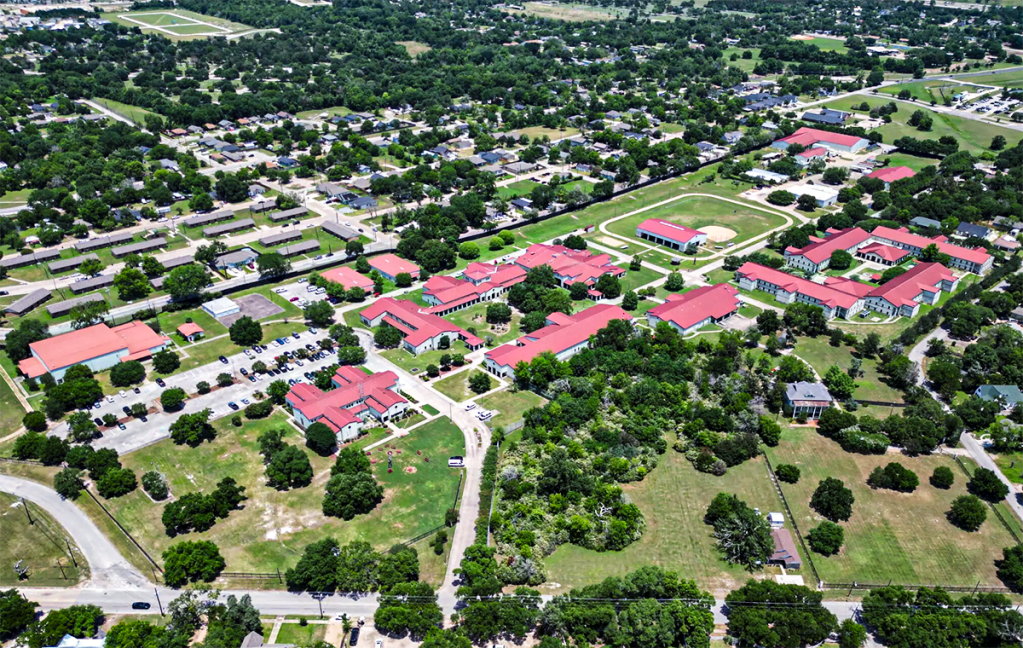
Pictured above is Ghislaine Maxwell’s new home—the federal women’s prison officially called the Federal Prison Camp, Bryan [Texas] and unofficially known as Club Fed.
On December 21, 2021, Ms. Maxwell was convicted of five counts of sex trafficking—charges that could have resulted in 65 years’ imprisonment. The prosecutors asked for 30 years. The judge gave her 20. In July, 2022, she began serving her sentence at the Federal Correction Institution, Tallahassee.
CNN writes,
Maxwell’s transfer to a minimum-security prison is relatively uncommon, as those convicted of sex offenses are almost always deemed too high of a risk to public safety. That means that those inmates are at best assigned to a low-security prison. …
The move comes a week after Maxwell met in private with Deputy Attorney General Todd Blanche at the US attorney’s office in Tallahassee. Details of that meeting have not been made public, though her lawyer has said that Maxwell “honestly answered every question that Mr. Blanche asked.”
Murphy declined to give any explanation for Maxwell’s move. The Justice Department has not responded to questions from CNN. …
A minimum-security prison camp, like in Bryan, is the least-restrictive type of facility among federal prisons, housing inmates considered to be low-risk, non-violent and unlikely to escape. Camps have very little or no fencing containing the inmates, and inside they are able to move relatively freely.
Other inmates in the camp for women include Jen Shah, who was on the TV show “Real Housewives of Salt Lake City,” and Elizabeth Holmes, formerly of the blood-testing company Theranos.
For an inmate like Maxwell to be transferred into a minimum-security prison, a top official inside of the Bureau of Prisons would need to conclude that her risk to public safety has lowered based off recommendations from prison staff or good behavior. That official, the administrator of the Designation and Sentence Computation Center, makes those determinations, according to the BOP.
The agency declined to explain the specifics of how Maxwell’s reassignment was handled.
Maxwell’s new facility, a federal prison camp, has limited perimeter fencing, a low staff-to-inmate ratio, and is “work- and program-oriented,” according to the [Bureau of Prisons] website.
Thing things about Ghislaine and her new prison home. Thing One: It’s a damn sight better for her than her old prison in Tallahassee. Thing Two: It’s a favor that Trump and his minions can take back at any time. Thing Three: The fact that Trump granted the favor—without any explanation or plausible reason, and given the ongoing Epsteingate saga—makes Trump look really, really bad.
In sum: big upside for Ghislaine, but downside for Orange Mussolini.
For those who shave with Occam’s razor, there’s only one possible explanation: Trump needs Ghislaine to zip her lips and keep ‘em zipped, because she knows things that would, at the very least, be seriously embarrassing to His Most High Excellency.
But Orange Mussolini, it must be remembered, is a man virtually without shame. He shamelessly admits to groping women by the genitalia. He shamelessly admits to barging into the dressing room at the Miss Teenage USA Pageant and taking a good look.
The mind boggles at what new shameful information might concern him now. It must be a hell of a secret.
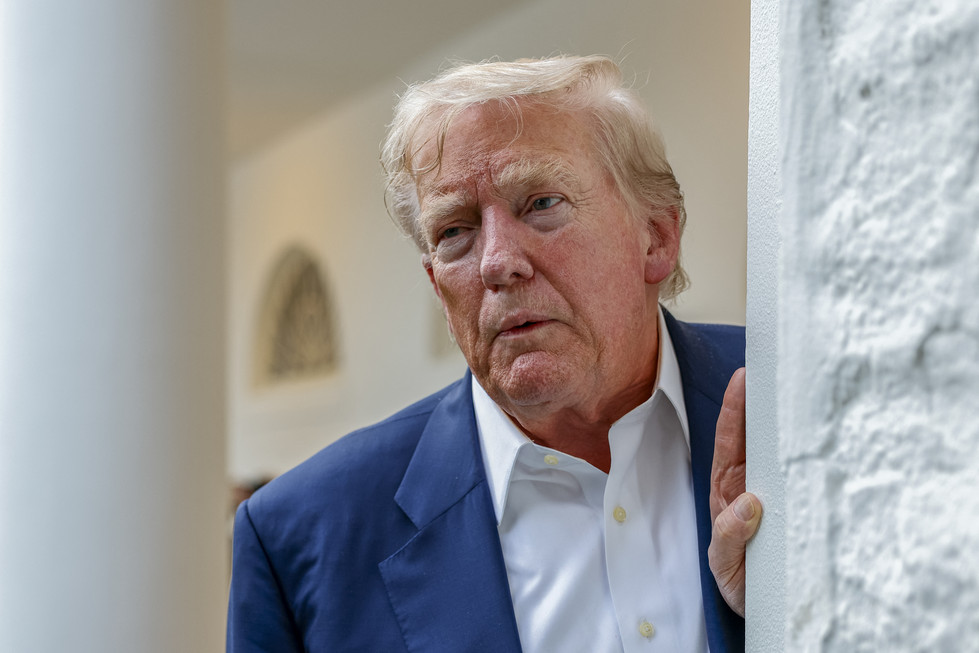
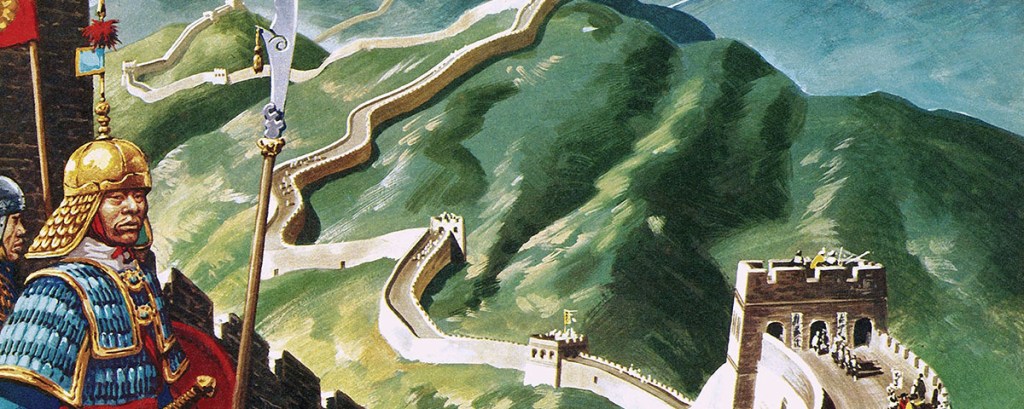
More than two millennia ago, Chinese leaders discovered that, if barbarians want to engage in mutually destructive fights among themselves, the thing for China to do is to hold their beer and let them have at it.
Today, they are delighted to see us destroy ourselves.
Ishaan Tharoor of the Post writes, a propos “China’s evolving view of President Donald Trump’s second term,”
Beijing sees Trump’s disruptive actions — his gutting of institutions of U.S. soft power, his launching of trade wars against adversaries and allies alike, his steady eroding of trust in the U.S. alliance system — as acts of self-sabotage that need no Chinese prompting. Better for now, as Gen Z would say, to let him cook.
After Trump moved to dismember the U.S. Agency for Global Media, which backed internationally oriented outlets such as Voice of America, Chinese state-made broadcasts took the place of U.S. programming on TV networks in countries as disparate as Indonesia and Nigeria. Trump, like a growing number of Republicans, viewed the media properties as suspicious fonts of “anti-American” liberalism. But Chinese propagandists exulted at the demise of these U.S.-funded news operations, which had, to varying extents, chronicled the state of pro-democracy movements around the world and provided space for dissident voices in countries where political freedoms are curtailed.
“The Chinese people are happy to see the U.S. anti-China ideological fortress breached from within,” cheered Hu Xijin, former chief editor of the Global Times, a Chinese state-run, English-language newspaper, this year on social media.
In a video circulating this month, Victor Gao, a former Chinese diplomat and vice president of the Beijing-based Center for China and Globalization, mused whether Trump may come to be remembered as an American Mikhail Gorbachev. The comparison to the late Soviet leader and famous author of glasnost and perestroika was not meant to be flattering: Gorbachev’s attempt at reforms, Gao said, precipitated the collapse of the Soviet empire and unleashed a “trauma” still being felt today.
Gao suggested that by the end of the decade, Trump’s own attempt at reforms will have “fundamentally changed” both the United States and NATO, likely for the worse. Trump would not have made America “bigger, stronger, greater,” Gao said, but rather may have “led it astray, like Gorbachev.”
The fall of the Soviet Union isn’t the only historical parallel alive in Chinese discourse about the U.S. A host of Chinese commentators see in MAGA a whiff of China’s own Cultural Revolution under Mao Zedong, which saw myriad purges and the defenestration of ranks of the intellectual classes and political elites. “Mao unleashed the Red Guards to ‘smash’ the police, prosecutors, and courts, so that loyal revolutionaries could seize control of state machinery,” Zhang Qianfan, a constitutional law professor in Beijing, recently told CNN. “Trump brought Elon Musk and six young Silicon Valley executives into the White House under the banner of eliminating corruption, waste, and inefficiency — akin to the ‘Cultural Revolution Leadership Group’ entering the party’s central leadership.” …
Various “initiatives” promulgated by Xion development, security and cultural harmony have put forward a rosy Chinese vision of global cooperation and prosperity stripped of liberal ideals around universal rights and democracy. China’s position is gaining ground thanks to the shifts in Washington. “Beijing’s assessment right now is that the United States is dismantling, fairly systematically, the sources of its strength,” Julian Gewirtz, a China scholar and former Biden administration official, said in a recent interview.
“The United States, in their view, is dismantling its alliance relationships and alienating much of the world,” Gewirtz told the Wire China. “It is dismantling aspects of the U.S. science and technology ecosystem, cutting funding to some of our great universities, and making it very unappealing, if not outright impossible, for foreign talent to come do research in those universities. And it is eliminating arms of U.S. influence around the world, from USAID to Voice of America. China’s view is that the United States is, in a sense, unilaterally disarming.”
 Facing MAGA