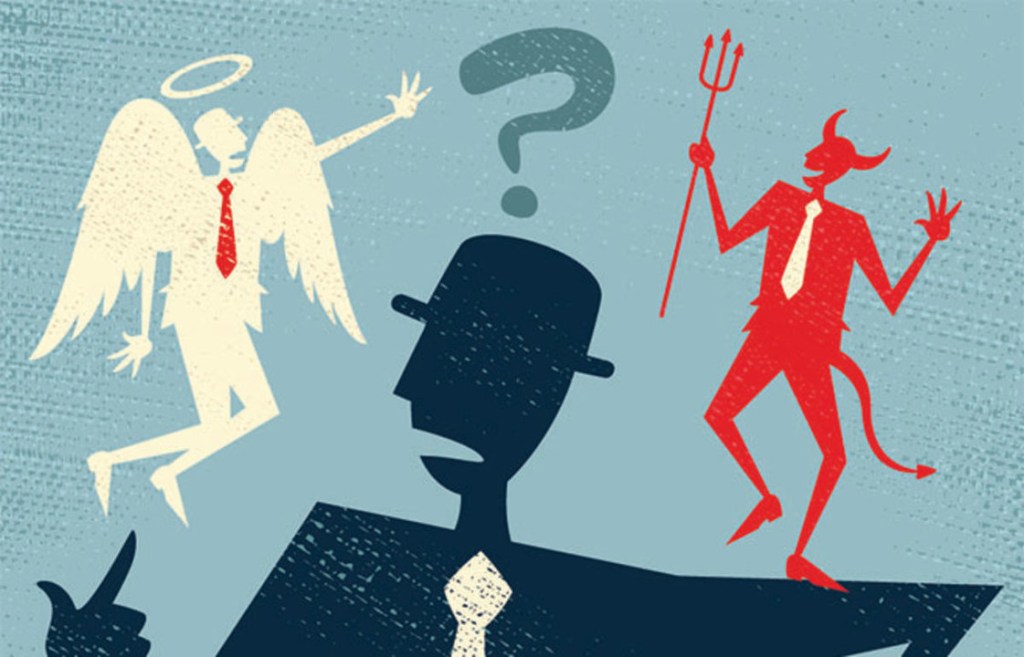
Moral relativism is enticing. It enables me to establish the moral value of everything I do by reference to the behavior of others. It allows me to avoid censure by judging my intentions, choices and actions not on the basis of whether they are intrinsically right or wrong, but by the lesser standard of whether someone in a similar position might have done something similar.
Moral relativism is hardly new in public life. Self-exoneration through false moral equivalence by public figures is as old as time itself. But when it becomes the controlling ethical architecture of public behavior, we are in serious trouble. Its effect is to give leaders permission to do just about anything they want, unconstrained by guilt, shame or political sanction. Moral relativism and the ratchet effect will ensure that there is always some precedent close enough to persuade people to shrug even when confronted with some evidence of genuine turpitude on their own side.
We’ve been descending this spiral for a long time, but as with just about everything to do with the gargantuan figure of Donald Trump, his behavior has accelerated the descent.
His corrosive effect on norms of ethics, language and, for that matter, conservatism, has been amplified by the eager acquiescence of the Republican Party in the process.
The party that once liked to think of itself as committed to values and principles has become the most cynical exponent of the idea that everything is relative. A cheerleading chorus of so-called conservatives in the media eased the way. Every time they are confronted with evidence of some new infamy by their president, many on the right will choose to avoid the unrewarding path of moral consistency and opt instead for the tactics of least resistance: misdirection, “whataboutism,” or simply reaching for the blinders. All of these relativist tools have been on display in the last week.
Take the pardon for Changpeng Zhao, the Binance cryptocurrency exchange founder, convicted of money-laundering offenses. This after his firm had been involved in a lucrative financial partnership for the president and his family that helped contribute to the $4.5 billion in wealth they have generated this year alone. Morally equivalent precedents: Hunter Biden? The Clinton Foundation? Hardly on the same scale. What we have seen this year is new levels of graft and grift. We seem to be moving rapidly toward a justice system in which the president essentially gets to decide who should be in prison. If you’re a political enemy, we’ll come up with a crime to fit your punishment. If you’re a friend, we will annul your crimes.
Then there is Mr. Trump’s grandiose plan for the East Wing of the White House. There has been a lot of nonsense about this. I don’t doubt that the left’s hysteria is overdone. It seems certain that, legally and constitutionally, the president could, if he wanted, tear down the whole executive mansion and replace it with a giant casino—and there’s certainly plenty of presidential precedent. This much is grounds for legitimate moral equivalence.
But there is the legitimate question of how it’s paid for. Usage has by now dulled us to the question “What would we say if a Democrat did this?” But some of us remember when Bill Clinton had wealthy donors for sleepovers in the Lincoln Bedroom, and for weeks Republicans and their supporters in the media treated it as if he were selling the sacred space to the highest bidder. Now we have a president who is literally selling the place to the highest bidders, all justified on spurious comparisons with some changes Barack Obamamade on a much smaller scale.
Misdirection is a convenient tool of relativism. Look at the latest mind-numbing assault on sanity of the president’s new tariffs on Canada. The obvious legal, political, moral, diplomatic and economic monstrosity of a president unilaterally imposing a tax on imports because he was upset by something that a Canadian provincial government decided to show on television is literally without precedent. Yet a lot of people on the right have spent the last week explaining how Mr. Trump was essentially right to say Ronald Reagan “loved” tariffs more than those wicked Canadians claimed. (He didn’t, but truth is another casualty of moral relativism.)
And never mind that the president is making personal laws and dispensing arbitrary justice, have you seen the tattoo on the chest of that Democratic candidate for Senate in Maine? My God, the Democrats have a Nazi problem.
It should be possible—and it is essential to a well-ordered society—to call out morally reprehensible behavior by your own side as well as by your opponents. That it no longer seems to be leaves us all morally degenerate.
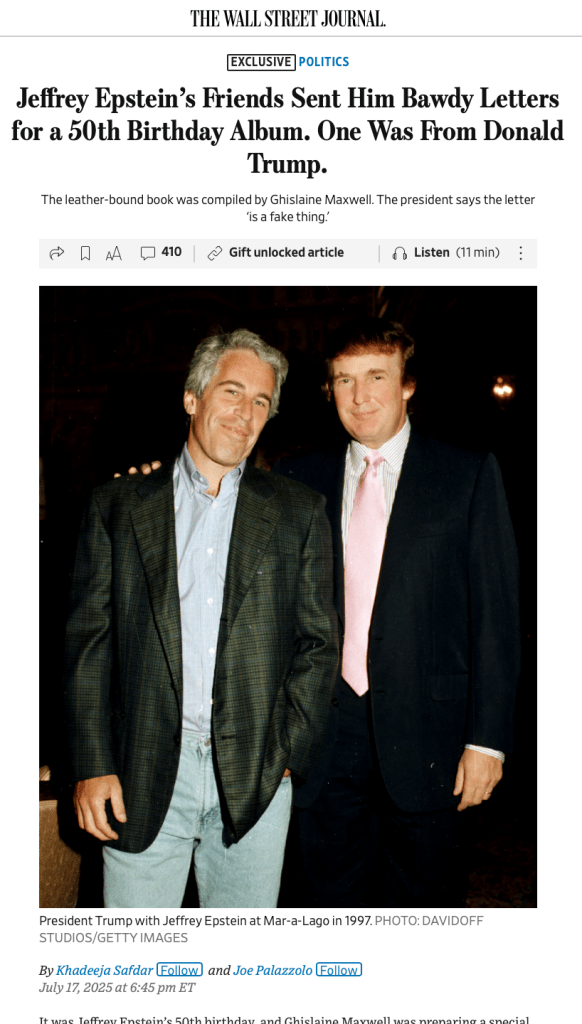
I was writing this post in my head when the Wall Street Journal served up this treat today at dinner time.
Donald Trump is, and has been for a long time, a bully, a liar, a con man, and a sociopath. Now he is something else as well—a doddering old fool. Whatever coherence his ramblings once had is disappearing fast. That said, one can construct something out of his disjointed utterings.
When Trump says that Thing X is a “hoax,” he means that
Thing X actually occurred or is now occurring, and that
Public knowledge about Thing X would reflect very badly on him—worse even than public knowledge that he routinely grabbed adult women by their genitalia, and bragged about this behavior.
I won’t regurgitate the whole sordid business. But it seems clear beyond peradventure of doubt that Trump is in the voluminous Epstein investigatory files, and that he is drenched in flop sweat.
To address this predicament, Trump now wants everyone to believe that Epstein was not in fact a pedophile; that he should not have been prosecuted (during Trump’s first administration) because Epstein did nothing wrong; and—by implication—that Epstein’s lover and co-conspirator, now in jail, did nothing wrong either; and that these wrongful prosecutions were the result of evil Democrats, just like the January 6 prosecutions.
To this end, Trump will cast James Comey’s daughter and career federal prosecutor, Maureen Comey, as chief villainess in the purportedly unjust prosecution of Jeffrey Epstein and Ghislaine Maxwell. That’s why he fired her yesterday.
From Team Trump’s perspective, firing Ms. Comey was a very bad idea.
As a former corporate advisor, I always told people to be careful about firing unsatisfactory employees who had dirt on you.
Firing Ms. Comey is mistake number 796. She has dirt on Trump.
Meanwhile, In Late Evening Developments
Trump says he is suing the Wall Street Journal, and all its corporate uncles, cousins, and aunts, for publishing the Epstein birthday letter.
It is widely reported that MAGA influencers—trying to play both ends against the middle—are asserting that the WSJ story about the birthday letter is fake news.
And Trump says he’s ordered the Justice Department to go to court to seek public disclosure of grand jury materials relating to Epstein.
The Business Roundtable has about 200 members—all chief executive officers of the largest corporations in America. Trump will be meeting with them later today.
Some politicians want to distribute income upward—in other words, screwing the poor to make the rich richer.
Some politicians want to be Robin Hood—robbing the rich to help the poor.
Trump wants to screw the poor, screw the middle, and screw the rich, all at the same time.




 Facing MAGA