The Mind Boggles
Even for those of us who despise Trump, the mind boggles at the thought of his walking into a major war without clear objectives, devoid of any understanding about how the war is going to end.
However, boggle as it may, the mind must accept that this is exactly what is happening. See, among many other examples, Reuters, Trump seeks to justify Iran war, but stated objectives shift.
Trump cannot explain his war aims and how they will be achieved because he is delusional—and misapprehends many vital facts about the situation—because he has no rudimentary understanding of the relation between cause and effect, and because he thinks that whatever horrific misjudgments he makes can be wiped out by his magical bullshit.
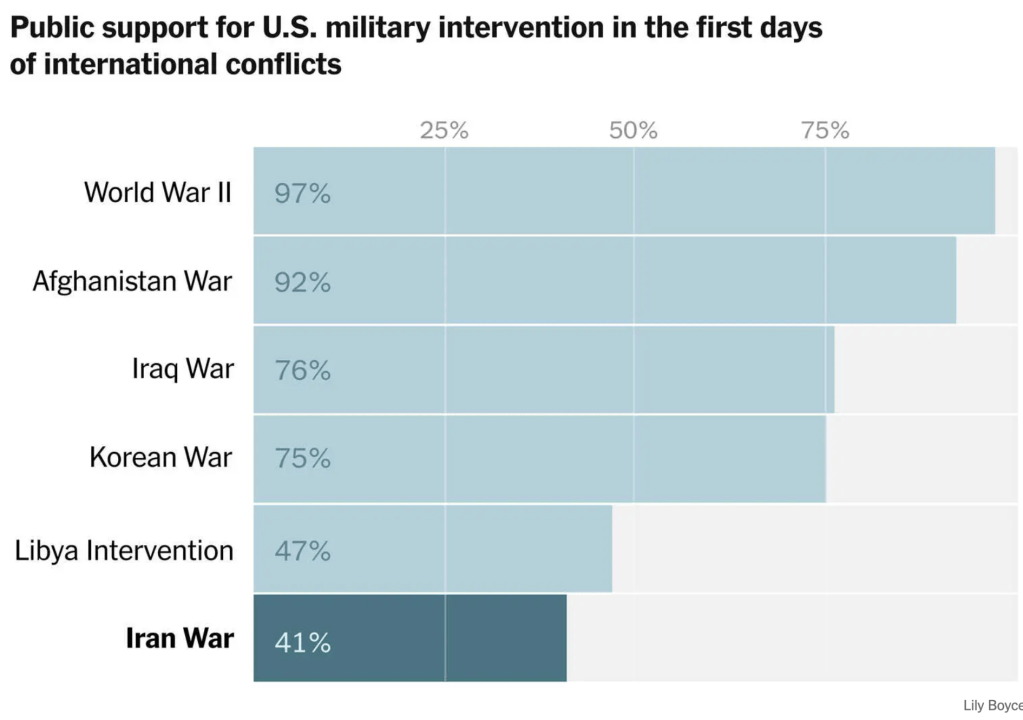
The New York Times this morning elucidates the consequences for public opinion:
A Suggestion for Discussion with Your Red Hatted Friends
If you chance to speak to one of the 41 percent who say they support the Iran war, you might consider trying this: Have a discussion about what they think Trump’s war aims are. Try to get them to be specific. Having done so, try to find agreement on an objective criterion to determine whether or not their imagined war aims have actually been achieved. Finally, agree on a date to schedule a follow-up conversation to discuss the actual state of the war, in light of what they imagine its objectives to be and whether their objective test of success has been met.
Too Late to TACO
Meanwhile, Ed Luce of the Financial Times tells us that Taco on Iran will come too late for Trump:
Sometime soon Donald Trump will ring the closing bell on his Iran war. That moment will have less to do with whether his mission is accomplished (whatever that is) than how much pain he can endure. We can safely assume that Iran’s pain threshold is higher than his. Trump will nevertheless present his exit as a victory. Iran will have every incentive to ensure nobody believes him. That is the crux of his self-inflicted dilemma.
Anticipating this would have served Trump well. One step would have been to build up America’s strategic petroleum reserves, which dropped sharply after Russia’s invasion of Ukraine and were never replenished. Oil and natural gas prices may have soared but an ounce of prevention is still worth a pound of cure. A second would have been to win the Gulf monarchies round to his war plan in advance. That he had no fixed goal made that difficult. Now he is faced with an increasingly irascible Gulf. A third would have been to prepare the US public for a longer conflict. Ditto.
The question is whether Trump has become aware of the drawbacks of not thinking ahead. Were he on a learning curve, he would know that even a severely degraded Iran can continue to frighten oil tankers from the Gulf and shutter much of the region’s energy production. Short of occupying Iran, Trump cannot guarantee safe passage in the Strait of Hormuz. Drone production is decentralised and hard to eradicate from the air.
Nor can Trump handpick a new Iranian leadership. Others have observed it took America two decades to replace the Taliban with the Taliban in Afghanistan. It took Trump just over a week to replace one Khamenei with another. Since Mojtaba, the new supreme leader, is considered more hardline than his father, Trump will likely draw a blank on securing an Iranian ceasefire, let alone an “unconditional surrender”. Which leaves him with a couple of very risky gambles.
The first would be to send US or Israeli commandos to Isfahan to seize what remains of Iran’s 400kg stockpile of enriched uranium. Success would offer Trump a spectacular off-ramp. Indeed, the temptation of a lightning operation that upends the Taco narrative could be overpowering. Hovering over that is the ghost of Jimmy Carter. His failed 1980 Iranian hostage rescue mission helped to sink his presidency. Having so often announced the obliteration of Iran’s nuclear programme, Trump would not survive an equivalent setback.
His other gambit would be to occupy Iran’s Kharg island to shut off its oil exports. Such a move could be even riskier because it would involve many more US boots on the ground than a commando raid — and for much longer. It would strangle Iran’s main revenue source and worsen the oil shock. But its risk-reward ratio looks reckless. After barely a week, public support for Trump’s Iran war is at the same level it was for the Vietnam war in late 1967 following more than 11,000 American deaths. There is no US tolerance today for even a few dozen casualties. Taco — “Trump always chickens out” — is thus a question of when.
Trump would still pay a high price for a unilateral declaration of victory. The biggest risk is that nothing will happen. By walking away, the US president would have given Iran knowledge of his price point, which is soaring energy prices. Iran also has a vote in deciding when this conflict ends. It would have every reason to sustain its disruption to global energy markets as a deterrent to Trump changing his mind. Iran has now been attacked by Israel four times in the past two years — twice with Trump’s America in the lead. Iran will want to raise the costs of another resumption a few months from now.
The Iranian regime’s surest route to safety would be to go nuclear. Good intelligence can keep making a rubble of Iran’s nuclear capacity but that is no sure bet. Iran’s logic of dashing to North Korea’s status will be compelling. Others, notably Russia’s Vladimir Putin and North Korea’s Kim Jong Un, may be tempted to help. Regimes everywhere are making the same calculations with fresh immediacy.
One piece of damage that Trump cannot repair is to trust in America. Long after oil prices have stabilised, the world will recall his administration’s glory in the imagery of “lethality”, as his defence secretary, Pete Hegseth, calls it. Trump chose to go to war and has taken explicit satisfaction in his power of life and death. War is a grave step after all other options have been exhausted. That Trump had other courses of action is well understood. That he preferred this one is hard to unsee.
 Facing MAGA