The Wall Street Journal Editorial Board Would Like to Let You Know That the Trump Economy is Stumbling

The Journal’s Editorial Board writes, 

The Trump Economy Stumbles

The President has his new world tariff order in place, but jobs and growth don’t look so good.

President Trump has now imposed his new tariff regime on the world, and the triumphalism is palpable in MAGA land. But maybe hold the euphoria, as this week’s reports on jobs and the economy suggest the new golden age may take a while to appear. 

Friday’s labor report arrived with a particular jolt, with a mere 73,000 net new jobs in July. Even more bearish were the downward revisions of 258,000 jobs in May and June. Job gains over the last three months are barely more than 100,000.

The details in the report provide little solace. The jobless rate ticked up only to 4.25% from 4.1%, but that was in part because the labor force continued to shrink. The labor participation rate fell again to 62.2% and is now down half a percentage point in a year.

Employers aren’t laying off workers, but they have all but stopped new hiring. Notably, most of the new jobs are in healthcare and social assistance, which rely heavily on government spending. This continues the Biden-era trend that Trumponomics was supposed to change. Not so far.

The much-advertised rebirth of U.S. manufacturing also hasn’t arrived. The economy shed 11,000 manufacturing jobs in July, following a loss of 26,000 in May and June. The ISM Manufacturing Index fell again in July to 48, the fifth straight month below 50. 

One labor market problem may be the crackdown on migrant workers. The foreign-born workforce has fallen by about a million since Mr. Trump took office. The National Foundation for American Policy, a nonpartisan think tank, says immigrants accounted for over half of the labor force increase in each of the last three decades. Fewer workers means fewer new jobs as employers conclude they can’t fill them.

***

How much of this jobs and growth slowdown owes to Mr. Trump’s tariffs? It’s hard to say for sure. But it has occurred in the wake of Mr. Trump’s April 2 tariff shock, his rapid backtrack from the highest rates, and then his willy-nilly threats and deal-making with the world. The policy uncertainty has surely affected business hiring and investment. How can you hire or invest if you don’t know what your cost of goods will be, or from which supplier you will be able to buy at a competitive price?

On that score, Mr. Trump’s latest tariff blast this week hasn’t put an end to the uncertainty. Much of the world will now pay 15%, if Mr. Trump sticks to his deals. But some of the biggest U.S. trading partners—Mexico, Canada, China and India—remain in tariff limbo. Brazil will pay 50%, though it has a trade surplus with the U.S. And what did Switzerland ever do to Mr. Trump to deserve 39%? Charge too much for a watch?

Mr. Trump and his supporters are hailing the trade deals as the dawn of a new world trading order that will be better for American workers. And it’s true that the rest of the world has declined to retaliate, China excepted. The U.S. market is so large that these countries seem willing to absorb the 15% tariff hit rather than risk even higher tariffs from Mr. Trump if they did retaliate.

But what matters will be the economic results over time. The U.S. economy is resilient, and perhaps it can absorb a new average tariff rate from 15%-20%, up from 2.4% when he took office in January. There will also be a clamor for wide exceptions.

But the tariff tax increase in dollar terms at Mr. Trump’s current rates will be close to $360 billion a year. That’s among the largest tax increases in recent history. Republicans have spent decades building credibility as the antitax party, but now they’re going along with Mr. Trump’s tariffs on the fiction that only foreigners will pay them. Let’s see how well that plays when prices on tariffed goods increase.***

Mr. Trump seems to understand that the jobs report signals trouble because on Friday he ordered the firing of the head of the Bureau of Labor Statistics. He claims the numbers are being politically manipulated, but he offered no proof. BLS has its problems, but the timing suggests he’s shooting the messenger. There are bound to be monthly revisions when tariff and deportation policies are so volatile.

Mr. Trump’s other scapegoat is the Federal Reserve, which he says has been too late to cut interest rates. Maybe that will prove to be true, but the Fed also has to navigate Mr. Trump’s tariff uncertainty and the large fact that inflation is still above its 2% target. Every public opinion poll says voters remain unhappy about the price increases they’re paying.

A saving grace, we hope, is that the new tax law and deregulation will reduce business costs and lift investment. But Mr. Trump can help by stopping his trade war. If he won’t roll back his tariffs, at least he can declare that he’s content with where they are and has no plans for more.
The Wall Street Journal Editorial Board Would Like Trump and Vance to Know That They Have Jumped the Shark

Wall Street Journal Editorial Board, Putin Wins the Trump-Zelensky Oval Office Spectacle: Vice President Vance starts a public fight that only helps Russia’s dictator

Last week, at the United Nations, the United States sided with North Korea and Belurus, refusing to support a European resolution condemning Russian aggression against Ukraine. Then, on Friday, there was the debacle in the Oval Office. Taken together, these developments have led many to conclude that the United States has switched sides in the Cold War

Writing about yesterday’s TV spectacle in the Oval Office, the Wall Street Journal Editorial Board does not focus on whether or not the US has actually switched sides. Rather, true to its lodestar value—namely, the election of Republicans to office, where they can pursue a business-friendly agenda of low taxes and minimal regulation—the Board has some pointed words about the political peril ahead. The Board writes, 

“He disrespected the United States of America in its cherished Oval Office,” Mr. Trump wrote on social media on Friday afternoon after the exchange, while booting the Ukrainian president from the White House. “He can come back when he is ready for Peace.” The two didn’t sign a planned agreement on minerals that would have at least given Ukraine some hope of future U.S. support.

The meeting between Messrs. Trump and Zelensky started out smoothly enough. “It’s a big commitment from the United States, and we appreciate working with you very much, and we will continue to do that,” Mr. Trump said of the mineral deal. Mr. Zelensky showed photos of Ukrainians mistreated as prisoners of war. “That’s tough stuff,” Mr. Trump said.

But then the meeting, in front of the world, descended into recriminations. The nose dive began with an odd interjection from Vice President JD Vance, who appeared to be defending Mr. Trump’s diplomacy, which Mr. Zelensky hadn’t challenged. Mr. Zelensky rehearsed the many peace agreements Mr. Putin has shredded and essentially asked Mr. Vance what would be different this time. 

Mr. Vance unloaded on Mr. Zelensky—that he was “disrespectful,” low on manpower, and gives visitors to Ukraine a “propaganda” tour. President Trump appeared piqued by Mr. Zelensky’s suggestion that the outcome in Ukraine would matter to the U.S. “Your country is in big trouble. You’re not winning,” Mr. Trump said at one point. 

Why did the Vice President try to provoke a public fight? Mr. Vance has been taking to his X.com account in what appears to be an effort to soften up the political ground for a Ukraine surrender, most recently writing off Mr. Putin’s brutal invasion as a mere ethnic rivalry. Mr. Vance dressed down Mr. Zelensky as if he were a child late for dinner. He claimed the Ukrainian hadn’t been grateful enough for U.S. aid, though he has thanked America countless times for its support. This was not the behavior of a wannabe statesman.

Mr. Zelensky would have been wiser to defuse the tension by thanking the U.S. again, and deferring to Mr. Trump. There’s little benefit in trying to correct the historical record in front of Mr. Trump when you’re also seeking his help. 

But as with the war, Mr. Zelensky didn’t start this Oval Office exchange. Was he supposed to tolerate an extended public denigration of the Ukrainian people, who have been fighting a war for survival for three years?

It is bewildering to see Mr. Trump’s allies defending this debacle as some show of American strength. The U.S. interest in Ukraine is shutting down Mr. Putin’s imperial project of reassembling a lost Soviet empire without U.S. soldiers ever having to fire a shot. That core interest hasn’t changed, but berating Ukraine in front of the entire world will make it harder to achieve. 

Turning Ukraine over to Mr. Putin would be catastrophic for that country and Europe, but it would be a political calamity for Mr. Trump too. The U.S. President can’t simply walk away from that conflict, much as he would like to. Ukraine has enough weapons support to last until sometime this summer. But as the war stands, Mr. Putin sees little reason to make any concessions as his forces gain ground inch by bloody inch in Ukraine’s east. 

Friday’s spectacle won’t make him any more willing to stop his onslaught as he sees the U.S. President and his eager deputy unload on Ukraine’s leader. Some Trumpologists have been suggesting Mr. Trump will put pressure on Mr. Putin in due time. But so far Mr. Putin hasn’t made a single concession on territory, or on Ukraine’s ability to defend itself in the future after a peace deal is signed. 

President Trump no doubt resents having to deal with a war he thinks he might have prevented had he won in 2020. But Presidents have to deal with the world they inherit. Peace in Ukraine is salvageable, but he and Mr. Zelensky will have to work together on an agreement that Ukrainians can live with. 

Mr. Trump does not want to be the President who abandoned Ukraine to Vladimir Putin with all the bloodshed and damage to U.S. interests that would result. Mr. Vance won’t like to run for President in such a world either.

This is What Happens When Rich Folks Want Their Tax Cuts So Much That They Hand Over Power to an Actual Crazy Person

Trump’s Hissy Fit About the WSJ Editorial Board

Folks, grab a six pack and pop a big old bowl of popcorn.

The Guardian, Trump threatens to sue media after Wall Street Journal editorial criticizes tariffs: Journal argued Trump’s tariff plans would harm ‘US auto workers and Republican prospects in Michigan’

The Guardian writes, 

Wall Street Journal editorial slamming Donald Trump’s tariff plans as terrible for the US economy and auto industry prompted a broadside from the president on Wednesday followed by threats to sue the media.

In an opinion piece titled Trump’s Tariffs Will Punish Michigan, the Journal argued Trump’s tariff plans would harm “US auto workers and Republican prospects in Michigan”.

Trump has threatened to impose 25% tariffs on goods from Mexico and Canada, a move the editorial argues would increase US vehicle prices, hurt auto workers and advantage Asian and European manufacturers.

“If the goal is to harm US auto workers and Republican prospects in Michigan, then by all means go ahead, Mr President,” wrote the Journal.

On his social media site, Truth Social, Trump wrote the Journal is “soooo wrong”. “The tariffs will drive massive amounts of auto manufacturing to MICHIGAN, a State which I just easily one [sic] in the Presidential Election,” he wrote.

Trump followed the rebuttal with a threat to those publishing “Fake books and stories with the so-called ‘anonymous’, or ‘off the record’, quotes” criticizing the opening month of his second presidency.

“At some point I am going to sue some of these dishonest authors and book publishers, or even media in general, to find out whether or not these ‘anonymous sources’ even exist, which they largely do not. They are made up, defamatory fiction, and a big price should be paid for this blatant dishonesty. I’ll do it as a service to our Country. Who knows, maybe we will create some NICE NEW LAW!!!,” he wrote.

The Journal’s conservative editorial board has been a persistent critic of Trump’s tariff plans, calling them “the dumbest trade war in history” earlier this month.

Actually, It’s Not Just Misunderstand and It’s Not Just Poor Strategery—It’s Magical Thinking

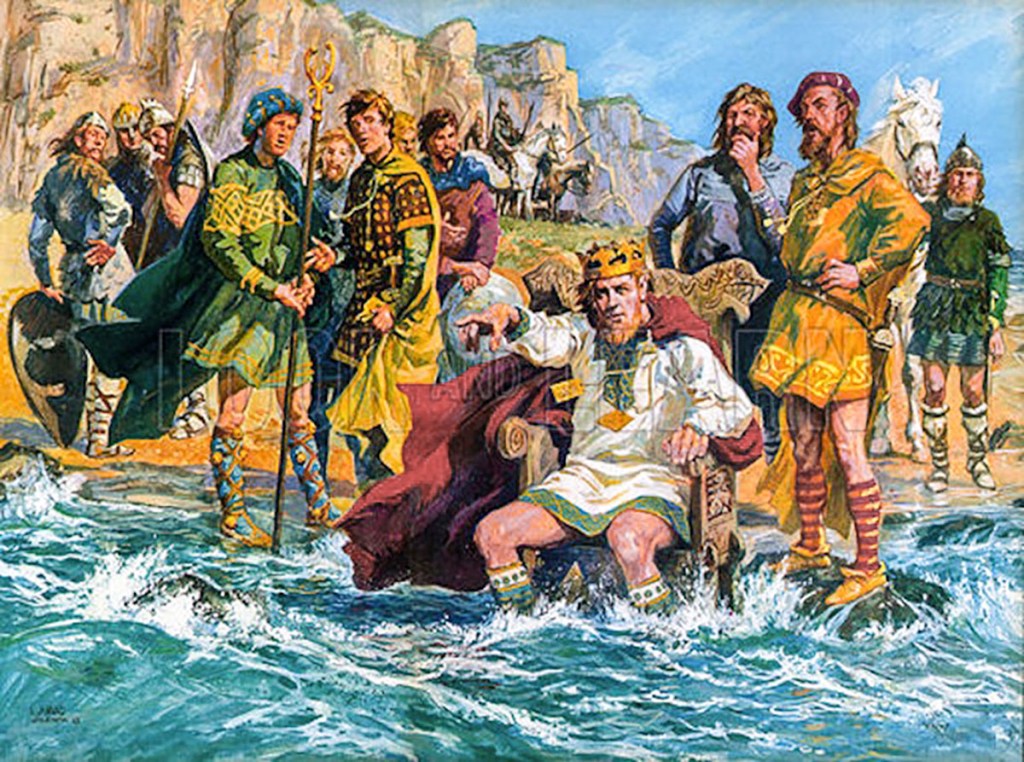
King Canute. Illustration from Once Upon a Time.

The two posts immediately below deal with Trump’s fundamental misunderstanding of how money and interest rates work. One quotes in full a Wall Street Journal Editorial Board piece published late yesterday. The other gives some context: it explains why the fact that these truths are now coming from the WSJ Editorial Board, not some other publication, is a man bites dog story, not a mere dog bites man piece of news. 

This is correct as far as it goes, but it does not go far enough. There are all manner of things that I do not understand. But that does not mean that I engage in magical thinking. I do not fancy myself the God of Genesis 1—who just says things, and then they are so. 

King Canute knew that he could not make the tide turn back just by telling the tide to turn back. 

Trump thinks that King Canute was wrong. 

We have elected someone with severe mental illness. 

Those who voted for him are getting the president they richly deserve. 

The WSJ Editorial Board Tells Donald That He Doesn’t Know Shit From Shinola, and That His Approval Rating is About to Sink Like a Stone

The Wall Street Journal Editorial Board writes,

Trumponomics and Rising Inflation

The President calls for easier money even though consumer prices keep rising. Does he want even higher prices?

The Editorial BoardFeb. 12, 2025 at 5:33 pm

“Interest Rates should be lowered, something which would go hand in hand with upcoming Tariffs!!!” Mr. Trump posted on his social-media site. The layers of intellectual confusion here are hard to parse, especially since higher tariffs will mean higher prices on the affected goods. But perhaps the President wants the public to look elsewhere when assigning blame for rising prices.

Yet if he’s trying to blame the Federal Reserve, which controls short-term interest rates, he has the analysis backward. Rising inflation means the Fed must be more cautious in cutting rates. This is how financial markets read the news that the consumer-price index (CPI) rose 0.5% in January. Long bond rates rose sharply, with the 10-year Treasury note popping to 4.63% from 4.53%. This reflects market worry over inflation.

The concern is warranted based on the trend in CPI, which has risen each month since a 0.2% increase in October. The 12-month increase in CPI is now back to 3%, up from a recent trough of 2.4% in September. So-called core prices, less food and energy, rose 0.4% for the month and are now up 3.3% over the last 12 months. 

The price increases were broad-based, hitting insurance, used cars and trucks, airline fares, medical care, haircuts, day care, sporting events, cable television, and more.

Mr. Trump isn’t responsible for this after only three weeks in office. But someone should tell him that the mistake goes back to the Fed’s premature interest-rate cut of 50 basis points in September. Long bond rates shot up immediately and have stayed higher, but the Fed still cut another 25 points in November. 

Fed Chair Jerome Powell seems to recognize that mistake because he has been saying for weeks that the central bank is in no rush to cut further. The last thing Mr. Trump should be doing now is demanding that Mr. Powell cut rates further and faster—unless the President wants inflation to resume its Biden-era climb.

The Powell Fed is likely to ignore Mr. Trump, and well it should. But the President’s demand illustrates another risk of Trumponomics. As a real-estate investor, Mr. Trump has long been an easy-money guy. He likes low rates and a weak dollar, which could lead to higher prices, all other things being equal.

As a political matter, an inflation revival may be the biggest threat to the Trump Presidency. Mr. Trump was elected as voters reacted to inflation and falling real incomes under Joe Biden. Real average earnings are flat over the last three months as inflation has bounced up. If this persists, Mr. Trump won’t have a 53% job approval rating for long.