
Like a Man Trying to Race Upward on a Downward-Moving Escalator
Before I quote from Frum’s piece, I begin with some key points.
First, Frum is a mighty shrewd fellow.
Second, Frum grasps a vital truth: to understand what’s going on around us, you have absolutely got to focus on what motivates people. That’s people in general. That’s individual people, with all their eccentricities and foibles. And that’s categories of people. And, in our day and age, the category of criminals and opportunists who surround Trump.
If the Trump hangers on think that Trump is prevailing, well, that’s one calculation. But if they begin to fear he’s losing, well, that’s another calculation entirely.
So, with those thoughts in mind, take it away, David!
David Frum (The Atlantic),Trump Might Be Losing His Race Against Time: The president is gambling that he can consolidate authority before the public turns too sharply against him:
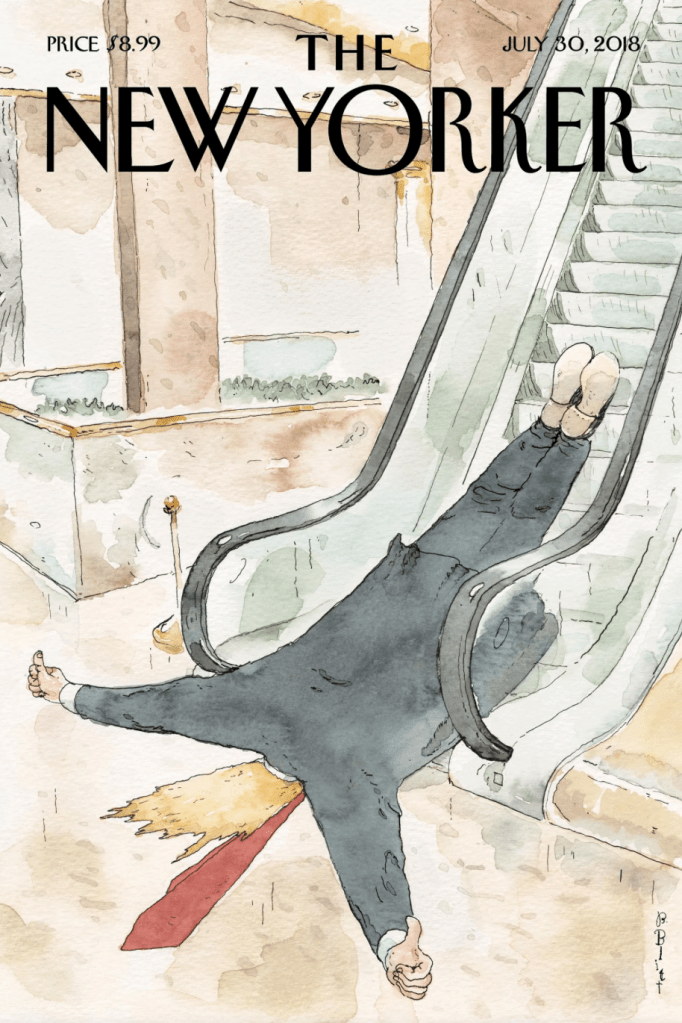
President Donald Trump is worried that Attorney General Pam Bondi is moving too slowly to prosecute his political adversaries on fake charges. Trump has good reason to be concerned. He is carrying out his project to consolidate authoritarian power against the trend of declining public support for his administration and himself. He is like a man trying to race upward on a downward-moving escalator. If he loses the race, he will be pulled ever deeper below—and the escalator keeps moving faster against him.
Autocracies are headed by one man but require the cooperation of many others. Some collaborators may sincerely share the autocrat’s goals, but opportunists provide a crucial margin of support. In the United States, such people now have to make a difficult calculation: Do the present benefits of submitting to Trump’s will outweigh the future hazards?
As Bondi makes her daily decisions about whether to abuse her powers to please Trump, she has to begin with one big political assessment: Will Trump ultimately retain the power to reward and punish her? It’s not just about keeping her present job. On the one hand, people in Trump’s favor can make a lot of money from their proximity to power. On the other, Richard Nixon’s attorney general, John Mitchell, served 19 months in prison for his crimes during Watergate. If Trump’s hold on power loosens, Bondi could share Mitchell’s fate.
Trump’s hold on power is indeed loosening. His standing with the voting public is quickly deteriorating. Grocery prices jumped in August 2025 at the fastest speed since the peak of the post-pandemic inflation in 2022. Job growth has stalled to practically zero.
Almost two-thirds of Americans disapprove of higher tariffs, Trump’s signature economic move. His administration’s attack on vaccines for young children is even more unpopular. This year has brought the highest number of measles cases since the Clinton administration introduced free universal vaccination for young children in 1993. Parents may be rightly shocked and angry.
Shortly after MSNBC reported that Tom Homan, Trump’s border czar, had accepted $50,000 in cash from FBI agents posing as businessmen last year, allegedly in exchange for a promise to help secure government contracts, the pro-Trump podcaster Megyn Kelly posted, “We DO NOT CARE.” This kind of acquiescence to corruption has been one of Trump’s most important resources. But the American people become a lot less tolerant of corruption in their leaders when they feel themselves under economic pressure. As of early August, nearly two-thirds of Americans regarded Trump as corrupt, 45 percent as “very corrupt.” More than 60 percent think the Trump administration is covering up the Jeffrey Epstein case. Almost 60 percent regard Bondi personally responsible for the cover-up.
The MAGA project in many ways resembles one of former businessman Donald Trump’s dangerously leveraged real-estate deals. A comparatively small number of fanatics are heart-and-soul committed. Through them, Trump controls the Republican apparatus and the right-wing media world, which allows him to do things like gerrymander states where he is in trouble (50 percent of Texans now disapprove of Trump, while only 43 percent approve) or wield the enforcement powers of the Federal Communications Commission to silence on-air critics. But overleveraged structures are susceptible to external shocks and internal mistakes.
Trump in his first term mostly avoided screwing up the economy. His trade wars with China triggered a nearly 20 percent stock-market slump in the fall and early winter of 2018. Trump retreated, and no recession followed the slump until the COVID shock of 2020. But in his second term, Trump has jettisoned his former economic caution. The stock market is doing fine in 2025 on hopes of interest-rate cuts. The real economy is worsening. The percentage of Americans who think the country is on the “wrong track” rose sharply over the summer. Even self-identified Republicans are now more negative than positive.
The souring is especially bitter among younger people. More than 60 percent of Republicans younger than 45 say things are on the wrong track, a 30-point deterioration over the three summer months.
Trump has a shrewd instinct for survival. He must sense that if he does not act now to prevent free and fair elections in 2026, he will lose much of his power—and all of his impunity. That’s why he is squeezing Bondi. But for her, the thought process must be very different. Trump is hoping to offload culpability for his misconduct onto her. She’s the one most directly at risk if she gives orders later shown to be unethical or illegal.
The survival of American rights and liberties may now turn less on the question of whether Pam Bondi is a person of integrity—which we already know the dismal answer to—than whether she is willing to risk her career and maybe even her personal freedom for a president on his way to repudiation unless he can fully pervert the U.S. legal system and the 2026 elections.
Immigration and the Democrats
Josh Barro (N.Y. Times), Democrats Blew It on Immigration:
Since the spring, the shine has come off President Trump’s handling of immigration. And yet there has been no apparent surge in voters’ desire to put immigration policy back in the hands of Democrats.
Frankly, Democrats have not earned voters’ trust on immigration — and I say this as a Democrat.
The most recent Democratic administration presided over an enormous surge in migration, with the unauthorized immigrant population exploding to 14 million in 2023 from 10.5 million in 2021 and likely millions more by the time Joe Biden left office, according to the Pew Research Center.
For too long, Mr. Biden and his team asserted they couldn’t stop the surge without new legislation. That proved false: In 2024, having failed to get an immigration bill through Congress, Mr. Biden finally took executive actions to curb abuse of the asylum system and slow the flow of migrants across the southern border. When Mr. Trump took office, illegal border crossings slowed to a trickle. In other words, the problem had been fixable all along; Mr. Biden simply did not fix it until much too late.
As a result, the unauthorized immigrant population in the United States today is considerably different from what it was before Mr. Biden’s presidency. In 2021, over 80 percent of unauthorized immigrants had been living here for at least five years. Now there are millions more recent arrivals without similarly deep links to American communities. Admitting all these new migrants was never an agreed-upon public policy — no voters endorsed this, no law passed by Congress contemplated it and to the extent the migrants are seeking asylum, their legal claims are too often bogus.
But it happened, and Democrats need to explain to voters why they should not expect it to happen again if they regain power. They also need a story about what happens with the millions of people who came here recently, even though they weren’t supposed to.
The longstanding preferred Democratic framework has been comprehensive immigration reform. The idea is that you secure the border, set an intentional and thoughtful immigration policy about who to admit going forward, and give some sort of amnesty to most of the unauthorized immigrants who are already here. Twenty years of legislative efforts to enact this framework failed, even when there was substantial Republican support for it, which is no longer the case. And that was before the composition of the unauthorized immigrant population changed so drastically.
Center-left commentators like Matthew Yglesias and Jerusalem Demsas have been proposing policy ideas that aim to make Democrats’ plans for immigration more appealing to the public. These include refocusing immigration toward higher-skilled migrants, allowing more guest workers on nonimmigrant visas to address inflation-producing labor shortages in industries like hospitality, adding requirements related to assimilation and English-language learning, and even taxing immigrants at higher rates than native-born Americans.
The Center for American Progress has a smart set of proposals to prevent a recurrence of the abuses of the asylum system that prevailed during the Biden administration. The institution’s Neera Tanden and Debu Gandhi propose to prohibit almost all asylum claims from migrants who crossed the southern border illegally, while those who make claims at the border would be held in custody instead of being allowed into the country on a parole basis. Their claims would be adjudicated within 30 days, with rapid removal for those whose claims are rejected. The proposal would also raise the standard of proof for asylum claims and maintain a list of democratic countries whose citizens are presumptively ineligible for asylum.
These sorts of reforms to prevent abuse are necessary to maintain the long-term political viability of the right to claim asylum — though Democrats should also be mindful that the total number of migrants matters, and further restriction could be necessary if too many migrants try to seek asylum under the new system.
The idea is to emphasize that immigration policy must be designed principally for the benefit of American citizens, who stand to gain from the economic and cultural contributions of immigrants so long as immigration is managed appropriately.
This is a good project — but it won’t work without a robust and credible commitment to enforcement, including interior enforcement. That’s because you can make whatever rules you want about who is supposed to immigrate and how, but if you continue to allow millions of people to come live in the United States in contravention of those rules, the immigration situation on the ground will not match what is written in policy.
The mental block that Democrats have here relates to an instinct about deportations: a feeling that it’s presumptively improper to remove an unauthorized immigrant who has settled in our country if that migrant hasn’t committed a crime unrelated to immigration. These people have been here a long time, the idea goes. They’re not causing trouble.
But if we build a system where people very often get to stay here simply because they made it in — the system that prevailed during most of Mr. Biden’s term — then we don’t really have an immigration policy, and voters won’t have any reason to believe us when we say our new policy will produce different results about who comes here.
Liberals also note, accurately, that there are negative economic consequences to a stepped-up program of interior enforcement that doesn’t focus narrowly on criminals. Unauthorized immigrants play an important role in our work force, especially in agriculture and construction. More deportations will make it more expensive to grow fruits and vegetables and reduce the number of housing units we can add. (On the other hand, it will also reduce demand for housing.) But these near-term economic costs need to be weighed against the way that stepped-up interior enforcement makes any future immigration policy more credible and more effective by sending migrants the message that they need a valid visa to stay in the United States.
The need to make a credible enforcement threat does not require Democrats to endorse specific enforcement practices of the Trump administration, like having ICE officers cover their faces during raids or pursue a goal of 3,000 detentions per day. Democrats are right to highlight and criticize the way that indiscriminate raids can sweep up U.S. citizens and to call for a more effectively targeted approach. But that more targeted approach still needs to contemplate that being in the country without authorization is reason enough to deport someone.
There is a political risk for Democrats in Mr. Trump’s softer poll numbers on immigration. Earlier in the year, when his immigration stances were clearly a political asset, Democrats looked for ways to moderate their image on immigration and show a willingness to get tough on enforcement; for example, many moderate Democrats in Congress voted for the Laken Riley Act (which directs the authorities to detain and deport immigrants who are charged or admit to — but are not yet convicted of — specific crimes, if they are in the country illegally).
But now that more Americans disapprove than approve of his approach to immigration, Democrats have often reverted toward centering the concerns of noncitizens — which is to say, nonvoters. The fact that voters increasingly see Mr. Trump’s approach to immigration as too harsh is not enough to turn the issue into an asset for Democrats. A late-July poll for The Wall Street Journalshows the problem for Democrats. It found respondents narrowly disapproving of the president’s handling of the issue — and yet it also showed that voters would not rather see immigration policy in the hands of Democrats. Only 28 percent said that they trust Democrats in Congress to handle immigration policy more than they trust Republicans, while 45 percent say they trust Republicans more than Democrats (the split was slightly wider on the question of illegal immigration).
If we force voters to choose between Mr. Trump’s overly harsh approach and our overly permissive one, we will continue to lose on the issue.
Most voters say immigration provides net benefits to the country, but they also want rules to be enforced. We need to echo both of those sentiments.
The Death and Life of Democracy
The main discussion begins at 6:45 of the video.
Ed Luce: Trump’s “Genius is to Keep Pushing the Democrats Into a Reactive Defence of the Status Quo”
Ed Luce of the Financial Times writes,
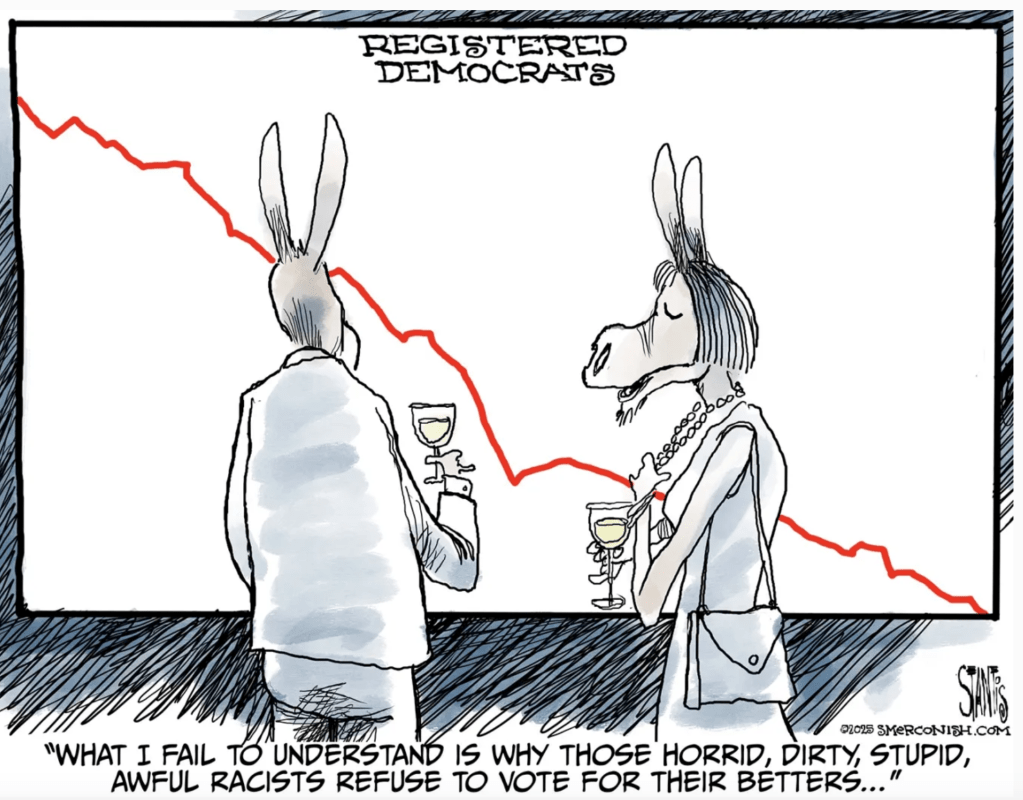
America has a conservative establishment. Its formal name is the Democratic party. Whether it be the federal government, universities, welfare or the regulatory state, Democrats fight to preserve the world as it is or was. “America is already great,” liberals cry, which is another way of saying that things were fine until Donald Trump came along. Their lodestar was Joe Biden, who personified nostalgia. Much of the party is now nostalgic for Biden. You have to be imprisoned in old ways of thinking to believe this is how US liberalism will rebound.
An invigorated US opposition would now be making hay. Trump’s team maintains a “promises kept” tally sheet. To be sure, he has in effect closed the border, demolished DEI quota culture, assaulted the deep state and launched trade wars against the rest of the world. But a big chunk of those who voted for Maga saw these moves as the means of lifting their economic prospects. The opposite is happening, which is why Trump’s numbers are in steady decline. Yet the fall in Democrats’ approval rating is even steeper. In relative terms, Trump’s political dominance has thus grown. Do not bet on a weakening economy changing that picture.
Trump’s genius is to keep pushing Democrats into reactive conservatism. That, plus the average age of the party’s leadership, makes Democrats look like permanently outraged grandparents. Trump’s assaults on pretty much every constitutional norm are indeed terrifying and outrageous. But they are remarkably inoculated against political backlash. To all intents and purposes, opposition to Trump has been reduced to a default outrage machine.
What is the solution? Democrats are a party of America’s professional elites plus various interest groups. And given that Trump won a majority of blue-collar voters, they are no longer the natural home of the working class. Any Democratic recovery would thus start by grappling with the latter’s worldview. The practical difficulty is that the party is shaped by elite professions, particularly law, government, media and academia. Such types often have a hard time concealing their distaste for those who voted for Trump. This is a poor starting point.
Democrats also face a deeper philosophical problem. Nobody knows how to reinvent 20th-century liberalism. In the US that was Franklin D Roosevelt’s 1930s New Deal, with updates over the next couple of generations. FDR built that world with “bold persistent experimentation”. His would-be heirs are stuck in a timid, persistent conservatism. They do not “welcome the hatred” of financial and business monopolists as Roosevelt did. They are the party of corporate America. No party in history could ever boast of so many expert fundraisers and humane philanthropists.
Lack of fresh ideas and cloistered demography are definitions of conservatism. If Trump did not exist, would Democrats want to reform the US administrative state? They should want to reinvent it but are now its militant defenders. A system that is so riddled with veto points that it takes years to execute simple projects and requires a PhD to navigate the tax system does not deserve to be defended. The same goes for a housing market that has priced younger voters out of the American dream and elite universities that are biased towards the children of alumni and donors. If Trump is attacking something, it must be defended to the hilt.
That Trump’s actions are destructive is no excuse. As political scientist Ruy Teixeira recently warned, Democrats are placing their chips on the “fool’s gold of midterm success”. Rather than seeking ways of reinventing a system in which America has lost faith, Democrats are betting on Trump’s defeat in next year’s congressional elections. The odds are that Republicans will lose the House of Representatives in 2026 and retain control of the Senate. Such midterm success would be a pyrrhic victory for Democrats. Biden based his 2024 re-election bid on his party’s relative success in the 2022 midterms. Look where that led.
A second piece of fool’s gold is to wait for Trumpism to die out with Trump. Even assuming that he does not launch a coup in 2028, Democrats would be unwise to think their problem will end with Trump. Familiarity with other democracies — Britain’s clueless Labour party, Germany’s moribund Social Democrats, France’s withered Socialists — shows that there is nothing unique to American populism.
The challenge for Democrats is to do what they should be doing were Trump not to exist. His superpower is to stop them from reaching that epiphany.
Chicken Little Clucks Again: The Supreme Court and the Federal Employees’ Lawsuit

A couple of days ago, on July 8, the Supreme Court issued its ruling in Trump v. American Federation of Government Employees. There was a two-paragraph unsigned decision by eight of the nine justices, there was a short concurring opinion by Justice Sotomayor explaining why she went along with the conservatives on this one. (Justice Kagan, who also went along with the conservatives but didn’t say anything on her own, presumably agreed with Justice Sotomayor.) And there was a lengthy and strong dissent by Justice Jackson.
The case involved Trump Executive Order 14210, dated February 11. You can read it here—and it might be a good idea to take a gander, because you will see that it orders the executive agencies to develop some plans, and to do so in accordance with applicable law.
Now Team Trump has some pretty screwy notions about what applicable law requires and doesn’t require. And the plans to be developed—essentially, schemes for a massive reduction in the federal workforce—would call for very unwise and very probably illegal actions to be taken.
Still, they were just plans. And the question before the Court was whether Trump was likely to win in his claim that the Constitution doesn’t prevent him from making plans—plans that he claims will be in accord with applicable law.
As I said, eight justices—two liberals, three wingnuts, and the three judges in what passes these days for the middle—all agreed that “The District Court enjoined further implementation or approval of the plans based on its view about the illegality of the Executive Order …, not on any assessment of the plans themselves. Those plans are not before this Court.”
In the Wake of the Decision
A number of lawsuits involving specific federal agencies remain ongoing. In a couple of cases, Trump’s plans have been blocked, and the validity of those injunctions was not before the Supreme Court this week. Much additional legal activity will surely follow.
Meanwhile, a plethora of catastrophizing headlines scream that the Supreme Court has given Trump the green light to fire federal workers.
True—but misleadingly incomplete. What they have actually done is to give Trump the green light to try to institute a massive reduction in force, and to do it as fast as they can, before litigation catches up with them. That said, there is also a green light for courts to enjoin the hell out of RIFs in specific agencies, if the RIFs don’t comply with a whole lot of legal rules, including the requirement that Congress be consulted on massive changes to the federal workforce.
The labor lawyers are going to have a good year.
Two Lengthy Thumb-Suckers on What’s Wrong With Us—One Worth Reading; The Other, Not So Much

David Brooks (The Atlantic), Why Do So Many People Think Trump Is Good? The Work of the moral philosopher Alasdair MacIntyre helps illuminate the central questions of our time.
Nathan Taylor Pemberton (N.Y. Times), Trolling Democracy (Also available here.)
David Brooks tries so hard. Today, he gets an E for Effort, seeking to persuade us that our national crisis has something to do with deficient moral philosophy.
Well, I am confident that moral philosophy has something to do with it. But before you get to moral philosophy, just answer this question:
Assume that John Doe has poor moral philosophy. Or, for that matter assume John Doe is utterly wicked, without a moral bone in his body. Even on that assumption, why would John Doe elect a national leader who manifestly lacks the mental capacity to be a national leader. And a national leader who is going to inflict grievous harm on John Doe’s own economic interests?
The answer, it would seem, is that Mr. Doe lacks not only morality but also the ability to see reality accurately and to draw reasonable inferences about the likely consequences of his own actions.
The One Worth Reading
The other piece, by Nathan Pemberton, is a lengthy account of the rise of Nazi ideology among a certain segment of our population—chiefly young men with poor economic prospects—and the cultivation of that ideology by many people close to the President of the United States.
Before reading it, you may want to visit the package store.
No Kings Day: Christy Walton, Net Worth = $19.3 Billion, Paid for this Ad

Judge Dugan’s Arrest, Civil Disobedience, the Authoritarian Playbook, Cosplay Fascism, and the Utility of Analytical Thinking
Please read these remarks in light of my comments, right below, on the character of judges.
By now, we have all read a lot about the authoritarian playbook. If, by and large, judges can’t be intimidated, can’t be bought, and can’t be fooled, then, presumably, the next step in the authoritarian playbook would be to start arresting them.
We are now conditioned to look for that sort of thing to start happening. We hear that, a couple of days ago, the FBI arrested a state judge out in Milwaukee for something having to do with immigration. Our confirmation bias kicks in, and the chorus all proclaim in unison, “Well, the fascism is now beginning in earnest!”
To add to the circus atmosphere, Attorney General Blondi goes out in public to do her cosplay fascist act—encouraging us to fear that federal judges who follow the constitution and demand due process might risk arrest, too. See Aaron Blake (Washington Post), Pam Bondi’s striking comments on arresting judges.
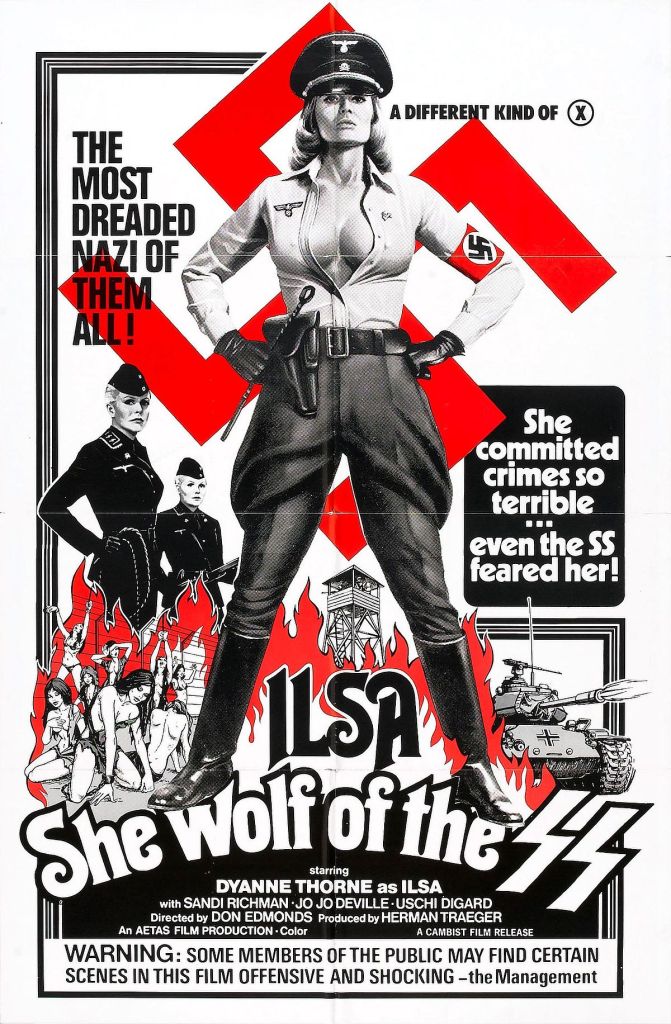
As a side observation: most humans, myself included, try to make ourselves look morally better than we really are. But that seems to be going out of fashion. Now the Attorney General of the United States wants everyone to think she is Ilsa, the She Wolf of the SS.
A sign of the times, I suppose.
We now return to our regularly scheduled program.
Back in Milwaukee, Judge Dugan, learning that ICE was about to snatch one Eduardo Flores-Ruiz—a misdemeanor criminal defendant in a case before her— allegedly showed Señor Flores-Ruiz how to get out the side door, thereby delaying his capture by ICE by a few minutes.
I don’t know how many people witnessed this incident. I don’t know whether they all remember it the same way. I don’t know what Judge Dugan’s account is; I don’t know what she says she did or didn’t do, and I don’t know what she says about her her intent. Accordingly, I have no rational basis to reach a conclusion as to what actually went down.
I don’t know—because I haven’t researched the matter, and I don’t intend to do so—what are the words of the statutes that Judge Dugan is supposed to have violated. Nor do I know how these words have been interpreted in judicial decisions (“case law,” as we call it). I don’t know whether Judge Dugan’s conduct clearly violated the law, clearly did not violate the law, or fell into an ambiguous gray area. I don’t know whether she will claim to have consciously run a legal risk to herself in order to advance a higher moral principle. If she does make such a claim, I don’t how whether the evidence will back up her claim.
But here is something I do know. I do know that it would be unwise for our side to be tricked into arguing that “lawless behavior by our guys is OK, while lawless behavior by your guys is not OK.”
Instead, we should just reserve judgment on the facts and the law in this case, agree that everybody who breaks the law should be punished—and that, sometimes, people who decide to break the law to promote righteousness should suffer legal punishment. And then we should erect a statue in their honor.

In This Post, I Explain Trump’s Tariff Strategy
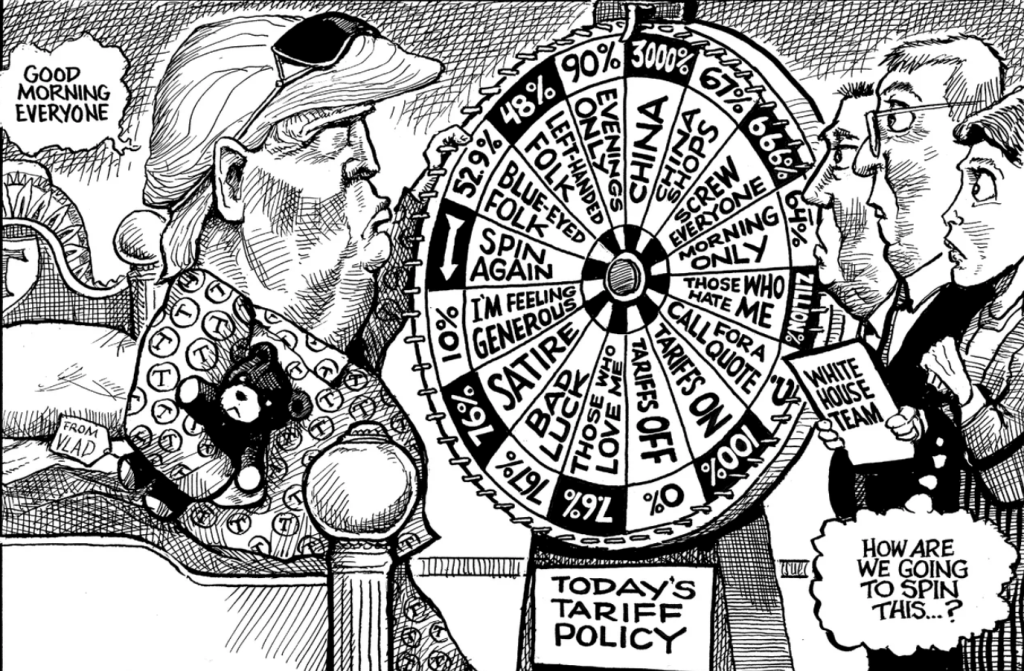
As an Added Bonus, in This Post, I Also Explain China’s Tariff Strategy
Here is what the Chinese government knows.
America is a very large country, where consumers still have enough freedom to complain loud and long when supplies run out and prices soar.
At Walmart and Target, the shelves are going to be empty in about two weeks. (You might want to schedule a shopping trip soon.)
China is a very large country, where consumers will put up with a lot of pain, because if they complain very loudly, they’ll get chucked in jail.
Hence China’s strategy:
Make His Most High Excellency negotiate against himself.
And what if he doesn’t want to negotiate against himself? And who does?
Well, in that case, just bloody well wait him out.
 Facing MAGA