As we have seen, the Learning Resources decision was 6 to 3, but there were three distinct factions:
the liberals, who thought that ordinary tools of statutory interpretation condemned Trumps IEEPA tariffs, and that the “major questions doctrine,” which they did not recognize, was not germane to the decision,
three of the rightwing justices, who cherished the “major questions doctrine” and thought it was of considerable relevance in ruling against Trump on the tariffs, and
the three other rightwing justices, who also cherished the “major questions doctrine” as a general matter, but who squirmed to deny its relevance to the case at bar.
In other words, at least for this case, probably for other tariff cases, and possibly for future cases on other topics, the six rightwingers have split down the middle into two opposed factions.
Justices Gorsuch and Barret, along with Chief Justice Roberts, are the swing votes. Who wins a future tariff case will turn on whether Barrett, Gorsuch, and Roberts side with the liberals or whether they side with the other three rightwingers.
And, make no mistake, there will be future tariff cases. There will be future tariff cases up the wazoo.
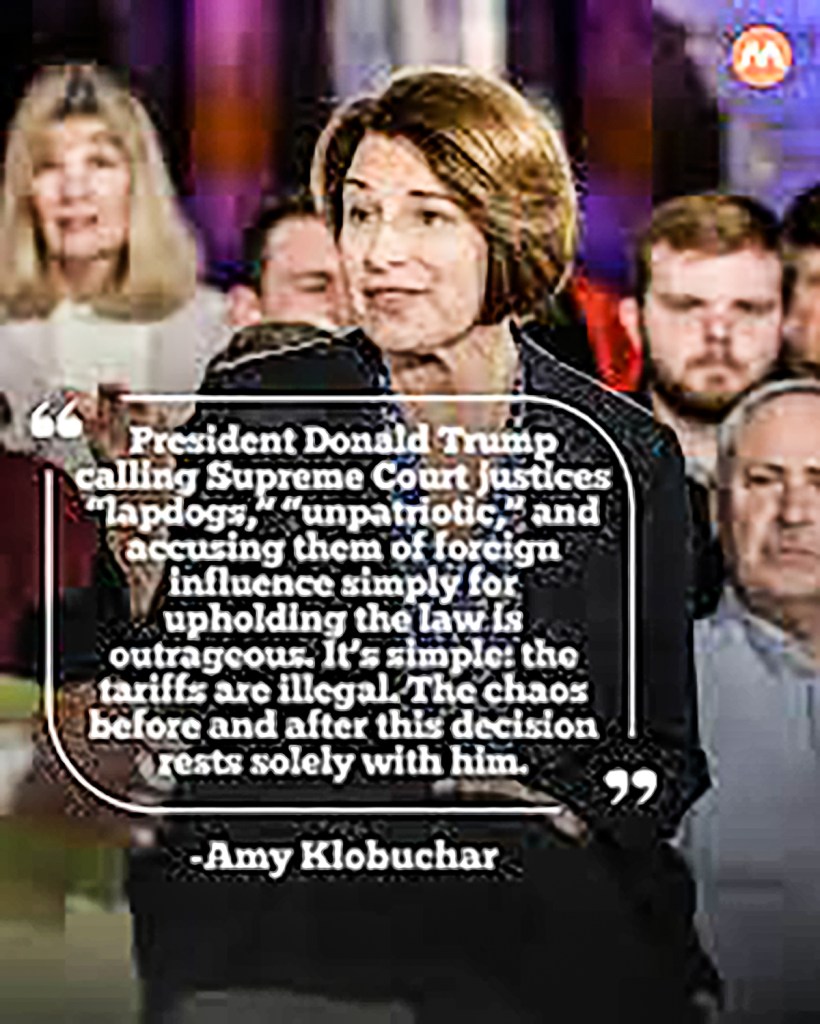
Trump’s post-decision hissy fit will do nothing to persuade its targets—who are, of course, the very three people he must persuade if he is to have an icecube’s chance in Hell of prevailing in future tariff litigation.
The hissy fit is also intended to threaten and intimidate, but I am persuaded that intimidation will not work either. Why? Because if Barrett, Gorsuch, and Roberts were going to be intimidated, I think we would already seen the effects of that intimidation.
Bottom line, at the end of five minutes of trenchant analysis: “Tariffs as an instrument of arbitrary power have been dismantled.”
Feel free to visit Krugman’ substack—it’s behind a paywall—if you so choose.
Meanwhile, in a world of great uncertainty, a couple of things are certain: Trump will continue to try to abuse whatever tariff power he may have, there will be lots and lots of litigation, and some of those cases will reach the Supreme Court in the coming months.
Among progressives, opinions differ—as do kneejerk reactions—about the likelihood of any degree of success by Team Trump. International trade law is not my field, and I have no crystal ball. But I do like this analysis by someone whose handle is EricAZ (not otherwise known by me from Adam’s housecat), who posted this yesterday on Daily Kos:
Trump’s Decision to Beat a Dead Horse on Tariffs Will Hasten His Fall
A smart person would take his lumps and move on. Trump is not a smart person. Let’s assume that the “best people” that Trump brought to his Cabinet and the White House picked the statute most favorable to his tariff plans. One of the most conservative Supreme Courts since the Civil War beat him with a stick.
Now, Trump is preparing to work his way through other statutes looking for support for his tariff plans. (Keep in mind that the U.S. Constitution says tariffs are under the control of Congress. And the Supreme Court just upheld that fact.)
Having been told, “Don’t let the screen door hit you,” Trump wants to try his luck again. Never mind that the public does not like tariffs, does not like paying higher taxes, does not like a loser and has dropped its esteem for Trump to a level somewhere between Nixon and a road-Kill skunk.
But here the valiant Donald prepares to make his stand.
Here is the list of statutes the president can use to regulate trade:
Section 232 of the Trade Expansion Act of 1962:Allows the president to impose tariffs if imports threaten national security. Pam Bondi can argue that avacados and plastic toys threaten national security. Even with Pete Hegseth guarding the coast, we probably can withstand avacado imports.
Section 201 of the Trade Act of 1974: Enables the president to impose tariffs if an import surge threatens a U.S. domestic industry. Pretty narrow in focus. Imaginary ballrooms are not an important domestic industry.
Section 122 of the Trade Act of 1974: Allows the president to impose tariffs to address international payments problems, with no cap on the level of duties or duration. Despite Trump’s best efforts, we still don’t have an international payments problem.
Section 301 of the Trade Act of 1974: Allows the president to investigate unfair trade practices and impose tariffs, with no limits on the size of the tariffs. Having tried to impose tariffs on the entire world, including uninhabited islands, it will be hard to make a case that the entire world is engaged in unfair trade practices. Especially when Trump claims to have made trade agreements with most of the world.
International Emergency Economic Powers Act (IEEPA): Provides the president with broad authority to impose tariffs in response to economic emergencies. Been there, done that. The court said no.
Many people expect Trump to use one or more of these statutes to repeat the long process he has gone through with his failed IEEPA effort.
One thing the justices really hate, is doing work. Especially repeating work that they or some other judge has already done.
Most likely, any new version of Trump tariffs would be thrown out at the District Court level very quickly. The court would likely leave an injunction against the new tariffs in place until the case works its way to the Supreme Court. At this level, there are no do-overs. The High Court would decline to hear the case and the injunction would stand.
All this happens against a background of Trump’s declining numbers and people’s distaste for high prices and unnecessary tariff taxes at the grocery store. Political parties sometimes survive immense blunders and sometimes they don’t.
I watched this lengthy, but very insightful, dialogue between two focus group experts. The time was well spent. Consider taking the trouble to watch yourself, if you want to understand the current state of opinion among the masses of our fellow Americans.
Honesty is the Best Policy, and Other Thoughts About Communicating with MAGA
First of all, if you want to employ advocacy in the real world—not just in environments where you feel comfortable, but also in situations where advocacy might actually achieve something—then you need to identify your target and to be clear about what you want he, she, or them to do.
Now, it would be nice if everyone on Team Red would recognize the error of their ways, and come join Team Blue. But that is not going to happen. A more realistic objective would be to help them realize that things are going badly for Team Red—and there’s no real point in their voting in the next election or two. If lots of Team Red stay home, then we win—which, by the way, is exactly what has been happening in recent special elections.
Second, while honesty is essential, candor is likely to be counterproductive. To illustrate: the next time you’re dining with a MAGA acquaintance, you probably don’t want to say something candid such as, “I know that I am your moral and intellectual superior, but I’ll deign to talk with you if you will listen politely.”
A better course would be to argue along the lines, “Well, if you believe X, let’s talk about the implications of that belief.”
Third, if your objective is to get your MAGA acquaintance just to stay home on election day, then a good way of accomplishing that objective may to join he, she, or them in reasoning rationally and honestly from the false premises that he, she, or they entertain. To wit: your MAGA dinner companion may have voted for Trump three times because he or she believes that, while Trump is an asshole, he is an asshole who is working for the MAGA community and against the people whom the MAGA community hates.
Your objective is not to convince your MAGA acquaintance that he or she ought not to hate people—or that she or he ought not to hate the particular kinds of people that he or she hates.
No, your objective is to convince him or her that Trump is an asshole all right, but he is the kind of asshole who actually despises the people who voted for him three times—and that Orange Mussolini has absolutely no intention of prioritizing the core economic interests of his core supporters, namely, white people without a college education.
In other words, MAGA folks, yes, he’s an asshole, but he is most emphatically NOT YOUR asshole.
“The Epstein Class”
The biggest and most important thing I learned as a professional advocate for several decades is that it is so much easier—so much easier—to sell an argument if that argument is based on actual facts, as distinguished from delusional bullshit.
Notice how Jon Ossoff uses actual facts to construct his argument, and then to tie it all together with a pink ribbon using the concept of “the Epstein class.”
The material in these two posts should be read and considered in context: the White evangelical church is leaking like a sieve. The crew that reveled in Trump’s vileness the other day at the National Prayer Breakfast represent a declining population. There are still a lot of them, but not as many as there were a decade ago, when Trump deescalated down the golden escalator.
Southern Baptist Convention membership peaked in 2006, at 16.3 million members. By the time Russell Moore was booted out, in mid-2021, membership had declined to 13.7 million. Subsequent to Moore’s defenestration, the SBC has lost another million members.
These data are consistent with data on overall participation in White evangelical Protestant Churches. In 2006, they were 23 percent of the U.S. adult population; now, it’s 13 percent, or about one quarter of the White population in the United States.
Why are So Many Evangelicals Abandoning Ship?
A variety of reasons, but clearly some of it is because folks who actually reads the words printed in red in the New Testament and who want to follow Jesus are disgusted by what they have seen in their church.
Who is the Progressive’s Biggest Ally in Combating National Prayer Breakfast-Style Christianism?
Jesus of Nazareth.
How Will White Evangelicals Reconcile the Tension Between Their Culture War Victories Under Trump and Their Economic Losses Due to Tariffs, Inflation, Loss of Job Opportunities, Etc.?
I don’t know, of course, but it’s going to be a non-trivial threat to Trump’s remaining 70%+ approval among the White evangelical crowd.
With Trump’s Deteriorating Mental and Physical Health, Will Significant Numbers of White Evangelicals Decide They Still Want an Authoritarian Messiah, Just Not Trump as Their Authoritarian Messiah?
In my opinion, this video has more insightful observations than Carter has Little Liver Pills.
Watch it if you’re interested in understanding what is actually going on.
David French Channels Dante
And another useful source: yesterday, David French gave us a highly informative tour of the hellscape that is the MAGA mind. Along with that, he also offered thought-provoking historical precedents for our current state of affairs. David French (N.Y. Times): What MAGA Sees in the Minnesota Mirror.
And now some thoughts from me, your humble ink-stained scrivener.
The Supreme Court’s Role in 2026 as the Joker in the Deck and Potential Savior of Donald Trump—from the Perils Posed by Donald Trump
In the video above, Rick Wilson expounds on the consequences of Trump’s erratic and disastrous action regarding his key political issues, immigration and tariffs. But he doesn’t address how the Supreme Court, if it so chooses, could intervene in ways that would help to save Trump’s bacon by helping to save him from himself.
Likewise, the Court, if it so chooses, can rein in Trump’s due process violations in connection with its mass deportation project.
Apart from the fact that requiring due process will help to save the constitutional republic, it would also, once again, help to save Trump politically from himself. Essentially, for the reasons that Rick Wilson laid out in the video.
Trump’s mental problems are myriad: sociopathy, constant lying coupled with a total inability to keep his lies straight, an inability to plan, and, among others, a grievously limited political skill set.
In this witch’s brew of mental illnesses, we tend to discount the signal importance of delusional thinking. For example, Trump really thinks that he can bend the courts to his will in the same way that he has bent the Justice Department and the FBI to his will.
He should have learned his lesson in 2020, when the courts universally rejected his stolen election delusion.
But he did not learn his less, because he is delusional.
Now, once again, he is ordering his prosecutors to comply with his delusions by initiating a slew of utterly bogus criminal cases.
The consequences of the inevitable failure of that delusion will be yet another joker in the deck as we continue our hellish journey through 2026.
Of the many lessons to be drawn from the administration’s retreat in Minneapolis, the most important is that Donald Trump can be stopped.
He spent his first year acting as though the 2024 election were the last time he would ever have to give a thought to public opinion. Now the myth that Trump is invincible has been exploded.
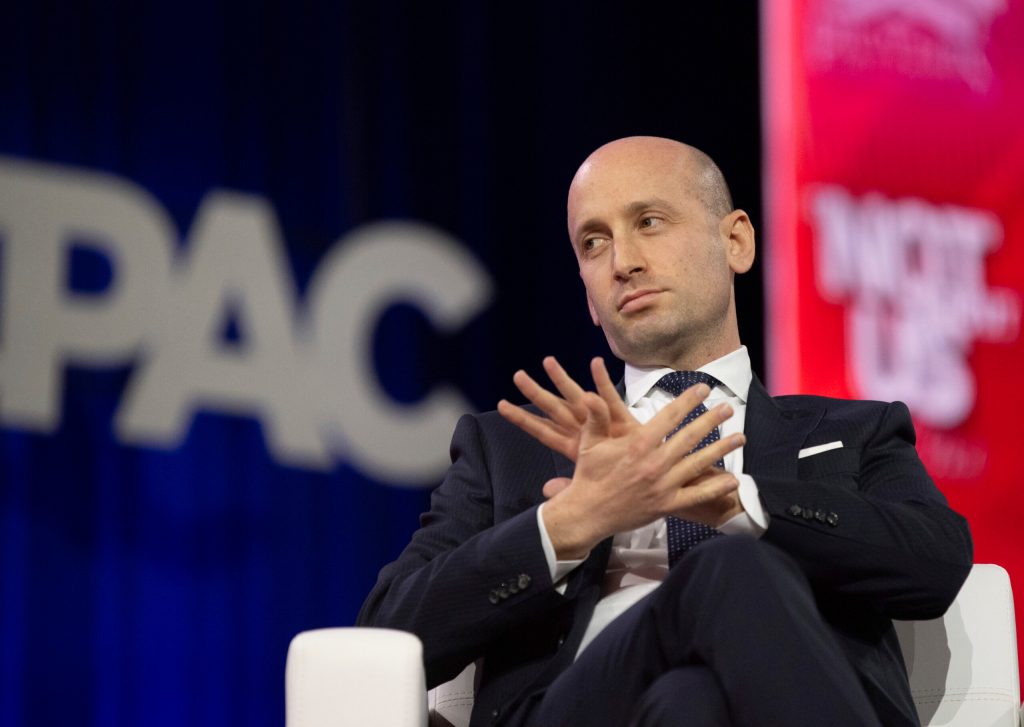
After federal agents killed Alex Pretti, Trump-administration figures including Secretary of Homeland Security Kristi Noem and Deputy Chief of Staff Stephen Miller described the victim as a terrorist, indicating their desire to ignore or intimidate all opposition. But other Republican sources signaled their discomfort, and some called for an investigation—a routine step for a normal presidency, but a daring breach of partisan discipline in an administration that shields itself from accountability and tries to put itself above the law.
During yesterday’s White House briefing, when a reporter asked if Trump shared Miller’s belief that Pretti was a domestic terrorist, Press Secretary Karoline Leavitt replied that she hadn’t heard him use that term. Trump also sent out conciliatory messages on social media indicating that he’d had productive talks with Minnesota Governor Tim Walz and Minneapolis Mayor Jacob Frey. And he dispatched Tom Homan, the border czar and a more traditional immigration hawk, to replace Gregory Bovino, the commander at large in Minnesota. Bovino has justified his agents’ misconduct with transparent lies.
Trump’s retreat in Minneapolis is a stinging defeat for the national conservatives, the Republican Party’s most nakedly authoritarian faction. The NatCons believe American liberalism cannot be dealt with through normal political methods such as persuasion and compromise. Speakers at the National Conservatism Conference have described the American left as “the enemy within” (Senator Rick Scott of Florida) and “wokeism” as “a cancer that must be eradicated” (Rachel Bovard of the Conservative Partnership Institute). NatCons also maintain that immigration poses a mortal threat to the United States. These two strands of thought are intertwined; NatCons consider immigration a weapon employed consciously by the left to assume permanent power, via manipulating elections and creating government dependency, a conspiracy that can only be reversed through the kind of ferocious operation on display in Minneapolis.
The NatCons, whose ranks include powerful administration figures such as Vice President Vance and Miller as well as members of Congress (such as Senator Eric Schmitt of Missouri) and activists (such as Heritage Foundation President Kevin Roberts), have wielded profound influence. They have rarely, if ever, lost important struggles to steer Trump’s strategy.
For the NatCons, the mass-deportation scheme overseen by Miller is an existential priority. Vance once claimed that immigration levels “would mean we never win, meaning Republicans would never win a national election in this country ever again.” Ten days ago, Miller explained on Fox News that Democrats were resisting ICE in Minneapolis because “this mass-migration scheme is the heart of the Democratic Party’s political power.” Miller sees his crusade not merely as a matter of relieving the burden on public services or raising wages, but as a final chance to stop permanent left-wing tyranny. Thus Miller’s immediate, fervent insistence that Pretti and the other Minnesotan recently killed by federal agents, Renee Good, both deserved their fates, a line the NatCons repeated vociferously through Monday.
The NatCons have attained their sway by positioning themselves as the vanguard of Trumpism in its purist form. Other conservative factions, such as social conservatives, libertarians, and foreign-policy hawks, supported Trump reluctantly in 2016, and backed away after the January 6 attack on the Capitol, hoping Florida Governor Ron DeSantis or some other rival could displace him. The NatCons never flinched in the face of Trump’s failed autogolpe, or any other actions that made other Republicans nervous. They won the loyalty contest—which, in the second Trump administration, is the only currency of influence.
Calls for Trump to stand firmly behind Miller had a desperate yet vague tone. “Leftist protestors who shut down streets, destroy property, refuse lawful orders, and physically assault federal officers cannot be rewarded with veto power over public policy,” beseeched the Manhattan Institute activist Chris Rufo, employing the passive voice. In response to a liberal observing yesterday afternoon on X that Trump was backing down, Will Chamberlain, a national conservative affiliated with numerous right-wing organizations, replied, “This isn’t happening, and it’s very important that it does not happen.”
Nevertheless, it was happening.
The reason it happened is that, although Trump listens to the NatCons, he has no deep grounding in their theories or, for that matter, any theories. The president’s despotism is not ideological but instinctive. He cannot tolerate criticism and he deems any process that embarrasses him, including a critical news story or an election, illegitimate, even criminal.
And while he has embraced a restrictionist immigration agenda, he has vacillated between endorsing mass deportation and allowing exceptions for categories of laborers he considers necessary. As Trump told The Wall Street Journaleditorial page before the 2024 election, “I mean, there’s some human questions that get in the way of being perfect, and we have to have the heart, too.” If that has ever occurred to Miller, he has hidden it well.
Whether or not Trump’s intermittent expressions of human feeling for the immigrants his administration has abused is heartfelt, his desire to maintain his political standing most certainly is. Trump appreciates the power of imagery. It does not take a political genius to understand that, if Americans were repulsed by the sight of a Vietnamese man being executed in 1968, an American being shot in the back, facedown on a midwestern street, would not go over much better.
Trump’s capitulation would never have occurred if not for the heroic, disciplined resistance in Minneapolis. Faced with something like an occupying army that was systematicallyflouting the law, the people of Minneapolis thrust its abuse into the public eye, raising the political cost of Miller’s war until enough Republicans decided that they couldn’t bear to pay it.
Political theorists have long debated whether Trump and his movement should be described as fascist. On an intellectual level, the answer depends largely on which definition of fascismyou choose (there are several). I have generally resisted the term because the definition I prefer, and the one most Americans probably think of when they hear the term, is not mere political oppression but a form of it so extreme that opposition becomes impossible.
That may be more or less Trump’s aspiration, and possibly our destiny. But this is not a fascist country, at least not yet.
I applaud her analysis and agree with much of it, though I think the optimism is premature. Let’s see what happens today. Let’s see what happens in the coming days on the streets of Minneapolis. Let’s see what happens in Congress with funding for the Department of Homeland Security.
A Signal Achievement
As Rachel emphasizes, Democratic pushback will be responsible for whatever good comes out of this disaster. That said, be it remembered that the Stephen Miller/Kristi Noem/Kash Patel/Greg Bongino team’s clusterfuck represents a signal achievement on their part—and a big reason why things are looking up today.
The progressives are riled up.
Lots of ordinary people are riled up.
Not only that: big business is riled up.
With big business riled up, the Republican empty suit politicians are beginning to speak up.
Even the Second Amendment wingnuts are fit to be tied, because of the suggestion that folks lawfully carrying a firearm deserve to be mowed down with impunity.
One of the early morning talking heads pointed out that, with Homan in Minneapolis allegedly reporting directly to Trump—thus, allegedly, bypassing and cutting the Miller/Noem gang—“Trump will personally own whatever happens next in Minneapolis.”
That sounds right. And I would add this: to get out of this mess with some dignity, Trump would need to be a Washington or a Lincoln or a Roosevelt.
Trump is not a Washington or a Lincoln or a Roosevelt. Instead, Trump is best compared to Jubilation T. Cornpone.
Yesterday, in broad daylight, Alex Pretti was executed.
Let’s be clear. What killed this poor man was not law enforcement. It was lawlessness.
The problem is not whether or how Alex Pretti complied with the law.
The problem is that federal agents, sent to sow chaos, are out of compliance with our Constitution.
Are out of compliance with the scope of their role. And are out of compliance with principles of public safety.
So, the question I’m asking is why don’t these agents comply with the law?
Any narrative that suggests that Alex Pretti was anything other than innocent is pure fabrication. The Administration is lying. But you can trust your friends. You can believe your own eyes.
What happened is horrifying. And, of course, it’s not new. This country has a long memory of Jim Crow terror, night patrols, and violence carried out with the blessing—or the silence—of those in power.
Still, many of good conscience this weekend are rightly feeling heartbroken, furious, helpless, and confused.
If you are scared, that makes sense.
If you are angry, you have a right to be.
If you are not sure what to do next, you are not alone.
I’m deeply grateful for, and inspired by, UUCA Associate Minister Rev. EN Hill, who stood in the cold in Minneapolis this past week, alongside hundreds of clergy, representing the body of holy love in the streets. Church people know simple, ancient good things–like that showing up matters. Especially when so much is at risk and the stakes are so high.
We are now in a moment when political violence is being normalized. When cruelty is defended as order. When fear is being weaponized in American streets. Today, it is Minneapolis. Tomorrow, it could be Atlanta. That is sobering to say out loud. It is also necessary.
I do not know what the future holds. I do not know how all of this will unfold. I do not yet know what UUCA will be asked to risk, or where solidarity will require us to stand. I do not know what our most vulnerable neighbors will need, or how they will call on us for protection and partnership.
But here is what I do know.
UUCA is not a bystander congregation.
UUCA is not a silent congregation.
And UUCA is held and fueled by a Love that our Universalist ancestors claimed never quit and left nobody out!
UUCA, you are powerful beyond measure—because of your history, your relationships, your commitments, and your hard-won wisdom. You have not been caught off-guard. You have been watching. You’ve been strengthening networks and joining Signal groups. You’ve been weaving strategic ties across difference. You have been preparing.
And you are not alone. You have neighbors. Partners. Shoulder-to-shoulder companions.
With strong UUCA Board leadership, with long-time movement veterans among you, with the boundlessly deep resource of music and joy, with Rev. EN’s steady courage, and with Rev. Taryn returning next week, this congregation is well-resourced—not only spiritually, but strategically.
We are a people of tenacious hope. Of stubborn, resilient love. We won’t back down. Nor will we be hardened or embittered or cornered. We will sing. We will rest. We will rise.
Let me say this, my sibling Unitarian Universalists: this engagement, ahead of us, is going to cost something. It may cost comfort. It may cost convenience. It may cost reputation. It may cost time and money and the illusion that someone else will handle it.
And still, we are called.
Some of you will offer care and compassion.
Some will show up on front lines.
Some will make sure things at home are steady and strong so others can do what they need to do on the streets.
All of it matters.
In the coming days, there will be opportunities to gather, to pray, to listen, and to discern concrete next steps together. Watch for those invitations. Bring your whole self. Feel it all.
Thank you for the discernment you are already doing about the part you will play.
Thank you for the preparation you are undertaking for UUCA to be a force for the Beloved Community—not in abstraction or in theory, but in neighborhoods, households, and in real lives.
Gratefully, mournfully, and with resolve,
Rev. Jake Morrill Senior Sabbatical Minister UU Congregation of Atlanta
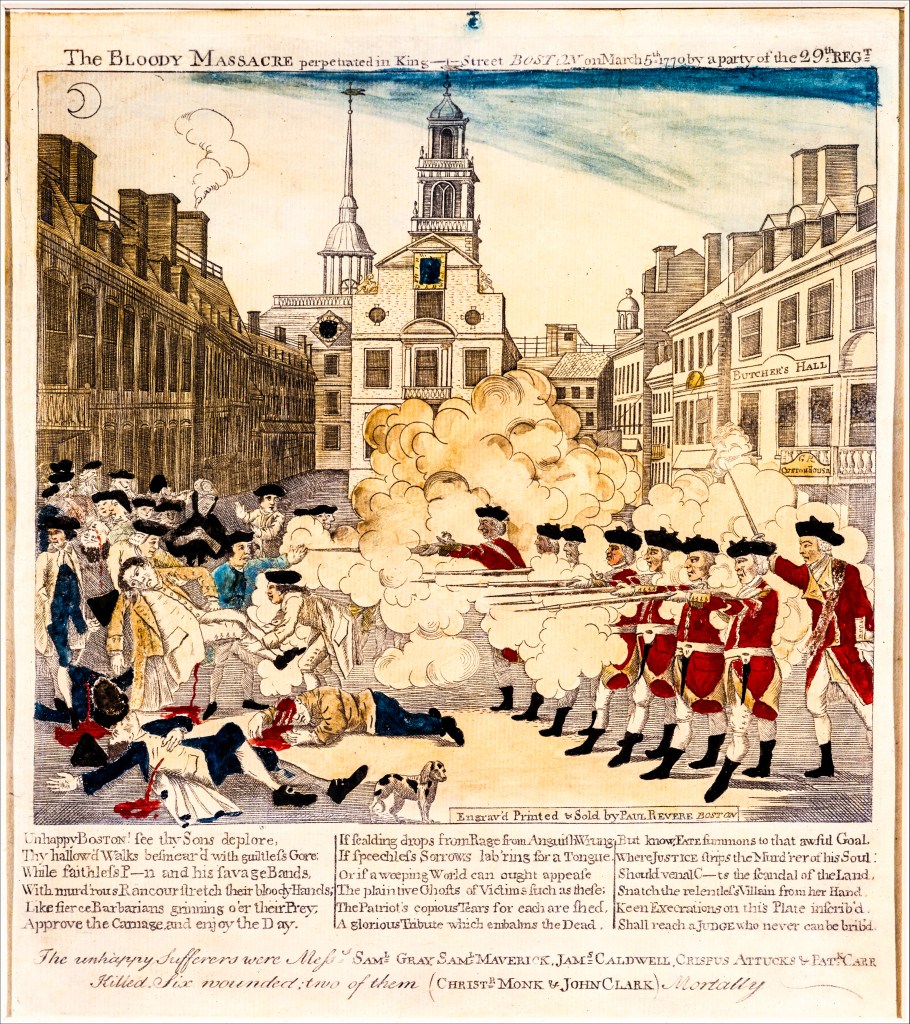
“Not the Battle of Lexington or Bunker Hill, not the surrender of Burgoyne or Cornwallis, were more important events in American history than the battle of King Street on the 5th of March, 1770,” said John Adams.
The soldiers were obviously acting in self-defense, and it will all blow over soon, said the British command occupying Boston.
“Those who cannot remember the past are condemned to repeat it,” wrote the philosopher George Santayana.
Trump and his goons cannot remember the past, because they never knew history in the first place. But they are bloody well condemned to repeat it.