Trump is His Own Worst Enemy. And Thank God for That.
This morning, New York Times columnist Jamelle Bouie has four important points to make. I’ll summarize them and then let Mr. Bouie speak for himself.
1. In an alternative universe, in his second term, a politically skilled and disciplined Trump could probably have engineered a dictatorship in the United States.
2. But in this universe, Trump is “so solipsistic, so plainly consumed with narcissism, so deeply indifferent to the details of governance and so eager to satisfy his basest impulses that there was little chance he’d ever complete the authoritarian consolidation of his dreams.”
3. The second Trump term, we have “a presidency in terminal decline, if not outright collapse.”
4. If you don’t understand that “presidential commands are never self-executing,” then you don’t understand what the hell is going on.
Jamelle Bouie (N.Y. Times), Trump Is the Anti-Trump:
There is an alternate universe in which Donald Trump is the popular, successful president of his imagination.
In this world, Trump has a clear view of the political landscape. He knows he won a narrow victory, not a landslide. He knows that his key voters — the ones who put him over the top, as opposed to his core voters — elected him to lower the cost of living and turn the page back to where it was before the pandemic. And while he has the advantage of an unpopular predecessor — an easy repository for blame should things go wrong — he also starts the clock with a small and finite amount of political capital. The modern American public is wary, fickle and quick to anger. The right move is to invest that capital carefully, not gamble with the people’s trust.
This hypothetical President Trump would take the path of least political resistance. He would work with the Republican majority in Congress to send a new round of stimulus checks, rehashing the most important political success of his first term and fulfilling his promise to lower costs for most Americans. He would work with Congress to pass modest tariffs on critical goods and he would take a less draconian path on deportations, focusing, as he promised, on people in jails and prisons — “the worst of the worst.” And he would put hard political limits on his most fanatical aides and deputies, like Russell Vought and Stephen Miller. This Trump wouldn’t give Elon Musk his run of the executive branch and he would sideline his own desire for retribution against his political opponents, or at least channel his rage into something more productive. He would also decline to hand management of the federal government to an ignominious cadre of hacks, apparatchiks and television personalities.
In short, this Trump would rerun the approach of his first term. He would still be corrupt. He would still stretch the limits of common decency. He would still be bombastic, transgressive and contemptuous of political norms. But he would be restrained, somewhat, by the practical realities of governance. And this restraint would give our hypothetical Trump the leeway to pursue his more authoritarian goals; to curtail civil society and consolidate power over the entire federal government, courts and Congress included.
From the perspective of liberal society and constitutional government, this alternative world, in which a more cautious and methodical Trump successfully builds public and political support for the transformation of the United States into a full-throated authoritarian regime, would have been the worst-case scenario for a second Trump term.
We are lucky, then, that this alternate reality is unimaginable. There is no apparent evidence that Trump is capable of even the slightest bit of deferred gratification. If life is a series of marshmallow tests, then he has failed one after the other, kept afloat only by his immense wealth and privilege. The actual Trump is so solipsistic, so plainly consumed with narcissism, so deeply indifferent to the details of governance and so eager to satisfy his basest impulses that there was little chance he’d ever complete the authoritarian consolidation of his dreams.
All of this is simply to contrast what might have been with what plainly is: a presidency in terminal decline, if not outright collapse. Consider the big picture. Trump is nearly as unpopular now as he has ever been. His average approval ranges from a net negative of about 13 points to a net negative rating of nearly 20 points. He is underwater on every issue of consequence. The Supreme Court nullified his signature economic program and his immigration enforcement actions are so toxic with voters that they’ve forced him to fire his head of Homeland Security, Kristi Noem. He has wrecked the coalition that brought him into office with major reversals among Latinos, young men and Black Americans, and he is treading water with his core supporters, white voters without college degrees.
Trump insists, of course, that he is as popular as ever, but even Republican lawmakers see the writing on the wall. There has been a historic number of retirements from Congress, led mostly by Republicans.
Last, but far from least, is the president’s foolhardy, reckless and immoral war in Iran, which was launched with neither public buy-in nor Congressional authorization. It didn’t take long after the bombing began before it destroyed an elementary school, killing more than 175 people, most of them children. Just two weeks in, the conflict has already grown beyond its initially limited scope, involving other belligerents and threatening the global economy. It is no surprise, then, that this is also the most unpopular war in modern American history, with few supporters beyond the president’s fellow partisans.
It is tempting to think that the president’s political collapse doesn’t really matter — that, as the Teflon Don, he suffers no particular consequences for his bad behavior. And it is true that the shamelessness, celebrity and cult of personality that defines Trump (and Trumpism) also works to buoy him in the face of political catastrophe. He might sink below water, but he’ll never go under. To end the story there, however, is to miss the larger relationship between presidential standing and presidential power.“Presidential commands are never self-executing,” the political scientist Jeffrey Tulis observes in his book “The Rhetorical Presidency,” paraphrasing another political scientist, Richard Neustadt. “Their efficacy depends upon artful wielding of informal power through bargaining — by showing other politicians that they will be helped, or at least not hurt, by doing what the president wants.”
The second Trump administration is defined by its total embrace of the “imperial presidency” and the “unitary executive.” But a key weakness of both concepts is that they treat presidential power as rigid, well-defined and highly formal — the “core duties” of Chief Justice John Roberts’s opinion in Trump v. United States.
The reality is more complicated. It may seem as if presidents have the power to command, to issue orders and see immediate results. But as Tulis reminds us, successful presidents do not order as much as they coax, cajole and persuade, for the straightforward reason that the formal authority of the presidency is limited compared with other actors in government. A skeptical lawmaker or recalcitrant bureaucrat can derail a presidential agenda and leave the chief executive at the mercy of an angry public. It’s for this reason that the most able men to hold the office of chief executive have rarely seen fit to act as tyrants, raining demands down onto the rest of the executive branch. They act instead as conveners, working to align different interests in pursuit of a single goal.
Presidential standing, in this paradigm, is the currency that makes presidential power work. A popular and well-liked president has more resources to deploy in pursuit of his agenda. He has the informal power he needs to bolster his more circumscribed formal authority. A distrusted, divisive and unpopular president, on the other hand, quickly finds that he is unable to work his will on political actors who are more worried about their own fates than the president’s interests and appetites.
And that is what we’ve seen with this president, a year after he gambled his political capital away in a disastrous attempt to reshape the nature of the American political system. His fast-eroding position has curtailed Trump’s ability to pressure lawmakers into backing his agenda: See the president’s empty demands for Congress to pass the SAVE America Act or the ongoing shutdown of the Department of Homeland Security. This rapid decline has also lowered the cost of institutional resistance to the administration’s attempts to curtail civil society and done the same for judicial opposition to the president’s most aggressive power grabs. I do not think it is an accident that the two most consequential rulings against Trump issued by this Supreme Court were decided as the president’s standing entered a tailspin.
You will notice that after months of teasing the possibility, Trump has mostly stopped talking about serving an unconstitutional third term. Perhaps he still intends to. Or perhaps he has enough self-awareness to know that he is not the triumphant leader of his imagination. That he is, instead, a lame duck whose White House is in disarray and whose actions have plunged the world into chaos. He thought he might remake the country in his own image. Instead, he’s likely to leave it like one of his casinos: broke, broken and in desperate need of new management.
If impeachment weren’t a dead letter, then we could remove him and end his misrule. As it is, we have nearly three more years to live through. It’s an open question whether we survive it intact.
The Illegal News for Thursday
The Guardian, ‘A subversion of the justice system’: DoJ shifts into Trump’s ‘political wing’ as criminal investigations accelerate
Subhead: “President has ‘succeeded in completely politicizing’ justice department, experts say, using it to punish his enemies
Well, yes, but what they have not succeeded in doing is indicting the bloody ham sandwiches. Tim Miller of The Bulwark marshals the facts about the Justice Department’s many failures in pursuing bogus legal cases against Trump’s political adversaries:
They have also succeeded in generating many, many state bar investigations into illegal conduct by Justice Department lawyers. See, for example, lawandcrime.com, AG Pam Bondi claims ‘right’ to take over state bar investigations of her lawyers’ ethics or else, cites ‘unprecedented weaponization’ of complaints.
Thank you, Sir. May I Have Another, Sir?
Meanwhile, earlier this week, in the Mother and Father of All Legal Clusterfucks, the Justice Department told the district court in Washington, DC, that it no longer wished to appeal its shellacking in the four cases brought by Perkins Coie, Jenner& Block, WilmerHale, and Susman Godfrey. Then, the next day, the Justice Department said “Never mind,” and tried to take it all back, asking the district court for permission to withdraw its motion of the previous day to voluntarily dismiss the appeal.
The court will have to rule on this mess. As I write, it has not yet done so.
One possibility is that, before the court acts, it will haul Team Trump into court, put them under oath, and demand that they explain what the hell happened.
Finally, legal commentator Jeffrey Toobin has taken time off from private pleasures to write an op-ed in the New York Times headlined Trump Has Elite Law Firms on a Punishing Merry-Go-Round. Toobin tells a tale of winners and losers, and casts Trump as the big winner against Paul Weiss and the other eight Cowardly Lion Law Firms.
In my opinion, his tale is misleadingly incomplete. For what it’s worth—and that’s probably not very much—Paul Weiss and the other capitulators plainly thought they recognized a familiar pattern: a dispute that can be made to go away when Party A doesn’t have to give up much of anything that it actually values, while Party B gets bupkis of real value but is allowed to make uncontradicted boastful claims of a famous victory.
As it has turned out, the nine cowardly firms underestimated the severity of the ongoing hits to their reputation. And they surely did, as Toobin states, act like cowards. So, yes, they are indeed losers.
That said, I dissent from describing Trump as a winner in this episode.
Like the craven cowards they are, Team Trump tried to pull the plug on their dispute with the Courageous Four: Perkins Coie, represented by Williams & Connolly; Jenner & Block, represented by Cooley LLP; WilmerHale, represented by Paul Clement; and Susman Godfrey, acting pro se, with the support of 700 other lawyers organized as Law Firm Partners United in Support of Susman.
Then someone—in all likelihood, Orange Mussolini himself—got wind of what was happening and ordered Team Trump back into the fray.
Team Trump’s Monday filing was effectively an admission that their legal case has no merit at all. It didn’t have any merit on Monday, when the pulled the plug. It doesn’t have any merit today. And it still won’t have any merit at whatever point down the road the court of appeals, or maybe the Supreme Court, drives the final nail into the coffin.
Orange Mussolini is, once again, cruisin’ for a bruisin’.
Trump and the 13-Year Old
This is about 12 minutes long, and if you take the time to watch and listen, you will learn a lot about the state of play regarding the Epstein files, the Epstein Transparency Act, and the claim by “Katie Johnson”—presumably a nom de plume—alleging that, back in 1994, when she was 13 years old, Trump allegedly forced young Ms. Johnson to perform oral sex at Epstein’s townhouse in Manhattan.
“Johnson” filed civil lawsuits against Trump in 2016 making these claims, but soon withdrew them. Was she pressured to abandon her claims, and, if so, how and by whom? We don’t know, although there are reports of “multiple death threats.”
Note that both the lawsuits and the withdrawals occurred during the 2016 campaign.
We do know she was interviewed by the FBI several times during the first Trump Administration, we know that a lot of the resulting documentation was not disclosed, even though it should have been disclosed, under the Epstein Transparency Act.
In the video, these and related issues are addressed by three heavyweights:
- Lisa Rubin, Yale Law graduate, former big-time corporate litigator, and currently a TV legal commentator,
- Peter Baker, chief White House correspondent for the New York Times, and
- former Senator Claire McCaskill, who has a background in criminal prosecution.
Is There a Coverup Going On, and is the Coverup a Crime?
I would say yes, based on the facts laid out in the video, there’s pretty clearly a coverup going on—specifically, there appear to be multiple violations of the Epstein Transparency Act.
A violation of the Epstein Transparency Act is not ipso facto a federal crime. However, an intentional violation of the Epstein Transparency Act could well violate provisions of the federal criminal code, including obstruction of justice.
Would the Supreme Court Immunity Decision Bar Prosecution of Trump if he Ordered the Coverup?
Possibly, but not certainly. There would be a big legal pissing contest about whether he alleged coverup order was “private” or whether he was acting within his official capacity.
Would a Justice Department or FBI Official Who Knowingly Obeyed a Coverup Order Have Potential Criminal Exposure?
Yes, they would.
The Nuremberg Defense didn’t work at Nuremberg, and it wouldn’t work here.
If the Katie Johnson Papers are Being Covered Up, How Many Government Officials Know About the Coverup, and How Many of Those People Will Cheerfully Risk Incarceration to Protect Donald Trump?
You tell me.
The Epstein Transparency Act Aside, Under State Law, Does Trump Still Have Criminal or Civil Exposure for his Alleged Assault on Katie Johnson?
The alleged assault took place at Epstein’s townhouse in Manhattan. The cases brought against Trump in 2016 were dismissed “without prejudice.” A very preliminary look at relevant New York law indicates that, yes, Trump might well have such exposure. New York law is not generous to folks who commit sex crimes against children and try to get off on a legal technicality.
Was My Grandmother Right When She Said, “Oh, What a Tangled Web We Weave When First We Practice to Deceive”?
You bet she was.
Trump’s New Tariffs ThIs Weekend are Even More Illegal Than the Old Ones, Or So They Say
Lev Menand and Joel Michaels (N.Y. Times), Again, Trump Completely Misreads the Law[1]
International trade law is a very, very specialized discipline, and casually thought out opinions are likely to be in error. Viz. my own apparent error.
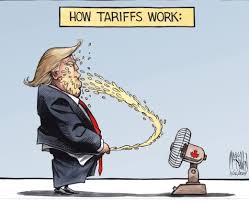
Shortly after the Supreme Court kicked Trump’s ass on Friday of last week, Orange Mussolini took another bite at the apple and purported to invoke Section 122 of the Trade Act of 1974 in order to impose a new set of worldwide tariffs. My impression was that, the second time around, he was on stronger legal ground.
First, unlike the situation with the International Economic Emergency Powers Act of 1977, it’s clear that tariffs are a legitimate tool under Section 122. Second—and here was the big misunderstanding—I thought that the Supreme Court would probably be reluctant to second-guess a presidential finding about an alleged economic emergency, invoked by a President to use authority that Congress had clearly granted to him.
Messrs. Menand and Michaels argue, convincingly, that this is fallacious, because the “emergency” that Trump invoked to employ Section 122 is not the kind of emergency that Section 122 actually addresses. Trump thinks that the Section 122 is all about trade imbalances, whereas, they argue, it’s not about trade imbalances at all, but instead its about financial imbalances. They write,
The provision is not about trade imbalances. Other parts of the statute address those. It is about financial imbalances — in particular ones that threaten financial stability.
The text and context of the law is clear: A Section 122 “payments problem” involves a flight from the U.S. dollar. At the moment, no such problem exists.
The president’s own lawyers essentially admitted as much months ago. In a filing in the earlier case, the Justice Department acknowledged that trade deficits are “conceptually distinct from balance-of-payments deficits,” citing the congressional history. And it suggested that Section 122 did not give the president the authority to impose tariffs to address trade deficits. (Section 122 does not “have any obvious application” where the concerns “arise from trade deficits,” the Justice Department’s lawyers wrote.)
To further appreciate how badly the president is misreading the law, it is necessary to place this particular statute in the context of the early 1970s. …
If you want further elucidation regarding the fascinating topic of financial imbalances, please read the article.
But here’s the bottom line. It’s as if Trump, faced with an emergency caused by foreign killer wasps, has purported to use extraordinary powers granted to the President to address toxic chemical spills.
The issue is not whether the foreign wasps are actually invading, nor is it about deference to the President’s judgment about the magnitude of the wasp problem or the appropriateness of his desired remedy.
The issue is legal, not factual or judgmental, and it has nothing to do with deference to presidential fact finding.
The issue is whether Orange Mussolini is using the wrong damn law as a flimsy cover for another blatant power grab.
[1] Lev Menand in an associate professor at Columbia Law School, so he must be good. Joel Michaels is a Fellow in Public Economic Law at that same institution, my legal alma mater.
The Tariff Decision, Looking Forward: the Rebate Issue, and a Lesson From Antitrust Law
Neal Katyal, the winning advocate in the Learning Resources case, says his team decided not to raise the question of rebates because their legal research showed that all the precedents said that if a tariff is found to be illegal, then it must be refunded.
By contrast, Team Fascist says they are still mulling what to do about all that money they collected illegally.
Some thing this will lead to a big, bloody mess. But, to me, the situation bears a close resemblance to the issue of illegal overcharges in antitrust law, which I used to practice back in the olden days when I still had all my hair.
In federal antitrust law, someone who pays an illegal overcharge for widgets has the legal right to damages calculated based on the amount of the overcharge. The direct purchaser has the right to the full amount of the overpayment. It doesn’t matter whether they passed on all or part of the overcharge to their own customers. The party that charged the excess amount may not be heard to argue that some of the overcharge was passed on to other purchasers down the line. And an indirect purchaser who bore some of the overcharge has no legal claim to a refund (whatever you might think of the indirect purchaser’s moral claim for the overcharge he paid).
State law may differ, but that’s how federal antitrust works. And, typically, the direct purchaser’s claim is enforced through class action litigation.
Logically, then, the solution here is that there should be a national class action in which the plaintiff class would consist of everyone who directly paid an IEEPA tariff. In that class action, Team Trump would be barred, by the doctrines of res judicata and collateral estoppel, from relitigating the question the Supreme Court just decided. Nor could Team Trump argue that payouts to those who directly paid the illegal tariffs should be reduced by the amounts they passed on to someone else. The remaining issue in the class action would be what documentation a plaintiff class member would be required to submit in order to claim her refund.
The Tariff Decision, Looking Forward: How Smart Was it for Trump to Hurl Vile, Hyperbolic Insults at Justices Gorsuch and Barrett and at Chief Justice Roberts?
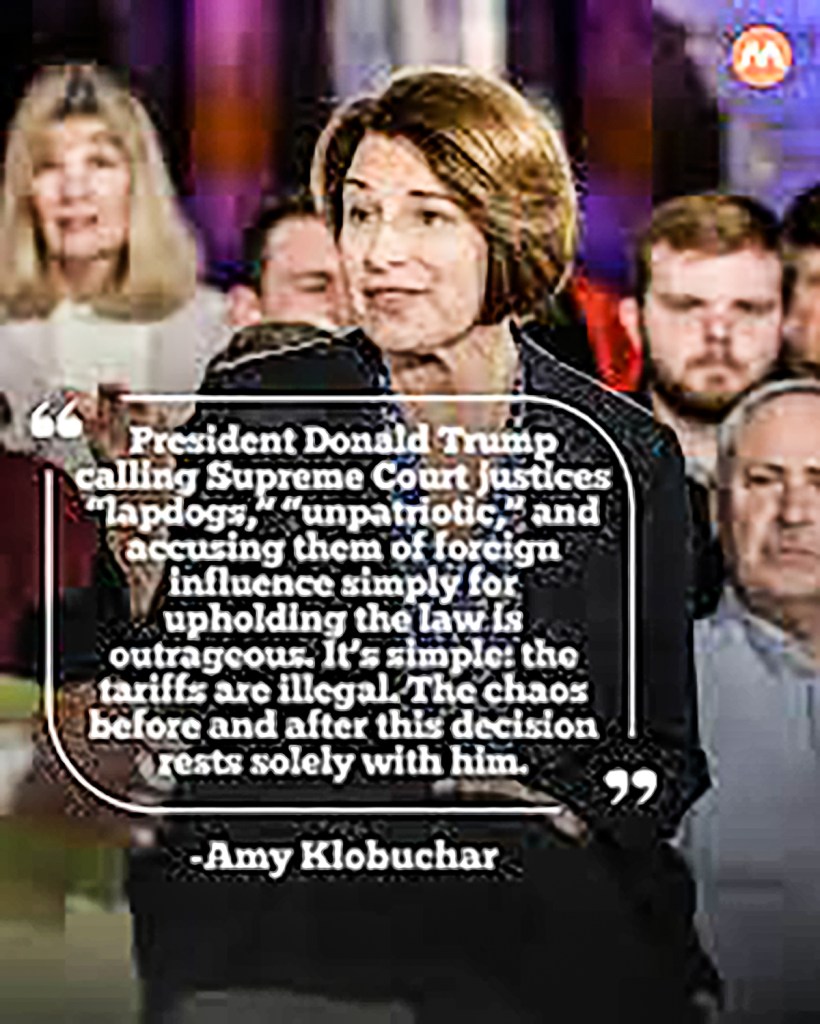
As we have seen, the Learning Resources decision was 6 to 3, but there were three distinct factions:
- the liberals, who thought that ordinary tools of statutory interpretation condemned Trumps IEEPA tariffs, and that the “major questions doctrine,” which they did not recognize, was not germane to the decision,
- three of the rightwing justices, who cherished the “major questions doctrine” and thought it was of considerable relevance in ruling against Trump on the tariffs, and
- the three other rightwing justices, who also cherished the “major questions doctrine” as a general matter, but who squirmed to deny its relevance to the case at bar.
In other words, at least for this case, probably for other tariff cases, and possibly for future cases on other topics, the six rightwingers have split down the middle into two opposed factions.
Justices Gorsuch and Barret, along with Chief Justice Roberts, are the swing votes. Who wins a future tariff case will turn on whether Barrett, Gorsuch, and Roberts side with the liberals or whether they side with the other three rightwingers.
And, make no mistake, there will be future tariff cases. There will be future tariff cases up the wazoo.
Trump’s post-decision hissy fit will do nothing to persuade its targets—who are, of course, the very three people he must persuade if he is to have an icecube’s chance in Hell of prevailing in future tariff litigation.
The hissy fit is also intended to threaten and intimidate, but I am persuaded that intimidation will not work either. Why? Because if Barrett, Gorsuch, and Roberts were going to be intimidated, I think we would already seen the effects of that intimidation.
Call the ambulance.
He has shot himself in the foot again.
The Tariff Decision, Looking Forward: Does Team Trump Have a Workaround to the Supreme Court’s Ruling?
Bottom line, at the end of five minutes of trenchant analysis: “Tariffs as an instrument of arbitrary power have been dismantled.”
Feel free to visit Krugman’ substack—it’s behind a paywall—if you so choose.
Meanwhile, in a world of great uncertainty, a couple of things are certain: Trump will continue to try to abuse whatever tariff power he may have, there will be lots and lots of litigation, and some of those cases will reach the Supreme Court in the coming months.
Among progressives, opinions differ—as do kneejerk reactions—about the likelihood of any degree of success by Team Trump. International trade law is not my field, and I have no crystal ball. But I do like this analysis by someone whose handle is EricAZ (not otherwise known by me from Adam’s housecat), who posted this yesterday on Daily Kos:
Trump’s Decision to Beat a Dead Horse on Tariffs Will Hasten His Fall
A smart person would take his lumps and move on. Trump is not a smart person. Let’s assume that the “best people” that Trump brought to his Cabinet and the White House picked the statute most favorable to his tariff plans. One of the most conservative Supreme Courts since the Civil War beat him with a stick.
Now, Trump is preparing to work his way through other statutes looking for support for his tariff plans. (Keep in mind that the U.S. Constitution says tariffs are under the control of Congress. And the Supreme Court just upheld that fact.)
Having been told, “Don’t let the screen door hit you,” Trump wants to try his luck again. Never mind that the public does not like tariffs, does not like paying higher taxes, does not like a loser and has dropped its esteem for Trump to a level somewhere between Nixon and a road-Kill skunk.
But here the valiant Donald prepares to make his stand.
Here is the list of statutes the president can use to regulate trade:
Section 232 of the Trade Expansion Act of 1962: Allows the president to impose tariffs if imports threaten national security. Pam Bondi can argue that avacados and plastic toys threaten national security. Even with Pete Hegseth guarding the coast, we probably can withstand avacado imports.
Section 201 of the Trade Act of 1974: Enables the president to impose tariffs if an import surge threatens a U.S. domestic industry. Pretty narrow in focus. Imaginary ballrooms are not an important domestic industry.
Section 122 of the Trade Act of 1974: Allows the president to impose tariffs to address international payments problems, with no cap on the level of duties or duration. Despite Trump’s best efforts, we still don’t have an international payments problem.
Section 301 of the Trade Act of 1974: Allows the president to investigate unfair trade practices and impose tariffs, with no limits on the size of the tariffs. Having tried to impose tariffs on the entire world, including uninhabited islands, it will be hard to make a case that the entire world is engaged in unfair trade practices. Especially when Trump claims to have made trade agreements with most of the world.
International Emergency Economic Powers Act (IEEPA): Provides the president with broad authority to impose tariffs in response to economic emergencies. Been there, done that. The court said no.
Many people expect Trump to use one or more of these statutes to repeat the long process he has gone through with his failed IEEPA effort.
One thing the justices really hate, is doing work. Especially repeating work that they or some other judge has already done.
Most likely, any new version of Trump tariffs would be thrown out at the District Court level very quickly. The court would likely leave an injunction against the new tariffs in place until the case works its way to the Supreme Court. At this level, there are no do-overs. The High Court would decline to hear the case and the injunction would stand.
All this happens against a background of Trump’s declining numbers and people’s distaste for high prices and unnecessary tariff taxes at the grocery store. Political parties sometimes survive immense blunders and sometimes they don’t.
The Tariff Decision, Looking Backwards: Why Did it Take So Long?
I plan to post some posts about the implication of the Learning Resources case going forward. But first a look backwards.
The oral argument was November 5, 2025. The decision was last Friday, February 20, 2026. The time from argument to decision was about 3 ½ months, or 107 days, to be exact.
What the hell was going on during those 107 days?
They Were Exchanging and Polishing Drafts
Consider this example. After oral argument, there is a split among the justices; the majority thinks the plaintiff should win, while the minority would have liked to see the defendant prevail. The job of writing the majority decision is assigned by Justice Smith, while Justice Jones is tasked with drafting the dissenting opinion.
Justices Smith and Jones, plus their respective law clerks, get to work drafting. Thereupon, they exchange drafts. Justice Smith discovers that the Jones draft makes some seemingly good points that she failed to consider in her majority draft opinion, while Justice Jones discovers the same thing about the other side’s draft.
Each side revises its draft to cast shade on the other, in a more precise and pointed way. They exchange second drafts, whereupon Smith concludes that Jones has misstated his position, set up a straw man argument, and needs to be taken to task.
Drafts continue to be prepared and exchanged until everybody is satisfied that they have set forth their respective positions in the best way possible. Finally, the law clerks go over the drafts to make sure, for example, that when Smith critiques a position taken by Jones on page 15 of his dissent, it really is page 15, not page 13 or page 16.
That was a simple example. In the actual Learning Resources case, there was a majority opinion, two concurring opinions, two opinions concurring in part and concurring in the judgment, and two dissenting opinions.
Whole lotta draftin’ goin’ on. Whole lotta exchangin’ drafts goin’ on.
A Lot of Drafting and Exchanging Drafts, but Should it Have Taken 3 ½ Months?
No. The justices, and their stellar law clerks who graduated at the top of the class in stellar law schools, all know how to sit down and write a polished legal draft in very short order.
In my opinion, a month would have been a generous amount of time for the drafting and exchanging process to play out.
Are There Some Other Vanilla Excuses for the Delay?
Of course there are.
A lot of other stuff was going on—particularly a whole bunch of emergency appeals from Trump’s many other usurpations.
And three months is not out of line for recent precedent involving consequential Supreme Court decisions.
Yadda, yadda, yadda.
OK, What do You Think was REALLY Going On?
Many scholars and many commentators have detected a tendency for the Supreme Court to avoid confronting a newly elected president and to wait until his popularity has declined, before handing him his head on a silver platter. Common examples are the Nixon tapes decision in 1974 and the Truman steel seizure case in 1952.
Here, the Court waited until the promised upsides of the tariff usurpation had failed to materialize, the downsides had become widely apparent, and Trump’s popularity was clearly sinking.
Gallup, Fox News, and Pew Research, among others, all show a material decline in Trump’s popularity from early November of last year to late February of this year.
I think that’s probably why they waited so long: they wanted to hand Trump enough rope to let him hang himself good and proper.
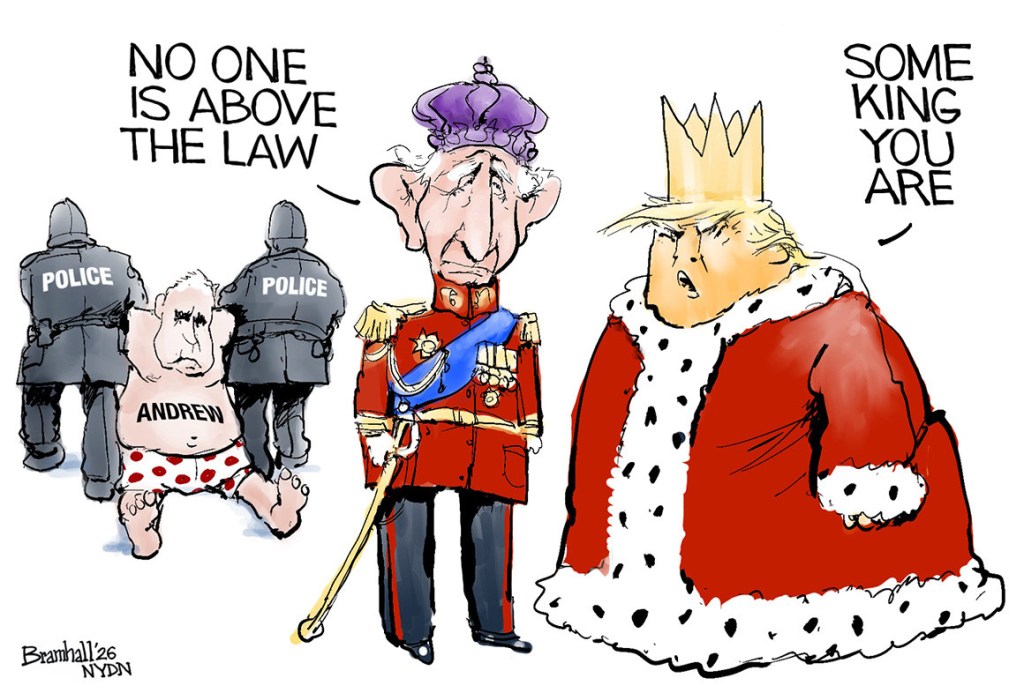
Some King You Are!