
The “Forthcoming Indictment of James Comey”
Ben Wittes is affiliated with the Brookings Institution and Harvard Law School and is editor of the website Lawfare.
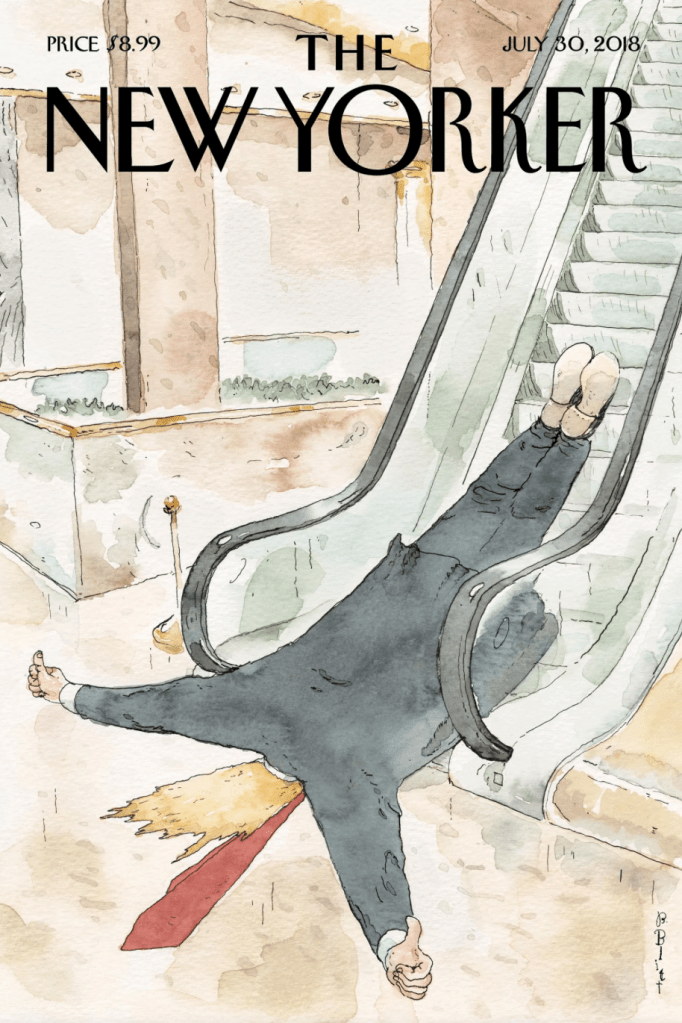
Like a Man Trying to Race Upward on a Downward-Moving Escalator
Before I quote from Frum’s piece, I begin with some key points.
First, Frum is a mighty shrewd fellow.
Second, Frum grasps a vital truth: to understand what’s going on around us, you have absolutely got to focus on what motivates people. That’s people in general. That’s individual people, with all their eccentricities and foibles. And that’s categories of people. And, in our day and age, the category of criminals and opportunists who surround Trump.
If the Trump hangers on think that Trump is prevailing, well, that’s one calculation. But if they begin to fear he’s losing, well, that’s another calculation entirely.
So, with those thoughts in mind, take it away, David!
David Frum (The Atlantic),Trump Might Be Losing His Race Against Time: The president is gambling that he can consolidate authority before the public turns too sharply against him:
President Donald Trump is worried that Attorney General Pam Bondi is moving too slowly to prosecute his political adversaries on fake charges. Trump has good reason to be concerned. He is carrying out his project to consolidate authoritarian power against the trend of declining public support for his administration and himself. He is like a man trying to race upward on a downward-moving escalator. If he loses the race, he will be pulled ever deeper below—and the escalator keeps moving faster against him.
Autocracies are headed by one man but require the cooperation of many others. Some collaborators may sincerely share the autocrat’s goals, but opportunists provide a crucial margin of support. In the United States, such people now have to make a difficult calculation: Do the present benefits of submitting to Trump’s will outweigh the future hazards?
As Bondi makes her daily decisions about whether to abuse her powers to please Trump, she has to begin with one big political assessment: Will Trump ultimately retain the power to reward and punish her? It’s not just about keeping her present job. On the one hand, people in Trump’s favor can make a lot of money from their proximity to power. On the other, Richard Nixon’s attorney general, John Mitchell, served 19 months in prison for his crimes during Watergate. If Trump’s hold on power loosens, Bondi could share Mitchell’s fate.
Trump’s hold on power is indeed loosening. His standing with the voting public is quickly deteriorating. Grocery prices jumped in August 2025 at the fastest speed since the peak of the post-pandemic inflation in 2022. Job growth has stalled to practically zero.
Almost two-thirds of Americans disapprove of higher tariffs, Trump’s signature economic move. His administration’s attack on vaccines for young children is even more unpopular. This year has brought the highest number of measles cases since the Clinton administration introduced free universal vaccination for young children in 1993. Parents may be rightly shocked and angry.
Shortly after MSNBC reported that Tom Homan, Trump’s border czar, had accepted $50,000 in cash from FBI agents posing as businessmen last year, allegedly in exchange for a promise to help secure government contracts, the pro-Trump podcaster Megyn Kelly posted, “We DO NOT CARE.” This kind of acquiescence to corruption has been one of Trump’s most important resources. But the American people become a lot less tolerant of corruption in their leaders when they feel themselves under economic pressure. As of early August, nearly two-thirds of Americans regarded Trump as corrupt, 45 percent as “very corrupt.” More than 60 percent think the Trump administration is covering up the Jeffrey Epstein case. Almost 60 percent regard Bondi personally responsible for the cover-up.
The MAGA project in many ways resembles one of former businessman Donald Trump’s dangerously leveraged real-estate deals. A comparatively small number of fanatics are heart-and-soul committed. Through them, Trump controls the Republican apparatus and the right-wing media world, which allows him to do things like gerrymander states where he is in trouble (50 percent of Texans now disapprove of Trump, while only 43 percent approve) or wield the enforcement powers of the Federal Communications Commission to silence on-air critics. But overleveraged structures are susceptible to external shocks and internal mistakes.
Trump in his first term mostly avoided screwing up the economy. His trade wars with China triggered a nearly 20 percent stock-market slump in the fall and early winter of 2018. Trump retreated, and no recession followed the slump until the COVID shock of 2020. But in his second term, Trump has jettisoned his former economic caution. The stock market is doing fine in 2025 on hopes of interest-rate cuts. The real economy is worsening. The percentage of Americans who think the country is on the “wrong track” rose sharply over the summer. Even self-identified Republicans are now more negative than positive.
The souring is especially bitter among younger people. More than 60 percent of Republicans younger than 45 say things are on the wrong track, a 30-point deterioration over the three summer months.
Trump has a shrewd instinct for survival. He must sense that if he does not act now to prevent free and fair elections in 2026, he will lose much of his power—and all of his impunity. That’s why he is squeezing Bondi. But for her, the thought process must be very different. Trump is hoping to offload culpability for his misconduct onto her. She’s the one most directly at risk if she gives orders later shown to be unethical or illegal.
The survival of American rights and liberties may now turn less on the question of whether Pam Bondi is a person of integrity—which we already know the dismal answer to—than whether she is willing to risk her career and maybe even her personal freedom for a president on his way to repudiation unless he can fully pervert the U.S. legal system and the 2026 elections.
Immigration and the Democrats
Josh Barro (N.Y. Times), Democrats Blew It on Immigration:
Since the spring, the shine has come off President Trump’s handling of immigration. And yet there has been no apparent surge in voters’ desire to put immigration policy back in the hands of Democrats.
Frankly, Democrats have not earned voters’ trust on immigration — and I say this as a Democrat.
The most recent Democratic administration presided over an enormous surge in migration, with the unauthorized immigrant population exploding to 14 million in 2023 from 10.5 million in 2021 and likely millions more by the time Joe Biden left office, according to the Pew Research Center.
For too long, Mr. Biden and his team asserted they couldn’t stop the surge without new legislation. That proved false: In 2024, having failed to get an immigration bill through Congress, Mr. Biden finally took executive actions to curb abuse of the asylum system and slow the flow of migrants across the southern border. When Mr. Trump took office, illegal border crossings slowed to a trickle. In other words, the problem had been fixable all along; Mr. Biden simply did not fix it until much too late.
As a result, the unauthorized immigrant population in the United States today is considerably different from what it was before Mr. Biden’s presidency. In 2021, over 80 percent of unauthorized immigrants had been living here for at least five years. Now there are millions more recent arrivals without similarly deep links to American communities. Admitting all these new migrants was never an agreed-upon public policy — no voters endorsed this, no law passed by Congress contemplated it and to the extent the migrants are seeking asylum, their legal claims are too often bogus.
But it happened, and Democrats need to explain to voters why they should not expect it to happen again if they regain power. They also need a story about what happens with the millions of people who came here recently, even though they weren’t supposed to.
The longstanding preferred Democratic framework has been comprehensive immigration reform. The idea is that you secure the border, set an intentional and thoughtful immigration policy about who to admit going forward, and give some sort of amnesty to most of the unauthorized immigrants who are already here. Twenty years of legislative efforts to enact this framework failed, even when there was substantial Republican support for it, which is no longer the case. And that was before the composition of the unauthorized immigrant population changed so drastically.
Center-left commentators like Matthew Yglesias and Jerusalem Demsas have been proposing policy ideas that aim to make Democrats’ plans for immigration more appealing to the public. These include refocusing immigration toward higher-skilled migrants, allowing more guest workers on nonimmigrant visas to address inflation-producing labor shortages in industries like hospitality, adding requirements related to assimilation and English-language learning, and even taxing immigrants at higher rates than native-born Americans.
The Center for American Progress has a smart set of proposals to prevent a recurrence of the abuses of the asylum system that prevailed during the Biden administration. The institution’s Neera Tanden and Debu Gandhi propose to prohibit almost all asylum claims from migrants who crossed the southern border illegally, while those who make claims at the border would be held in custody instead of being allowed into the country on a parole basis. Their claims would be adjudicated within 30 days, with rapid removal for those whose claims are rejected. The proposal would also raise the standard of proof for asylum claims and maintain a list of democratic countries whose citizens are presumptively ineligible for asylum.
These sorts of reforms to prevent abuse are necessary to maintain the long-term political viability of the right to claim asylum — though Democrats should also be mindful that the total number of migrants matters, and further restriction could be necessary if too many migrants try to seek asylum under the new system.
The idea is to emphasize that immigration policy must be designed principally for the benefit of American citizens, who stand to gain from the economic and cultural contributions of immigrants so long as immigration is managed appropriately.
This is a good project — but it won’t work without a robust and credible commitment to enforcement, including interior enforcement. That’s because you can make whatever rules you want about who is supposed to immigrate and how, but if you continue to allow millions of people to come live in the United States in contravention of those rules, the immigration situation on the ground will not match what is written in policy.
The mental block that Democrats have here relates to an instinct about deportations: a feeling that it’s presumptively improper to remove an unauthorized immigrant who has settled in our country if that migrant hasn’t committed a crime unrelated to immigration. These people have been here a long time, the idea goes. They’re not causing trouble.
But if we build a system where people very often get to stay here simply because they made it in — the system that prevailed during most of Mr. Biden’s term — then we don’t really have an immigration policy, and voters won’t have any reason to believe us when we say our new policy will produce different results about who comes here.
Liberals also note, accurately, that there are negative economic consequences to a stepped-up program of interior enforcement that doesn’t focus narrowly on criminals. Unauthorized immigrants play an important role in our work force, especially in agriculture and construction. More deportations will make it more expensive to grow fruits and vegetables and reduce the number of housing units we can add. (On the other hand, it will also reduce demand for housing.) But these near-term economic costs need to be weighed against the way that stepped-up interior enforcement makes any future immigration policy more credible and more effective by sending migrants the message that they need a valid visa to stay in the United States.
The need to make a credible enforcement threat does not require Democrats to endorse specific enforcement practices of the Trump administration, like having ICE officers cover their faces during raids or pursue a goal of 3,000 detentions per day. Democrats are right to highlight and criticize the way that indiscriminate raids can sweep up U.S. citizens and to call for a more effectively targeted approach. But that more targeted approach still needs to contemplate that being in the country without authorization is reason enough to deport someone.
There is a political risk for Democrats in Mr. Trump’s softer poll numbers on immigration. Earlier in the year, when his immigration stances were clearly a political asset, Democrats looked for ways to moderate their image on immigration and show a willingness to get tough on enforcement; for example, many moderate Democrats in Congress voted for the Laken Riley Act (which directs the authorities to detain and deport immigrants who are charged or admit to — but are not yet convicted of — specific crimes, if they are in the country illegally).
But now that more Americans disapprove than approve of his approach to immigration, Democrats have often reverted toward centering the concerns of noncitizens — which is to say, nonvoters. The fact that voters increasingly see Mr. Trump’s approach to immigration as too harsh is not enough to turn the issue into an asset for Democrats. A late-July poll for The Wall Street Journalshows the problem for Democrats. It found respondents narrowly disapproving of the president’s handling of the issue — and yet it also showed that voters would not rather see immigration policy in the hands of Democrats. Only 28 percent said that they trust Democrats in Congress to handle immigration policy more than they trust Republicans, while 45 percent say they trust Republicans more than Democrats (the split was slightly wider on the question of illegal immigration).
If we force voters to choose between Mr. Trump’s overly harsh approach and our overly permissive one, we will continue to lose on the issue.
Most voters say immigration provides net benefits to the country, but they also want rules to be enforced. We need to echo both of those sentiments.
Free Speech and Cosplay Fascism
Charlie Kirk was assassinated on Wednesday, September 10. Shortly thereafter, J.D. Vance and Stephen Miller began to implement what looks like a preplanned program to find some pretext to destroy free speech.
Jimmy Kimmel supplied the pretext on Monday night, September 15, when he (1) unwisely assumed that political assassination was a good topic for comedy and (2) stated—apparently incorrectly—that one of the “MAGA gang” was the actual assassin. Shortly thereafter, beginning on September 17, President Snowflake and his minion Brendon Carr, the Chair of the Federal Communications Commission, began calling for the revocation of ABC’s license and those of its local TV affiliates.
Kimmel’s bosses at ABC hit the panic button and—on that same day, Wednesday, September 17—said they would “indefinitely suspend” Kimmel from the airwaves.
Large chunks of shit began to hit the fan. As the hours and days went on, chunks of shit kept on hitting the proverbial ventilator.
Actors by the hundreds and others by the thousands began to protest and to initiate boycotts. The unspeakable Ted Cruz found that, after all, he could speak out against the planned death of the free speech.
The tide quickly began to turn. When we bought groceries on Saturday, Kroger still had its flag at half staff in loving memory of St. Charly Kirk, the martyr. But the next day, Brendon Carr was on TV trying to walk back his threat to start killing TV licenses.
Over in England, the indispensable March Family began to write a very nice song about the American First Amendment. They wrote the song, recorded it, and put it on YouTube very quickly—but not quickly enough to get ahead of ABC’s cowardly decision to reverse their own cowardice, and to get our friend Jimmy Kimmel back on the air as of tonight.
The “indefinite suspension” ultimately lasted less than one week.
Walks Like Cosplay Fascism, Talks Like Cosplay Fascism
I have no quarrel with those who, beginning on September 17, have been wailing, gnashing their teeth, and rending their garments about the death of freedom in the United States. But my instincts told me that the public was not going to react well to Vance and Miller goosestepping all over Washington, and that insight seems to have been correct.
Why? Well, I have to begin by admitting that recent events have tended to confirm H.L. Mencken’s claim that no one ever went broke underestimating the intelligence of the American people. “Don’t know much about history/Don’t know much geography/Don’t know much about a science book/Don’t know much about the French I took.”
And yet … shockingly ill-informed as so many of us are, we do seem to have the sense to realize that government censorship is not a good thing.
And so, as of this writing, midday, Tuesday, September 23, Trump and Vance and Miller don’t look like Nazis. Instead, they look like clownish, comic, cosplay Nazis as they strut about on the national stage.
Right now, it looks as if the great plan to use the Kirk assassination as a pretext to destroy freedom has backfired. Bigly.
But the Fat Lady Hasn’t Yet Delivered Her Aria
I think the cosplay Fascists have two alternatives.
Here’s the first one: when your evil plot comes crashing down, what you should do is minimize your losses, change the subject, and then go on a retreat to see whether you can find a more intelligent way to work your evil plan and to establish authoritarianism in the United States.
Here’s the other alternative: when your evil plot comes crashing down, respond by lashing out blindly in all directions, form a circular firing squad, and do everything you can to make yourselves look even more idiotic.
Wanna bet on which choice they make?
As Kimmel Plans to Return Tomorrow, Some Evening Thoughts from Walt Disney
“I believe that this spiritual and intellectual freedom which we Americans enjoy is our greatest cultural blessing. Therefore, it seems to me, that the first duty of culture is to defend freedom and resist all tyranny.”
And one more thought-provoking quotation from Disney:
“In America, we are guaranteed these freedoms. It is the constitutional privilege of every American to become cultured or to grow up like Donald Duck.”
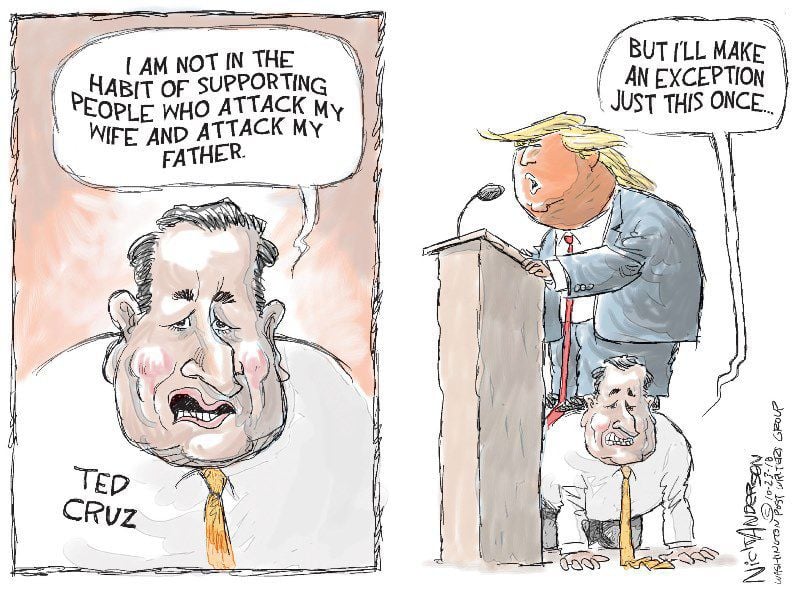
Snowstorm Reported Down in Hell: Ted Cruz Denounces Trump’s First Amendment Violations
Politico, ‘Dangerous as hell’: Cruz blasts FCC’s Jimmy Kimmel takedown:
Sen. Ted Cruz on his podcast Friday admonished Federal Communications Commission Chair Brendan Carr for demanding ABC suspend Jimmy Kimmel’s late night show over comments regarding Charlie Kirk — calling Carr’s actions “dangerous as hell” and “right out of ‘Goodfellas.’”
“If the government gets in the business of saying, ‘We don’t like what you, the media, have said; we’re going to ban you from the airwaves if you don’t say what we like’ — that will end up bad for conservatives,” said the Texas Republican.
And while Cruz said he liked Carr and was “thrilled” to see Kimmel’s show taken off the air, he cautioned that leveraging the FCC’s power to punish certain speech creates a concerning precedent that could leave conservatives vulnerable in a future Democratic administration.
“They will silence us,” said Cruz. “They will use this power, and they will use it ruthlessly.”
The comments are notable coming from Cruz — both as a loyalist of President Donald Trump and as chair of the Senate Commerce Committee, which has oversight authority over the FCC.
He also joins other prominent GOP lawmakers warning about how the FCC wields its power, as Democrats continue to decry the pressure to suspend Kimmel’s show as a free speech violation.
Earlier this week, Cruz said at a POLITICO AI & Tech summit that the First Amendment “absolutely protects hate speech,” although he added that it doesn’t make people “immune from consequences” from their employers.
During his Monday evening monologue, Kimmel said Republicans were trying to mischaracterize the background of Kirk’s killer for political points and compared Trump’s reaction to the killing as that of a 4-year-old mourning a goldfish. ABC announced Wednesday he would be taken off the air following Carr’s reprimand.
While Kimmel is the most high-profile public figure so far to lose his job for how he characterized the Kirk assassination, multiple academics and a Washington Post columnist have also been let go as a result of their remarks.
 Facing MAGA