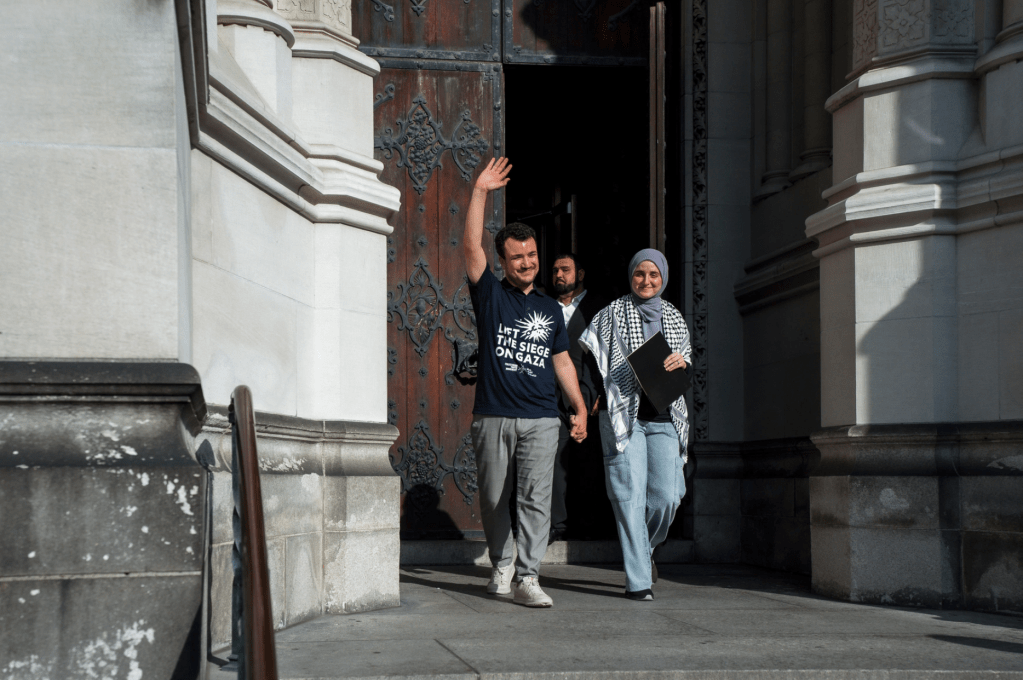
Your Trump Team of Legal Geniuses at Work

With clear eyes, hard facts, critical thinking, new political strategy, empathy, and a soupçon of Schadenfreude
This morning, on the Fourth of July, I watched an hourlong seminar on constitutional law. The host was Preet Bharara, fellow graduate of Columbia Law School, widely admired for his work as the U.S. Attorney for Manhattan, fired by Trump for doing his job with competence and integrity, and current partner of WilmerHale (one of the Big Law firms resisting Trump’s illegal targeting).
Guest commentators were
Scrolling down, you will find several of my recent posts on Trump v. CASA, birthright citizenship, and “nationwide”/universal injunctions. Unlike me, the four people in the video have spent their lives studying constitutional law and federal civil procedure. That is one reason why they bring many valuable insights to the “nationwide” injunctions kerfuffle—and why, if the subject interests you, watching the video will richly repay your time.
And also why watching the video will provide valuable insights into how good constitutional law is done.
And why, moreover, good constitutional law reasoning is hard—an activity not best left to people whose thinking consists of bumper sticker slogans.
All that said, I am gratified that these people mostly agreed with my amateur understanding of the big legal issues—though they made their points will more precision and detail than I brought to bear.
With one exception. I think I missed the boat on a subtle but important point.
Justice Barrett’s majority opinion makes a big bloody deal of the claim that, in the Judiciary Act of 1789, Congress did not grant the courts any general power to issue “nationwide” injunctions. (If I were writing for fellow shysters, I would say that the justice’s interpretation of the Judiciary Act was the ratio decidendi—the rationale for her decision. But since I’m not writing for other shysters, I’ll just say “big bloody deal.”)
Now, if Congress gave no such power to the district courts or to the courts of appeal, then it must follow, as the night the day, that Congress did not give any such power to the Supreme Court, either. For that reason, I was puzzled by certain commentators’ claim that the Supreme Court reserved for itself the power to issue universal injunctions in cases where there had been no class certification.
My mistake.
As one of the speakers in the video—Prof. Goldsmith, I think—pointed out, the very last sentence of the majority opinion is in fact a “nationwide”/universal injunction! That sentence reads, “Consistent with the Solicitor General’s representation [that Team Trump won’t play games with the Supreme Court], §2 of the Executive Order shall not take effect until 30 days after the date of this opinion.”
For context, note that Section 2 is the operative language of the executive order—the part that claims to declare the policy of the United States government about who is, and who isn’t, a birthright citizen.
The Learned Hand Professor of Law at Harvard did not know what authority the Court might claim to justify writing that sentence and issuing that order.
And if he doesn’t know, then neither do I.
[1] For anyone who might wonder, “Learned Hand” does not refer to Prof. Goldsmith’s penmanship, but rather to Judge Learned Hand, a distinguished jurisprude and federal appellate judge who died in 1961.

This follows up on my prior posts on Trump’s Executive Order on Birthright Citizenship and “Nationwide” Injunctions, Birthright Citizenship, and the Supreme Court Decision in Trump v. CASA.
So, what comes next?[1]
Justice Barrett wrote a 26-page opinion, speaking for herself and five other justices. In footnote 2 she wrote, “The Government does not dispute—nor could it—that the individual plaintiffs have standing to sue.” The individual plaintiffs are, of course, Liza and her newborn baby, the three other undocumented new mothers and babies, along with Maribel and the baby she is expecting, plus Juana and the two other undocumented women who might become pregnant.
All of these plaintiffs have already received preliminary injunctions blocking Team Trump from enforcing its executive order as to them. Justice Barrett stays these preliminary injunctions “but only to the extent that the injunctions are broader than necessary to provide complete relief to each plaintiff with standing to sue.”
As to “each plaintiff with standing to sue,” the justice has already said that the four new mothers, their four little babies, the pregnant mother, her unborn child, and the three women who might get pregnant all have standing to sue.
As to “complete relief,” Justice Barrett says she means a prohibition on Team Trump’s enforcement of its executive order against those specific 13 people.
Footnote 18 of the majority opinion anticipates that Team Trump will not play cute by declining to appeal adverse rulings on specific plaintiffs while attempting to enforce the executive order against others. Instead, the justice says that she has extracted a promise, in open court, that yes, the government will appeal if it loses, and, yes, if the Supreme Court rules on the merits against Trump, then the government will abide by the Court’s ruling.
So that’s what Justice Barrett thinks is going to happen.
The problem, of course, is that Team Trump is comprised of liars, and the truth is not in them. On birthright citizenship, Team Trump has promised to stop playing legal games. If Justice Barrett places full faith and credit on that promise, then I have a nice bridge in Brooklyn that I’m willing to sell at a reasonable price.
Yes, it would. Because, where a class is certified, a court can grant injunctive relief to the whole class, not just the specific named plaintiffs.
Plus, of course, if there is class certification, then there is no longer any need to perseverate over whether, absent class certification, the Judiciary Act of 1789 does or does not forbid “nationwide injunctions.”
And take note that, while Justice Barrett’s majority opinion said nothing about class certification, the class action option was raised in concurring opinions by Justice Alito and by Justice Kavanaugh.
Rule 23 is complex and verbose. A party opposing certification usually has lots of issues to raise and lots of language to work with—and a whole lot of hoops to make the other side jump through. I’m going to give you a quick and dirty version of how I see it playing out here.[2]
Class Definition and Related Issues. A class action decision is binding on the whole class—if the class loses the case, then individual members of the class are bound by the loss, and cannot relitigate the question. For that reason and others, a class definition must be clear, and it must be relatively easy to know who’s in the class and who’s out of it. And, on a related note, there must be some feasible means to give all class members notice of the pending litigation.
For example, if your proposed class is “all female employees of Walmart who have suffered discriminatory treatment on account of their gender,” the definition is arguably too loose to justify class certification.
Here, however, in the executive order, Trump himself has explicitly defined the class of people he seeks to mistreat.
Uniform Treatment of All Class Members. Rule 23 recognizes that class action treatment may be appropriate when “the party opposing the class has acted or refused to act on grounds that apply generally to the class, so that final injunctive relief or corresponding declaratory relief is appropriate respecting the class as a whole.”
If you try to define a class of “all female employees of Walmart who have suffered discriminatory treatment on account of their gender,” the Walmart is going to argue that there are eight million stories in the naked city, and there’s no way to lump all these stories into one big lawsuit. Pretty good argument. But suppose that Walmart had issued a formal written policy providing that all female employees were to be paid at 80 percent of the salaries of male workers with corresponding jobs. Class action litigation to challenge that uniform policy would be entirely appropriate.
Conflicts of Interests and Objectives Within the Defined Class. Sometimes this is a big issue, but not, I think, here. I don’t think there a whole lot of fertile undocumented women who hope their babies will be deprived of U.S. citizenship—and thus risk statelessness.
Calculation of Damages. If the proposed class is seeking damages for past misconduct, the defendant will often argue that it’s difficult or impossible to use a single formula to calculate the damages accruing to each member of the plaintiff class—and that, accordingly, individual legal questions predominate over common legal questions. But that’s a moot point here, because the object of the lawsuit would be injunctive relief to prevent future harm, not damages.
To me, all the relevant factors point toward the use of class action litigation to challenge the executive order.
We have seen that
[1] And specifically, what comes next for the legal claims of the plaintiff undocumented immigrant mothers, as distinguished from the claims of the states and of the organizations suing to protect birthright citizenship?
[2] I dealt with class certification issues throughout my 35 years of antitrust legal practice.

The case is here. For a variety of takes from the commentators, see, e.g.,
Amy Howe (SCOTUSblog), Supreme Court sides with Trump administration on nationwide injunctions in birthright citizenship case
Washington Post Editorial Board, Justices need to own the consequences of their injunction ruling: the court has significantly weakened district courts’ ability to halt illegal presidential actions.
Jason Willick (Washington Post), Justice Kavanaugh explains what the injunctions ruling won’t change
Philip Rotner (The Bulwark), Ignoring Substance, SCOTUS Permits Lawlessness
Nicholas Bagley (The Atlantic), The Supreme Court put Nationwide Injunctions to the Torch: That isn’t the disaster for birthright citizenship that some fear.
N.Y. Times, Guest Essay, ‘There’s Just Too Much Lawlessness’: Three Legal Experts on an Embattled Supreme Court
See also yesterday’s update from the ACLU.
I discussed the executive order on birthright citizenship in the preceding post.
The term “nationwide injunction” is inapt and misleading, but lots of people want to use it anyway. So let’s define it for present purposes. For present purposes, a “nationwide injunction” is an injunction issued in a case brought by one or more persons (either two-legged persons or juridical persons such as corporations) that protects not only the individual plaintiff(s) but also everyone else in a similar legal position, even though there is no certified “class action” in accordance with Rule 23 of the Federal Rules of Civil Procedure.
As so defined, a nationwide injunction is an end run around the normal requirements for class certification under Rule 23.[1]
To illustrate and explain the point: Plaintiffs in the CASA case include four new mothers and their babies, one pregnant woman and her unborn child, and three undocumented immigrant women who might become pregnant. If the plaintiffs wanted to secure a ruling protecting not only their children but also all children whom Trump threatened to deprive of citizenship, then the normal/traditional route would be to ask the district court to “certify” such a “class” of similarly situated mothers. That class certification process involves a number of inquiries about whether it would be advisable for the litigation to go forward on a class basis, not an individual basis. But Liza, Andrea, and the other expectant mothers asked for nationwide/universal relief, without going through the certification exercise.
Yes. Long story. But yes.
In fact, the Biden administration asked the Supreme Court to impose severe limitations on “nationwide injunctions.”
Yes, I do agree. And if anyone reading this post wants to delve deeper, many of the sources cited above will be useful.
But I think the much more interesting question is whether plaintiff can represent a class of similarly situated mothers, babies, and unborn children.
And whether, by so complying with Rule 23, they can find effective legal relief against Trump’s illegal position on birthright citizenship.
I’ll write about that in my next post, which will appear immediately above this one, because the posts on my blog appear in reverse chronological order.
[1] Related, but distinct, issues are raised by lawsuits with plaintiffs claiming to represent a category of other people—for example, a suit brought by a state government on behalf of all its citizen or a suit brought by a trade association on behalf of all its members. Team Trump challenged the “standing” of states and associations to bring such cases, but the Court decided to kick this can down the road.

The executive order is prospective. It purports to deny citizenship to future babies born in the United States if (1) the baby’s mother is unlawfully present in the United States and (2) the baby’s father is not a U.S. citizen or lawful permanent resident.[1]
The 14th Amendment provides, “All persons born or naturalized in the United States, and subject to the jurisdiction thereof, are citizens of the United States …”
Thus, if you want to argue that babies born in the United States to undocumented parents are not citizens, then you have to hang your hat on the words “and subject to the jurisdiction thereof.” And you have to make a very strained and slanty-eyed interpretation of that phrase.
That strained interpretation is the position Trump takes in the executive order.
Back in 1898, the Supreme Court considered—and rejected—the legal position that Team Trump now espouses. So Trump has to argue (among other things) that the Supreme Court got it wrong in 1898, and that the law has stayed wrong for the past 127 years.
(1) A Test Case before the Supreme Court. A charitable reading is that the executive order is intended as the predicate to a test case, in which the Supreme Court would revisit the issue it decided back in 1898.
Trump may argue that it’s OK to set up a test case. After all, we all have a constitutional right to be wrong, and we all, including His Most High Excellency, have a right to ask the Supreme Court to embrace our erroneous legal claims.[2]
(2) Defiance of the Supreme Court. An uncharitable reading of the executive order is that Mango Mussolini claims that HE ALONE, not the Supreme Court, may divine the definitive definition of the words in the Constitution.
(3) Evasion of Supreme Court Review, or, the Cuter Than Bambi Reading. A third interpretation—perhaps even more uncharitable, though very possibly accurate—is Team Trump is attempting to evade Supreme Court review of his novel constitutional argument by
Some lawyers—not that many, but some—are under the impression that they are cuter than Bambi. This is the sort of horseshit that they come up with.
(4) The FAFO Reading. Lastly, one may read the executive order as implying that Team Trump hasn’t thought through how to get their novel legal theory accepted. Under this interpretation, they just plan to Fuck Around and Find Out.
Someone other than me must surely have spotted this issue—but, if so, I haven’t seen any evidence of it. Here’s the issue.
Suppose that—some way, somehow—Team Trump gets the courts to all enforcement of the executive order in respect of future babies born to undocumented immigrants. Bear with me on that. Just entertain the supposition.
Logically, that would imply everybody already born in the United States to undocumented parents also lacks U.S. citizenship.
Would Team Trump be prepared to take that position?
That’s at least five million people, and probably more.
[1] The order also addresses another distinct issue/problem, that of “birth tourism.” That’s an interesting issue, but pales in importance compared to the issue of babies born to undocumented immigrants.
[2] That right flows from the First Amendment right to petition for redress of grievance. And, BTW, Trump also has a constitutional right to ask Congress to pass a law endorsing his view of citizenship. But that wouldn’t work, because any such law would be unconstitutional unless and until the Supreme Court changes its mind about its 1898 interpretation of the Fourteenth Amendment.
Broadcast live yesterday afternoon for ACLU contributors.
If you are not an ACLU contributor, you should be.
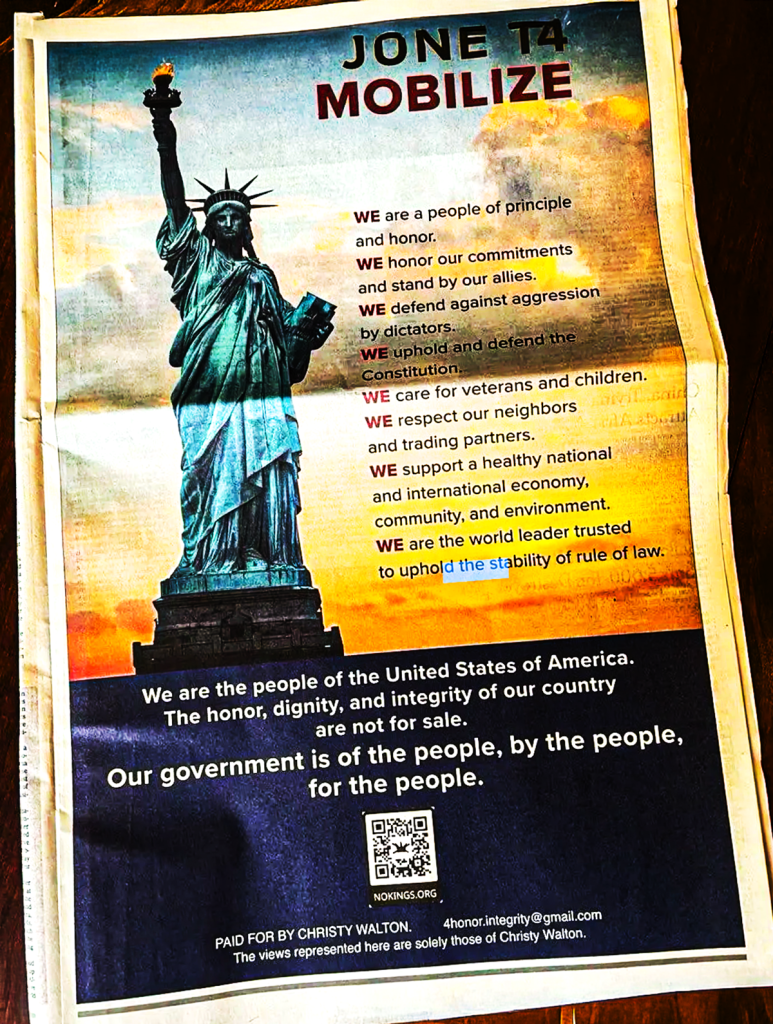
Today, many talking heads are talking about the events in Los Angeles as a step on the road to authoritarianism—and an attempt to distract from Team Trump’s many failures.
All true.
And yet there remains an elephant in the room for Team Blue.
As a movement, we do not yet have a coherent and politically viable answer about
or about
or about
Not to have coherent and politically viable answers to these questions is political malpractice.
Trump Isn’t Appointing Judges Because He Can’t Find People to Appoint
Wall Street Journal, The Law Firms That Appeased Trump—and Angered Their Clients:
Support for the law firms that didn’t make deals has been growing inside the offices of corporate executives. At least 11 big companies are moving work away from law firms that settled with the administration or are giving—or intend to give—more business to firms that have been targeted but refused to strike deals, according to general counsels at those companies and other people familiar with those decisions.
Among them are technology giant Oracle, investment bank Morgan Stanley, an airline and a pharmaceutical company. Microsoft expressed reservations about working with a firm that struck a deal, and another such firm stopped representing McDonald’s in a case a few months before a scheduled trial.
In interviews, general counsels expressed concern about whether they could trust law firms that struck deals to fight for them in court and in negotiating big deals if they weren’t willing to stand up for themselves against Trump. The general counsel of a manufacturer of medical supplies said that if firms facing White House pressure “don’t have a hard line,” they don’t have any line at all. …
Not long after Latham struck a deal in April, the firm’s chair, Richard Trobman, met with Morgan Stanley’s chief legal officer, Eric Grossman, people familiar with the meeting said. Grossman heard him out about the firm’s reasoning for striking a deal and acknowledged that companies have to do what is best for themselves.
Soon after that meeting, Grossman and other Morgan Stanley lawyers communicated to law firms targeted by the White House that hadn’t signed deals that they were looking to give them new business, the people familiar with the meeting said. …
A top legal executive at another company said she called partners at Paul Weiss before it cut its deal to reassure the firm she would remain loyal, even though doing so risked millions in government contracts. She was shocked when the firm chair Brad Karp announced a deal, she said, and her company has plans to move work away from Paul Weiss.
The day after Paul Weiss struck its deal, female general counsels gathered for a conference in Washington. During a panel at the Women’s General Counsel Network event, a lawyer stood up and said her company had taken steps that morning to pull its business from Paul Weiss. The lawyer received thunderous applause.
About two weeks later, McDonald’s told a court that star Paul Weiss lawyer Loretta Lynch was withdrawing as its attorney in a high-profile lawsuit accusing the fast-food giant of discrimination against Black-owned media companies. Lynch, who had served as attorney general under former President Barack Obama, had been involved with the case for several years. It is unusual for companies to shake up representation close to trial. …
Emotions have run high inside some firms that struck deals, particularly among younger lawyers. At Skadden, Simpson, Latham and Kirkland, some associates have quit over the deals. One associate leaving Simpson wrote in his departure email, shared on LinkedIn, that he refused to “sleepwalk toward authoritarianism.” Partners, too, have left some of the firms that made deals.
At Sullivan & Cromwell, some lawyers have bristled at the role that co-chair Robert Giuffra played in facilitating a deal for Trump to drop an executive order against rival firm Paul Weiss. Giuffra, one of Trump’s personal lawyers, participated by phone in an Oval Office discussion with the Paul Weiss leader, who was there to work out a deal.
N.Y. Times, A Fiery Brief Fueled by Conservatives Helped Put Trump’s Tariffs in Peril
This is a legally sophisticated yet understandable exposition of the legal issues. Despite the Times’ headline, the article shows how there is a large degree of bipartisan agreement among legal scholars that Trump’s tariffs are unconstitutional.
That bipartisan agreement should help the Supreme Court if and when it rules against Trump on the tariffs.
And, apart from the legal niceties, there is the fact that the tariffs are sending the economy to hell in a handbasket.
 Facing MAGA