
Cancel Culture
The Death and Life of Democracy
The main discussion begins at 6:45 of the video.
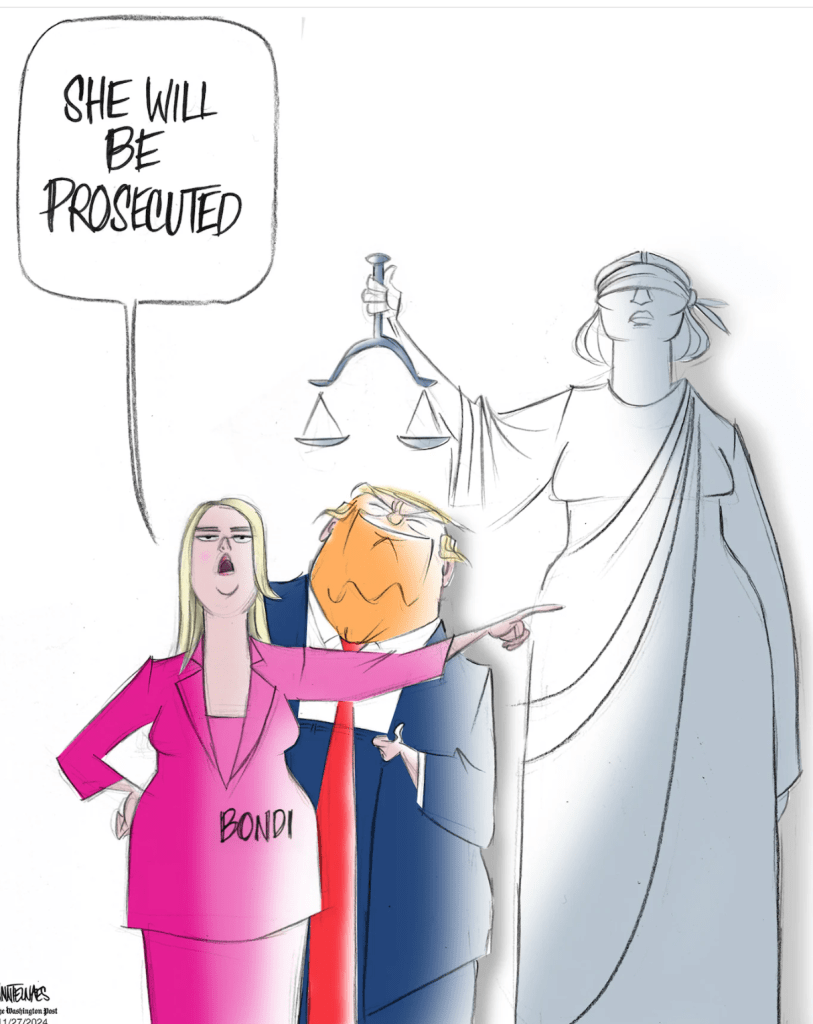
In a Country Riven by Polarization, There is Astonishing Bipartisan Consensus That Pam Bondi is a Moron
The Guardian writes,
US attorney general Pam Bondi’s pledge that the Trump administration will “absolutely target” people who use “hate speech” in the wake of the killing of conservative activist Charlie Kirk has prompted criticism of the idea from across the political spectrum, including from prominent conservatives.
Bondi said on a podcast hosted by Katie Miller, the wife of the rightwing White House deputy chief of staff Stephen Miller, that there is “free speech and then there’s hate speech, and there is no place, especially now, especially after what happened to Charlie, in our society”.
Legal experts and conservative pundits have condemned the comments because there is no “hate speech” exception in the first amendment right to speech and as such, targeting people for their charged rhetoric would be unconstitutional.
There is no unprotected category of speech in the constitution or in the case law called ‘hate speech’,” said Heidi Kitrosser, a Northwestern University law professor. “By being so vague and by talking about speech that doesn’t fit into any legal category, she is basically opening the door for taking action against anyone who engages in speech that the president or the Department of Justice or Stephen Miller doesn’t like.”
Kirk, the founder of the powerful rightwing youth activist group Turning Point and a close ally of Donald Trump, was killed on 10 September at Utah Valley University during one of his signature events in which he debated students.
The murder was part of a wave of political violence in the United States, including attempted assassinations of the US president and the assassination of Melissa Hortman, the Democratic speaker of the Minnesota House of Representatives, and her husband.
While some people on both sides of the aisle have spoken about the need for respectful dialogue, Trump and others in his administration have continued to largely blame the violence on the left and warned of a “vast domestic terror movement” prompting fears he plans a broad crackdown on his political opponents.
JD Vance guest-hosted Kirk’s podcast this week, during which the vice-president urged people to call the employers of people celebrating Kirk’s murder and said that the administration would “work to dismantle the institutions that promote violence and terrorism in our own country”.
When asked about Bondi’s comments on Tuesday, Trump told an ABC News reporter: “We’ll probably go after people like you because you treat me so unfairly. It’s hate. You have a lot of hate in your heart. Maybe they’ll come after ABC.”
Bondi also threatened to prosecute an Office Depot employee who reportedly refused to print flyers for a vigil for Kirk.
But people on the right who normally strongly support Trump have condemned Bondi’s comments and called for her ouster.
Conservative pundit Matt Walsh, who said after Kirk’s death: “We are up against demonic forces from the pit of Hell,” posted on Twitter/X of Bondi: “Get rid of her. Today. This is insane. Conservatives have fought for decades for the right to refuse service to anyone. We won that fight. Now Pam Bondi wants to roll it all back for no reason.”
Erick Erickson, a conservative commentator, also wrote on X: “Our Attorney General is apparently a moron. ‘There’s free speech and then there is hate speech.’ No ma’am. That is not the law.”
And Savanah Hernandez, a commentator with Turning Point, described those words from Bondi as “most destructive phrase that has ever been uttered … She needs to be removed as attorney general now.”
Commentators also pointed to Kirk’s own comments from 2024 concerning the idea of hate speech.
“Hate speech does not exist legally in America. There’s ugly speech. There’s gross speech. There’s evil speech,” Kirk wrote. “And ALL of it is protected by the First Amendment. Keep America free.”
Bondi’s talk of targeting people who use “hate speech” is not legal because the “first amendment creates very, very strong protections from punishment for speech that’s offensive or for speech with which people disagree. The bar for punishing speech based on content, and especially based on viewpoint, is extremely, extremely high,” Northwestern’s Kitrosser said.
Following the backlash, Bondi, who already faced calls to resign for how she handled files related to sex trafficker Jeffrey Epstein, appeared to try to walk back her comments on Tuesday.
“Freedom of speech is sacred in our country, and we will never impede upon that right,” Bondi said in a statement to Axios. “My intention was to speak about threats of violence that individuals incite against others.”
Kitrosser, however, said she remained “very concerned as to how broadly they are going to define what is an illegal threat and as to what other loopholes they may try to carve out from existing free speech case law”.
She added: “I think that we all need to remain very vigilant.”
I Join with J.D. Vance in Opposing Political Violence
Redistricting: Team Red Can’t Find Its Ass with Both Hands
I’ll leave the fine details to the experts, but here is the gist. If Team Red—or, of course, Team Blue—finds itself with a lot of extremely safe congressional districts, the partisan redistricting may be accomplished by spreading out those partisan voters, so that the team has somewhat fewer safe seats and a larger number of seats that it’s going to win by, say, only five percent or so.
That works just fine if you can accurately predict which way the political win will be blowing, come next election. But what happens if the political wind starts blowing against you?
If, let’s say, the wind unexpectedly blows against you—let’s say by seven percent in favor of Team Blue—then your bunch of five percent wins turn into a bunch of two percent losses. And you have well and truly shot yourself in the foot.
You will recognize this situation as a corollary of the general rule that the straight edge ruler is not your best tool for short term and long term planning.
Down in Texas, Team Red—having partaken generously of Trump’s Kool-Aid—thinks that Orange Man’s popularity in the Lone Star State will continue from strength. In particular, they think the Latino community is overjoyed by the ICE arrests, and will reward Mango Mussolini in 2026 by increasing their support in congressional districts bordering on the Rio Grande.
Good luck with that.
Meanwhile, His Most High Excellency has declared today that he will order his “Justice Department” to sue California for retaliatory redistricting on the part of Team Blue.
The Very Stable Genius did not, however, articulate a coherent legal principle that would condemn Team Blue in California while, at the same time, blessing Team Red’s efforts in Texas.

State Capitalism with American Characteristics
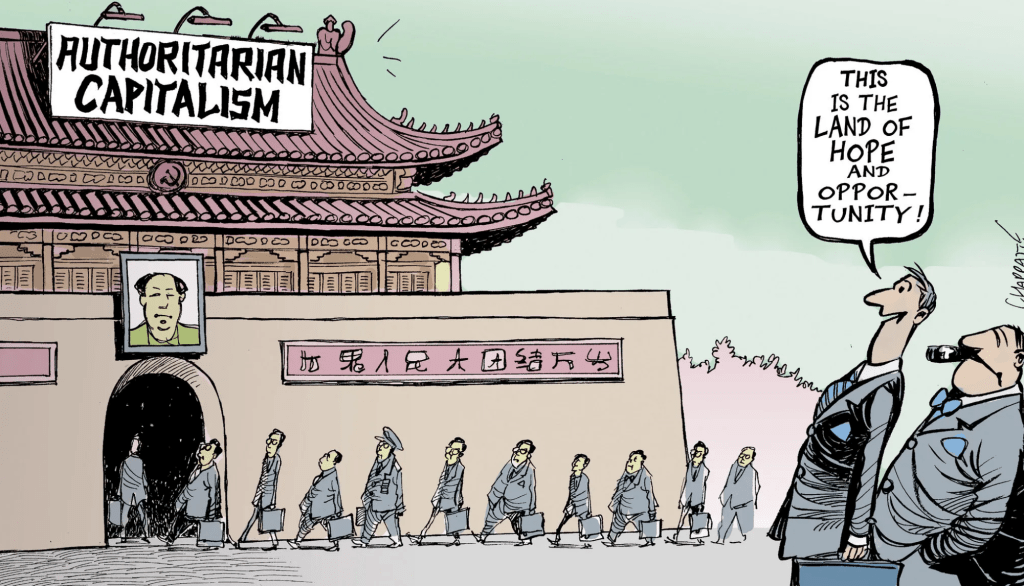
Bill Saporito (N.Y. Times), Trump Thinks He Is the C.E.O. of Everything. Awesome.
Greg Ip (Wall Street Journal), The U.S. Marches Toward State Capitalism With American Characteristics: President Trump is imitating Chinese Communist Party by extending political control ever deeper into economy
Hot take by me at the end of this post. Meanwhile, the indispensable Greg Ip writes,
Recent examples include President Trump’s demand that Intel’s chief executive resign; the 15% of certain chip sales to China that Nvidia and Advanced Micro Devices will share with Washington; the “golden share” Washington will get in U.S. Steel as a condition of Nippon Steel’s takeover; and the $1.5 trillion of promised investment from trading partners Trump plans to personally direct.
This isn’t socialism, in which the state owns the means of production. It is more like state capitalism, a hybrid between socialism and capitalism in which the state guides the decisions of nominally private enterprises.
China calls its hybrid “socialism with Chinese characteristics.” The U.S. hasn’t gone as far as China or even milder practitioners of state capitalism such as Russia, Brazil and, at times, France. So call this variant “state capitalism with American characteristics.” It is still a sea change from the free market ethos the U.S. once embodied.
How we learned to love state capitalism
We wouldn’t be dabbling with state capitalism if not for the public’s and both parties’ belief that free-market capitalism wasn’t working. That system encouraged profit-maximizing CEOs to move production abroad. The result was a shrunken manufacturing workforce, dependence on China for vital products such as critical minerals, and underinvestment in the industries of the future such as clean energy and semiconductors.
The federal government has often waded into the corporate world. It commandeered production during World War II and, under the Defense Production Act, emergencies such as the Covid-19 pandemic. It bailed out banks and car companies during the 2007-09 financial crisis. Those, however, were temporary expedients.
Former President Joe Biden went further, seeking to shape the actual structure of industry. His Inflation Reduction Act authorized $400 billion in clean-energy loans. The Chips and Science Act earmarked $39 billion in subsidies for domestic semiconductor manufacturing. Of that, $8.5 billion went to Intel, giving Trump leverage to demand the removal of its CEO over past ties to China. (Intel so far has refused.)
Biden overrode U.S. Steel’s management and shareholders to block Nippon Steel’s takeover, though his staff saw no national-security risk. Trump reversed that veto while extracting the “golden share” that he can use to influence the company’s decisions. In design and name it mimics the golden shares that private Chinese companies must issue to the CCP.
Biden officials had mulled a sovereign-wealth fund to finance strategically important but commercially risky projects such as in critical minerals, which China dominates. Last month, Trump’s Department of Defense said it would take a 15% stake in MP Materials, a miner of critical minerals.
Many in the West admire China for its ability to turbocharge growth through massive feats of infrastructure building, scientific advance and promotion of favored industries. American efforts are often bogged down amid the checks, balances and compromises of pluralistic democracy.
In his forthcoming book, “Breakneck: China’s Quest to Engineer the Future,” author Dan Wang writes: “China is an engineering state, building big at breakneck speed, in contrast to the United States’ lawyerly society, blocking everything it can, good and bad.”
To admirers, Trump’s appeal is his willingness to bulldoze those lawyerly obstacles. He has imposed tariffs on an array of countries and sectors, seizing authority that is supposed to belong to Congress. He extracted $1.5 trillion in investment pledges from Japan, the European Union and South Korea that he claims he will personally direct, though no legal mechanism for doing so appears to exist. (Those pledges are already in dispute.)
Trouble with state capitalism
There are reasons state capitalism never caught on before. The state can’t allocate capital more efficiently than private markets. Distortions, waste and cronyism typically follow. Russia, Brazil and France have grown much more slowly than the U.S.
Chinese state capitalism isn’t the success story it seems. Barry Naughton of the University of California, San Diego has documented how China’s rapid growth since 1979 has come from market sources, not the state. As Chinese leader Xi Jinping has reimposed state control, growth has slowed. China is awash with savings, but the state wastes much of it. From steel to vehicles, excess capacity leads to plummeting prices and profits.
The U.S. hasn’t fared any better. Interventions made in the name of national security or kick-starting infant industries lead to boondoggles like Foxconn’s promised factory in Wisconsin or Tesla’s solar-panel factory in Buffalo, N.Y.
State capitalism is an all-of-society affair in China, directed from Beijing via millions of cadres in local governments and company boardrooms. In the U.S., it consists largely of Oval Office announcements lacking any policy or institutional framework. “The core characteristic of China’s state capitalism is discipline, and Trump is the complete opposite of that,” Wang said in an interview.
Means of control
State capitalism is a means of political, not just economic, control. Xi ruthlessly deploys economic levers to crush any challenge to party primacy. In 2020, Alibaba co-founder Jack Ma, arguably the country’s most famous business leader, criticized Chinese regulators for stifling financial innovation. Retaliation was swift. Regulators canceled the initial public offering of Ma’s financial company, Ant Group, and eventually fined it $2.8 billion for anticompetitive behavior. Ma briefly disappeared from public view.
Trump has similarly deployed executive orders and regulatory powers against media companies, banks, law firms and other companies he believes oppose him, while rewarding executives who align themselves with his priorities.
In Trump’s first term, CEOs routinely spoke out when they disagreed with his policies such as on immigration and trade. Now, they shower him with donations and praise, or are mostly silent.
Trump is also seeking political control over agencies that have long operated at arm’s length from the White House, such as the Bureau of Labor Statistics and the Federal Reserve. That, too, has echoes of China where the bureaucracy is fully subordinate to the ruling party.
Trump has long admired the control Xi exercises over his country, but there are, in theory, limits to how far he can emulate him.
American democracy constrains the state through an independent judiciary, free speech, due process and the diffusion of power among multiple levels and branches of government. How far state capitalism ultimately displaces free-market capitalism in the U.S. depends on how well those checks and balances hold up.
Hot Take by Me: Does Silence Necessarily Mean Capitulation?
I was struck by Mr. Ip’s observation that CEOs now keep silent about things they would have publicly protested in earlier years. I’m sure that’s right. But here’s another truth: CEOs also bloody well know how to scheme and collude in private.
The Wall Street Journal Editorial Board Waxes Sardonic

Wall Street Journal Editorial Board, Trump’s Dommsday Tariff Letter: He says judges must bless his ‘emergency’ or we’ll have a depression.
I join with those who say the legal case against Trump’s power grab under the purported authority of the International Emergency Economic Powers Act of 1977 is overwhelming. That case, moreover, ought to appeal both to the Supreme Court’s progressives as well as to the other six justices, who achieved their high station through the good offices of the Federalist Society.
Notably, the litigation challenging Trump’s tariff power grab is being financed by Mr. Federalist Society himself, Leonard Leo, along the Cato Institute, the Charles Koch Foundation, and many others of their ilk.
In this context today, the Wall Street Journal waxed sardonic. I’ll share the Journal’s words, followed by a final hot take by my good self.
The Journal’s Editorial Board writes,
Mr. Trump justified his “reciprocal” tariffs by invoking the 1977 International Emergency Economic Powers Act to declare emergencies over fentanyl and the trade deficit. A lower court blocked the tariffs in May (V.O.S. Selections v. Trump) as an illegal exercise of presidential power, and Mr. Trump is appealing.
The Federal Circuit put a stay on the lower- court ruling so it could hear the President’s appeal. Oral arguments before the full Federal Circuit late last month didn’t go well for the government, which may explain the Justice Department letter, which echoes a tirade by Mr. Trump against the judges.
“If a Radical Left Court ruled against us at this late date, in an attempt to bring down or disturb the largest amount of money, wealth creation and influence the U.S.A. has ever seen, it would be impossible to ever recover, or pay back, these massive sums of money and honor,” Mr. Trump wrote Friday on Truth Social. “It would be 1929 all over again, a GREAT DEPRESSION!”
Wow. Ending a tax increase means depression. Who knew? Mr. Trump also seems to think any judge who rules against him is a radical leftist. But the 11 judges who heard the appeal include Republican and Democratic appointees. Messrs. Sauer and Shumate parrot Mr. Trump’s doomsday prophesies in their letter.
“The President believes that our country would not be able to pay back the trillions of dollars that other countries have already committed to pay, which could lead to financial ruin,” the lawyers write. We doubt the President believes that, but in any case it isn’t true.
It is true that foreign countries have pledged to increase investment in the U.S. in return for avoiding even higher tariffs than Mr. Trump has imposed. But these are nonbinding commitments, and the government wouldn’t have to pay anything back to countries if the tariffs are blocked. It would have to compensate U.S. businesses that paid the illegal tariffs—and with interest.
Obtaining a refund could be a bureaucratic mess and take years. But putting an end to this tax increase would also be a relief to thousands of businesses. The U.S. Chamber of Commerce recently estimated that the Trump tariffs will cost the average small business importer $856,000 a year. Consumers notably won’t be able to seek refunds for tariff costs passed on to them.
The letter to the Federal Circuit judges illustrates the Trump style: try to intimidate by exaggerating the impact of a decision he doesn’t like and suggest he’ll blame the judges. We trust the judges won’t fall for it. If they do rule against the President and he appeals, we hope the Supreme Court quickly takes the case.
A Final Hot Take: Perhaps You Have Heard the Old Proverb, “Give a Fool Enough Rope and He’ll Hang Himself”
Along with Leonard Leo and his many close friends, thirteen states are suing to get a judicial finding that Trump is making a lawless power grab on tariffs: Arizona, California, Colorado, Connecticut, Delaware, Illinois, Maine, Minnesota, Nevada, New Mexico, New York, Oregon, and Vermont.
Ironically, a victory by these assorted plaintiffs would not only save the country from a lot of economic grief, it would also save Trump’s bacon by depriving him of the rope he needs to keep on hanging himself.
My hot take: If I were on the Supreme Court, I’d consider voting for Team Trump on this one, just to spite him.
J.D. Vance is an Inveterate Liar. Happily, He is also the World’s Most Incompetent Liar.

The Guardian, JD Vance’s attempt to link Democrats to Epstein renews calls to ‘release the files’: Vice-president tries to deflect criticism and blames Biden for doing ‘absolutely nothing’ about convicted sex offender. The Guardian writes,
Four days after JD Vance reportedly asked top Trump administration officials to come up with a new communications strategy for dealing with the scandal around the late convicted sex offender Jeffrey Epstein, he appears to have put his foot in it, sparking a new round of online outrage even as he tried to defuse the furor.
In an interview with Fox News broadcast on Sunday, the vice-president tried to deflect criticism of the administration’s refusal to release the Epstein files by blaming Democrats. He accused Joe Biden of doing “absolutely nothing” about the scandal when he was in the White House.
“And now President Trump has demanded full transparency from this. And yet somehow the Democrats are attacking him and not the Biden administration, which did nothing for four years,” he said. Epstein’s former girlfriend, Ghislaine Maxwell, was convicted of conspiring with Epstein to sexually abuse multiple minor girls and sentenced to 20 years in federal prison during the Biden administration.
If Vance’s attempt to switch public blame onto Democrats was the big idea to emerge from his strategy meeting with attorney general Pam Bondi and FBI director Kash Patel, which according to CNN he convened at the White House last week, then their labours appear to have backfired. (Vance denied to Fox that they had discussed Epstein at all, though he did acknowledge the meeting took place.)
Within minutes of the Fox News interview being broadcast, social media began to hum with renewed cries of “release the files!”
Clips of Vance smearing Democrats quickly began to circulate on X. “We know that Jeffrey Epstein had a lot of connections with leftwing politicians and leftwing billionaires … Democrat billionaires and Democrat political leaders went to Epstein island all the time. Who knows what they did,” he said. Vance also repeated Trump’s previously debunked claim that Bill Clinton had visited Epstein’s private island dozens of times. Clinton has acknowledged using Epstein’s jet, but denied ever visiting his island.
“Fine. Release all the files,” was the riposte from Bill Kristol, the prominent conservative Never Trumper who urged the documents to be made public with “no redactions of clients, enablers, and see-no-evil associates”.
Jon Favreau, Barack Obama’s former head speechwriter, replied: “Release the names! Democrats, Republicans, billionaires, or not. What are you afraid of, JD Vance?”
Favreau added that Trump’s name “is in the Epstein files”. That was an apparent reference to a report in the Wall Street Journal last month that a justice department review of the documents conducted under Bondi had found that the president’s name did appear “multiple times”.
Other social media users used the Fox News interview as an excuse to re-run video of Trump in the hosting Epstein and Maxwell at Mar-a-Lago.
Epstein died in August 2019, during Trump’s first presidency, while the financier and socialite was awaiting trial in a Manhattan jail; the death was ruled a suicide.
The White House has been caught in a bind over the Epstein affair which spawned conspiracy theories among many of Trump’s supporters, which now senior figures in the administration had actively encouraged during the 2024 campaign.
In July the justice department announced that there was no Epstein client list and that no more files would be made public, a decision that clashed with earlier statements from top Trump officials, including Bondi’s statement in February that a client list was “sitting on my desk right now to review”. The decision triggered an immediate and ongoing uproar that crossed the partisan political divide.
Among the most viral clips in the aftermath of that reversal was video of Vance himselftelling the podcaster Theo Von, two weeks before the election: “Seriously, we need to release the Epstein list, that is an important thing.”
In his Fox News interview Vance also warned that “you’re going to see a lot of people get indicted” after Trump accused Obama of “treason” and called for his predecessor to be prosecuted.
The director of national intelligence, Tulsi Gabbard, has passed documents to the justice department that she claims show that the Obama administration maliciously tried to hurt Trump by linking Russian interference in the 2016 election to him.
Obama has dismissed Trump’s call for his prosecution as weak and ridiculous.
How J.D. Vance Sees the Base:
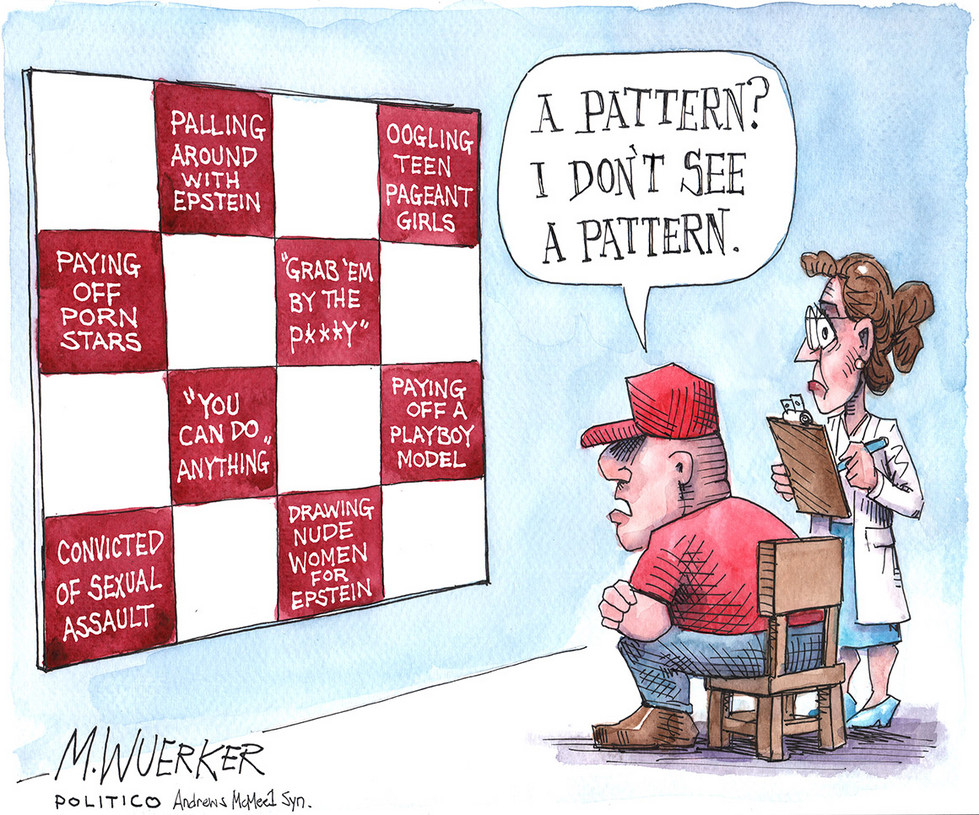
What the Base is Actually Thinking:
Ghislaine’s Life at Club Fed—And an Observation on Minimum Security Prisons and Flight Risk Inmates
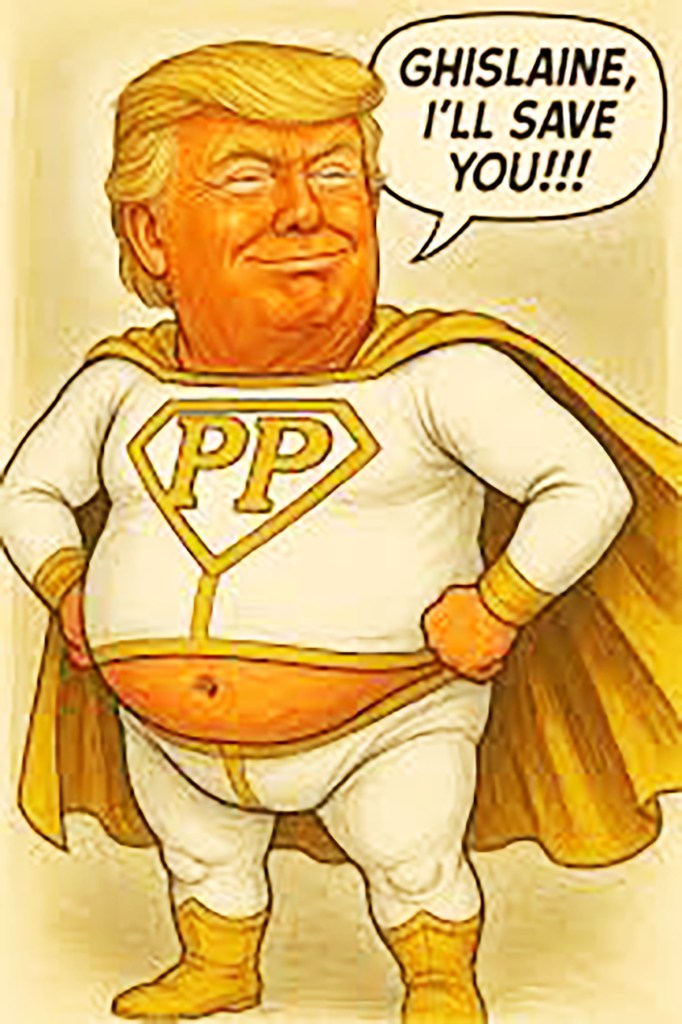
A Flight Risk
Ghislaine asked the judge for bail, before her sex trafficking trial. The judge said no, describing Maxwell as “the very definition of a flight risk,” citing
- prior evasion of law enforcement,
- vast wealth, from undisclosed sources,
- multiple passports, and
- the seriousness of the charges.
A Minimum Security Prison
Club Fed—the women’s prison camp at Bryan, Texas, is a minimum security facility. There are fences, but they aren’t very high. Sometimes the inmates, or at least the well behaved ones, are allowed outside.
I would not be shocked if Ghislaine just disappears, after a time.
Meanwhile, her life will be greatly improved. Thanks to Drudge for referring is to this reporting from The Telegraph:
Puppy prison: Inside Ghislaine Maxwell’s new home
British socialite will have freedom to roam expansive grounds, earn money to spend on cosmetics and train dogs to become service animals
When Ghislaine Maxwell was convicted of sex trafficking underage girls to the paedophile Jeffrey Epstein in December 2021, her victims rejoiced, no doubt imagining the British socialite under lock and key, wearing orange overalls.
But the reality of Maxwell’s life behind bars is very different.
Having been transferred to a minimum security prison in Texas from Florida, Epstein’s ex-girlfriend can spend the rest of her 20-year sentence cuddling puppies and pampering herself with anti-ageing face creams.
Similar to the upmarket retreats she no doubt grew accustomed to during her former life of luxury, the Federal Prison Camp (FPC) Bryan in Texas offers yoga classes and a fully-stocked gym.
Described as a “luxury” facility by her victims, Maxwell will be rubbing shoulders with other wealthy inmates and can spend the earnings from her prison jobs on cosmetics.
Bryan grants its female prisoners the freedom to roam the facility’s expansive grounds with limited to no perimeter fencing to pen them in. There are gardening opportunities for the green-fingered criminals.
The 37-acre all-female facility, located 100 miles outside of Houston, is home to 635 inmates, according to the prison’s website, most of whom are serving time for non-violent offences and white-collar crimes.
Inmates sleep in bunk beds with four people per room.
Julie Howell, 44, who self-surrendered in July to serve time at Bryan, said that the prison is “nothing like you see on TV or in the movies because it’s a camp, which only houses non-violent offenders”.
Since arriving, she has enroled in the “puppy programme”, which involves playing with a 12-week old Labrador all day and even sleeping in the same room as each other, she wrote on Facebook.
The prison has a partnership with Canine Companions for Independence, which allows prisoners to train dogs to become service animals and is said to “boost the inmates’ morale, provide them with a sense of responsibility and improve overall behaviour”, according to the programme’s website.
“We do water and mud play and keep them busy from morning until night with some kennel rests in between,” Mrs Howell said.
“This is my ‘job’ while I’m here and it’s literally 24/7 as the puppies stay in the room with us. It’s me, my bunkie, and a puppy and we have to supervise the puppy at all times…I absolutely love it.”
Besides Maxwell, the prison’s celebrity clientele includes Elizabeth Holmes, the founder of Theranos, who is serving an 11-year sentence for defrauding investors by falsely claiming her company’s blood-testing technology was revolutionary.
Jen Shah, the Real Housewives of Salt Lake City star, is also doing a six-year stretch for conspiracy to commit wire fraud.
Other high-profile inmates include Michelle Janavs, the Hot Pockets heiress, who served five months in Bryan for bribing university officials to inflate her daughters’ exam scores.
Lea Fastow, the wife of Enron chief executive and fellow convicted felon Andrew Fastow, also spent 11 months at the facility in 2005 for tax fraud after the Texas energy company collapsed.
Holmes and Shah have each been pictured exercising in the prison camp’s grounds, with the latter’s team sharing an image of her skipping in May while wearing grey workout gear.
“I am in great spirits and well,” she captioned the post. “I wanted to share a personal image that I mailed to my team of one of my shah-mazing workouts.”
The facility is among the best in the country for convicts to serve time in, according to multiple lists compiled by inmates’ rights groups.
According to the prison handbook, life at the prison is centred around work, with prisoners earning up to $1.15 an hour for their jobs – many of which involve food service and factory work. These can even be off-site opportunities, for the best behaved prisoners.
They can spend up to $360 a month of their earnings during assigned shopping days at a commissary, which sells beauty products including L’oreal Revita anti-ageing cream for $26.00, a Kerasal nailcare product for $20, and chest binders for trans prisoners for $26.
Beyond work, inmates may take classes on foreign languages, gardening and beautification. They can play sports, watch television and attend religious services. They are also granted freedoms not available in most low security prisons, including more relaxed visiting hours and more time outside, and lower guard-to-inmate ratios.
For inmates trying to trim down, the prison has a gym kitted out with treadmills, elliptical trainers, stairmasters and a range of weights.
Outside, convicts can take part in sports including football, table tennis, softball, volleyball, weightlifting, yoga, Pilates and the Jumpstart weight loss programme. There are also picnic tables, bleachers and televisions available for prisoners to wind down.
The Bryan prison camp also subscribes to rehabilitation programmes, such as one called “assert yourself for female offenders”, where “women learn to be assertive without trampling the rights of others”, according to a DoJ document from 2020.
As she embarks on life at the new facility, Maxwell will rise at 6am each day for a roll-call with the other female inmates and will have to dress in a prison-issue khaki shirt and fatigues, according to the handbook.
Inmates are permitted to have one approved radio or MP3 player and can wear minimal jewellery, such as a plain wedding band or a chain worth under $100.
Breakfast consists of a choice of a hot or continental-style breakfast, while the lunch and dinner menu offers standard federal prison fare consisting of chicken, hamburgers, hotdogs, macaroni and tacos.
Inmates are also allowed visitors during weekends and holidays, but along with other inmates, Maxwell would be allowed only limited physical contact with friends and family.
Maxwell’s victims blasted the decision to allow her to move prisons, saying the move “smacks of a cover up”.
“Ghislaine Maxwell is a sexual predator who physically assaulted minor children on multiple occasions, and she should never be shown any leniency. Yet, without any notification to the Maxwell victims, the government overnight has moved Maxwell to a minimum security luxury prison in Texas,” the statement said.
“The American public should be enraged by the preferential treatment being given to a pedophile and a criminally charged child sex offender.
“The Trump administration should not credit a word Maxwell says, as the government itself sought charges against Maxwell for being a serial liar. This move smacks of a cover up. The victims deserve better.”
The reason for her move to the less secure facility remains unclear, but comes a week after she was interviewed by Todd Blanche, Donald Trump’s deputy attorney general, about information she holds on the Epstein Files.
Capitalising on the recent attention her case has drawn, Maxwell’s legal team have said she is willing to testify before Congress in exchange for a presidential pardon or having her sentence commuted – a possibility Mr Trump has not ruled out.
 Facing MAGA